Some weapons simply lie under the water and wait for a ship. They do not chase anything, and they do not fire. Even so, the mere chance that one is there can change the routes ships take.
These are naval mines. How does a mine notice a ship, and how do people find one in a wide stretch of sea? Below are the kinds of mines and where they sit, the two ways of clearing them, and cases from history. The rules of international law come next, and last an effort to find mines with lasers.
A cheap weapon that waits quietly
A mine does not follow a ship; it holds a passage. A 2001 mine warfare report from the U.S. National Research Council (NRC) sorted its uses into two levels. At the larger scale, mines can shut or steer traffic through tight waters and the entrances of harbors. At the smaller scale, they can hold up or halt forces heading for narrow straits and landing beaches.
The size of the threat is tied to cost. In the report's judgment, modern mines were cheap and easy to obtain. That made them a fast-growing danger to merchant ships and naval operations alike. When the report came out in 2001, more than 50 countries could lay sea mines.
Things look different for the side that must clear them. Mines are found in more places than the expected air and missile threats, and in many ways they are harder to counter. Countering them also clearly takes more time. Putting one mine into the sea and proving that an area is free of mines are very different jobs.
Contact mines and influence mines
The simplest kind is the contact mine. It works only when a ship's hull touches it. The full name of the 1907 Hague Convention VIII even contains the phrase "automatic submarine contact mines."
The other kind is the influence mine. It needs no touch and reacts to the signatures a passing ship gives off. If a contact mine is a doorbell that rings only when pressed, an influence mine is closer to a motion-sensor porch light. Unlike a porch light, though, it senses underwater signals such as sound, magnetism and pressure, not light.
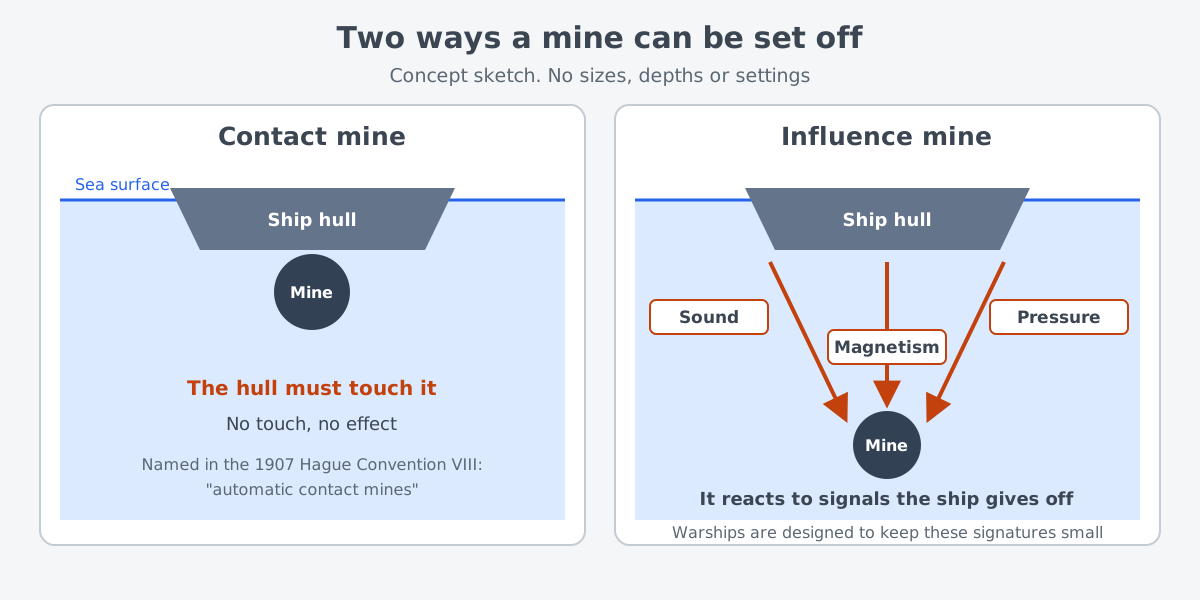
That is why warships manage their own signatures. Many warships are built with low acoustic, magnetic and electric signatures, so influence mines are less likely to fire on them. Keeping those designed levels takes good upkeep of the equipment and regular measurement of the ship's magnetic signature at the degaussing and measurement ranges the Navy runs. A signature is not fixed once at design time; it has to keep being measured and looked after.
Some mines respond to pressure. The sea itself shifts pressure, too. Tides and turbulence cause natural swings in pressure, which can set off a pressure influence mine and can also help bury mines in the seabed.
Floating, moored, or on the bottom
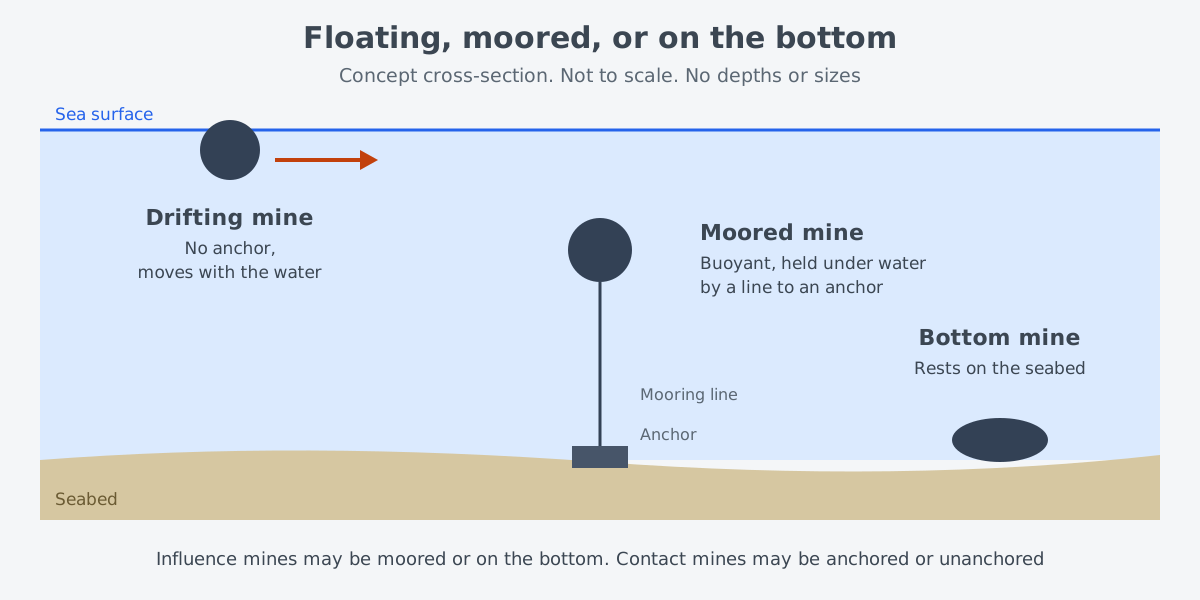
Mines are also grouped by where they sit. The Hague Convention VIII treats anchored and unanchored mines separately. A mine tied by a line to an anchor and held under the water is called a moored mine.
A bottom mine rests on the seabed. Influence mines can be either moored on a line or resting on the bottom.
Some mines drift freely with no line at all. These are what the Hague Convention VIII handles separately as "unanchored" mines. The section on international law below shows the time limit the convention set for them.
Clearing mines: sweeping and hunting
The work of clearing mines from the sea is called mine countermeasures (MCM). It includes two quite different methods. Minesweeping clears a stretch of water, and minehunting finds mines one at a time and deals with each.
Sweeping itself comes in two forms. A mechanical sweep cuts the lines of moored mines that float fairly close to the surface. An influence sweep works the other way around and imitates a ship's signals. A 1998 U.S. General Accounting Office (GAO) report lists one such project, a magnetic and acoustic system meant to mimic landing craft and clear influence mines fast.
Minehunting has four steps. Detect means finding an object in the water. Classify means judging whether it looks like a mine, identify means confirming that it really is one, and neutralize means making it harmless. In 2001, U.S. Navy surface mine countermeasures ships covered all four functions.
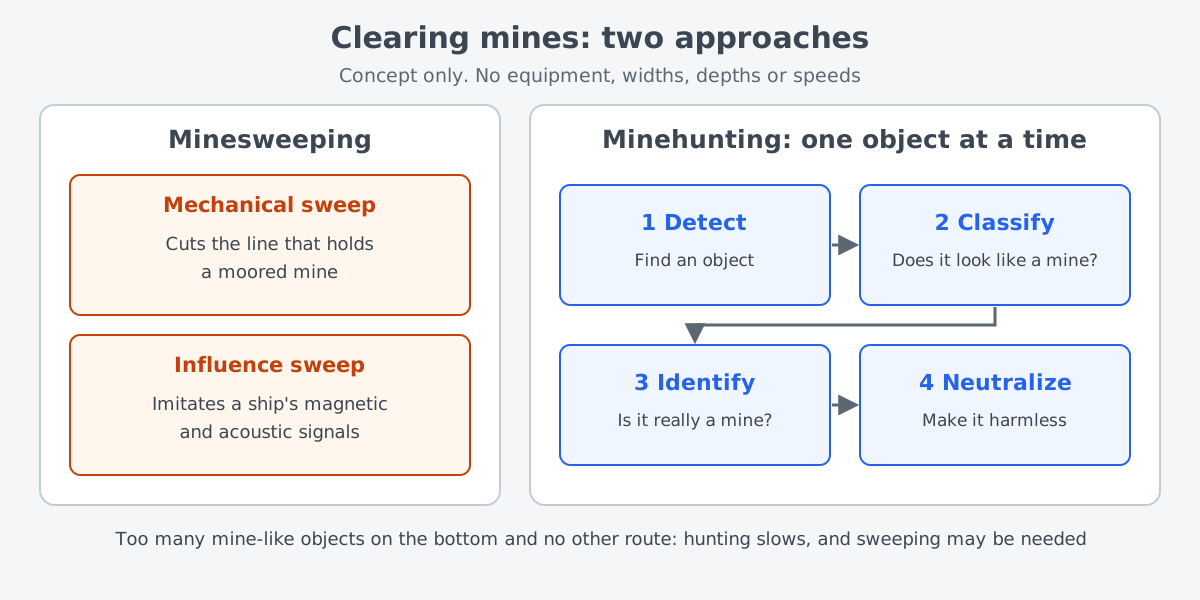
The two methods fill each other's gaps. Hunting relies on sonar and on marine mammals. Some seabeds are littered with mine-like objects, and sometimes no other route is open. There, searching object by object tends to crawl, and sweeping may become necessary.
Who does this work? At the time of the 1998 GAO report, the U.S. Navy kept its mine countermeasures in a dedicated force.
Its ships were 12 coastal minehunters, 14 MCM ships and 1 command and support ship. It also had 24 helicopters for finding and clearing mines and 17 explosive ordnance disposal (EOD) detachments. One more detachment worked in very shallow water, and another used marine mammals.
People and animals also go into the water themselves. Around 2001, EOD divers and marine mammal systems played key roles in underwater mine countermeasures. At that time, small unmanned undersea vehicles (UUVs) were being developed and could someday help, or even take over from, those divers and animals.
A dedicated force had its limits. The Navy's MCM ships were too slow, and lacked the range, to sail overseas alongside carrier battle groups and amphibious ready groups. So the Navy shifted its strategy and began building mine countermeasures that combat ships in the fleet could carry.
A 1995 white paper from the Chief of Naval Operations pushed the same way. It called for the fighting fleet itself to own mine countermeasures, not just a separate support force.
Mines in history
Mines have changed the shape of a fight more than once. At Mobile Bay in the American Civil War, Confederate forces were too weak to face the Union fleet head-on, so they laid mines as a protective barrier. The Union commander, Rear Admiral David Farragut, got through by watching and scouting first and then locating and avoiding the minefield. He lost only one ship.
In World War II, mines shook entire sea lanes. The 2001 NRC report gives these figures. In the Atlantic, British Royal Air Force (RAF) aircraft made 20,000 flights to lay mines across 5 years. Those mines sank 638 ships, and 450 aircraft were lost.
In the Pacific, B-29 bombers dropped mines in the spring of 1945. Combined with the U.S. submarine campaign, this kept overseas food and raw materials from reaching Japan until the war ended.
In May 1972, during the Vietnam War, thousands of mines that respond to both magnetism and sound fell into Haiphong harbor and other North Vietnamese ports. Shipments of war supplies by sea nearly came to a halt.
In the 1991 Gulf War the roles were reversed. Iraqi mines disrupted plans for a U.S. landing from the sea. They also badly damaged the cruiser Princeton as well as the amphibious ship Tripoli, which could no longer support the operation.
The numbers make the point sharper. According to the 2001 report, mines sank or damaged 14 U.S. Navy ships after World War II. Missiles and aircraft damaged only 2 in the same period. Ten of the 14 mine hits came during the Korean War.
The 1998 GAO report gave a similar count: of 18 Navy ships lost or damaged after 1950, enemy mines accounted for 14. It added that the Navy started to strengthen its mine warfare forces after two ships were badly hurt in the Gulf War.
Lines drawn by international law
International rules on mines go back more than a century. The 1907 Hague Convention VIII drew several lines around automatic contact mines. An unanchored contact mine may be laid only if it is built to turn harmless within an hour of the moment its owner loses control of it. An anchored mine must turn harmless the moment it breaks free of its mooring.
The convention also looks after other ships at sea. A party using anchored automatic contact mines must do everything possible to keep peaceful ships safe. When the war ends, each party must do its utmost to remove the mines it laid.
There are peacetime rules as well. As the 2001 report explains, treaties the United States has signed ban armed mines in international waters during peacetime. The exception is a minefield that is watched at all times and whose location is announced to ships.
Where this meets lasers: looking into the water with light
Sound is not the only way to look for mines. The 1998 GAO report describes "Magic Lantern," a laser and camera system mounted on a helicopter. Its job was to detect and classify moored mines, and its targets were floating mines and moored mines in shallow water.
According to the GAO, Magic Lantern was a brand name used by one maker of this technology. The U.S. Navy funded the work under the program title Airborne Laser Mine Detection System (ALMDS). However, the 1998 GAO report notes that the system meant to field Magic Lantern was never produced, because the Navy did not fund its procurement. In 2001, the NRC report included ALMDS among the equipment it recommended adding to helicopters.
Because it uses light instead of sound to look into the water, this story connects with technology that measures distance and maps surfaces with lasers. The principle of timing a light pulse's round trip to find a distance is covered in Measuring with lasers: range finding and lidar basics.
What to read next
- Sonar: why sound is used to see underwater: how sound is used to search the water, including for mines.
- Unmanned underwater vehicles: robots beneath the sea: the underwater vehicles that may support or replace divers.
- Unmanned surface vessels: ships without crews: the technical challenges of ships with no one aboard.
- Measuring with lasers: range finding and lidar basics: how distance is measured with light.