When a laser is switched on, the beam has to end somewhere. Leftover light cannot be allowed to land on a wall, the ceiling or a metal part at random. On a lab bench, the beam usually stops in a small black can or plate. That part is a beam dump.
Sometimes the goal is not to throw the light away but to send a little less of it. A measurement where a sensor can only take so much light is one example. The part used then is an attenuator. The two parts look like they do different jobs, yet they often work as a pair, because the light an attenuator removes also has to be put somewhere.
The sections below start with where leftover light appears and how a dump turns light into heat. They then cover three ways an attenuator reduces light, the units that record the amount, and how a regulation and a safety handbook treat the two parts.
Where leftover light comes from
A laser system produces unused light in several places. When the system is run as a test, the whole output needs somewhere to go. One datasheet for an industrial diode laser sizes its recommended cooling capacity with a worst case in mind. In that case, 100% of the laser power ends up in a beam dump, inside or outside the laser.
Measuring light also leaves light over. The sensor of a power meter takes in the light and reports its power, but that light does not vanish inside the sensor. It becomes heat. If the light is stronger than the sensor can handle, some of it must be removed first, and the removed light needs its own place to go.
Lasers themselves often carry a part that stops the beam. A laser safety handbook from The University of Texas at Austin says that most laser heads come with a stop or attenuator fixed to the head for good. It lowers the beam power at the aperture to below the maximum permissible exposure (MPE).
Beam dumps: turning light into heat
Depending on the maker or the safety document, a beam dump is also called a beam trap, a beam block or a beam stop. One optics company presents beam traps and beam blocks as common safety devices in laser labs. In its description, they sit at the very end of an optical system and take in the beam that arrives. Separate versions exist for continuous-wave (CW) beams and for both CW and pulsed beams.
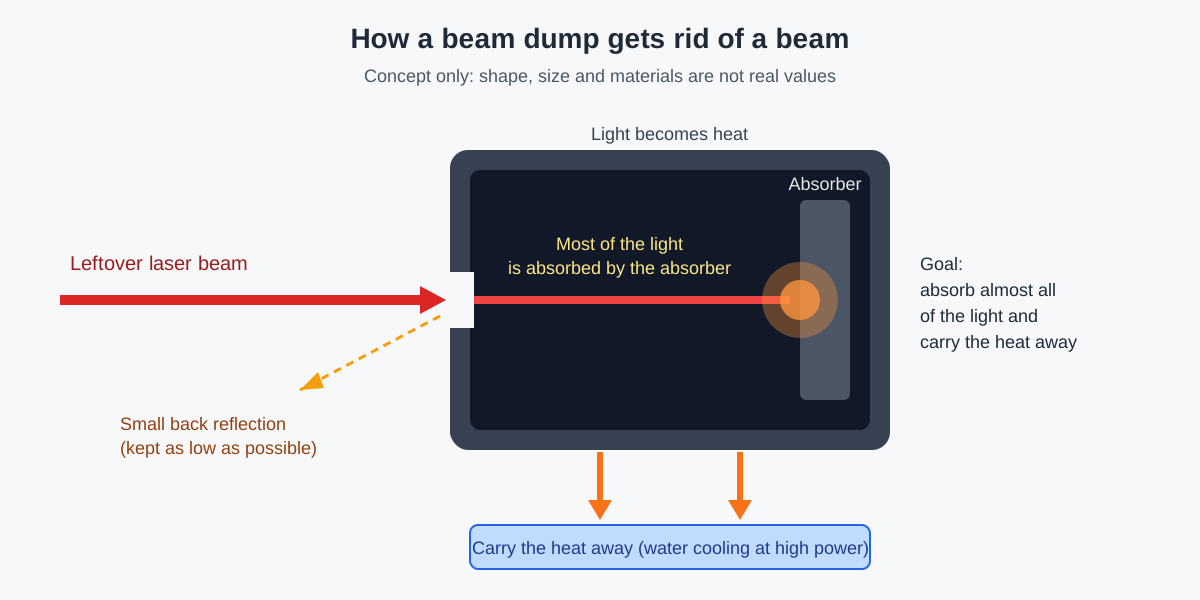
The working idea is absorption. The energy of light that a material takes in comes out as heat. So instead of making light disappear, a dump turns it into heat, and it also has to get rid of that heat. The same company's product table lists anodized aluminum, absorptive ND glass and graphite as absorbers.
Heat becomes a problem quickly. The company states that all of its beam traps get hot to the touch once the beam power is above 10 W. For stronger beams it offers beam blocks cooled by liquid, and it says one of them handles up to 500 W of average power in CW operation. Gentec-EO, a measurement equipment maker, describes water-cooled dumps that can take in as much as 12,000 W in continuous operation.
Not all the light that goes in is absorbed, and some of it bounces back. Gentec-EO notes that an optional isolation tube added to its dumps helps cut these back reflections. The Texas handbook also recommends beam stops that do not reflect and do not burn. The aim is to lower the chance of accidental exposure or fire.
Think of a reservoir that catches overflow water behind a dam. A reservoir stores water, but a dump cannot store light. In reality the incoming light turns into heat at once, and the dump only does its job if that heat keeps being carried away.
A power meter sensor can double as a dump. Gentec-EO explains that its power detectors with certain coatings absorb a high share of the incoming light and scatter the rest back. For that reason, those detectors can work as dumps when the power stays within their maximum rating.
Attenuators: three ways to pass less light
ANSI Z136.1 is the U.S. laser safety standard. Its 2022 edition defines attenuation as the drop in power or energy as light travels through a medium that absorbs or scatters it. An attenuator does this on purpose. The ways to reduce light fall into three broad groups.
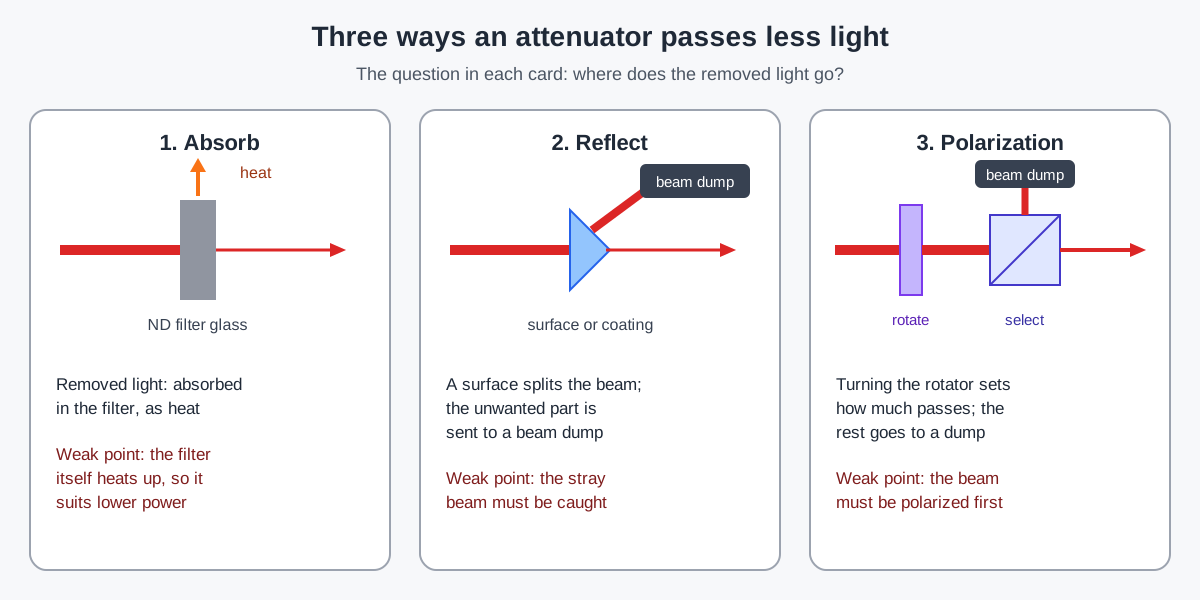
The first is absorption, and the typical part is a neutral density (ND) filter. One maker builds its absorptive ND filters from a particular glass, and a filter with a higher optical density (OD) passes less light and absorbs more of it. The absorbed light becomes heat inside the filter, so strong beams are a poor match. The company says these filters suit low-power uses below 1 W and are not designed as laser safety equipment.
The second is reflection. Reflective ND filters with a metal coating exist, and for high power there are attenuators that use reflection from surfaces. One product reflects the beam twice, off two stacked prisms, to reduce it. According to the company, the two reflections offset each other and keep the polarization, size and shape of the beam that leaves.
The third route uses polarization: a polarizing filter lets through only light lined up with its axis. When the axes of two filters are parallel, all the light that got through the first also gets through the second. Rotating the second filter lowers what passes, and with the axes at right angles no light gets through. The passing intensity changes with the angle θ between the axes as shown below, a rule called Malus's law.
I = I₀ cos²θ
At 45°, the intensity drops to 50% of the starting value. Unpolarized light behaves differently. Its intensity first falls by half at the first filter, and only after that can the angle set the amount.
Labs use this idea to build variable attenuators whose setting can change. Keller's textbook Ultrafast Lasers explains that an attenuator covering a wide range can be built in many ways. Examples include graded ND filters, acousto-optic modulators (AOMs), and polarization splitters combined with polarization rotation optics. The polarization method the author's group chose uses two elements: one turns the direction of linear polarization, and the other picks out the wanted polarization.
Each method has a weak point. In the same book, a wheel of ND filters can cause thermal lensing at high average power, where a warm filter starts to bend light like a lens. An AOM can add amplitude noise at strong attenuation and usually stops at about a factor of 100. How far the polarization method can reduce light depends on how cleanly its first splitting element separates the two polarizations.
Writing down the reduction: OD and dB
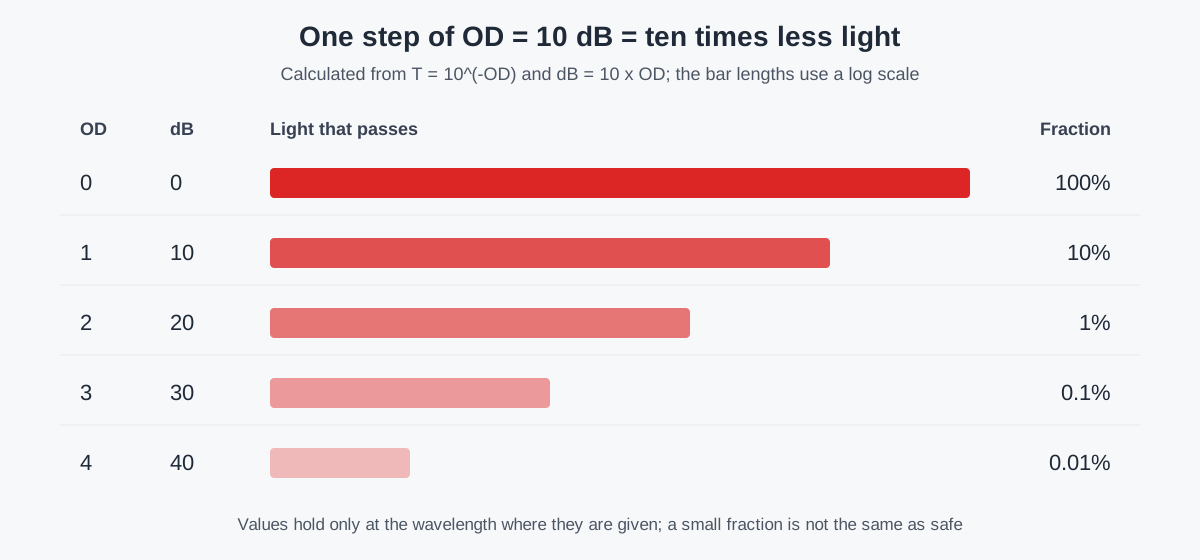
The amount of attenuation is often written as optical density (OD). In one maker's explanation, OD expresses how strongly a filter attenuates, meaning how much it cuts the power of the beam that enters. In the company's example, an OD 2 filter has a transmission of 0.01, so it brings the beam down to 1% of the incoming power.
OD is a log scale, so each step of 1 cuts the light that passes to one tenth. OD 1 is 10%, OD 3 is 0.1% and OD 4 is 0.01%. Converted to the decibel (dB), the unit that fiber and telecom sources favor, the attenuation is OD times 10. OD 2 is 20 dB and OD 3 is 30 dB.
The prism attenuator described above has a typical attenuation of 29–34 dB in the company's data. Worked out, that means the light leaving is around one thousandth of the light going in. How to turn dB into ratios is covered in "Units and dB notes: reading W, dBm and ratios".
An OD value is tied to wavelength. The absorptive ND filters above use a glass chosen for even absorption across visible light from 400–650 nm, and the OD in the table is measured at 633 nm. At other wavelengths, the same filter can have a different OD. How to read the OD printed on laser eyewear is in "Laser safety: classes and how to read eyewear labels".
Attenuators and dumps work as a pair
The light an attenuator removes does not vanish. In an absorptive filter, the filter itself takes the heat. In reflective and polarization types, the removed light leaves as a beam going another way. Without a place for that beam, the attenuator only moves the problem somewhere else.
The prism attenuator is a good example. The company says the prisms send up to 95% of the light out through the transmission ports. A beam block or trap, not included with the product, should be mounted on those ports to catch the strong leftover light. The weak light used for measurement leaves by reflection, and most of the power goes to the dump.
The polarization method works the same way. A polarization splitter sends light of the unselected polarization down a different path, so the end of that path also needs a catcher. Light taken in by a dump becomes heat again, and that heat adds to the cooling load of the whole setup. Where laser heat goes is picked up in "Cooling and thermal management: where the heat that did not become light goes".
Where these parts sit in a lab is shown in "Inside a laser lab: from the optical table to the power meter". The instruments used with them appear in "Measuring light: power meters, beam profilers, spectrum analyzers".
The two parts in rules and safety guides
The U.S. federal regulation 21 CFR 1040.10 covers laser products whose manufacture or assembly took place after August 1, 1976. Its "beam attenuator" item requires laser systems in Class II, III or IV to carry at least one means that is permanently attached. That means must be separate from the laser energy source switch, the electrical supply connectors and the key-operated master control.
Its job is to keep every part of the human body away from laser radiation above the Class I limits. The requirement may be unnecessary because of how a product is configured or how it works. In that case, the director of the U.S. Food and Drug Administration (FDA) Center for Devices and Radiological Health can approve other means on the maker's written application. What the laser classes mean is covered in "Laser safety: classes and how to read eyewear labels".
A university safety handbook states the same idea from the lab side. The Texas handbook says laser beams should end in a suitable beam stop and recommends enclosing the beam where possible. Under its guidance, laser areas should be designed so that beams above the MPE cannot leave the area, with suitable barriers that attenuate the beam.
These parts do not replace safety training or the judgment of an institution's safety officer. As noted above, even the company that makes ordinary ND filters says those filters are not laser safety equipment.
What to read next
- "Laser safety: classes and how to read eyewear labels": reads classes, the MPE and the OD on eyewear as the official documents mean them.
- "Units and dB notes: reading W, dBm and ratios": turns the dB used for attenuation into ratios and watts.
- "Polarization: the direction in which light vibrates": looks at the polarizers and wave plates that polarization attenuators rely on.