On the morning of Sunday 18 June 1815, the fields not far from Brussels were soaked after a night of heavy rain. Two low ridges faced each other across them. On one stood the French army of Napoleon Bonaparte; on the other, the allied army of the Duke of Wellington. That one day of fighting ended a war that had lasted 23 years.
The Battle of Waterloo is famous, yet the records of that day often disagree. How many French soldiers were there? When did the first gun fire, and how many men fell? National museums in Britain and Germany and the Fondation Napoléon in France give slightly different answers.
This article follows the four months from the escape from Elba to exile on St Helena, and looks at the muskets and rifles the soldiers carried. Where the numbers differ, they appear side by side with their sources.
From Elba to Belgium: the Hundred Days
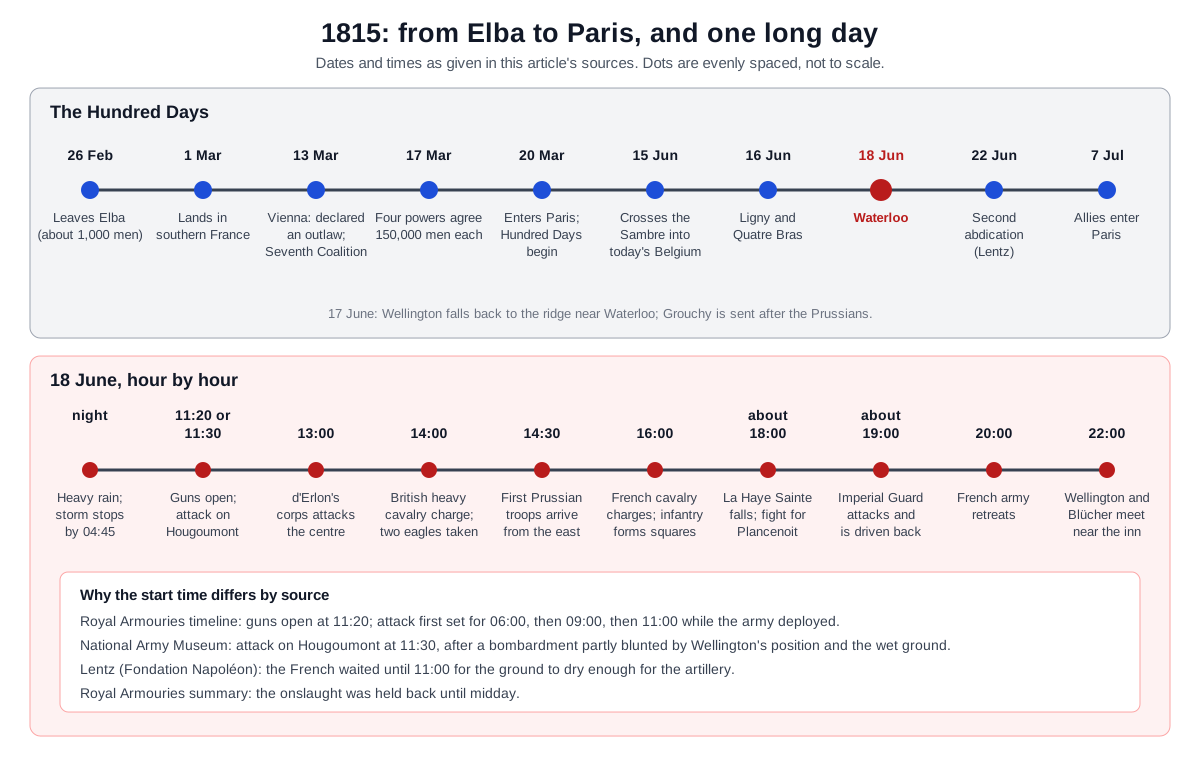
Since May 1814, Napoleon had been in exile on Elba, an island in the Mediterranean. On 26 February 1815 he slipped away on a brig with about 1,000 men, and on 1 March he landed in the south of France. His exile had lasted eleven months.
On the road to Paris, a regiment waited at Grenoble to arrest him. In the Royal Armouries timeline, Napoleon walks up to them alone and shouts, "Here I am. Kill your Emperor, if you wish!" The soldiers went over to his side.
On 20 March he entered Paris. His second reign, known as the Hundred Days, had begun. Waterloo was little more than three months away.
People did not greet his return in the same way everywhere. The German Historical Museum (DHM) explains that for millions of French people the news brought joy and hope for a better future. In Germany in particular, it stirred fear of renewed French rule and despotism.
The great powers of Europe moved fast. On 13 March, the allies gathered at the Congress of Vienna declared Napoleon an outlaw and formed the Seventh Coalition. Britain, Prussia, Austria, Russia, Sweden, Switzerland, Spain, Portugal and others joined. On 17 March, Britain, Russia, Austria and Prussia each agreed to raise 150,000 men.
Napoleon did not wait for those armies to gather. To the north, in the Netherlands, Field Marshal Blücher's Prussian army and Wellington's Anglo-Allied army were assembling. Together they outnumbered the French.
So he planned to strike first, keep the two armies apart and beat each one in turn. A quick victory, he hoped, would break up the coalition.
16 June: Ligny and Quatre Bras
On 15 June Napoleon crossed the River Sambre into what is now Belgium. The move was meant to drive a wedge between his two enemies. The next day, two battles were fought at once.
At Ligny, the main French force beat the Prussians and forced them to retreat. According to the National Army Museum (NAM), the Prussians lost over 20,000 men, and French casualties were half that number. On the same day, Wellington beat back the French at the Quatre Bras crossroads.
Neither side was driven from the field at Quatre Bras. The Royal Armouries calls it a tactical victory for Wellington and a strategic one for Napoleon, who had kept the allies from helping Blücher. Even so, with the Prussians gone, Wellington also had to fall back or risk being outflanked and overwhelmed.
One odd scene played out on the French side that day. D'Erlon's I Corps spent the day marching between the two fields and fought at neither. The NAM blames poor staff work and suggests the Prussian defeat could have been more decisive if that corps had fought.
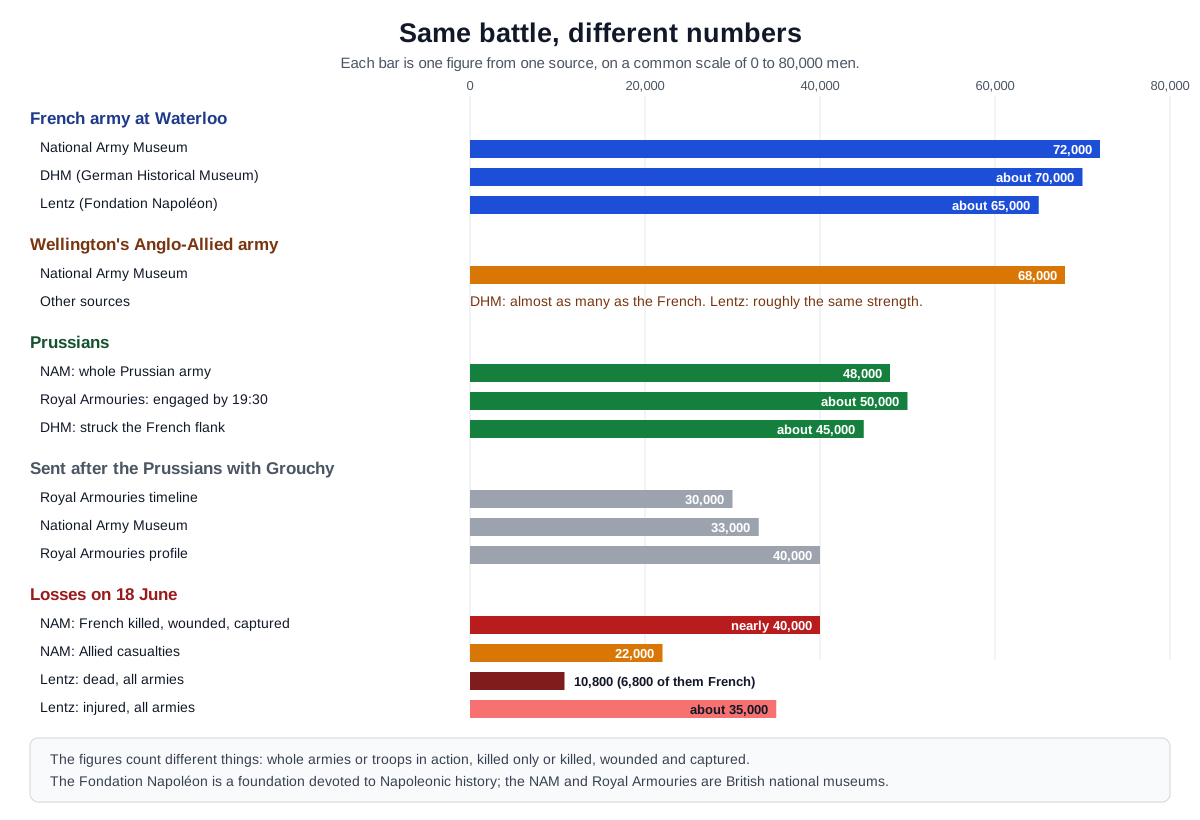
On 17 June Wellington fell back toward the village of Waterloo, and Napoleon detached troops under Marshal Grouchy to chase the Prussians. The size of that force varies from source to source, and even within one museum's pages: 30,000, 33,000 or 40,000.
But the beaten Prussians were in better shape than they looked. The Prussian army of 48,000 was experienced and professional, and its General Staff reorganized it and moved it to Waterloo within 48 hours of Ligny. The Royal Armouries counts Napoleon's belief that he had all but wiped out the Prussians as his great mistake. With Blücher's promise of help, Wellington decided to stand and fight until the Prussians arrived.
A night of rain and the ridge of Mont-Saint-Jean
Heavy rain fell on the night of 17 June. How much it changed the next day depends on whom you read.
The Royal Armouries summary says Napoleon held back his attack until midday so the ground could dry. Thierry Lentz is a historian writing for the Fondation Napoléon. He says the French had to wait until 11 am for the ground to dry enough to place their guns and use them well. The Fondation Napoléon is a foundation devoted to the history of the Napoleonic era.
The Royal Armouries timeline shows another factor. When the storm stopped at 4:45 am, Napoleon said he would attack at 6:00. Most of his army was still deploying, so he moved it to 9:00 and then to 11:00.
Wet ground and slow deployment ate up the morning together. The NAM explains that the delay gave Blücher's Prussians time to join the fight.
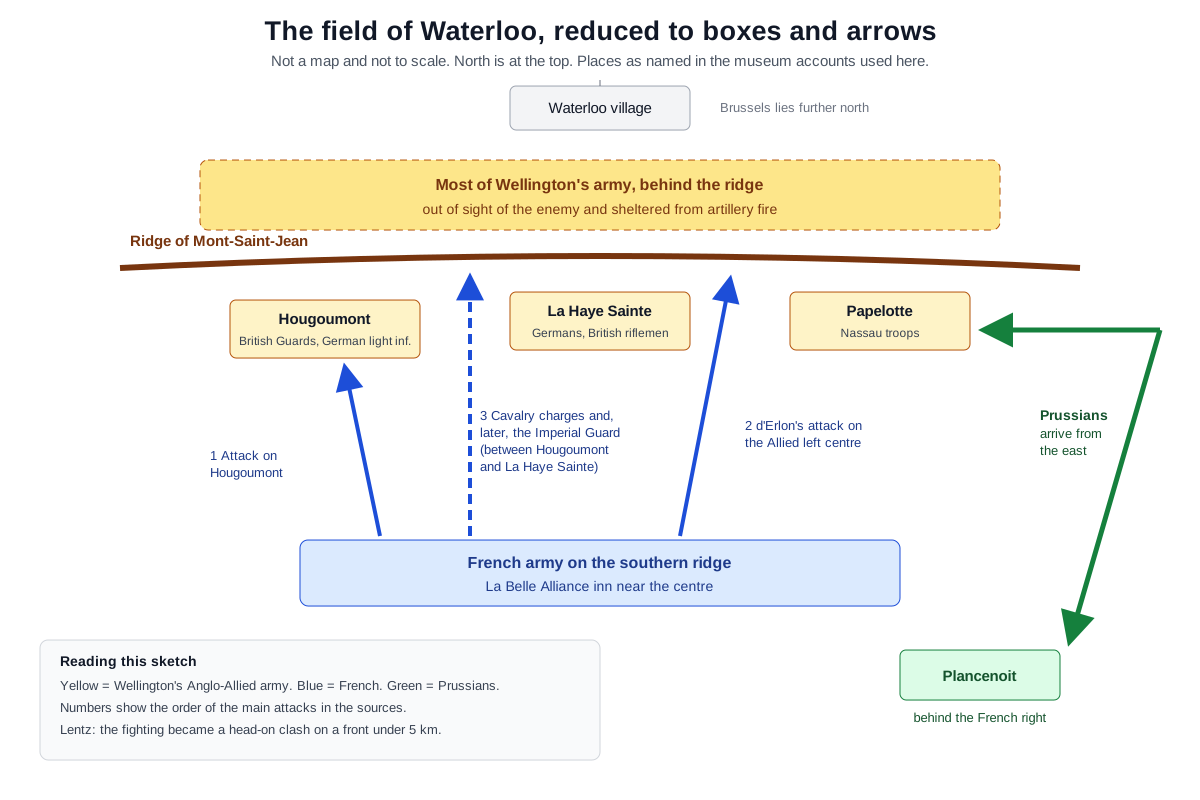
Wellington spread his army along the ridge of Mont-Saint-Jean. As he had learned to do in the Peninsular War, he placed most of it behind the ridge, out of sight and sheltered from artillery fire. The rest manned three strongpoints ahead of it.
To the west, British Guards and German light infantry held the Chateau of Hougoumont. In the centre, Germans and British riflemen held the farm of La Haye Sainte. At the east end, troops of the German Duchy of Nassau held the hamlet of Papelotte. Wellington's army also included Dutch, Hanoverian, Brunswick and Nassau soldiers alongside the British.
It mixed raw recruits with veterans of the Peninsular War (1808–14), and the NAM judges that Wellington was in no position to attack first. On the southern ridge opposite, the French formed around the inn of La Belle Alliance, which Napoleon used as his forward headquarters.
18 June: how the day unfolded
There are two accounts of Napoleon's plan. The NAM describes a diversionary attack on Hougoumont to draw Wellington's reserves, followed by a main attack on the rest of his army. Lentz describes a plan to pin down Wellington's strongest point on the right and turn his weakest point on the left. That would push Wellington off to the north-west, away from the Prussians.
The time of the first shot also differs. In the Royal Armouries timeline, the French Grande Batterie opens fire at 11:20 and Reille's II Corps attacks Hougoumont. In the NAM account, the attack on Hougoumont begins at 11:30 after a heavy bombardment. Its effect was reduced by how Wellington had placed his men and by the soaked ground.
Hougoumont was fought over all day. French troops pushed through the wood before the chateau, only to be cut down as they left its cover. A small party forced its way in through the north gate, kept open so supplies could pass, but Lieutenant Colonel MacDonnell and Corporal Graham barred it again. The chateau stayed in British hands to the end.
Around 1 pm, d'Erlon's I Corps launched a massed attack on the allied centre. It drove back the Dutch-Belgians, but at the crest of the ridge it was stopped by British infantry and then hit by British heavy cavalry. In this fighting the allied general Picton was shot dead. No officer of higher rank died on the field that day.
The British heavy cavalry broke the French infantry and captured two eagles, the standards of the French 45th and 105th regiments. But they charged too far and were cut to pieces by a French cavalry counter-attack. The eagle now held by the NAM is one of nearly 100 that Napoleon gave his army in 1815 to replace those destroyed during his exile.
Around 2:30 pm the first Prussian troops reached the field from the east. By mid-afternoon the news forced Napoleon to form a separate defensive line on his right.
At 4 pm Marshal Ney, wrongly believing the allies were pulling back, sent a mass of horsemen against the line between Hougoumont and La Haye Sainte. Wellington's infantry formed squares, formations shaped just as the name says. The soggy ground slowed the French horsemen, and the British squares held through repeated charges all afternoon, despite losses to artillery fire.
Lentz tells this part a little differently. An avalanche of misunderstandings, he writes, sent the entire French cavalry into the attack, and Napoleon could not stop it. The charges achieved nothing and broke against the squares.
Meanwhile, to the east, Bülow's Prussian IV Corps attacked the village of Plancenoit behind the French lines. The village was bitterly fought over until the end, and the Prussians only secured it at 9 pm.
Around 6 pm the French finally took La Haye Sainte. Its worn-out defenders were the King's German Legion, led by Major Baring. Wellington's centre was badly weakened and Ney asked for reinforcements, but Napoleon first sent troops to retake Plancenoit. That pause gave Wellington time to shore up his line.
Around 7 pm, in a last bid for victory, Napoleon sent in the Imperial Guard. The Guard reserve committed at this point numbered about 3,500 men, while some 50,000 Prussians were now in the fight. The Guard advanced up the slope between the two farms, straight at the strongest part of Wellington's line. Under fire from British guardsmen and light infantry, it halted, wavered and broke.
When Ziethen's Prussian I Corps linked up with the allied left, the whole French army began to retreat. The retreat went on all night, with Prussian cavalry in pursuit. Around 10 pm, Wellington and Blücher met at or near the inn of La Belle Alliance to congratulate each other. About an hour later, Grouchy beat Thielmann's Prussians at Wavre, unaware of the defeat at Waterloo.
Muskets, rifles, cannon and swords: the weapons of the day
The Royal Armouries calls Waterloo the last great set-piece battle in Europe of its kind. Infantry carried flintlock muskets and rifles, cavalry carried swords, pistols and lances, and the artillery used muzzle-loading cannon. Here is what the soldiers carried that day.
The standard arm of British line infantry was the India Pattern musket. Muskets of the time were often called "Brown Bess." Royal Armouries research traces the name to a nickname for a working-class woman, hinting at the close, dependent bond between a soldier and his weapon. Between 1795 and 1815, nearly 3 million of this musket and its earlier version were made.
Muskets were used at shorter ranges than many people imagine. In tests they were most accurate at about 50 yards (about 46 m).
An analysis of 19 battles from 1750 to 1830 puts the average infantry engagement distance at 64 yards (about 59 m). Fire while advancing came at just 30 yards (about 27 m). A British infantryman was expected to fire three rounds a minute in combat.
Some soldiers carried the Baker rifle. Its barrel had grooves cut inside, and it was far more accurate and longer-ranged than the line infantry's musket, as well as shorter and lighter. It stayed accurate out to at least 200 yards (about 183 m).
The price was speed. A musket could fire 3 or 4 rounds a minute; the Baker managed about 2. The ball had to fit tightly in the grooves, so it was hard to ram home, and black powder fouling made it harder still. By the end of the Napoleonic Wars, more than 14,000 Baker rifles had been made.
All the cannon were muzzle-loaders, charged with powder and shot through the mouth of the barrel. By the NAM's count, Napoleon had 246 guns at Waterloo and Wellington's allied army had 156.
The cavalry swords tell their own story.
At Waterloo the British faced armoured French cuirassiers for the first time. The 1796 British heavy cavalry sword had a hatchet-shaped point that made thrusting all but impossible. In the days before the battle, some blades were ground down to a spear point. Being able to thrust made the sword more useful against armoured opponents.
Both eagles taken that day were won by men carrying the 1796 heavy cavalry sword.
When the war ended, so did the demand for guns. After Waterloo the British government cancelled all its musket contracts, and more than 700,000 muskets stored around Britain were disposed of over the following decades.
How many fought, and how many fell
Even the size of the armies differs by source. The NAM gives the French 72,000 men and 246 guns, and the Anglo-Allied army 68,000 men and 156 guns. The German Historical Museum puts the French at about 70,000 and the allies at almost as many. Lentz writes that about 65,000 French faced an enemy of roughly the same strength.
The Prussian figure depends on what is being counted. The NAM's 48,000 is the whole Prussian army. The Royal Armouries' figure of about 50,000 is the number in action by around 7:30 pm. The German Historical Museum's 45,000 or so is the force that struck the French flank.
Casualties differ even more. By the NAM's count, close to 40,000 of Napoleon's men were killed, wounded or taken prisoner, against 22,000 allied casualties. Lentz writes that when it was all over at 10 pm, 10,800 men were dead, 6,800 of them French soldiers. Around 35,000 were wounded, two-thirds of them French.
The two counts measure different things. The NAM's French figure includes prisoners, while Lentz counts the dead and wounded of all armies. His two figures add up to more than 45,000, and that total leaves out prisoners.
Behind the numbers are people. The German Historical Museum describes the field on the next morning as a grim scene, lined with thousands of dead. Wounded soldiers sat about in a daze, and what many scattered fighters wanted most was a sip of water. Wellington himself said his heart was broken by the loss of old friends, companions and soldiers: "nothing except a battle lost can be half so melancholy as a battle won."
Why Napoleon lost is still argued over. Lentz points to an illness that clouded Napoleon's judgment, together with Wellington's well-planned defence, inefficient French artillery and mistakes by French corps commanders. He adds that a battle on paper began as soon as the fighting ended.
Did Ney throw away the cavalry? Should Grouchy have arrived before Blücher? Did Soult do his job as chief of staff? Those questions are still debated.
What Waterloo left behind
On 22 June Napoleon gave up the throne for a second time. On 7 July the allies entered Paris, and Napoleon surrendered to the British and was shipped off to St Helena, a remote island in the South Atlantic. He died there in 1821.
The NAM sees Waterloo as the end of the wars that had shaken Europe since the French Revolution. It also closed the long run of French bids for mastery of the continent, from Louis XIV to Napoleon. Apart from the brief break of the Crimean War (1854–56), a general peace held in Europe until 1914. Old enemies Britain and France drew closer and fought side by side in the Crimea.
This battle brought the British Army's first campaign medal. The Waterloo Medal went to every soldier present at Waterloo and in the two days of fighting before it, whatever his rank or role. Generals and privates received the same medal.
The battlefield soon drew visitors. Within days souvenir hunters and the first tourists arrived, and battlefield tours that began right after the campaign continue today. In 1820 King William I of the Netherlands raised the Lion's Mound where he thought his son, the Prince of Orange, had been hit.
The name lived on too. In English, a person whose winning streak ends in defeat has "met their Waterloo." ABBA's "Waterloo," which won the 1974 Eurovision Song Contest, was built on that phrase. Written about and retold again and again, Waterloo became a near-mythical symbol of Napoleon's final fall.
What to read next
- The Napoleonic Wars at a Glance: Corps and Conscription: the 23 years that led to Waterloo, and how those armies were organized.
- The 1812 Russian Campaign: Why the Grande Armée Didn't Come Back: the campaign three years before Waterloo.
- The Crimean War: The War of the Telegraph, the Camera and Nightingale: the war that first broke the long peace after Waterloo.
- Military logistics: what it takes to keep an army moving in the field, seen through today's weapons.
- A history of laser weapons: long after gunpowder, how weapons that use light came about, traced through official records.