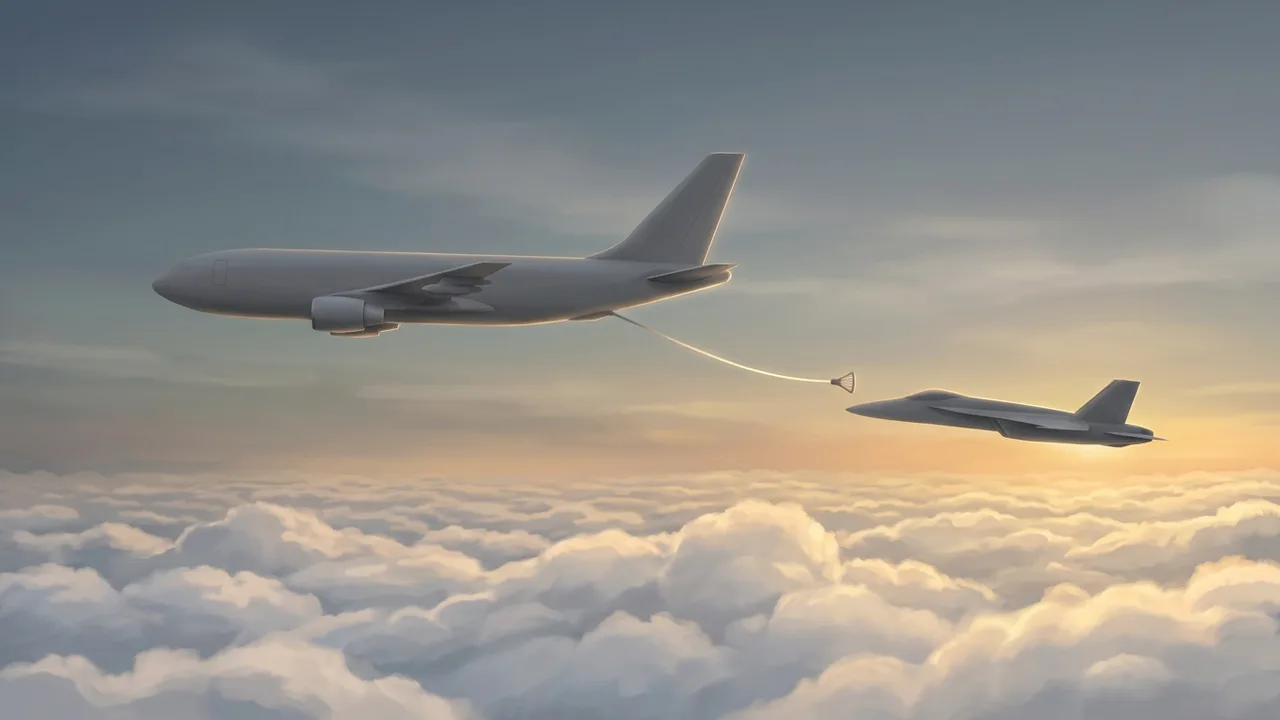
A car has to stop at a gas station to fill up. An airplane usually has to land. Some military aircraft, though, can take on fuel from another aircraft while both are still flying.
This is called aerial refueling. There are two main ways to do it.
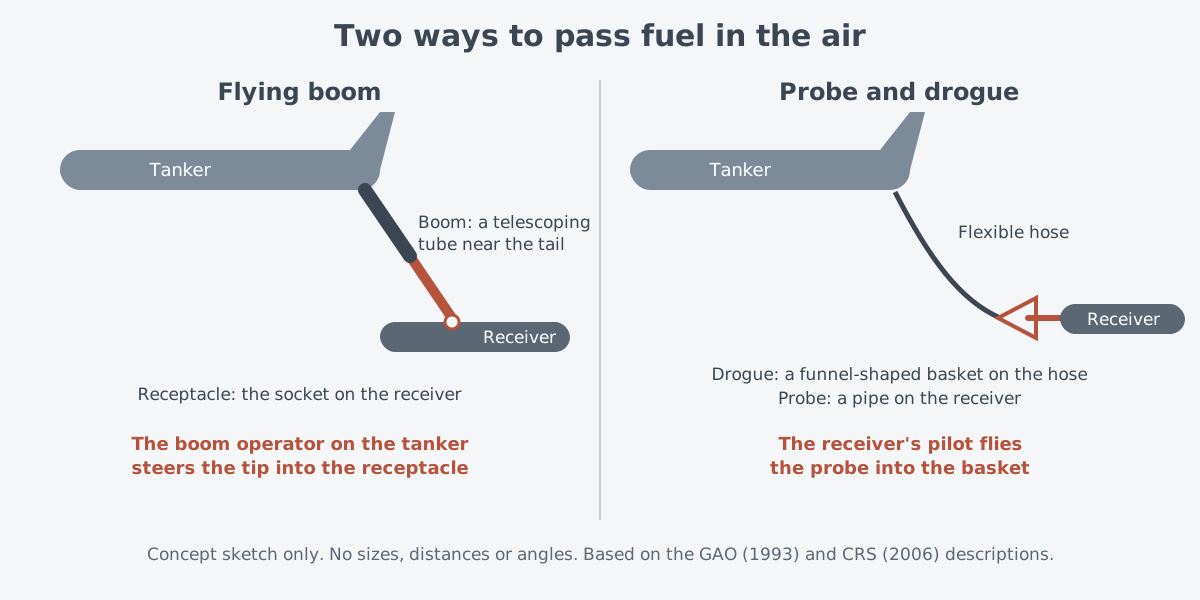
In one, the tanker plugs a rigid tube into the receiving aircraft: the flying boom. In the other, the receiving aircraft flies into a basket at the end of a hose: the probe and drogue.
How do they differ? And at a time when every U.S. fighter used the probe and drogue, why did the U.S. Air Force make the boom its standard?
Taking on fuel while flying
The aircraft that gives fuel is the tanker. The one that takes it is the receiver. In the air, the two have to be joined by a single pipe.
Picture two runners side by side, one passing a water bottle to the other. Real refueling is not done by hand, though. Matching pieces of equipment have to lock together, and that equipment is different for each method.
What does aerial refueling change? The first thing is distance. In July 1952, three squadrons of U.S. Air Force F-84G fighters flew from Georgia to California and then across the Pacific to Hawaii, refueling in flight several times. In a second operation that October, fighters were refueled all the way from the U.S. mainland to Japan.
The second thing is weight. The history office of the U.S. Air Mobility Command (AMC) describes the British goal in the 1930s this way. It was not to fly longer, but to carry less fuel at takeoff so the aircraft could carry more bombs. If fuel can be added in the air, the aircraft can leave the ground lighter.
Tankers do more than refuel. After 2001, in the operations in Afghanistan and Iraq, U.S. tankers also carried passengers and cargo and were even used to fly patients out by air.
The flying boom: the tanker plugs in
The boom is a rigid tube near the tanker's tail that can extend and retract. A boom operator rides in the tanker. During refueling, the operator steers the tip of the tube into a socket on top of the receiver, called the receptacle.
The key feature of this method is that the tanker side makes the connection. U.S. Air Force fixed-wing aircraft have used this method. As of the 2006 CRS report, boom tankers such as the KC-135 and KC-10 carried a single boom, so that device serves just one receiver at once.
Probe and drogue: the receiver plugs in
Here the tanker lets out a long, flexible hose behind it. The hose ends in a funnel-shaped basket called the drogue. The drogue looks like a small windsock. It steadies the hose in flight and gives the receiver an opening to aim for.
The receiver has a pipe on its front called the probe. During refueling, the receiver's pilot flies the probe into the basket. Unlike the boom, the receiving aircraft makes the connection.
A 1993 report by the U.S. General Accounting Office (GAO) says fighters of the Navy and Marine Corps use this method, as do most fighters of U.S. allies. A 2006 Congressional Research Service (CRS) report adds that the hose and drogue serves every Navy and Marine Corps aircraft, Air Force helicopters, and NATO countries and other allies.
How they differ: speed, two at once, compatibility
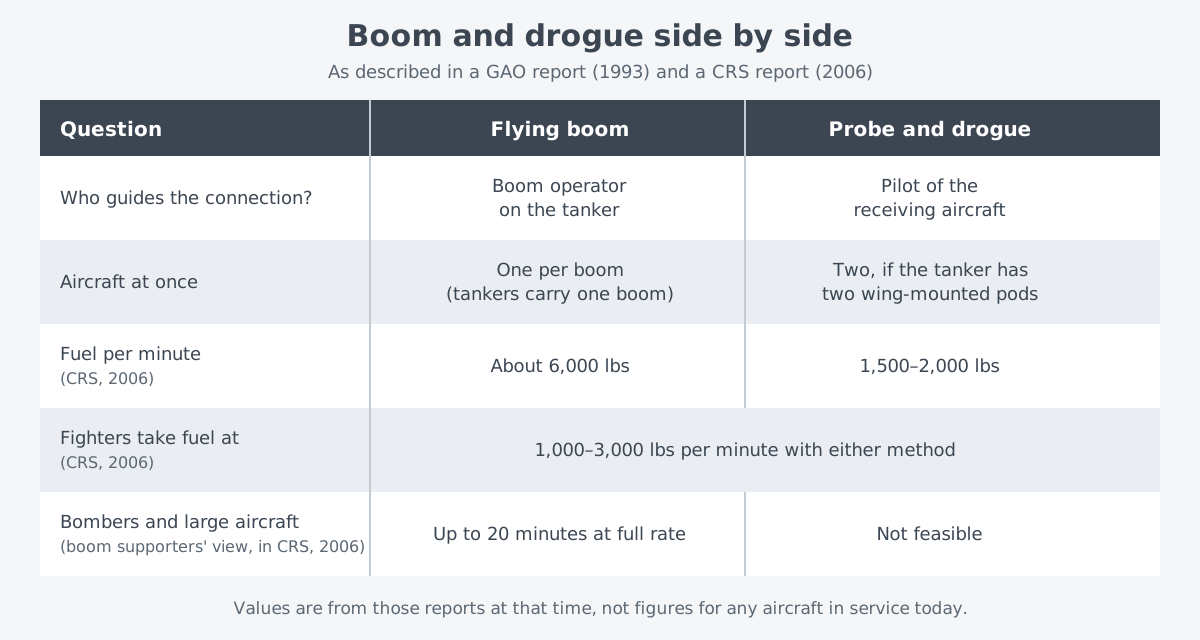
Start with speed. Fuel is often measured by weight, in pounds (lbs). According to the 2006 CRS report, one boom passes about 6,000 lbs per minute, and one hose and drogue passes 1,500–2,000 lbs per minute. The boom is much faster.
That only matters if the receiver can take fuel that fast. The same report says fighters of that time took fuel at 1,000–3,000 lbs per minute from either the boom or the hose and drogue. So when a fighter is refueling, the boom's main advantage disappears.
What about large aircraft such as bombers? Here the 2006 CRS report presents the case made by supporters of the boom. In their view, it is prudent for the Air Force to keep plenty of boom tankers. Their reason is that a large aircraft may spend up to 20 minutes taking fuel at the boom's full rate, and a hose and drogue cannot fill such aircraft.
Next is how many aircraft can refuel at once. A multipoint tanker with two drogue pods under its wings can refuel two fighters at the same time. A boom tanker refuels one at a time.
The rationale for a multipoint plan, as presented in the 1993 GAO report, also touched on fuel. Because a multipoint tanker passes fuel faster, the argument went, it uses less of its own fuel, which leaves more for the fighters.
Third is compatibility. A probe-equipped fighter can still take fuel from a KC-135 boom, as long as a drogue adapter kit goes on the boom before takeoff. While the kit is on, though, receptacle-equipped aircraft are shut out, and that can cause scheduling and coordination problems.
Supporters of the boom also argue that boom tankers are more flexible in some ways (CRS, 2006). If needed, they say, a boom tanker can be adapted on site to serve probe-equipped aircraft, but a hose and drogue tanker cannot be converted to take aircraft with receptacles. They add that a boom tanker can slow its fuel flow for fighters, while a hose and drogue tanker cannot speed up its flow for large aircraft.
Fitting the equipment is not the same effort either. Adding a boom to a commercial airplane takes bigger structural changes than adding hose and drogue units. The boom is also the pricier and more complex of the two.
So which one is better? In 1993, GAO did not pick a side. In its view, the information then available backed neither moving the Air Force to the probe and drogue nor keeping it out of the change. It also said the Air Force's concerns, such as its satisfaction with the system it had and the money and work a switch would take, were fair.
What GAO asked for was a fresh look. Its advice was for the Secretary of Defense to review the plan again, looking at all the services together rather than one. The main goal would be to settle whether Air Force fighters should get probes, and how many multipoint tankers the services would need.
Some tankers today carry both. Boeing describes the KC-46A as having a boom as well as hose and drogue units on the centerline and on the wings.
A short history
The first air-to-air refueling took place on June 27, 1923. Two specially fitted DH-4B aircraft flew together. One stayed up for 6 hours and 38 minutes, while the other acted as the tanker, using a hose that fed fuel down by gravity.
In May 1948, the U.S. Air Force began testing the probe and drogue system developed by the British aviator Alan Cobham. By September 1950, Boeing had developed the flying boom. The new boom handled bad weather, night refueling and fast aircraft better, and let aircraft refuel more quickly and safely.
In 1957, the Air Force bought 29 Boeing KC-135 tankers, and that number grew to 830 over the next two decades. Until then, all U.S. fighters had used the probe and drogue. Then, late in that decade, the boom became the Air Force standard, and its fighters switched over.
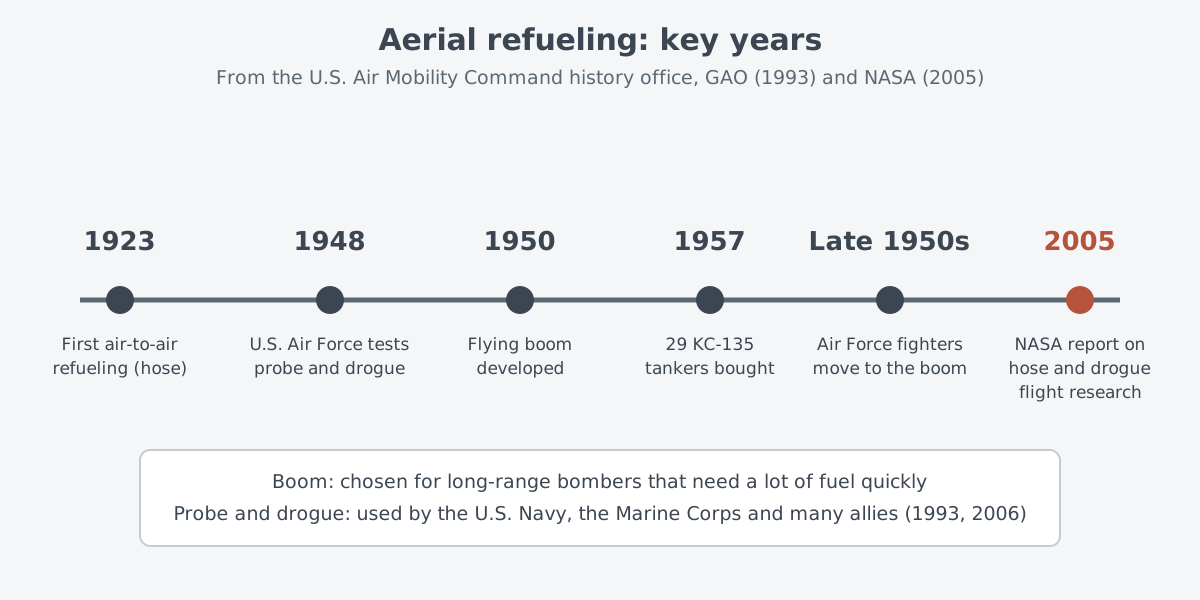
The reason for the boom was the long-range strategic bomber. Bombers need a lot of fuel, and the boom could deliver it faster. Fighter units inside the Air Force pushed back. Fighters take much less fuel, much more slowly, and the GAO report put it as "a sip as opposed to a gulp."
Difficulties and what comes next
The hose and drogue respond differently as conditions change. A 2005 report from the NASA Dryden Flight Research Center lists what affects the hose and drogue. The list includes flight conditions, the type of hose and drogue, the tanker's type and weight, the receiver's type, and how both aircraft maneuver.
The study gathered flight data with two F/A-18s and a Navy hose and drogue refueling unit. Its aim was a model of hose and drogue motion for designing automated refueling systems.
Automation is hard. The same report notes that everyday jobs a pilot does, refueling among them, get much harder once a machine must do them alone. When it was written, automated aerial refueling had not yet been shown in flight.
Research continued for a reason. Autonomous refueling would let uncrewed aircraft travel farther and stay in the air longer.
There have also been plans to deal with having two methods in use. The multipoint plan described in the 1993 GAO report would keep the boom and add wing pods. One reason given for it was that a KC-135 could then serve both receptacle-equipped and probe-equipped aircraft on a single mission.
What to read next
- Weight and platforms: fitting on a vehicle, ship or aircraft: what has to be weighed when equipment such as a laser goes on an aircraft.
- Airborne early warning and control: a control tower in the sky: another article in the military aircraft group.
- Stealth aircraft: truly invisible?: another article in the military aircraft group.