On the afternoon of May 7, 1915, the liner Lusitania, bound from New York to Britain, was hit by a torpedo in the sea south of Ireland. She sank in less than 20 minutes, and 1,198 people lost their lives. A war in which hidden boats under the water hunted merchant ships and liners had already been going on for months.
At sea in World War I, German submarines, the U-boats, tried to cut off the ships that kept Britain supplied. Britain first fought back by hunting for submarines. Only after losses climbed sharply in the spring of 1917 did it bring in convoys, groups of merchant ships sailing together with warships. That decision came after a long argument.
How did the rules of war at sea break down, and how did that pull the United States into the war? Why did convoys work? This article follows the story through public records and looks at the places where sources give different numbers.
A new weapon against a blockade
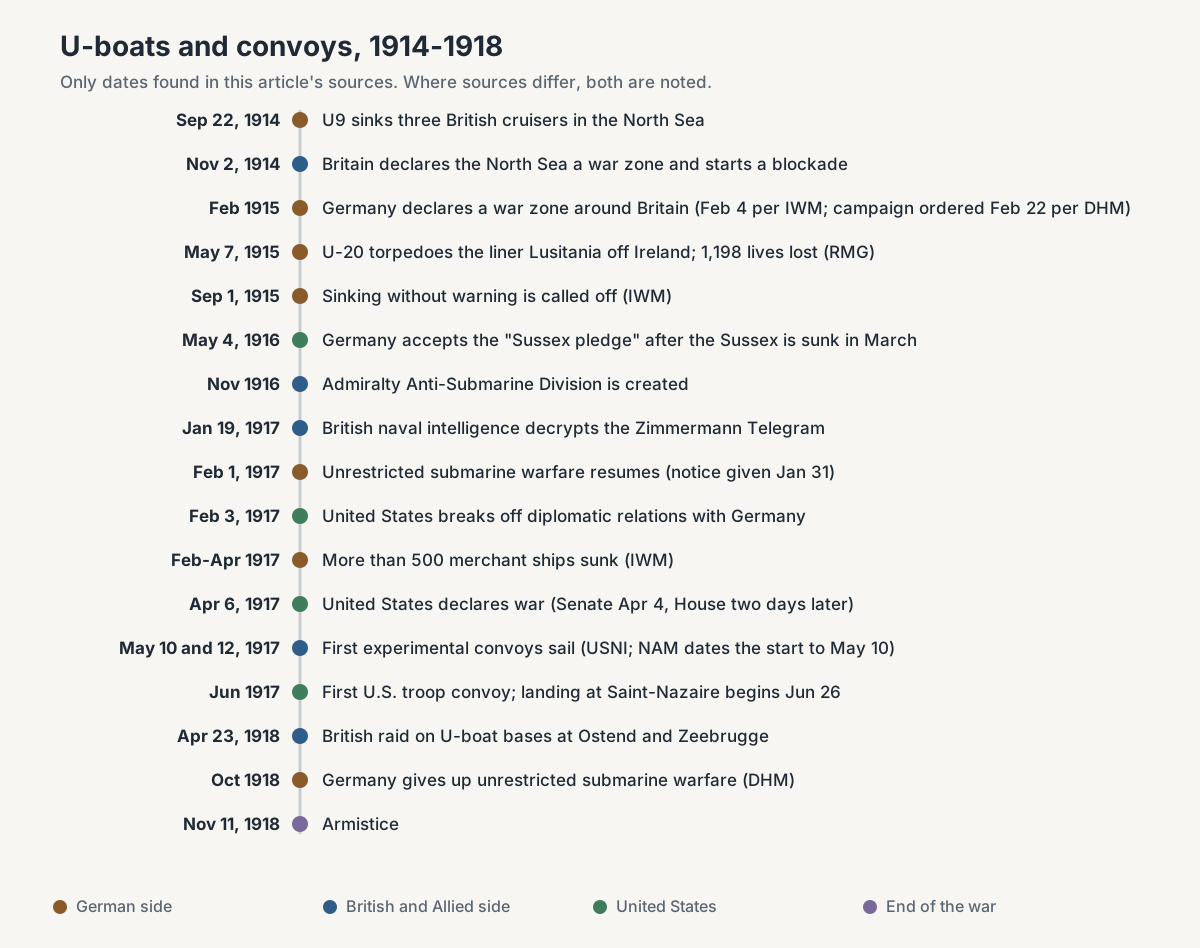
On November 2, 1914, Britain declared the North Sea a war zone and began a blockade. The aim was to cut Germany off from world trade.
Britain also depended on the sea. Even before the war, about half of its food came from abroad, and in 1914 nearly half the world's steamships flew the British flag. Leaning this heavily on food and supplies from across the empire could itself become a danger.
The submarine was a 19th-century invention. For a long time, navy leaders in many countries put their trust in surface fleets of heavy battleships and fast cruisers. They expected submarines to play only a minor part in raiding trade and scouting.
Germany was especially slow to take an interest. German submarines carried numbers instead of names, and the first, U1, entered service in 1906.
U-boats of this era ran on diesel or petroleum engines on the surface and on a weaker electric motor for short stretches underwater. They also did most of their fighting on the surface. For that reason, the German Historical Museum (DHM) describes them as closer to "diving boats" than true submarines. How submarine power changed after that is the subject of Diesel-electric, AIP and nuclear submarines.
On September 22, 1914, U9, commanded by Lieutenant Commander Otto Weddigen, sank three British cruisers in the North Sea in a single action. Suddenly the submarine looked like a weapon to be taken seriously.
Prize rules and attacks without warning
International law at the time treated a submarine like a cruiser. It could not simply sink an enemy merchant ship on sight. It had to stop the ship, search it and see to the crew's safety before seizing or sinking it, and these were known as prize rules.
At first, U-boats obeyed these rules, surfacing and letting crews and passengers get away. A submarine on the surface was easy to attack, all the more so after the British brought in "Q-ships," warships dressed up as harmless vessels with their guns concealed. The Allies also put guns on merchant ships. The Q-ships helped push Germany to abandon prize rules in the end.
In 1915, Germany declared the waters around Britain a war zone. Sources describe the date and the method a little differently. Imperial War Museums (IWM) says Germany made the declaration on February 4 and sank merchant ships inside the zone without warning. DHM says Germany ordered a U-boat campaign under prize rules on February 22, and in exceptional cases fired without warning.
Sinking ships without warning is called unrestricted submarine warfare. Neutral countries, especially the United States, reacted angrily.
The Lusitania and the Sussex pledge
The Lusitania left New York on May 1, 1915, with 1,959 people on board. Around 2:15 p.m. on May 7, about 15 miles south of the Old Head of Kinsale in Ireland, she was torpedoed by the German submarine U-20. A second explosion followed, and its cause has never been fully explained.
Germany called the attack legitimate, saying the liner carried military equipment and supplies from America, and the British authorities denied it. There was in fact a quantity of ammunition on board, so the German claim later turned out to be technically correct. Even so, the sinking set off worldwide outrage and worked against Germany politically.
The number of Americans killed differs by source. DHM gives over 100 and Royal Museums Greenwich (RMG) gives 128, while the State Department's Office of the Historian gives 131 for the Lusitania and the Arabic together.
The United States protested and, for the first time, threatened to enter the war. Wilhelm II ordered that neutral ships and enemy passenger liners be spared, and later limited the U-boat war to the Mediterranean. Sinking without warning stopped on September 1, 1915.
In March 1916, the unarmed French ship Sussex was sunk in the English Channel. President Wilson warned that he would break off diplomatic relations unless Germany stopped attacking all passenger ships and let the crews of enemy merchant ships leave before any attack. Germany agreed to these terms on May 4, 1916, and the promise became known as the Sussex pledge.
1917: unrestricted submarine warfare and the United States
In 1916 the German fleet could not wrest control of the sea from Britain at Jutland. On February 1, 1917, Germany turned back to unrestricted submarine warfare. At a conference that January, navy representatives persuaded the military leadership and Wilhelm II that a return to unrestricted attacks could help defeat Britain within five months.
Chancellor Theobald von Bethmann-Hollweg objected that the move would draw the United States in on the Allied side and lead to Germany's defeat. The German government went ahead anyway, betting that its submarines could finish the war well before any American troopships arrived in Europe. On January 31, Ambassador Johann von Bernstorff handed Secretary of State Robert Lansing a note saying the campaign would restart the next day.
On February 3, Wilson told Congress he had broken off relations with Germany. In February and March, German submarines sank several U.S. ships, and many American seamen and citizens died. Wilson went back to Congress on February 26 to seek authority to arm merchant ships, and when anti-war senators blocked it with a filibuster, he armed them by executive order.
Meanwhile, on January 19, British naval intelligence had intercepted and broken a coded message sent by Foreign Minister Arthur Zimmermann to Germany's ambassador in Mexico City. In it, Germany offered Mexico an alliance against the United States and promised help in winning back land Mexico had once ceded. The decoded text also said that unrestricted submarine warfare would begin on the first of February. Britain passed the telegram to Wilson on February 24, and American newspapers carried it across the country from March 1.
On April 2, Wilson asked Congress to declare war. The Senate voted yes on April 4 and the House two days later, and the United States entered the war on April 6. The Office of the Historian names the renewed submarine attacks as the main reason for Wilson's choice. It adds that historians still debate exactly why he chose war in 1917.
The argument over convoys
Losses after the restart were heavy. According to IWM, more than 500 merchant ships were sunk by U-boats from February through April 1917. In late April, 13 ships on average were lost every day.
An article in Naval History, the U.S. Naval Institute (USNI) magazine, puts losses in the campaign's first three months at nearly 2 million tons. It adds that the British government kept these record losses secret.
The Royal Navy was looking for answers too. In November 1916, Admiral John Jellicoe created an Anti-Submarine Division inside the Admiralty, but effective measures came slowly.
The first response was "hunting patrols," in which destroyers and armed trawlers searched for U-boats with the newly introduced hydrophone and depth charges. Finding an enemy on the open ocean was hard, so these patrols were largely ineffective. Of the 140 U-boats operating around Allied shipping lanes in 1917, the patrols destroyed only 14.
Opponents of convoys gave several reasons. The main one was that Britain did not have enough warships to spare. Escorting convoys would take many destroyers. Some argued that grouping ships together would make a bigger target and lead to more losses, and Jellicoe added that slow merchant ships would hold the whole convoy back.
Support came from more junior officers inside the Admiralty. Captain Kenneth Dewar and Commander Reginald Henderson found that merchant ships were being lost faster than the public had been told. They also found that far fewer oceangoing ships needed an escort than earlier reports suggested. They took these figures to Prime Minister David Lloyd George by way of the civilian Ministry of Shipping.
Sources weigh the question of who introduced convoys differently. The USNI article says Lloyd George's preference was the decisive factor and that Jellicoe set up a committee and launched two experimental convoys on May 10 and 12, 1917.
The National Army Museum (NAM) timeline says the Royal Navy introduced the convoy system on May 10. The Canadian War Museum says the British Admiralty brought in convoys during 1917. The Commonwealth War Graves Commission (CWGC) lists the convoy system among measures brought in by the Ministry of Shipping.
How convoys protected ships
Opponents assumed that a large group of ships would be easier to find. The opposite proved true. A U-boat was barely more likely to spot a convoy of 20, 30 or 40 merchant ships than to spot one lone ship. It was far less likely to spot the convoy than to spot one of dozens of ships sailing on their own.
When ships are spread out, one might pass through any patch of sea a submarine is watching. When they gather in one group, the sea outside that group is empty, and the submarine has to find that one group somewhere on a wide ocean. Once merchant ships were grouped and given warship escorts, U-boats found it much harder to locate and sink them, and Allied losses dropped sharply.
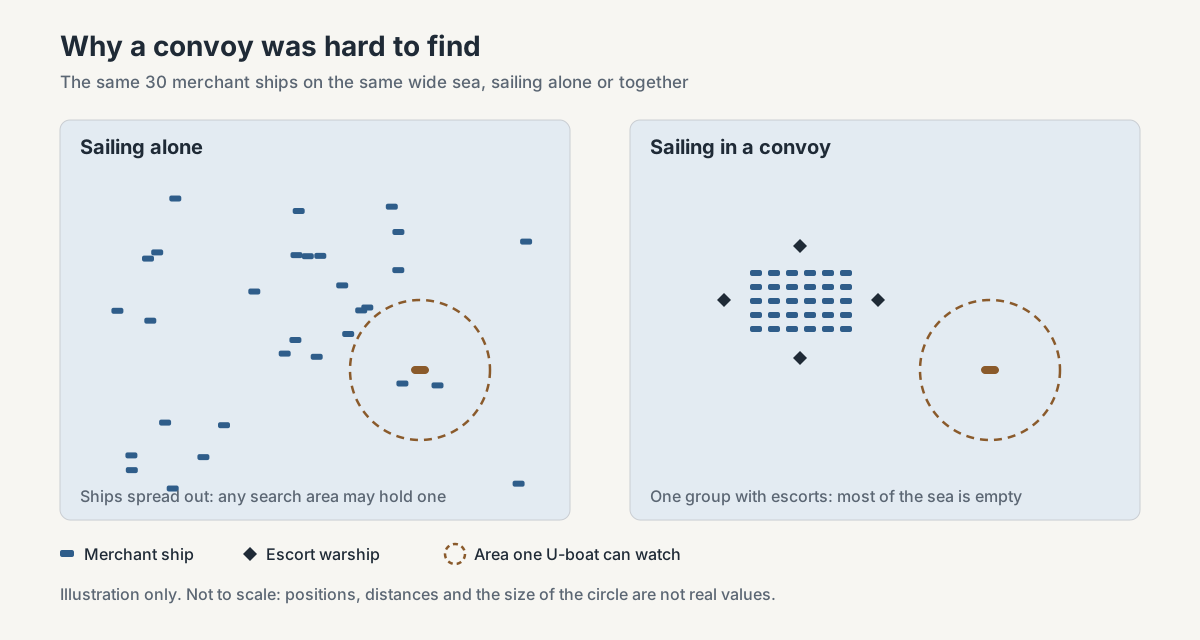
Escort warships sailed around each convoy. A typical convoy had six to eight destroyers looking after as many as 40 merchant ships, and the Germans sank only two warships on escort duty. After June 1917, the tonnage lost fell steadily.
Convoys were not the only answer. Merchant ships wore eye-confusing dazzle paint schemes, aircraft and direction-finding stations on the coast helped track U-boats down, and warships gained an early form of sonar and depth charges. On April 23, 1918, British naval forces raided Ostend and Zeebrugge, where U-boats were based. How sound is used to see underwater is explained in Sonar: why sound is used to see underwater.
After the United States entered the war, convoys also protected the ships carrying its soldiers. The American Battle Monuments Commission (ABMC) records that in early June 1917 an escort force assembled in New York Harbor. It had four cruisers, 13 destroyers, two armed yachts and two fuel tankers. It shepherded 14 steamships and three navy transports across to France.
Late on June 22, torpedoes ran through the convoy and narrowly missed several ships. An officer on the destroyer Wilkes listened for nearby U-boats with an early form of passive sonar. Because U-boats were off Brest, the convoy turned for Saint-Nazaire, and the landing began on June 26.
DHM sees the improved defenses as one reason German hopes fell short. The movement of American troops across the Atlantic was not disrupted at all.
Numbers that differ by source
The same event can appear with different numbers in different sources. Some count two events together, and some use different units, such as ships versus tons.
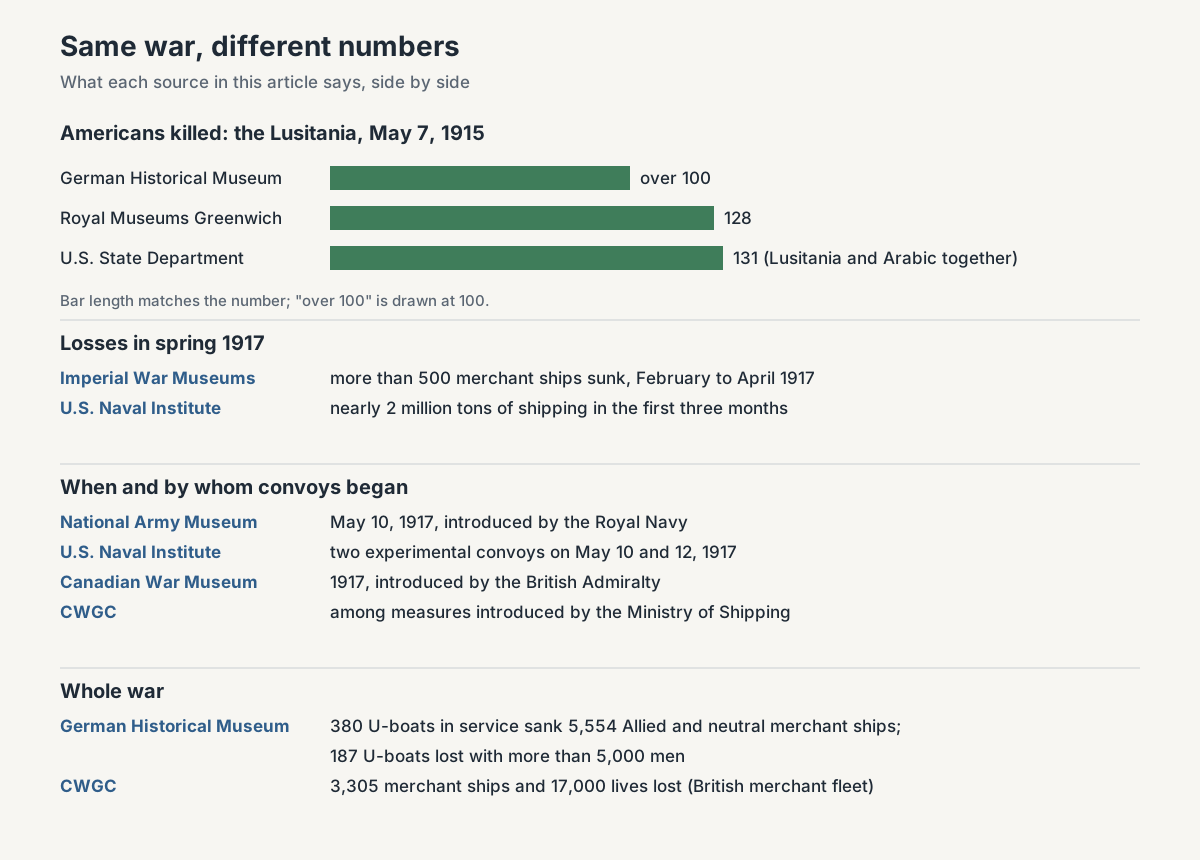
The number of Americans killed on the Lusitania appears as over 100, as 128 and as 131. The figure of 131 also includes those killed on the Arabic. For the spring of 1917, IWM gives more than 500 merchant ships from February to April, while the USNI article gives nearly 2 million tons for the first three months. One counts ships, and the other counts the size of ships in tons.
For the whole war, DHM says 380 German U-boats in service sank 5,554 Allied and neutral merchant ships, along with many warships. By its count, the German navy lost 187 U-boats and more than 5,000 men. CWGC and Veterans Affairs Canada say the British merchant fleet had lost 3,305 ships and 17,000 lives when the war ended. The first figure covers all Allied and neutral merchant ships, and the second covers British merchant losses only.
Other numbers show how the losses changed. The USNI article says average monthly losses, which had peaked above 800,000 tons, were below 200,000 tons a month by late 1918. Behind every one of these numbers are sailors and passengers who did not come home.
What it left
In DHM's assessment, sinkings jumped sharply after February 1, 1917, and alarmed the Allies, but the campaign fell far short of German hopes for a quick British collapse. Unrestricted submarine warfare did not change the course of the war and remained a disappointment for Germany. It was called off in October 1918, before the war ended, in response to Woodrow Wilson's Fourteen Points. When the Armistice came, the U-boat threat had been neutralized.
On the role of convoys, the USNI article holds that they undermined Germany's strategy of forcing the Allies to give in through economic starvation. The fighting stopped with the Armistice of November 11, 1918, and all surviving German U-boats were surrendered under the Treaty of Versailles. The intention was that Germany would never again pose such a threat to British trade.
The merchant sailors who died at sea are remembered too. In the heart of London, the Tower Hill Memorial honors nearly 12,000 merchant seamen, sailors and fishermen of World War I whose only grave is the sea. Sir Edwin Lutyens designed it, and Queen Mary unveiled it on December 12, 1928.
What to read next
- The Battle of Jutland: The One Clash of the Dreadnought Fleets: the surface battle between the two fleets before Germany turned back to unrestricted submarine warfare.
- Sonar: why sound is used to see underwater: the principle behind seeing underwater with sound, which World War I warships already used in an early form.
- Destroyers and frigates: why warships have different names: the names and roles of the kinds of warships that once escorted convoys, by today's standards.
- Heavyweight torpedoes: how they differ from lightweight ones: how the torpedo, the U-boat's weapon, divides into types today.
- Military logistics: performance must be sustainable: why supply lines hold up a war, in today's terms.
- A history of laser weapons: from chemical to electric lasers: long after a new weapon under the water changed war at sea, how another new kind of weapon grew up.