At 4 a.m. on November 11, 1918, the Canadian Corps entered the Belgian town of Mons. The British Army had fought its first battle of the war there in August 1914, and German troops had held the town ever since. Fighting on the Western Front went on that morning until 11 a.m., and then it stopped.
What took effect at 11 a.m., though, was an armistice, not a peace treaty. The peace treaty with Germany was signed the following June 28 in the Hall of Mirrors at the Palace of Versailles. It only came into force on January 10, 1920.
Why did Germany, still on a major offensive that spring, ask for an armistice so quickly? What did the treaty actually say, and was it too harsh, or was it a product of compromise?
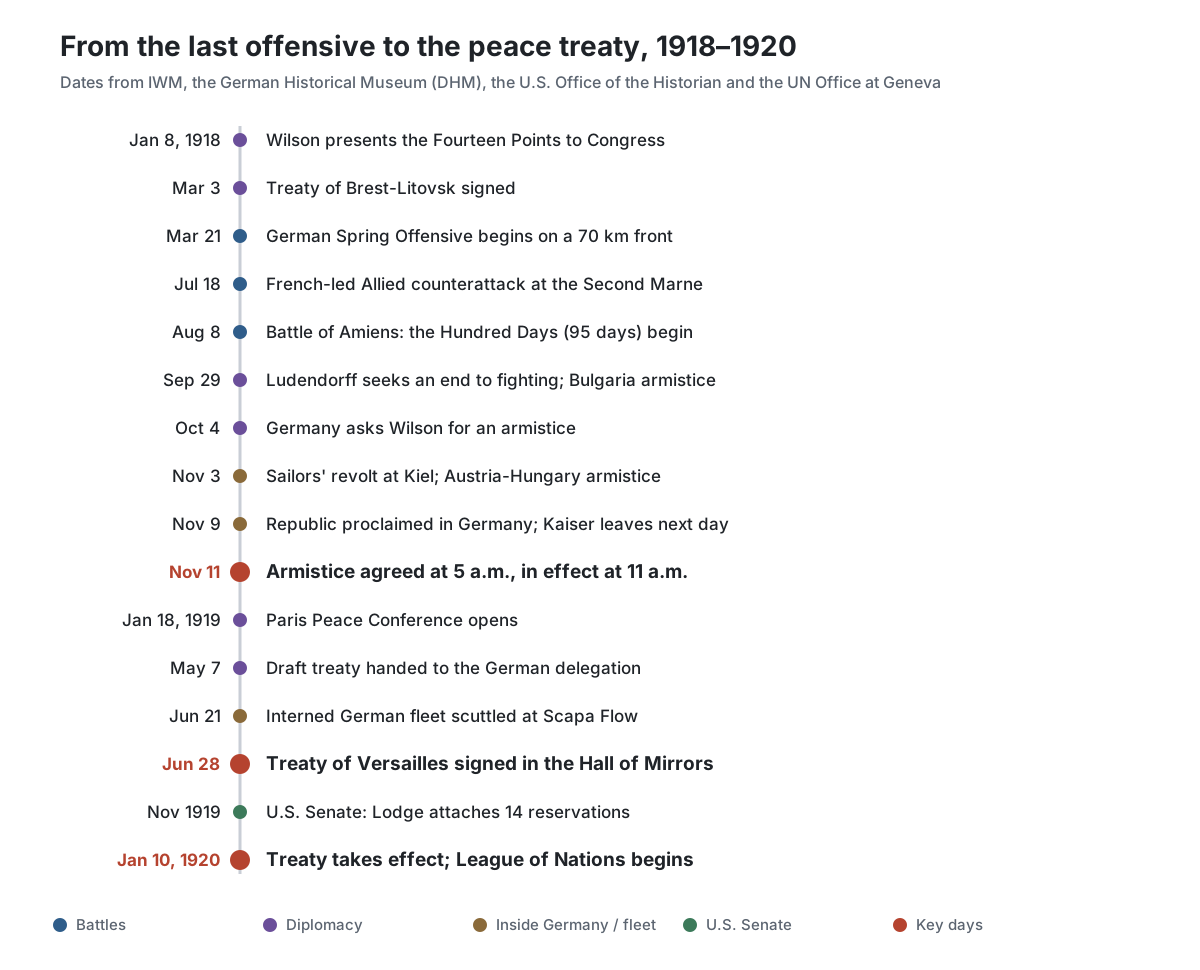
1918: the last offensive and the counterstroke
On March 3, 1918, Russia and the Central Powers signed the Treaty of Brest-Litovsk. Russia lost more than 25% of its population and 27% of its economically usable land. On March 21, the German Army opened its Spring Offensive on a front 70 km wide in Picardy, on the Western Front. Erich Ludendorff hoped a military success would push the Allies into negotiating.
The Spring Offensive nearly broke the Allied line, but the Allies held on, just barely. In the Second Battle of the Marne, from July 15 to August 6, the Germans again failed to land a decisive blow. On July 18, a French-led counterattack drove them back.
The Marne became the last German offensive. Since March, Ferdinand Foch of France had been commander-in-chief of the Allied forces on the Western Front.
The Battle of Amiens began at 4:20 a.m. on August 8. The Australian and Canadian Corps led the attack behind 534 tanks and reached their objectives within hours. Ludendorff called it the "black day of the German Army."
The period from that day to November 11 is often called the Hundred Days Offensive, although it actually lasted 95 days. By late August, more than 1.4 million American troops were in France. A new way of fighting that combined artillery, tanks and aircraft took hold, and the war moved out of the trenches into open ground. On September 29, at the St Quentin Canal, the Allies broke through one of the strongest stretches of the Hindenburg Line.
The cost was heavy. From August to November, Allied casualties were about 700,000, and German casualties were slightly higher, at about 760,000. Even the Allies did not expect this offensive to end the war at first. They were planning their final attack for the spring of 1919.
Asking for an armistice
By the autumn of 1918, Germany and its allies were worn out. Their armies had been beaten, and hungry civilians were starting to revolt. As early as September 29, Ludendorff concluded that a way to stop the fighting had to be found, and that same day Bulgaria signed an armistice with the Allies.
Max von Baden became chancellor on October 3, and the next day he asked U.S. President Woodrow Wilson to broker a ceasefire. He pointed to the Fourteen Points, which Wilson had laid out before a joint meeting of Congress on January 8 that year. The speech drew on reports by "The Inquiry," a study group of about 150 scholars.
Eight of the fourteen points dealt with territorial questions between the warring nations. Of the remaining six, five set out general principles: open diplomacy, freedom of the seas, free trade, arms reduction, and settling colonial claims with self-determination in mind. The fourteenth proposed an international body that would later become the League of Nations. The fourth point called for cutting national armaments to "the lowest point consistent with domestic safety."
Wilson set conditions. In October he made clear that unrestricted U-boat warfare had to end and that Germany's current rulers had to go. On October 23, he replied that he would only broker an armistice that left Germany unable to resume fighting.
Meanwhile, Germany's allies dropped out one by one. The Ottoman Empire signed an armistice with the Allies on October 30, and Austria-Hungary followed on November 3.
Order inside Germany was breaking down too. In October, when the naval command planned a final sortie without approval, sailors refused orders to get their ships ready for sea. A sailors' revolt broke out at Kiel on November 3, and the unrest spread widely. At 2 p.m. on November 9, Philipp Scheidemann of the Social Democrats proclaimed a republic, and Kaiser Wilhelm II went into exile in the Netherlands the next day.
11 a.m., November 11
Records differ slightly on when the armistice delegations first met. One Imperial War Museums (IWM) article gives November 7, and another gives the day after the republic was proclaimed. The German Historical Museum (DHM) chronicle says talks led by Matthias Erzberger began at Compiègne on November 8. The meeting place was a railway carriage in the forest of Compiègne, northeast of Paris.
Germany was in no position to bargain. The Allies, led by Foch, drew up the terms, and the German delegation won only minor relief from their severity. The delegation agreed at 5 a.m. on November 11, and the armistice took effect at 11 a.m.
An armistice is normally just a halt to the fighting. The 1918 armistice went further. German forces had to clear occupied France, Belgium and Luxembourg, along with Alsace-Lorraine, within 15 days, and hand over weapons, aircraft, warships and U-boats. The treaties of Brest-Litovsk and Bucharest were also annulled.
Officially it was a ceasefire of only 36 days, but the fighting never resumed. Because its terms removed any chance of Germany carrying on the war, IWM describes the armistice as a German surrender in all but name. Reactions at the front ranged from euphoria to indifference, and the celebrations were softened by the grief of the many who mourned the dead.
The fleet was handled separately. All U-boats were surrendered at once, while the surface fleet was to be interned until the peace conference decided its fate. On November 21, 1918, 191 Allied and 70 German vessels sailed together into the Firth of Forth in Scotland, and 74 German ships were later interned at Scapa Flow.
On the morning of June 21, 1919, while the British fleet was away on exercises, the German commander von Reuter ordered his ships to be sunk by their own crews. Of the 74 ships interned, 52 went down within five hours, and 22 were run aground in shallow water. France and other Allies, who had wanted a share of the ships, were furious.
The Paris Peace Conference
The Paris Peace Conference opened on January 18, 1919. Nearly thirty nations took part, but the conference was led by the "Big Four": Britain, France, the United States and Italy. On March 24, a "Council of Four" made up of Wilson, Georges Clemenceau, David Lloyd George and Vittorio Emanuele Orlando became the conference's top body.
Some countries were left out. The defeated Germany, Austria-Hungary, Turkey and Bulgaria were not invited, and Russia was not invited either because the Allies did not recognize the Bolshevik government.
The United States had fought as an "Associated Power" rather than one of the Allies. So it was not bound by the Allies' earlier deals on dividing territory after the war. Wilson strongly opposed many of those deals, including Italy's claims on the Adriatic.
The conference ran until January 1920 and produced a separate treaty for each defeated country. As with the armistice, the winners set the terms. Public opinion in the Allied countries wanted the toughest terms possible, and 233 members of the British House of Commons sent Lloyd George a telegram demanding a hard line.
The German delegation reached Versailles on April 29 and received the draft treaty on May 7. In Germany the terms were met with dismay. The British Labour Party and the French trade union federation, the CGT, also protested that the draft denied self-determination.
Scheidemann's cabinet resigned in June so that it would not have to take responsibility for signing. The new government offered to accept the treaty if the admission of sole war guilt was removed, but the Allies refused a "conditional acceptance." With the Allies threatening military action, there was no politically workable choice other than signing.
On June 22, the German National Assembly approved the treaty by 237 votes to 138. On June 28, Foreign Minister Hermann Müller and Transport Minister Johannes Bell signed it in the Hall of Mirrors. It was exactly five years after Archduke Franz Ferdinand was assassinated in Sarajevo. It was also the very hall where the German Empire was proclaimed in 1871, with Wilhelm as its first emperor.
The treaty was set to take effect once Germany and three of the principal Allied powers had ratified it. The German National Assembly ratified it on July 9, and the French Chamber of Deputies on October 2, with Britain and Italy also ratifying in October. The treaty came into force on January 10, 1920.
What the treaty said: land and armed forces
In the west, Alsace-Lorraine, which Germany had taken in 1871, returned to French sovereignty as of the armistice date, November 11, 1918, under Article 51. Under Article 45, the coal mines of the Saar went to France as compensation for the destroyed mines of northern France and as part of reparations. The Saar region itself would be run by the League of Nations, with a vote of its residents after 15 years to decide its future. France could use its economic resources until 1935.
In the east, Article 87 had Germany recognize Poland's full independence. Under Article 102, Danzig and the area around it became a Free City under the League of Nations' protection. Article 80 required Germany to respect Austria's independence, which could not be changed without the consent of the League's Council.
Article 119 took away all of Germany's overseas colonies. Sources describe the size of its losses differently. The U.S. Office of the Historian puts it at "approximately 10 percent of its prewar territory in Europe" plus all overseas possessions. DHM gives one-seventh of its territory with one-tenth of its population.
The armed forces were limited in more detail. Under Article 160, the army had to shrink to no more than seven infantry and three cavalry divisions by March 31, 1920. After that, it could not exceed 100,000 men, officers included.
Officers were capped at 4,000, and the army's role was limited to keeping order at home and controlling the borders. Article 173 abolished universal conscription, so only volunteers could serve.
Article 181 let the navy keep only 6 battleships, 6 light cruisers, 12 destroyers and 12 torpedo boats in commission, and no submarines at all. DHM gives the navy's personnel as 15,000. Article 198 banned military and naval air forces outright, and no dirigibles could be kept.
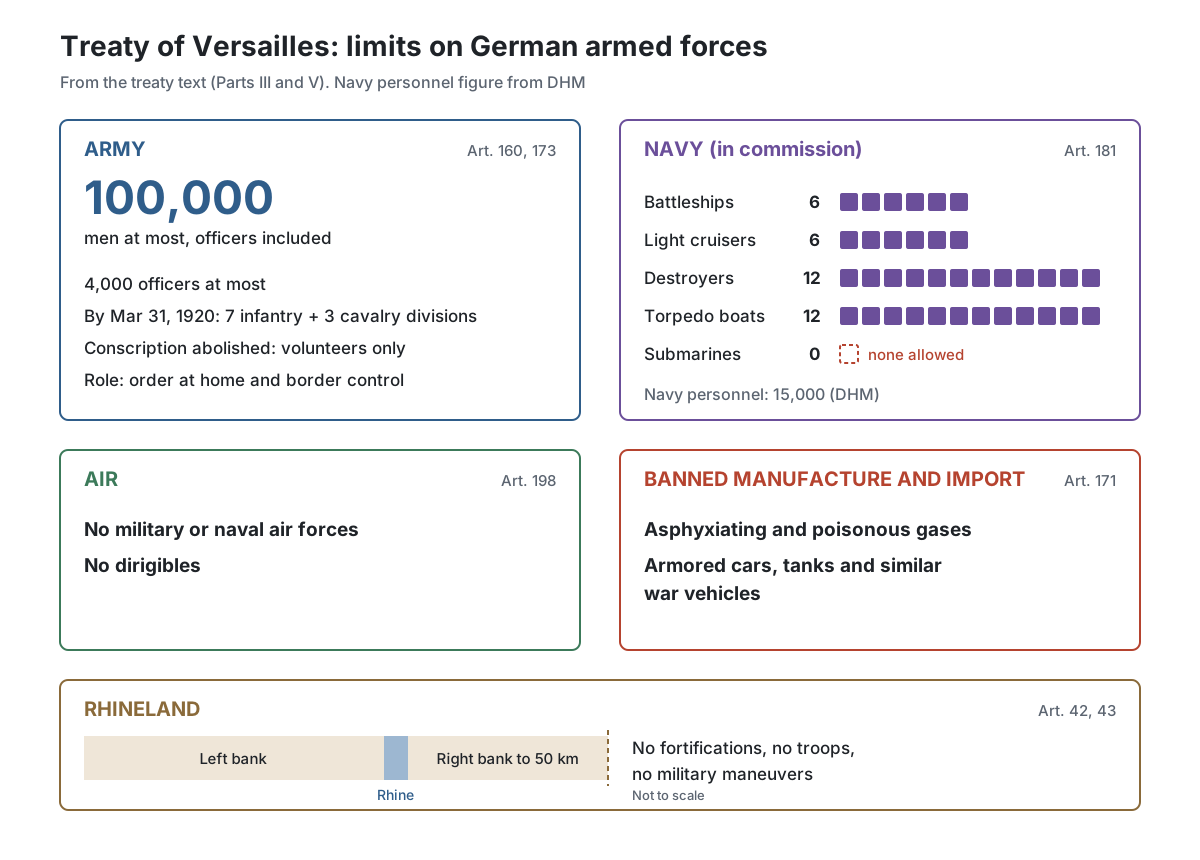
Article 171 began from the point that using asphyxiating and poisonous gases was already prohibited, and on that basis it strictly banned their manufacture and import in Germany. The same article also banned making or importing armored cars, tanks and similar war vehicles. Put together, the banned list covers submarines, military aircraft, dirigibles, tanks, armored cars and poison gas.
Article 42 allowed no fortifications along the Rhine's left bank, or along its right bank west of a line 50 km east of the river. Article 43 also forbade stationing or gathering troops and holding any military maneuvers in that zone. Allied troops were to occupy the left bank and the bridgeheads for 15 years, and the Allies set up an international military control commission to check the many disarmament clauses.
War guilt and reparations
In Article 227, the Allies publicly charged the former German emperor, Wilhelm II, with "a supreme offence against international morality and the sanctity of treaties." A special court was to be formed with one judge each from the United States, Britain, France, Italy and Japan. The Netherlands was to be asked to hand him over.
Article 231 caused the most controversy. Germany accepted responsibility, with its allies, for all the loss and damage the Allies and their citizens suffered. That damage came from a war "imposed upon them by the aggression of Germany and her allies." The article is often called the "War Guilt Clause."
The very next article, 232, admits that Germany's resources were not enough to pay for all of that loss in full. Instead, it required compensation for damage done to Allied civilians and their property.
The treaty did not name a sum. Under Article 233, a Reparation Commission was to set the amount and notify Germany by May 1, 1921. It would then draw up a schedule to pay it within 30 years from that date.
Until then, Article 235 required Germany to pay the equivalent of 20 billion gold marks over 1919, 1920 and the first four months of 1921. The amount the commission fixed in 1921 was 132 billion gold marks. The U.S. Office of the Historian gives this as 32 billion dollars. That sum was in addition to an initial 5 billion dollars the treaty had required.
At the Spa conference in July 1920, the shares were split as France 52%, Britain 22%, Italy 10%, Belgium 8% and the remaining countries 8%.
The League of Nations and the U.S. Senate
Part I of the treaty is the Covenant of the League of Nations. Wilson pushed hard to attach the Covenant to the treaty, believing that a working League would ease any unfairness in the peace terms. Under the Covenant's 26 articles, members promised to settle disputes peacefully, give up secret diplomacy and reduce their armaments.
Article 8 of the Covenant said keeping the peace required cutting national armaments to "the lowest point consistent with national safety." That is nearly the same wording as the fourth of the Fourteen Points. In Article 10, members agreed to respect and protect each other's territory and political independence against outside aggression. The UN Office at Geneva calls this the first effort to set up collective security.
The League came into being on January 10, 1920. When its first Assembly met in Geneva on November 15, 1920, 41 states attended according to the UN Office at Geneva, or 42 according to the DHM chronicle. A total of 63 states joined over time, with no more than 60 at any one moment. The League also oversaw the mandate system, which placed former German colonies and Ottoman lands under the "tutelage" of mandatory powers.
The United States never joined. When Wilson returned in July 1919, American public opinion strongly backed ratification and 32 state legislatures voted resolutions backing it, but the Senate was firmly opposed. Opponents argued that Article 10, on collective security, would hand the U.S. government's war powers to the League Council.
The opponents fell into two groups. The "Irreconcilables" would not join the League on any terms, while the "Reservationists," headed by Henry Cabot Lodge, who chaired the Senate Foreign Relations Committee, wanted changes before ratifying. Lodge attached 14 reservations to the treaty in November, and when the last vote came on March 19, 1920, the treaty fell seven votes short of ratification. The United States signed a separate Treaty of Berlin with Germany on August 25, 1921.
Treaties with the other defeated powers followed. Austria signed at Saint-Germain on September 10, 1919, and Bulgaria at Neuilly on November 27. Hungary signed at Trianon on June 4, 1920, giving up 71% of its territory and cutting its army to 35,000 men. The Treaty of Sèvres on August 10 reduced the former Ottoman Empire to one-tenth of its original size, but Turkish nationalists led by Atatürk did not recognize it.
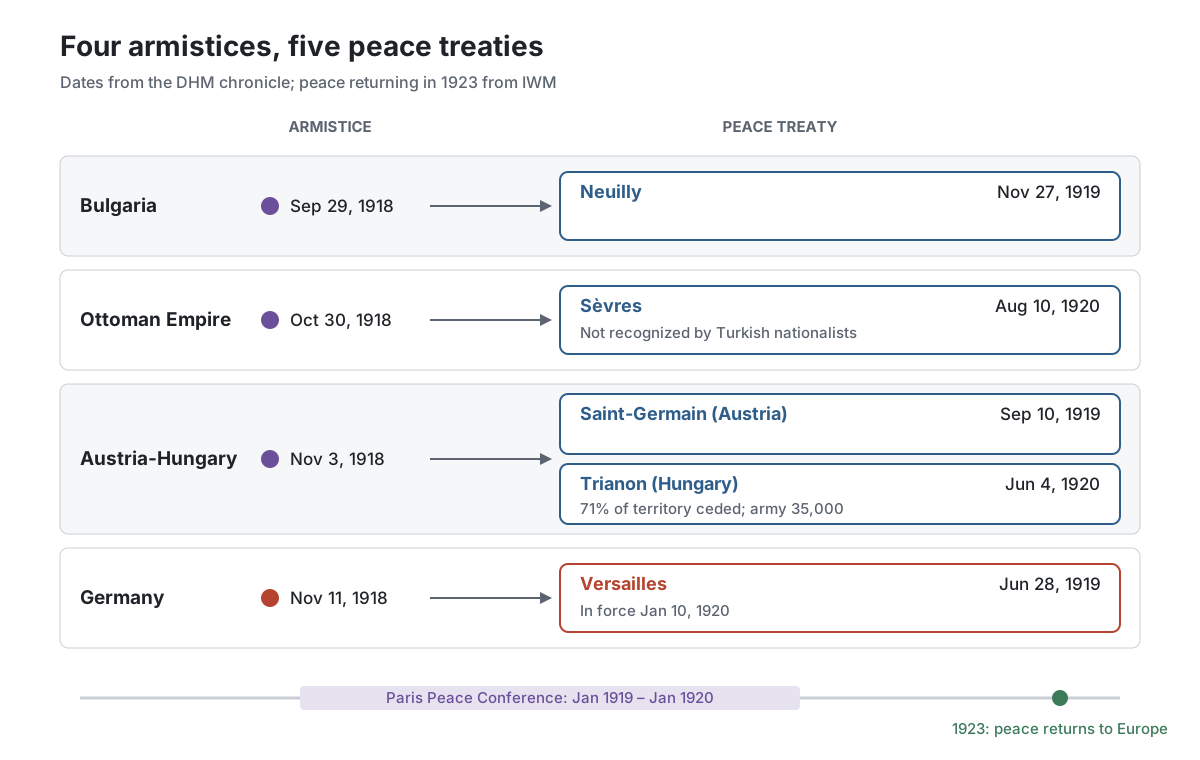
Signing did not bring peace at once. After the armistice, armed groups pursuing nationalism, revolution or counter-revolution kept fighting in many places, and the Russian Civil War killed more Russians than the world war had. Peace did not return to Europe until 1923.
Too harsh, or a compromise?
In Germany, everyone from the far right to the Social Democrats rejected the treaty, mainly because of the war guilt article. They called it a "Diktat," a dictated peace, and a "peace of shame." President Ebert, in an appeal to the U.S. government, called the terms a complete "negation" of Wilson's Fourteen Points.
On November 18, 1919, Paul von Hindenburg told a parliamentary inquiry that the German army had not been beaten but "stabbed" from behind. That statement became the basis of the stab-in-the-back myth. Together with that myth, the treaty was used for years afterward in fierce agitation against the Weimar Republic.
Dissent came from the winning side too. In June 1919, John Maynard Keynes, who led the British Treasury delegation, resigned because he believed the reparations forced on Germany would lead to a worldwide financial disaster.
Official histories do not all point the same way. The U.S. Office of the Historian says the treaty, at French and British wishes, placed strict punitive measures on Germany, and that Germans came to resent its harsh terms. It adds that over time the treaty lost credibility, seen as "unenforceable, short-sighted, or too extreme".
One IWM article holds that Article 231 and the reparations of some 132 billion gold marks caused wide resentment and economic hardship. In its view, they became a significant factor in rising support for Hitler's Nazi Party in the 1920s and early 1930s.
Another IWM article puts the weight elsewhere. It notes that the settlements, imposed by the winners, have been criticized for laying the ground for future wars. Yet it argues that the terms placed on the defeated powers were not unduly harsh, and that the treaties held many compromises on hard questions. Their long-term success was limited as a result, it says, but the treaties did not by themselves make the Second World War inevitable.
Some facts stand behind both views. The First World War brought down the German, Russian, Austro-Hungarian and Ottoman empires. The new states that appeared in Europe and the Middle East sometimes became seeds of later conflict.
Britain and its empire alone lost nearly a million dead, with more than twice that number wounded. Only twenty years after the treaty was signed, Germany invaded Poland in 1939, and the League, which had tried to prevent another world war, could not stop it.
What to read next
- Why World War I Began: From Sarajevo to Mobilization. Start with the event whose fifth anniversary fell on the day the treaty was signed.
- The Battle of the Somme: Questions Left by the First Day. See what attrition on the Western Front looked like two years before the armistice.
- Poison Gas in World War I and the Ban on Chemical Weapons. Follow how the poison gas named in Article 171 later led to an international ban.
- Turning Points in Military Technology. Continue with the weapons technology that came after, from radar and the proximity fuze to uncrewed systems.
- Eye Safety and International Norms: The Protocol on Blinding Laser Weapons. See how binding a specific weapon with treaty language worked out for laser weapons.