On 22 August 1914, a British aircraft flying over Belgium was hit by rifle fire from the ground and came down. Both men aboard were killed, and the Avro went into the record as the first British aircraft lost in action. That same day, the British flying corps flew twelve reconnaissance sorties. One of them spotted the German advance swinging around the British left at Mons.
That summer, aircraft carried eyes and maps more than guns. Four years later, there were separate fighters, bombers and reconnaissance planes, and nearly 1,500 aircraft gathered for one battle. What changed in between?
The story here runs from reconnaissance to fighters, raids on cities and the birth of an independent air force. The sources are public records from the RAF Museum, the Smithsonian National Air and Space Museum (NASM) and the Australian War Memorial (AWM). Records from the German Historical Museum (DHM) and the U.S. Air Force fill in the rest. Where institutions give different numbers or judgments, they appear side by side.
1914: watching the war from above
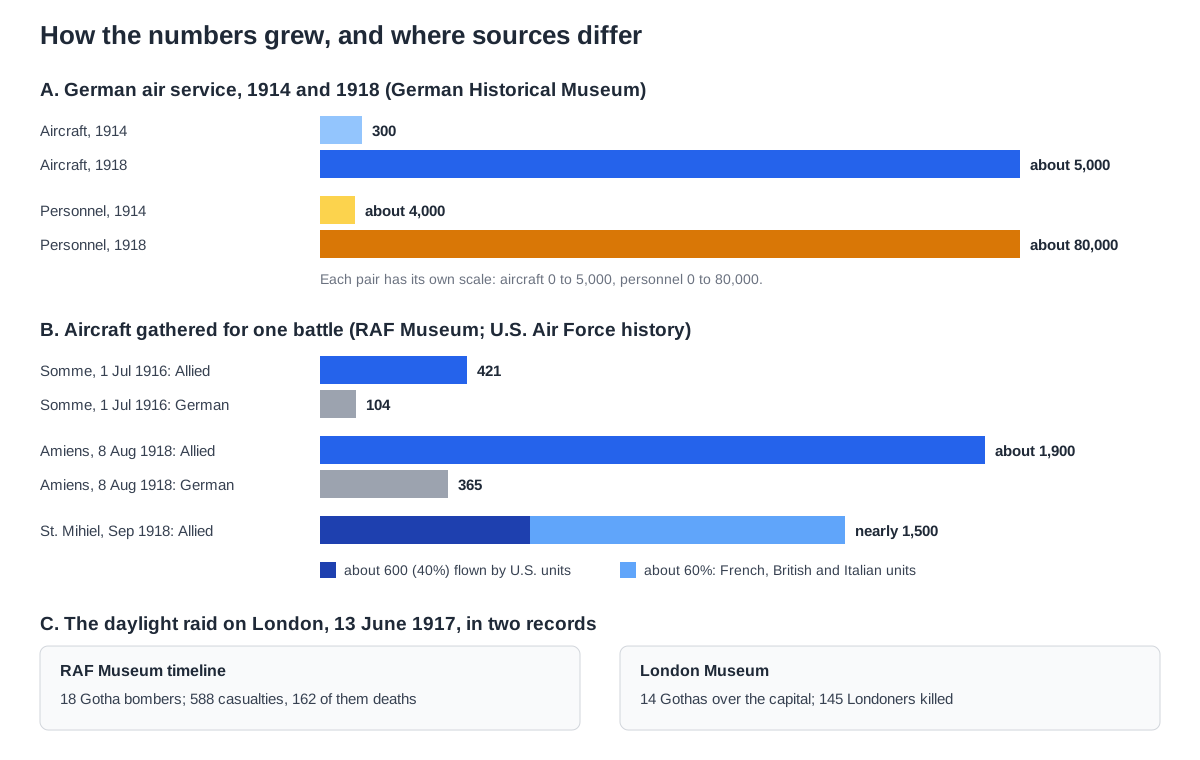
Britain's Royal Flying Corps (RFC) sent four squadrons to France in mid-August 1914. On the Continent the RFC mustered 105 officers, 63 aeroplanes and 95 vehicles. The German air service in 1914 had about 4,000 men and 300 aircraft. The U.S. Army was still outside the war, and its 1st Aero Squadron, with 12 officers, 54 enlisted men and six aircraft, was its entire tactical air strength.
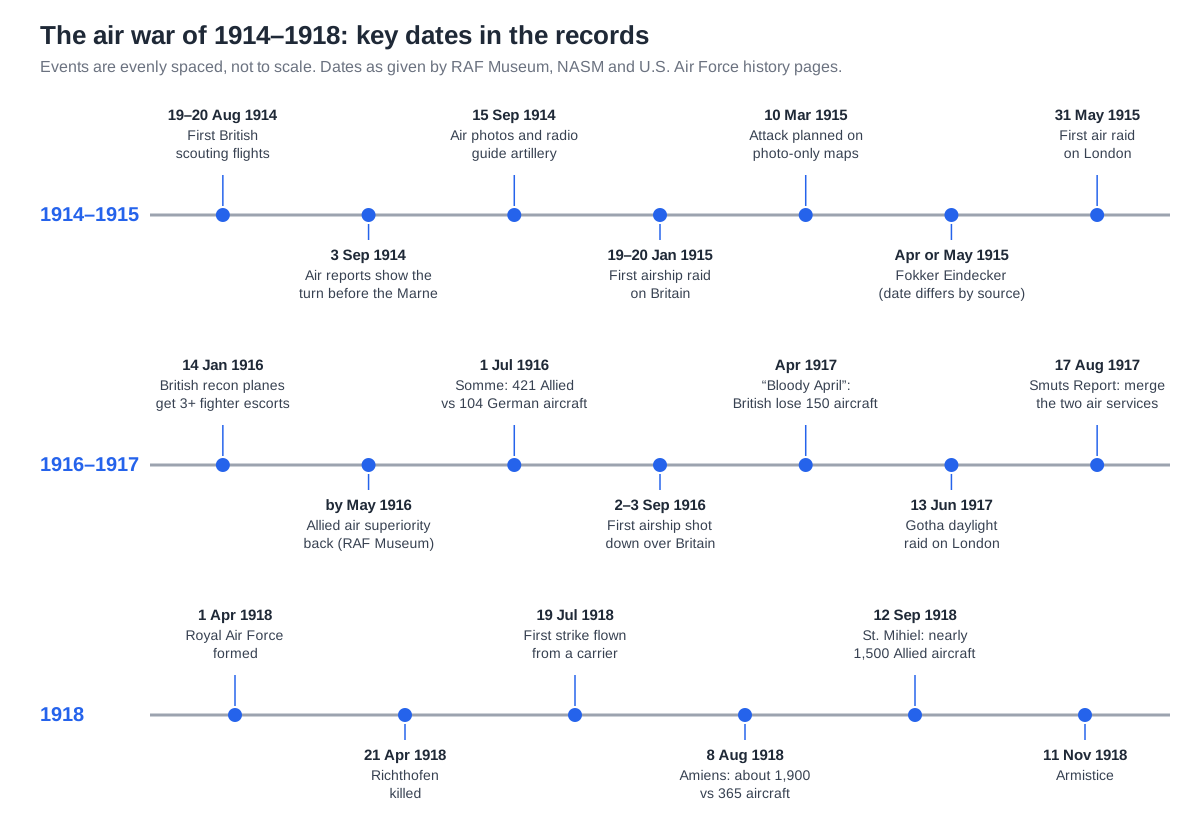
The first scouting flights did not go smoothly. On 19 August, both pilots who took off from Maubeuge lost their way and found neither the enemy nor the Belgian Army they were looking for. Only the next day did the RFC complete its first successful reconnaissance, locating German columns near Tervueren and Wavre.
The flights of 3 September led to something bigger. The RFC reported that von Kluck's German First Army had changed its line of march to the south-east and east. The French commander-in-chief, Joffre, received the report and ordered a counter-stroke, and the Battle of the Marne followed. He later said the British flyers had played "a prominent, in fact a vital part" in watching that movement.
In the first year of the war, the aircraft was above all the commanders' eye. The DHM notes that at first nobody planned to use it as a means of attack. Once trenches closed the ground and cavalry could no longer scout as before, aircraft took over that job.
Balloons, cameras and radio
Watching from the air meant two different jobs. Observation is watching one place for a long time, usually to see where heavy artillery shells land. Reconnaissance is going out to look for something, such as an enemy fleet or troops moving up to the front.
For long watching, a balloon tied to the ground worked well. The balloon was tethered to a winch, and the observer in the basket told the artillery whether its shots were on target. Even within one museum, the height is given differently. NASM's story page says balloons usually floated around 1,500 feet, or 1,000 feet on windier days, while its exhibition fact sheet gives a standard altitude of 500 m.
The hydrogen inside burned easily. Enemy pilots attacked balloons with incendiary bullets, and some became known as balloon busters. Observers went up wearing harnesses tied to parachutes so they could jump if the balloon caught fire. The British first used kite balloons for artillery observation in France on 4 May 1915.
Aircraft reconnaissance began with spoken reports. Crews landed and told what they had seen. Soon two-seat aircraft had space for a camera-carrying observer, and the two-seat layout quickly became standard. Observers handled their cameras in the open air, often in freezing cold.
On 15 September 1914, at the Battle of the Aisne, air photography and wireless telegraphy were first used for artillery observation in combat.
On 24 September, two officers directed an artillery shoot by airborne radio. Their radio log opens with "A very little short. Fire! Fire!" and closes 40 minutes later with word that they were coming home.
Talking to the guns needed a shared map. In October 1914 the RFC began using maps with a grid of letters and numbers, so it could report enemy positions to the artillery to within a few yards. Earlier maps had no common grid. A "clock code" for quickly correcting the fall of shells followed soon after.
The attack at Neuve Chapelle, opened on 10 March 1915, was the first in the history of warfare based on maps made only from photo reconnaissance. A NASM curator sees this kind of reconnaissance as the airplane's most critical role, with fighters arriving later to deny the enemy these eyes and protect friendly reconnaissance flights.
Firing past the propeller
The first pilots to meet in the air did not always shoot at each other. According to the DHM, many had known one another from international flying events before the war and were more interested in the other side's machines than in shooting them down. The first air fights were improvised with pistols, and observers took hand-held weapons aloft.
British records show a similar picture. The first British aerial victory, on 25 August 1914, came when three aircraft chased a German Taube until it was forced to land. On 16 September, the first RFC machine in France armed with a machine gun crossed the Channel, but rifles and revolvers stayed the main armament until the summer of 1915. On 22 November, a machine-gun-armed Avro shot down a German Albatros for the first time, and the two German crew members were captured unhurt.
The propeller was the obstacle. The best firing position was to point the aircraft's nose at the target and fire forward, and a propeller spinning in front blocked exactly that path. Designers built aircraft with the propeller at the back, or mounted a machine gun on the upper wing to fire over the propeller.
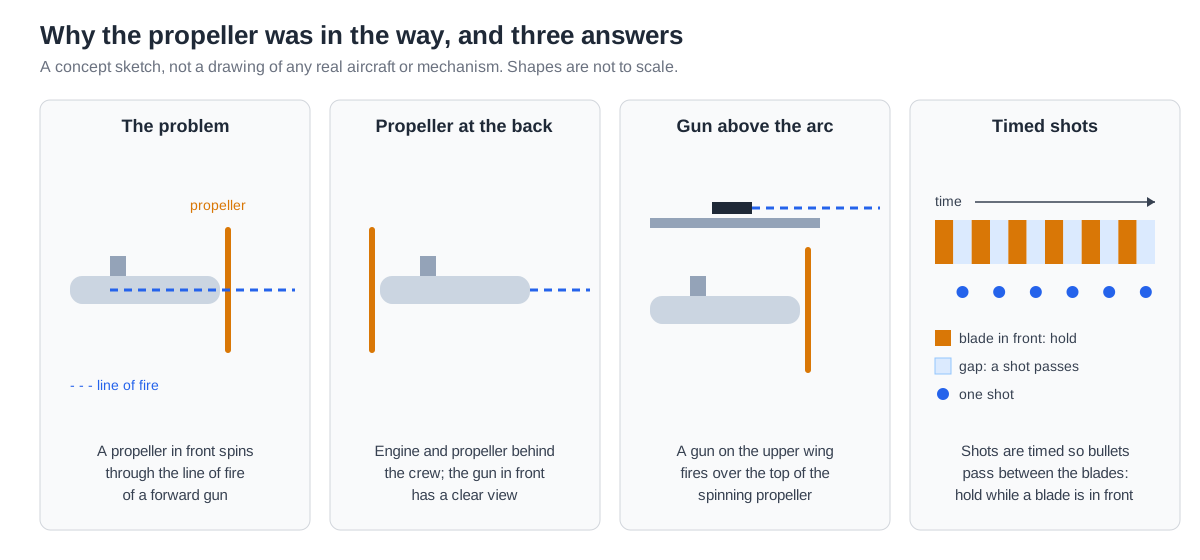
The best answer was the gun synchronizer, which timed the shots so that bullets passed between the propeller blades. The AWM describes these interrupter gears as developed in 1915, letting pilots of single-seat fighters fire straight ahead through their propellers.
Germany used it in combat first. NASM says that in May 1915, Anthony Fokker fitted one of his monoplanes with a forward-firing machine gun and the first operational synchronizer. The RAF Museum timeline places the first Fokker Eindecker on the Western Front in April 1915, about a month earlier. This monoplane is often called the first true fighter.
In late 1915, Eindeckers shot down so many Allied planes that the period became known as the "Fokker Scourge." The Allied response took several forms. In February 1916, Britain's single-seat DH2 arrived in France with its propeller at the back. Together with the FE2b and the Nieuport, it won back air superiority by May 1916.
France's Nieuport 11 "Bébé" had no synchronizer and fired over the propeller from a Lewis gun on its upper wing, and it helped end that period. On 24 May 1916, the Sopwith 1½ Strutter, the first British front-line aircraft fitted with an interrupter gear, arrived in France. All three answers in the drawing were used in practice.
Formations and fighter units
The Eindecker also changed how aircraft flew. On 14 January 1916, the RFC made formation flying its formal policy. Until then aircraft had gone out alone or in pairs, but now every reconnaissance aircraft was to be escorted by at least three fighters.
Light, maneuverable pursuit planes appeared about nine months into the war. By mid-1916 the first dedicated fighter squadrons had formed. The DHM also notes that from 1916 both sides moved from solo flights to air combat in set group formations, and permanent flying squadrons appeared.
When the Battle of the Somme began on 1 July 1916, the Allies had gathered 421 aircraft against 104 German machines. That edge let them keep control of the air through most of the fighting.
The balance tipped again. In the first week of April 1917 alone, the RFC lost 75 aircraft over the Western Front. Over the whole month, British air units lost 150 aircraft and 316 aircrew, and the French and Belgian air services lost another 200 aircraft. The month came to be called "Bloody April."
In June, four German fighter squadrons were combined into Jagdgeschwader 1 under Manfred von Richthofen. Still, the balance did not stay there for long. The DHM holds that in summer 1917 the Allies finally won control of the air through greater numbers.
Airships and bombers over cities
Cities far from the front also came under the sky. On 19–20 January 1915, German Navy airships made the first airship raid on Britain, and two people died in each of Great Yarmouth and King's Lynn. On the night of 31 May, the German Army Zeppelin LZ38 bombed London for the first time, killing 7 people and injuring 35.
Airships had no means of navigating precisely or aiming well, and bombs often fell almost at random. London dimmed its lights at night. By July 1916, more than 64 anti-aircraft guns, searchlights and a squadron of planes with incendiary bullets defended the city.
On the night of 2–3 September 1916, 16 German Army and Navy airships set out for London, the biggest airship raid of the war. One of them, the Schütte-Lanz SL11, fell in flames after an attack by Lieutenant William Leefe Robinson and became the first German airship destroyed over Britain. By this time British pilots were using new incendiary ammunition. Germany then began shifting to large, multi-engine bombers that were less vulnerable.
On 13 June 1917, Gotha bombers came over London in daylight. The records give different figures. The RAF Museum timeline lists 18 Gothas and 588 casualties, 162 of them deaths. The London Museum lists 14 Gothas and 145 Londoners killed, among them 18 children at one Poplar school.
A public warning system arrived only in May 1917, after the Gotha raids began. By the end of September 1917, about 300,000 people are thought to have spent each night in the Underground. The last raid on London came on 19 May 1918, with 19 German planes, the most in any raid of the war. Between 1915 and 1918, raids on the capital killed 668 Londoners and wrecked homes and businesses.
The DHM says the airship raids, which ran until spring 1917, killed more than 500 people. In the DHM's reading, their military effect lay in tying down defensive forces and in interrupting war production during the many alarms.
The raids also reshaped British air organization. In July 1917 a government committee on air organization and air defense was set up, in practice Lieutenant General Jan Smuts alone. His report of 17 August recommended an Air Ministry and the merger of the two air services. On 1 April 1918, the RFC and the Royal Naval Air Service (RNAS) merged to form the Royal Air Force (RAF), with a Women's Royal Air Force alongside it.
1918: a sky of much larger numbers
The United States entered the war on 6 April 1917 with no combat-worthy aircraft. The DH-4, based on the British DH.4, was the first American combat aircraft built in large numbers. The Army's Air Service was officially recognized on 24 May 1918, and its combat record covered only nine months, from February to November 1918.
On 8 August 1918, the first day of the Battle of Amiens, British and French air forces had about 1,900 aircraft available against 365 German aircraft.
On 12 September, nearly 1,500 aircraft gathered for the Battle of St. Mihiel. A document collection published by the Office of Air Force History notes that only about 40%, roughly 600, were flown by Americans in American units. The other 60% belonged to French, British and Italian units. The Allies never again assembled that much airpower for one battle during the war.
By then aircraft had separate jobs: fighting, reconnaissance and artillery spotting, and bombing inside enemy territory. From about 1917, some aircraft carried bomb racks and machine guns for repeated low-level attacks on the ground. At sea, aircraft had been sinking ships and submarines from about 1915, though successful sinkings stayed few. On 19 July 1918, seven Camels launched from the carrier HMS Furious struck the airship sheds at Tondern, the first air strike ever flown from a carrier.
The air itself became harsher. To escape better anti-aircraft guns and more capable fighters, pilots had to climb into thinner air, where they could pass out without extra oxygen. Before that, most reconnaissance flying took place under 10,000 feet (3,048 m). Pilots and observers still sat in noisy open cockpits.
Production changed as well: more than 8,000 SPAD XIIIs were built, more than any other fighter of the war. At the armistice no air force in the world was bigger than the RAF. It held 22,647 aircraft in all, 3,300 of them front-line machines, plus 103 airships. British manufacturers were turning out 3,500 aeroplanes a month.
The American figures were much smaller. On 11 November 1918, the 740 American aircraft with squadrons at the front made up little more than 10% of total Allied air strength. The Air Service downed 756 enemy aircraft and 76 balloons, and lost 289 airplanes and 48 balloons.
The German air service grew to about 80,000 men and 5,000 aircraft by 1918. About 12,000 were killed or wounded, 4,578 airmen and 299 ground crew died in action, and nearly 2,000 more died at home in accidents and test flights.
Accidents also stand out in the Australian record. No other British dominion formed its own flying corps for the war. Of the 460 officers and 2,234 men who served in it, 178 were killed, more than a third of them in Britain. Many pilots died in accidents before they could ever join a front-line squadron.
The ace story and the record
One-on-one combat in the air fit civilians' ideas of honorable war better than the bloody, anonymous fighting on the ground. A culture grew up around pursuit pilots, and pilots with five or more enemy planes to their name, the "aces," were the most admired. In Germany, too, successful fighter pilots became celebrated war heroes.
The best-known name is Richthofen, called the "Red Baron." The RAF Museum says that by the time he was shot down and killed on 21 April 1918, he had downed 80 Allied aircraft in aerial fighting. Who brought him down is disputed. Britain's Captain Roy Brown was credited with it, but it has also been suggested that he fell to ground fire.
Some pilots, such as Britain's Edward Mannock, have victory totals that vary from author to author. The record for one pilot can change depending on who writes it.
Fighters held the popular imagination, but real air combat was a hard skill that demanded split-second timing and full mastery of aircraft and weapons. By the end of the war, a dogfight could involve up to 100 aircraft, and hitting anyone in it was very difficult. F.M. Cutlack, who wrote Australia's official history of its flying corps, said the star airmen of both sides saw each other with "a curious mixture of personal esteem and deadly hostility."
A NASM curator points out that video games and popular culture show the air war mostly as shooting contests between aces, which hides the real range of experience. The job he names as the airplane's most critical was the reconnaissance described earlier. The ace story was one part of the sky, and beneath it were cameras, radios and maps.
What it left behind, and how judgments differ
NASM calls World War I the "laboratory" that turned airplanes from vehicles of limited use into reliable weapons. The war created the distinct classes of fighters, bombers and reconnaissance aircraft, and established the profession of military aviator. In the years just after the war, the DH-4 was the main plane flying the first regular airmail routes.
The DHM's judgment has a different tone. It notes that by the end of the war, every militarily useful type had been tried, from fighters, bombers and reconnaissance planes to infantry support and transport aircraft. Even so, it says the importance of air power for the war as a whole remained relatively small up to 1918. In its account, the destructive potential and decisive role of air forces became clear only at the start of World War II.
The two judgments look from different places. One asks what technology and organization learned in four years, and the other asks how much the air changed the outcome of the fighting up to 1918.
In April 1918 Britain set up a separate air force that combined its two air services. In June it created the Independent Air Force, the first formed to fight a war without being placed under army or navy command. The Australian Flying Corps became a foundation for the later Royal Australian Air Force. The United States cut back fast: Air Service officer strength fell from 19,189 at the armistice to 1,168 by 30 June 1920.
The Allies demanded that Germany hand over all of its Fokker D.VII fighters. Even where that demand was written differs by source. NASM's story page says it was in the November 1918 armistice agreement, while the same museum's exhibition fact sheet says it was the Treaty of Versailles.
The raids on cities brought large numbers of civilians face to face with combat for the first time. The DHM says this foreshadowed World War II, and the London Museum sees London in the war's last year as a preview of the next war.
What to read next
- Trench Warfare: Why the Western Front Barely Moved for Four Years: the situation on the ground that made aircraft take over scouting from cavalry.
- The First Tanks and Cambrai: Machines Built to Cross Trenches: machines that tried to cross the same locked front on the ground.
- Anti-aircraft artillery in the missile age: how the guns that defended London carried on to the present day.
- Aircraft carriers: turning a ship into an airport: the carrier story that followed the first strike from HMS Furious in 1918.
- Reconnaissance satellites: information from orbit: how watching from above moved into space.
- Turning points in military technology: other moments when new technology changed warfare.
- A history of laser weapons: from chemical to electric lasers: the history of another way to stop targets in the sky.