Late in the afternoon of April 22, 1915, a yellow-green cloud drifted over the trenches near Ypres, Belgium (today's Ieper). It was chlorine gas released by the German Army. The French line gave way for several kilometers that day. A few days later, though, both armies faced each other again from the same trenches.
Poison gas did not break the trench stalemate. What it did leave were lasting injuries to soldiers' bodies and minds, and a postwar promise that this weapon must not be used again. That promise became a treaty in 1925, and again in 1993.
This article uses public records to look at how gas was used and countered in World War I. It also asks why the casualty numbers differ from source to source, and what the two treaties banned and left open.
April 1915 at Ypres
The Western Front was locked in trench warfare and barely moved. Several new weapons appeared as armies tried to break the stalemate, and poison gas was one of them.
The Organisation for the Prohibition of Chemical Weapons (OPCW) names April 22, 1915, at Ypres as the first large-scale attack with chemical weapons. According to Veterans Affairs Canada, the German Army released 160 tons of chlorine gas that day. The cloud drifted over French trenches, and just to the left of the Canadians stood the French 45th (Algerian) Division.
The French defenses collapsed. Veterans Affairs Canada puts the resulting gap in the Allied line at 6.5 km, while a 2008 article by Fitzgerald in a public health journal gives 6 km. The same article says that within minutes more than 1000 French and Algerian soldiers were killed and about 4000 more were wounded.
Yet the German Army could not widen the gap much. The German plan called for a limited attack, and there were not enough reserves to follow it up. German units advanced about 3.25 km, then stopped and dug in, and within a few days the two sides were back in their old positions.
Two days later, on April 24, a second gas attack was aimed at the Canadian line. Soldiers held on while breathing through soaked, muddy handkerchiefs. Veterans Affairs Canada records 6,035 Canadian casualties in those 48 hours, roughly one soldier in three, and more than 2,000 of them died.
From chlorine to mustard gas
After Ypres, gas was no longer one side's weapon. Both sides were using chlorine by mid-1915. A year later, both were adding phosgene to the chlorine.
At Loos in September 1915, the first British gas attack, much of the gas blew back toward the British troops. From 1916, gas was put into artillery shells.
Imperial War Museums (IWM) lists chlorine, mustard gas, bromine and phosgene as the gases of World War I, and the German Army as the heaviest user. Chlorine and phosgene damaged the lungs. Chlorine was a strong lung irritant, and long exposure could kill.
In July 1917, the German Army used mustard gas. Although it came late in the war, it ended up injuring more people than every other war gas put together.
Unlike the lung irritants, mustard gas raised large blisters wherever it touched. Heavy exposure could permanently damage the eyes, though this was rare. After release, it settled in the area and contaminated the ground.
Gas wounded far more often than it killed. According to Fitzgerald, chlorine or phosgene attacks usually caused relatively few deaths when troops were properly prepared and equipped. Even so, gassed soldiers of the American Expeditionary Forces (AEF) spent an average of 60 days away from the front after chlorine exposure, and 45.5 days after phosgene. IWM judges that gas was not as decisive a weapon as expected.
From cotton pads to respirators
The first protection was crude. Early British masks were pieces of muslin tied around the nose and mouth, and they were largely ineffective. In 1915, troops were issued cotton face pads soaked in bicarbonate of soda.
In July 1915, the British medical corps produced a wool hood that covered the whole head. A small mica window in front let the soldier see out. Soldiers, however, found these early masks awkward to put on, unpleasant to wear and easy to damage.
The British small box respirator of 1916 was different. Because it could be modified when a new gas appeared, it protected against most of the agents used in the war, mustard gas included. By 1918, respirators that filtered air through charcoal or chemicals were common.
Masks were not the whole story. Gongs and bells hung along the front lines so that sentries could sound the alarm when gas came. By late 1915, gas had become a weapon against the mind as well as the body. Fitzgerald writes that soldiers on every side saw gas as an illegitimate weapon that crossed a line of humanity.
The harm did not stop with soldiers. The wind also carried gas into villages and towns near the front. The official count of civilian casualties is about 5200, but Fitzgerald argues that the real number was surely much higher.
Numbers that differ by source
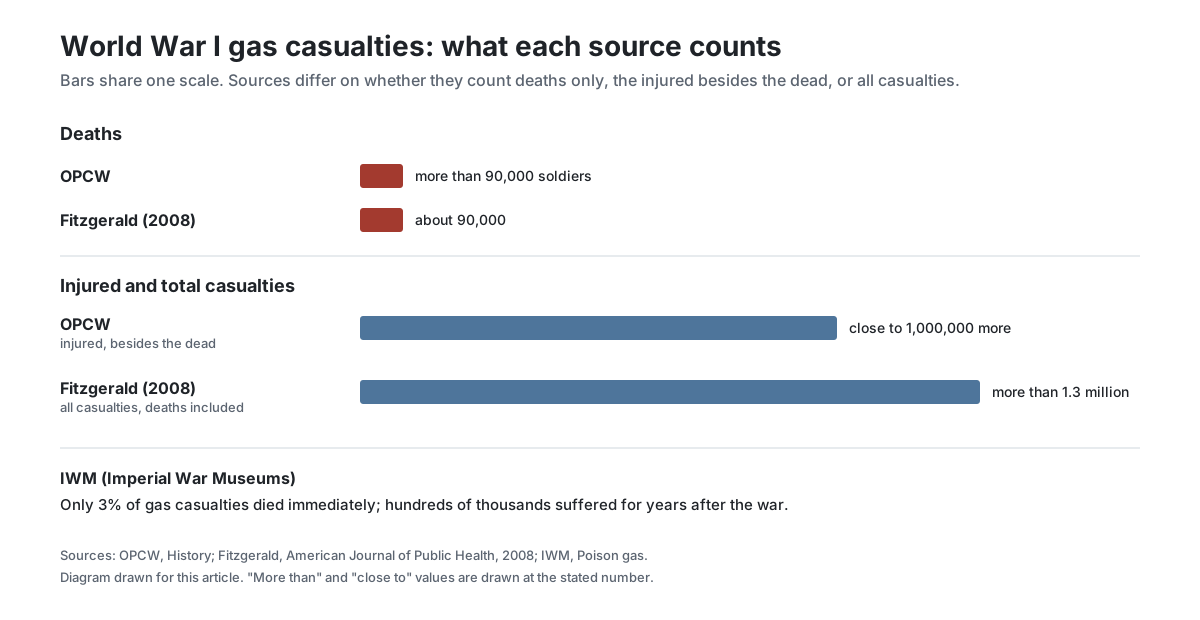
How many people did gas harm in World War I? Put the sources side by side and the numbers differ, and so does what each one counts.
| Source | Deaths | Injured or total casualties | Amount of gas |
|---|---|---|---|
| OPCW | More than 90,000 soldiers | Besides the dead, close to a million left the battlefields blind or injured | About 124,200 tonnes released |
| Fitzgerald (2008) | About 90,000 | More than 1.3 million casualties | More than 124,000 tons produced |
| IWM | Only 3% of gas casualties died immediately | Hundreds of thousands suffered for years after the war | (not given) |
The death figures, "more than 90,000" and "about 90,000," are close. For the injured, one source counts people wounded in addition to the dead, while the other counts all casualties, deaths included. For the amount of gas, one source gives what was released on the battlefield and the other gives what was produced.
There are national figures too. Fitzgerald reports that more than 80% of the roughly 186,000 British chemical casualties came from mustard gas alone, with a death rate of about 2.6%. Of more than 52,800 AEF battlefield deaths, about 1500 died of gas-related injuries.
Behind the numbers in the table are also the lives that came after. After the war, many soldiers and factory workers who had been exposed to gas struggled to work, held back by repeated illness and trouble breathing.
Why earlier promises did not stop it
Promises not to use poison in war are far older than World War I. Toxic substances had been used as weapons for thousands of years, but they always carried a stigma of cruelty and unfair play. The first international agreement was a 1675 ban on poison bullets agreed by France and Germany at Strasbourg.
The 1874 Brussels Convention banned poison, poisoned weapons and arms that cause unnecessary suffering, but it never entered into force. On July 29, 1899, The Hague produced a Declaration concerning Asphyxiating Gases. Its parties agreed not to use projectiles whose sole purpose was to spread asphyxiating or harmful gases. The second Hague Convention of 1907 restated the ban on poison and poisoned weapons.
Even so, toxic chemicals were used on an unprecedented scale in World War I. In Fitzgerald's view, suspicion and self-interest among allies and rivals generally limited how much these agreements could do. Despite the Hague promises, the warring states turned out more than 124,000 tons of gas before the fighting ended.
The 1925 Geneva Protocol: a ban on use only
New promises came after the war. Article 171 of the Treaty of Versailles, signed on June 28, 1919, dealt with gas. Because the use of asphyxiating and poisonous gases was prohibited, it strictly forbade their manufacture and import in Germany. Public horror at what chemical warfare had done pushed governments into postwar talks.
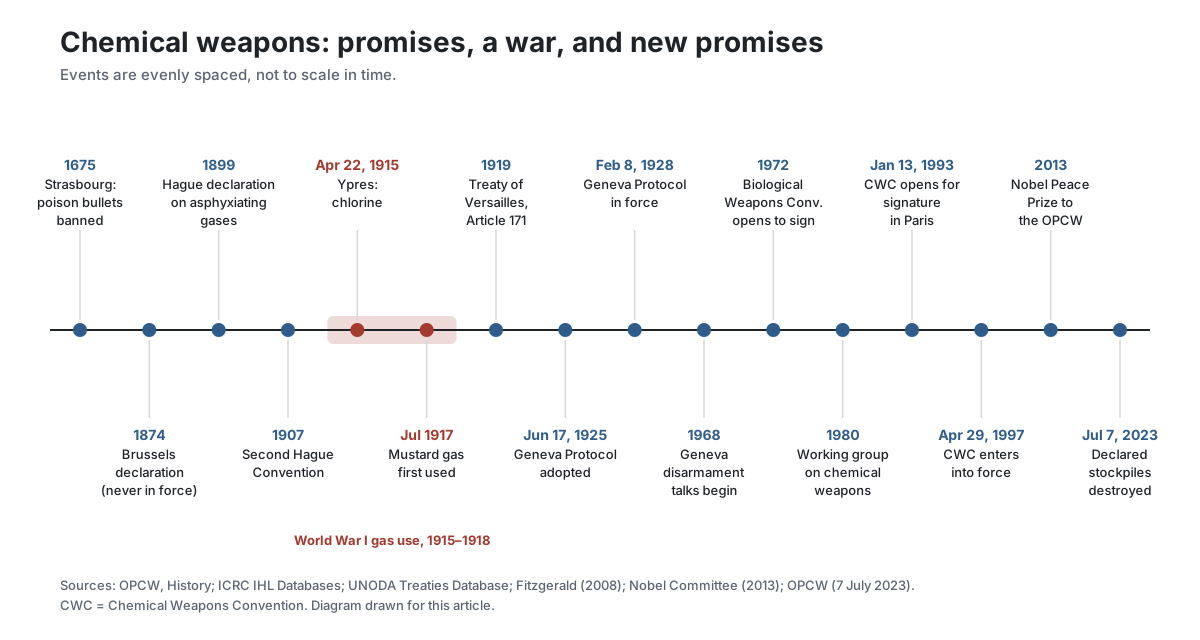
From May 4 to June 17, 1925, a League of Nations conference on the arms trade met in Geneva. A separate document from that conference was the Geneva Protocol. It states that the use of asphyxiating and poisonous gases in war had been condemned by world opinion, and it extended the ban to bacteriological methods of warfare.
The Protocol was adopted on June 17, 1925, and entered into force on February 8, 1928. The UNODA treaties database lists 38 signatories and 146 parties.
The Protocol had a large gap. It banned only use in war, not development, production or possession. Many countries signed with reservations that let them use chemical weapons against states outside the Protocol, or to hit back with the same weapons if attacked with them. Some states later withdrew these reservations and accepted a full ban on use.
The gap soon showed. A number of states used chemical weapons between the wars, and newly discovered nerve agents revived interest toward the end of the 1930s.
The major powers of World War II expected large-scale chemical warfare, but no chemical weapons were used on Europe's battlefields. Historians still argue about why. In the Cold War years, the United States and the Soviet Union each held stockpiles measured in tens of thousands of tonnes.
The Chemical Weapons Convention and the OPCW
Chemical weapons returned to the serious agenda only in 1968, when Geneva disarmament talks took up both biological and chemical arms. The Biological Weapons Convention, opened for signature in 1972, committed its parties to keep negotiating on chemical weapons. In 1980 the Conference on Disarmament set up a working group on chemical weapons. In the late 1980s, warmer superpower relations, the 1988 chemical attack on Halabja in Iraq, and wide publicity about chemical warfare threats during the Gulf War all added momentum.
In 1992 the Conference on Disarmament adopted a draft treaty. The Chemical Weapons Convention (CWC) was opened for signing in Paris on January 13, 1993, and 130 countries signed during the three-day conference. Hungary's ratification on October 31, 1996, was the 65th, which started a 180-day countdown. The Convention took effect on April 29, 1997.
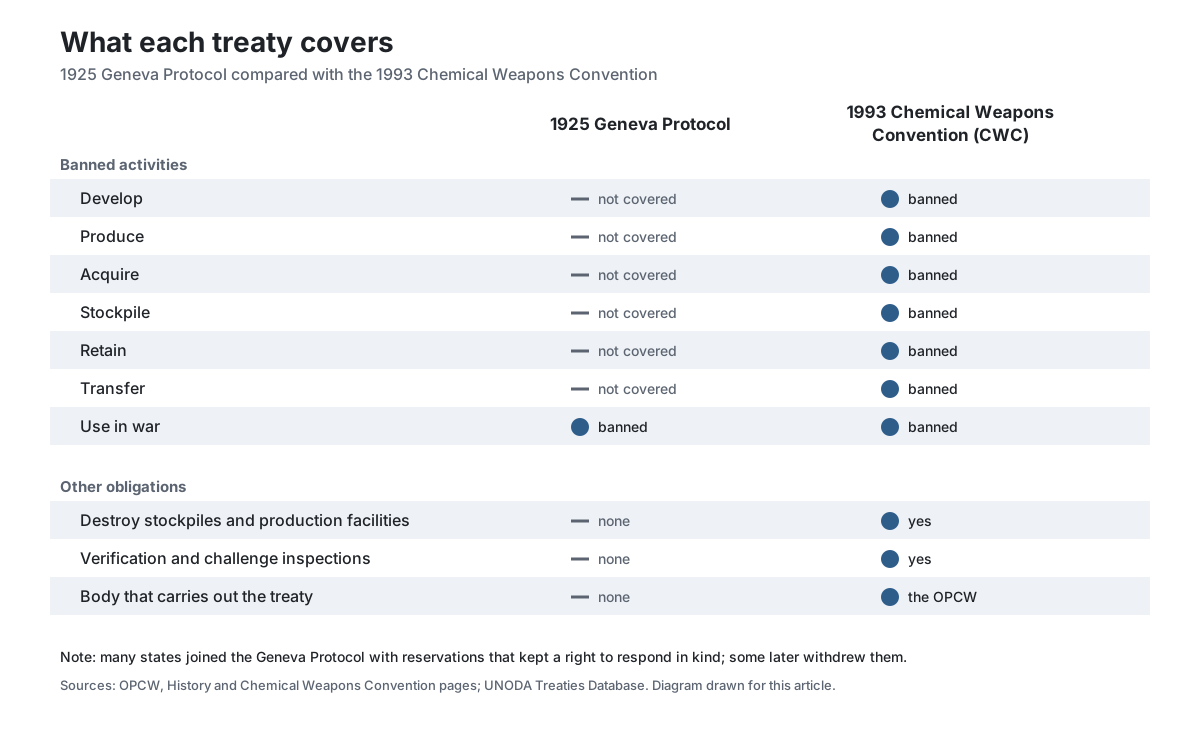
The difference between the two treaties shows in their lists of bans. The Geneva Protocol stopped at "do not use." The Chemical Weapons Convention bans the development, production, acquisition, stockpiling, retention, transfer and use of chemical weapons. Its parties agreed to destroy any stockpiles they hold, the facilities that produced them, and any chemical weapons they once abandoned on another party's territory.
The Convention also added ways to check compliance. Listed toxic chemicals and the substances used to make them are subject to checks, and a party that suspects another of breaking the rules can ask for an unannounced inspection. These "challenge inspections" follow an "any time, anywhere" rule, and the inspected state has no right to refuse.
The OPCW carries out this work. It has three main bodies: the Conference of the States Parties, the Executive Council and the Technical Secretariat. The first Conference of the States Parties met on May 6, 1997. In 2013 the Nobel Peace Prize went to the OPCW for its work to rid the world of chemical weapons.
On July 7, 2023, the OPCW confirmed that every stockpile declared by its States Parties had now been destroyed, down to the last weapon. That day, the last munition of the declared U.S. stockpile was destroyed at the Blue Grass plant in Kentucky. The total destroyed under OPCW verification since 1997 came to 72,304.34 tonnes of stockpiled chemical weapons. The organization has 193 member states.
The work is not over. In the same announcement, the OPCW Director-General said four countries remain outside the Convention. Old and abandoned weapons still have to be found and destroyed.
The Director-General added that recent uses and threats show that preventing their return remains a priority. The OPCW also explains that old and abandoned chemical weapons left from the two world wars are still a problem for many countries.
What to read next
- Trench Warfare: Why the Western Front Barely Moved for Four Years: the trench stalemate that set the stage for poison gas.
- The Battle of Verdun: Three Hundred Days of Attrition: a look at the best-known battle of attrition on the Western Front in 1916.
- Turning points in military technology: other cases where new weapons changed the face of war.
- Eye safety and international rules: the protocol on blinding laser weapons: a laser weapon banned by international rules before it reached the battlefield, for comparison.