On the afternoon of August 1, 1914, thousands of people gathered in front of the royal palace in Berlin. They had come to watch the deadline of a German ultimatum to Russia run out. Around 5 p.m., Germany announced mobilization, and a declaration of war on Russia followed soon after.
Five weeks earlier, on June 28, the heir to the Austro-Hungarian throne and his wife had been shot dead in Sarajevo, in Bosnia. How did a killing in one Balkan city become a war that drew in Germany, Russia, France and Britain? It took less than six weeks for the crisis to turn into war.
There is no one-line answer. Decisions made in July piled up on an old base of rival alliances, arms races and national conflicts in the Balkans, and mobilization orders squeezed the time left for diplomacy. Who carried the most blame is a question historians have argued over for more than a hundred years.
Europe before 1914: two alliances
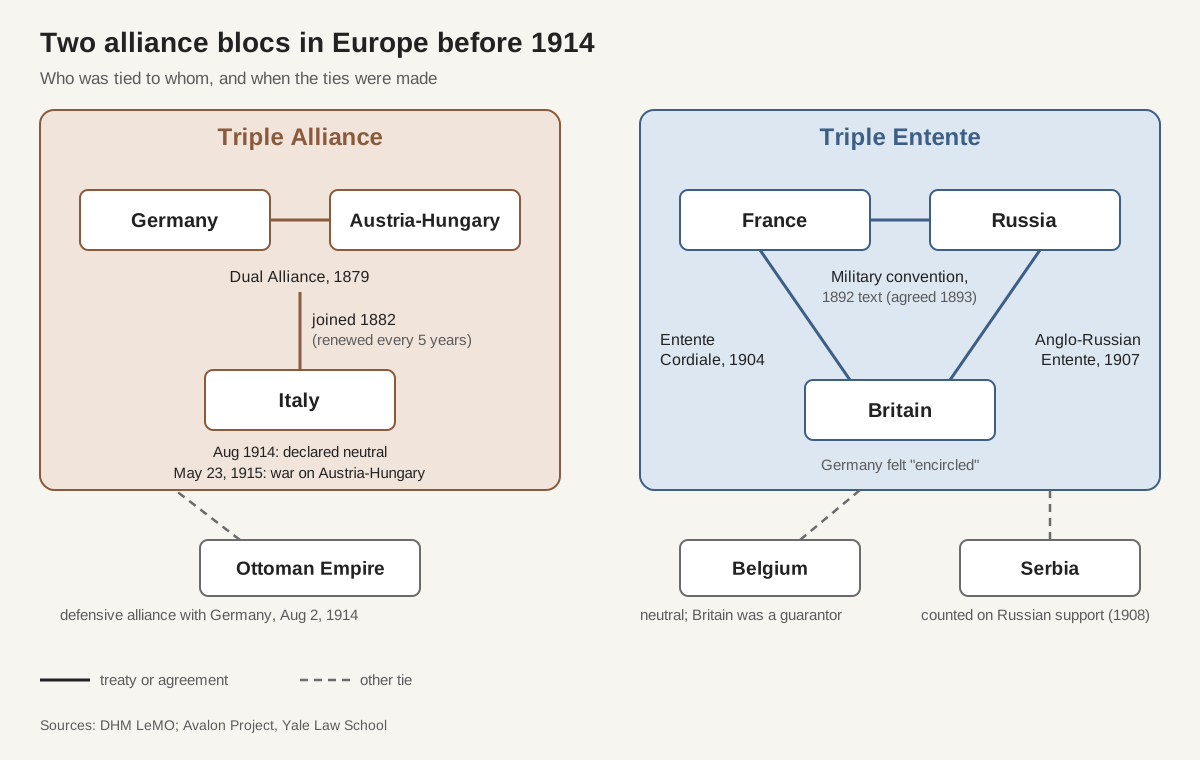
By annexing Alsace-Lorraine, Germany made France a lasting enemy. France wanted back the land it had lost in 1871. In October 1879 Germany signed the Dual Alliance with Austria-Hungary. If Russia attacked one of them, the other would help with its army; if another power attacked, the partner would stay benevolently neutral.
When Italy joined in 1882, the pact became the Triple Alliance. It ran for five years at a time and was renewed every five years up to 1914.
The opposing camp formed step by step. In 1890 Wilhelm II refused to extend Germany's Reinsurance Treaty with Russia, and Russia moved closer to France. The text of their military convention is dated August 18, 1892, while LeMO, the online museum of the German Historical Museum (Deutsches Historisches Museum, DHM), lists it as a convention agreed in 1893. It said that if Germany attacked one partner, the other would turn all its forces against Germany.
On April 8, 1904, Britain and France exchanged a declaration that settled questions about Egypt and Morocco. This deal is usually called the Entente Cordiale. In 1907 Britain and Russia signed an agreement that divided their spheres of interest in Persia. The three countries linked this way are known as the Triple Entente.
In Germany a feeling of being "encircled" by hostile powers spread, and Britain got most of the blame for it. Yet an alliance paper did not mean automatic entry into war. In August 1914 Italy refused to accept its Triple Alliance duty and declared itself neutral, and on May 23, 1915, it declared war on Austria-Hungary instead. Britain's two agreements with France and Russia were, even by their titles, about colonies and spheres of influence such as Egypt, Morocco and Persia.
Arms races and nationalism
In the early twentieth century, rivalry among the great powers and an intense arms race weighed on international relations. The sea was where it showed most. From the end of the nineteenth century, Britain and Germany competed openly over their fleets.
Germany's naval law of 1900 aimed to double its navy and to shift the ratio of German to British warships from 1:2 to 2:3. In 1906 the German parliament, the Reichstag, approved huge sums for building large battleships of the dreadnought class. Between 1909 and 1912 there were attempts to limit arms and ease relations, but they all failed because Germany refused to cut its fleet plans in any real way. The race raised tension between states and put a heavy load on national budgets.
Imperial rivalry added to it. Under Wilhelm II, Germany demanded "world standing" and its "place in the sun." In the Morocco crisis of spring 1911, Germany tried to force France into concessions over French moves in Morocco.
France, Britain and Russia saw Germany and its armaments as a growing and serious threat. Germany, for its part, felt surrounded by enemies and drew up plans for a war on two fronts.
In the Balkans, national questions were tangled up with borders. Austria-Hungary had occupied and run Bosnia and Herzegovina since 1878, and on October 5, 1908, it declared the provinces annexed. Serbia also claimed this land, where many Serbs lived. Serbia counted on Russian support, and Russia said it would not recognize the annexation.
On October 8, 1912, Montenegro declared war on the Ottoman Empire, and the other states of the Balkan League followed within ten days. On June 29, 1913, the Second Balkan War broke out among the former allies, and it ended with the Peace of Bucharest in August. Across the two wars, Serbia's territory grew by 81% and its population by 1.5 million.
Nationalism also showed in how people met the war. Because of the nationalism found in every country and skillful state propaganda, most people believed the enemy had forced the war on them. This is part of why young men answered mobilization orders posted on walls and in special newspaper editions so willingly.
The shots in Sarajevo
June 28, 1914, was a Sunday. Archduke Franz Ferdinand and his wife Sophie came to Sarajevo so that he could inspect maneuvers of the Austro-Hungarian army. Since the annexation had deepened the quarrel with Serbia, the heir's visit was also a political show of strength. Newspapers printed the schedule and protocol of the visit in advance.
The assassins were a group of young men who fought for uniting all South Slavs in one state under Serbian leadership. The first attempt failed. A bomb thrown at the motorcade only wounded several passersby and members of the archduke's party, among them his adjutant.
The couple carried on with the visit. Shortly after 11 a.m., Gavrilo Princip, a 19-year-old Bosnian Serb, stepped out of the crowd and fired a revolver at their open car. Both died soon after.
The police inquiry concluded that Serbian military intelligence had helped the plotters with weapons, money and information. On the same day, riots against Serbs broke out in Sarajevo. Politicians and military leaders in Austria-Hungary saw a chance to humble Serbia politically, a neighbor whose power had grown through the Balkan Wars.
From October 1914, Princip and 24 co-conspirators stood trial in an Austro-Hungarian court. The court convicted Princip of high treason and murder and sentenced him to 20 years; he died in April 1918 in prison at the fortress of Theresienstadt. Memory of him is still divided. Yugoslavia, founded after the war, honored him with monuments, and many Serbs still see him as a freedom fighter.
The July Crisis: from ultimatum to declarations of war
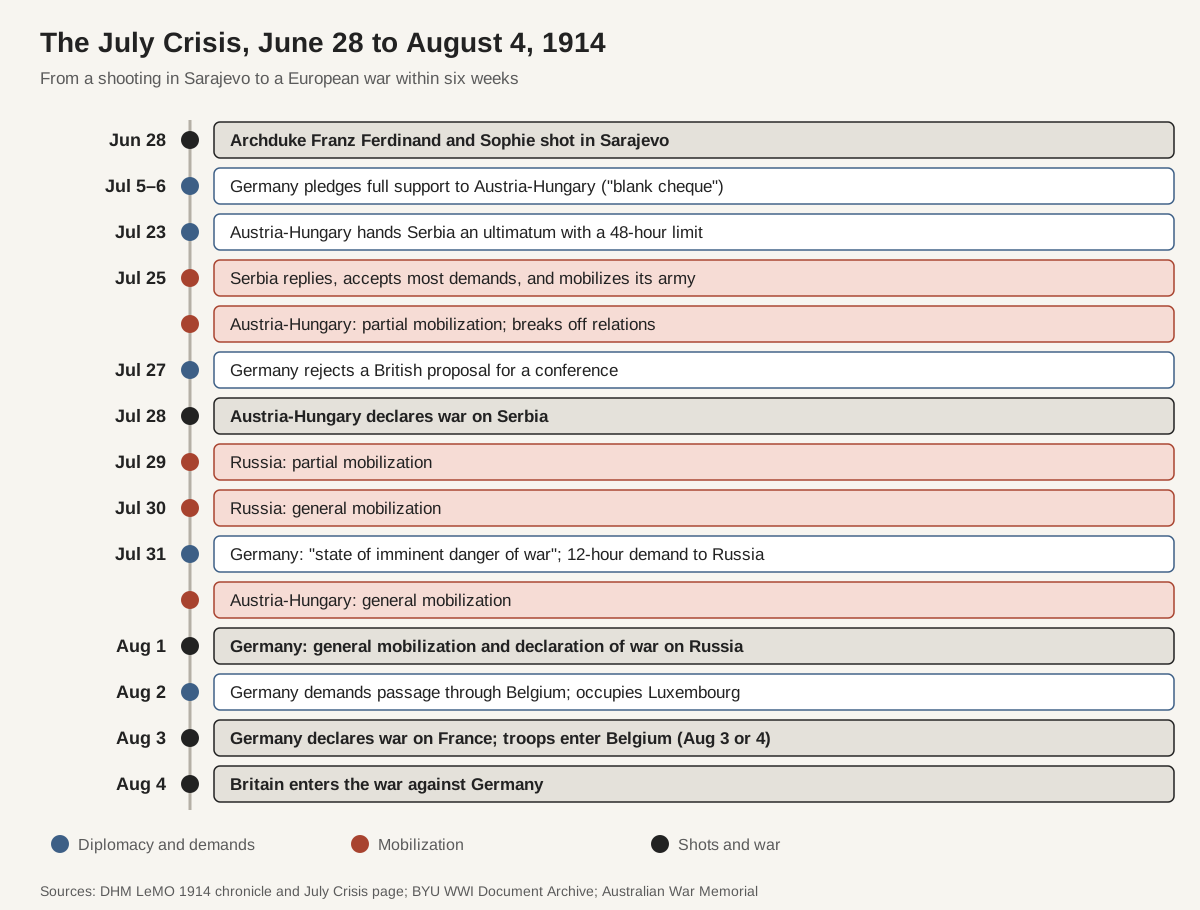
On July 5–6, Germany promised Austria-Hungary its unconditional loyalty as an ally. This promise is often called the "blank cheque." Chancellor Theobald von Bethmann Hollweg and Wilhelm II told the Austro-Hungarian envoy that Germany would stand by its partner in a war against Serbia.
The calculations of the German general staff and government reached beyond the Balkans. A war with Serbia would become a test for the whole alliance system. Would Russia come to Serbia's aid with its army, and would France and Britain, tied to Russia, step in as well? Diplomats in every capital knew how the alliances could turn a local quarrel into something much larger.
On the afternoon of Thursday, July 23, Austria-Hungary handed Serbia an ultimatum. The reply was due by 6 p.m. on Saturday, July 25. The ultimatum claimed that the plot had been hatched in Belgrade and that Serbian officers and officials belonging to a group called Narodna Odbrana had supplied the weapons.
There were ten demands. Point 5 required Serbia to let Austro-Hungarian bodies work inside Serbia to suppress the movement against the monarchy. Point 6 said Austro-Hungarian officials would take part in the proceedings against the conspirators. In LeMO's view, the ultimatum was drafted in close agreement with Germany, and its demands were made unacceptable on purpose.
Serbia replied on July 25. It would open the investigation named in point 6, but it could not accept Austro-Hungarian officials taking part, since that would break its constitution and its criminal procedure. Serbia accepted most of the ultimatum but mobilized its army the same day. Austria-Hungary answered with partial mobilization and broke off diplomatic relations.
On July 27 Germany turned down a British proposal to settle the dispute at a conference of foreign ministers. Austria-Hungary rejected further mediation by the other great powers and declared war on Serbia on July 28.
Mobilization and the railways
Mobilization means calling up the forces a country will use in war and sending them where they will fight. The Franco-Russian military convention of 1892 shows what this meant in practice. If any member of the Triple Alliance mobilized, France and Russia would mobilize all their forces at the first news, with no need to consult each other. They would then move those forces as close to their borders as possible.
The convention also set out numbers. Against Germany, France would use 1,300,000 men and Russia 700,000 or 800,000. They would engage so fast that Germany would have to fight in the east and the west at once. In effect, one side's mobilization was set up to trigger the other alliance's.
Railways carried armies to the frontier. In the Franco-Prussian War of 1870, the German armies deployed quickly in the west with the help of the railway.
Teaching material from the French Army Museum (Musée de l'Armée) explains that Prussia then completed its mobilization in seven days and the concentration of its troops in nineteen. At the same moment, French regular units still had not received their equipment and the reserves had not joined. France learned from the defeat: from 1872 it built a conscript army and planned mobilization and concentration in advance.
Forty-four years later, French mobilization ran to that plan. On the afternoon of August 1, 1914, alarm bells rang and the mobilization posters went up. Mobilization took 10,000 trains between August 1 and 15, and concentration used 5,000 "standard trains" that carried units together with their equipment. When concentration ended on August 18, 2.7 million French soldiers were ready to take the field.
Mobilization multiplied the size of the armies. According to the same museum material, the French regular army of 800,000 men grew to 3,580,000, and the German regular army grew from 880,000 to 3,750,000. Unlike France, Germany placed its reserve units in the first line of battle from the start.
For the two camps as a whole, LeMO counts about 3.5 million soldiers of the Central Powers facing more than 5.7 million of the Entente at the outbreak. The two sources count different things, so their figures cannot simply be added or compared.
Germany's war plan added more pressure. Alfred von Schlieffen was chief of the general staff from 1891 to 1905. His plan was to defeat France first, during the time Russia needed to mobilize, and then shift troops to the east.
His successor, Helmuth von Moltke, revised the plan. To carry it out, German troops had to march through neutral Belgium.
At the end of July, one mobilization followed another. Russia ordered partial mobilization on July 29 and general mobilization on July 30. On July 31 Germany proclaimed a "state of imminent danger of war" and gave Russia 12 hours to stop mobilizing, and Austria-Hungary ordered general mobilization the same day. When Russia did not stop, Germany announced general mobilization on August 1 and declared war on Russia.
France proclaimed general mobilization on the same day, August 1. The first day of mobilization printed on its posters was August 2.
Why the rush? No government knew what its rival would do next, and each wanted to be ready for anything so as not to fall behind by mobilizing too late. LeMO explains that in Germany in particular, what leaders saw as military necessity shaped political decisions. At the same time, no power wanted to look like the aggressor.
How the war spread
France signaled that it would honor its alliance with Russia. On August 2 Germany demanded in an ultimatum that Belgium let German troops pass, and it occupied Luxembourg. On August 3 Germany declared war on France.
On the morning of August 3, Belgium handed the German minister a note of refusal. It pointed out that the treaties of 1839 secured Belgium's independence and neutrality under the guarantee of the powers. Accepting the demand, it said, would sacrifice the nation's honour and betray its duty towards Europe.
LeMO's chronicle dates the German entry into Belgium to August 3. The World War I Document Archive at Brigham Young University Library dates it to the morning of August 4.
On the same day, August 3, the British foreign secretary Sir Edward Grey set out Britain's position in the House of Commons. France, he said, was drawn in by an obligation of honour under its alliance with Russia. That obligation did not apply to Britain in the same way, because Britain was not a party to the Franco-Russian alliance and did not even know its terms.
When mobilization was beginning, Grey had asked France and Germany whether they would respect Belgian neutrality. France said it would. The German foreign secretary said he could not answer before consulting the Emperor and the Chancellor. Grey told the House that the question of Belgian neutrality was becoming more serious every hour.
Britain was a guarantor of Belgian neutrality. Citing the attack on neutral Belgium, Britain entered the war on the side of France and Russia on August 4. According to the Australian War Memorial, Australia, then a British dominion, found itself at war the moment Britain declared war.
The war soon spread beyond Europe. The Ottoman Empire signed a defensive alliance with Germany on August 2 but did not join the fighting at once. Russia declared war on it on November 2, Britain on November 5 and France on November 6. In the Far East, Japan declared war on Germany on August 23 and in November took Germany's colony at Tsingtao.
Italy declared war on Austria-Hungary on May 23, 1915, and on Germany on August 28, 1916. In the United States, President Wilson asked Congress for war against Germany on April 2, 1917; the Senate agreed on April 4 and the House two days later. The United States declared war on Austria-Hungary on December 7 of that year. In all, 38 states are counted as taking part in the war.
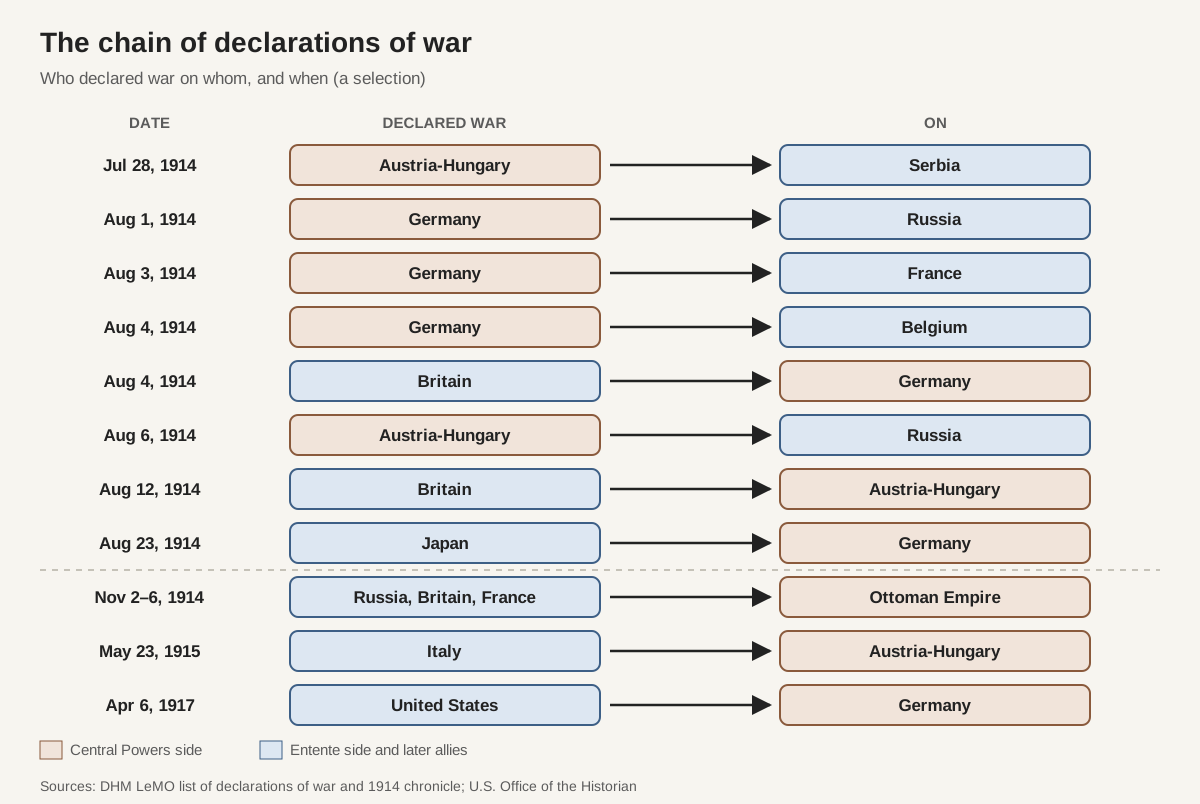
Dates can differ from one source to another. Even within the same museum, France's declaration of war on Austria-Hungary appears as August 11 in the 1914 chronicle and as August 13 in the list of declarations.
The fighting stopped with the armistice of November 11, 1918. How many people died depends on what is counted and how, and the figures differ widely between sources. Military deaths are given as somewhere between just over 8.5 million and about 9 million. The Holocaust Encyclopedia of the United States Holocaust Memorial Museum (USHMM) says more than 8.5 million, and LeMO says about 9 million.
Civilian figures vary even more. The USHMM notes that no official agencies kept careful accounts of civilian losses during the war, and cites scholars' estimates of as many as 13 million. LeMO's figure is more than 6 million.
Counting soldiers and civilians together, total deaths range from about 15 million to about 20 million. The lower figure is the sum of LeMO's two numbers. The higher one comes from a memorial panel of the German War Graves Commission, the Volksbund.
Huge numbers were also mobilized: Germany alone mobilized about 13.2 million men. Australia, with fewer than five million people, saw 416,809 men enlist. Over 60,000 of them died, and 156,000 were wounded, gassed or captured.
Whose fault? Differing interpretations
The victors' verdict went into the peace settlement of 1919. Article 231 of the Treaty of Versailles is written as a statement that the Allied governments affirm and Germany accepts. It holds Germany and its allies responsible for all the loss and damage of a war imposed on the Allies by their aggression. The huge Allied reparation claims rested on this assignment of blame.
Germany did not accept this verdict. The new Weimar government distanced itself from the victors' decision, and a fight broke out against what Germans called the "war guilt lie." By the early 1930s a new view had taken hold that blamed the failure of the alliance system rather than the ambitions of any one nation. Former British prime minister David Lloyd George wrote in his 1933 memoirs that Europe had "slithered over the brink into the boiling cauldron of war."
In the 1960s the question reopened in Germany. Fritz Fischer, a historian in Hamburg, placed the main responsibility for the outbreak in Berlin in his 1961 book Griff nach der Weltmacht (Grasping for World Power). The debate grew heated, and even the government and the Foreign Office joined in. Fischer never said Germany alone was guilty, only that it was mainly guilty.
Annika Mombauer, a historian at the Open University in Britain, summed up the course of research in an article of April 2014, written ahead of the centenary.
In her account, the dispute had settled down by the 1980s. Most historians did not agree that Germany had planned the war long in advance. Yet it was hardly disputed that Germany bore the larger share of responsibility for the start of the war. After that, the decisions of Austria-Hungary came under closer, critical study too.
By the early twenty-first century, most agreed that the war had not been inevitable. The choices of the other great powers were examined again. The American historian Sean McMeekin argues that Russia was interested in gaining the Turkish Straits and Constantinople. Russia is also criticized for an early decision on partial mobilization that made a peaceful settlement impossible.
Christopher Clark's The Sleepwalkers appeared in Britain in 2012, and when the German translation came out in autumn 2013, it set off a big debate in Germany. Clark holds that searching for a single guilty party is neither necessary nor useful, and he called the outbreak of war "a tragedy, not a crime." The historian Gerd Krumeich replied that, in his conviction, Germany bore the greatest responsibility.
In that 2014 article, Mombauer saw the brief consensus as gone, with historians once again in opposite positions, much as in the 1960s. Mombauer herself has written a book that offers a different reading from Clark's. As of 2014, when the article appeared, neither side's conclusion had become the agreed view of the field.
What to read next
- Military logistics: performance must be sustainable: why moving and feeding troops and supplies is the base of any war.
- Turning points in military technology: the big changes in weapons technology in the twentieth century.
- A history of laser weapons: from chemical to electric lasers: how laser weapons, the core subject of this site, developed.