On July 4, 1863, at ten in the morning, white flags went up again over the earthen forts of Vicksburg, Mississippi. After 47 days under siege, the Confederate defenders marched out of their lines and stacked their arms. Five days later Port Hudson, farther down the river, surrendered too, and the Union controlled the river along its whole length.
Why fight for almost two years over one river? The story starts with the big idea of the war's first year, the "Anaconda Plan." It then follows the 1862 fighting down the river, the 1863 campaign and siege at Vicksburg, and the river technology of steamboats and ironclad gunboats. The sources are public records from the National Park Service (NPS) and the U.S. Army Center of Military History (CMH).
Why the Mississippi mattered
The Mississippi and its branches gather water from more than a million square miles across the United States and Canada. Some twenty thousand miles of these waters were deep enough for boats. During the Civil War no feature of the continent mattered more to its economy than this river, and when the southern states seceded, Confederate forces closed it to navigation. Northern trade faced being strangled.
For Midwestern farmers the river was the outlet for their corn and hogs. One of Lincoln's worst fears, an Army booklet notes, was that those states might make a deal with the Confederacy just to keep using it. Illinois alone sent more than 36,000 troops to the campaign for Vicksburg.
Leaders on both sides left memorable words. Confederate President Jefferson Davis called Vicksburg the "nailhead that holds the South's two halves together." Lincoln called Vicksburg "the key."
The shape of the land mattered as well. Most of the ground along the river is swamp and low floodplain. Along the floodplain's eastern edge, though, a line of bluffs runs from Kentucky into Louisiana, and only from these heights could cannon easily sweep the water below. So the war for the Mississippi became largely a struggle for the few spots where river and bluff meet.
The Anaconda Plan: a name born as a jibe
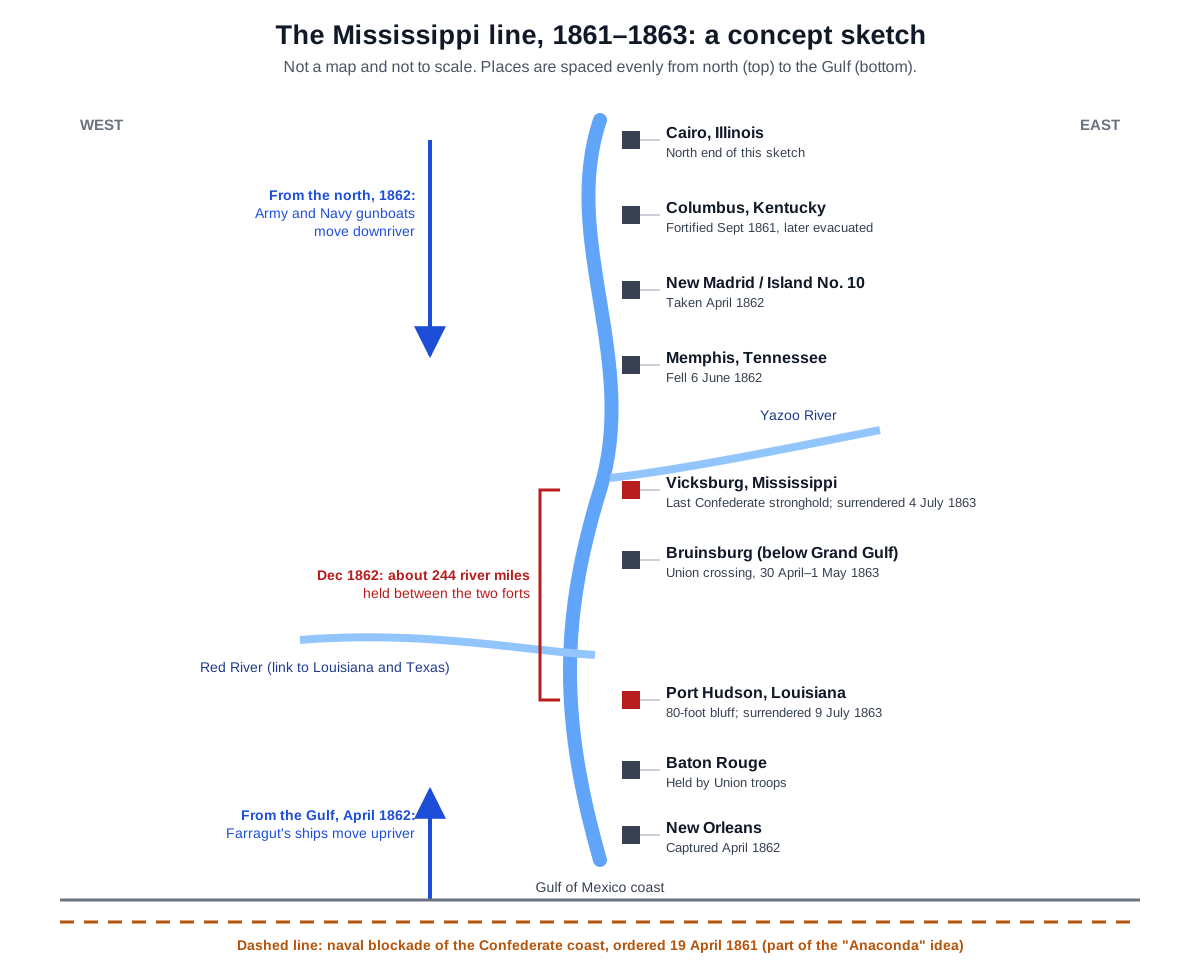
When the war began, the Union army was led by its 74-year-old general in chief, Winfield Scott. Scott opposed a full invasion of the South, and his military option aimed to keep bloodshed and violence low. He proposed a blockade of the Southern coast and the Mississippi River. Sixty thousand soldiers would then move down the river in what he called "a powerful movement" to divide the South.
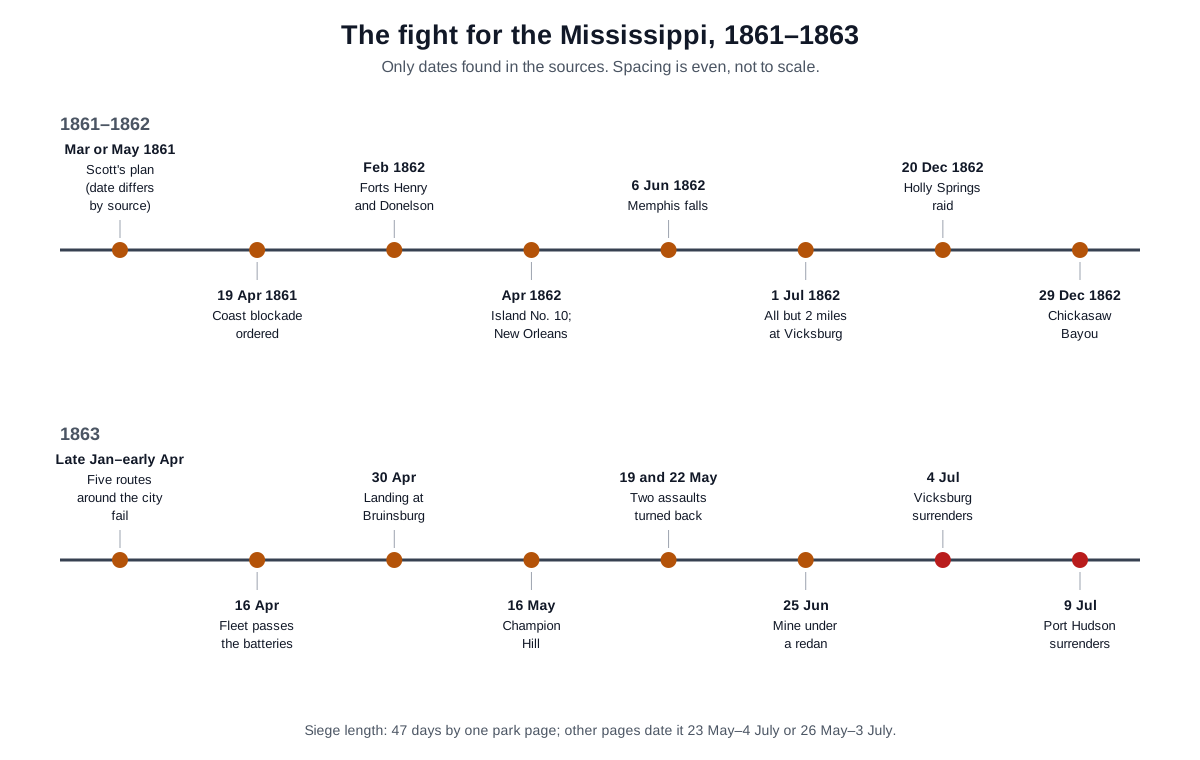
The date of the proposal differs by source. The Army's booklet on 1861 dates it to March 1861, when Scott gave the president a memo listing four possible courses the day before Lincoln's inauguration speech. The booklet on the 1862 western theater says Scott drafted the plan in May 1861.
Lincoln accepted parts of the proposal and ordered a blockade of the Confederate coast on April 19, 1861. The Northern press mocked the idea as "Scott's Anaconda Plan," a squeeze that would be far too slow. The name pictured a giant snake coiling around its prey. Many voices also called for a direct strike at Richmond to end the war in one battle.
In practice nothing could coil that fast. The blockade was enforced only now and then at first, and the North needed years to build a large enough navy. Lincoln saw merit in the plan, but he also knew the Army would need to fight much harder and more actively than Scott pictured.
1862: fighting down the river
The river war opened in September 1861, when Confederate troops seized the bluffs at Columbus, Kentucky, and built a fort there. In February 1862, Ulysses S. Grant's soldiers and Andrew Foote's Navy gunboats took Forts Henry and Donelson, on the Tennessee and the Cumberland. Foote's gunboats then steamed up both rivers, getting around Columbus and forcing the Confederates out.
In April the Confederates lost their forts at New Madrid and on Island Number 10. That same month David Farragut led his ships into the mouth of the river, got past Forts Jackson and St. Philip, and took New Orleans, the Confederacy's biggest city. On June 6, after a last naval defense, Memphis fell as well.
Those two fights ended most Confederate naval strength on the western rivers. Lost were every one of fourteen rams, twenty of the twenty-five gunboats made from merchant ships, and six of seven ironclads that were finished or still being built. From then on it had to rely almost entirely on shore batteries.
In the summer of 1862, Vicksburg remained the Confederacy's last stronghold on the Mississippi, and on May 18 it turned down Farragut's demand to surrender. By July 1, Union forces held all of the river except about two miles in front of the city's batteries. An effort to cut a canal through the neck of land across from the town failed, however. With the water falling and the Confederate ironclad Arkansas on the scene, Farragut withdrew to deeper water downstream.
The fortress on the bluffs
Starting in September 1862, Confederate soldiers, along with slaves taken from nearby farms and plantations, dug defenses on the land side of Vicksburg. Nine large forts joined by rifle pits made a line nine miles long that ran from the river above town to the river below it. The river batteries grew to thirteen, mounting thirty-seven large-caliber cannon. That autumn, only Richmond was more heavily fortified among Confederate cities.
Port Hudson sat some 244 river miles farther down, atop a bluff eighty feet high on the eastern bank. The river current made the two forts different. Union boats passing Vicksburg rode the current downstream at nearly double speed. At Port Hudson they had to plod upstream against it, which kept them under fire much longer.
By December 1862, the two forts gave the Confederacy control of 244 miles of the river. The Red River flowed in along this stretch from the west, linking Louisiana and Texas with the rest of the South. Lieutenant General John C. Pemberton's department, which covered the area, eventually held 43,000 troops in five divisions.
A winter of failed routes
On November 26, 1862, Grant led 45,000 troops south into northern Mississippi along the railroad. On December 20, Confederate cavalry under Earl Van Dorn captured his main supply base at Holly Springs, and Grant had to break off and withdraw. William T. Sherman's force went by river instead and, on December 29, failed in an attack on the bluffs at Chickasaw Bayou north of Vicksburg.
By about January 20, 1863, the back swamps were full, and the river then flooded its banks for nearly three months. With little dry ground for camps, disease spread and deaths rose. From late January to early April, Grant tried five routes around Vicksburg, and none of them worked. They were canals across from the city and at Duckport, a route from Lake Providence toward the Red River, the Yazoo Pass, and Steele's Bayou.
Spring 1863: across the river and inland
Grant turned from boats to marching. On March 29, the Army of the Tennessee left Milliken's Bend and moved south down the Louisiana bank to Hard Times. The soldiers built bridges and laid log roads over the mud as they went.
To cross, Grant needed boats below the city. On the night of April 16, part of Rear Admiral David Dixon Porter's fleet slipped past the Vicksburg batteries with engines muffled and lights out. Confederates set fire to cotton bales and tar barrels on the shore to light up the river, and every vessel was hit many times. Out of a force of seven ironclads, a ram, three transports and a tug, only one transport and one coal barge were lost, and twelve men were wounded.
On April 29, hours of bombardment failed to silence the Confederate batteries at Grand Gulf. Grant shifted the crossing downstream to Bruinsburg and put his army over the river on April 30 to May 1. Some 17,000 soldiers had landed by late in the afternoon of April 30. The park's account ranks this as the biggest landing from the water in U.S. military history before the Normandy invasion of World War II.
The fighting then moved inland. After Port Gibson on May 1, Grant pushed east to strike the railroad, then turned west after Raymond (May 12) and Jackson (May 14).
May 16 brought Champion Hill, the campaign's most decisive fight in the park's account. From a force of 32,000, Grant had 410 dead, 1,844 wounded, 187 missing. Pemberton, with 23,000, had 381 dead, 1,018 wounded, 2,441 missing, and lost 27 cannon as well. On May 17, while Confederates held the crossings at the Big Black River bridge, Pemberton's army fell back to Vicksburg.
Forty-seven days of siege, then surrender
Grant first tried two direct assaults. On May 19, Sherman's corps attacked and was thrown back with the loss of 1,000 men. On May 22, after a four-hour bombardment, three corps advanced along a three-mile front, and their flags were planted at several points on the outer slopes of the forts. They were driven back again, losing more than 3,000 men.
Grant concluded that force alone would not take Vicksburg, so he laid siege to it. From May 26, Union troops dug thirteen approach trenches toward different points of the Confederate line, while reinforcements lifted Grant's numbers from 56,000 to roughly 90,000. On June 25 they exploded a mine beneath the Third Louisiana Redan on the Jackson Road and rushed into the crater. After 26 hours of fighting they were pushed back.
Life inside the lines kept getting worse. Rations were cut again and again, and malnutrition and disease wore down the garrison. Many residents moved into "caves" dug into the hillsides to escape the shelling. The shelling killed or wounded only a few civilians, yet the records describe a heavy psychological toll.
On June 7, Confederates trying to lift the siege struck the Union supply depot at Milliken's Bend on the west bank. Recently recruited and poorly trained United States Colored Troops were among its 1,061 defenders. The attackers got over the defenses, but fire from the ironclad Choctaw drove them back again and again, and the Union side suffered 652 casualties. Together with other battles in the South, this fight began to shift opinions about employing African American soldiers.
Joseph Johnston assembled more than 30,000 men to relieve the city, but he only set out toward Vicksburg on July 1. When it neared the Big Black River on July 3, it was too late. That afternoon Pemberton and Grant met between the lines, and that night Grant offered parole for the garrison instead of unconditional surrender. At ten the next morning, July 4, the Confederates marched out and stacked their arms.
Downriver, Nathaniel Banks had surrounded Port Hudson with 30,000 men. The 7,500 defenders under Franklin Gardner turned back his assaults on May 27 and June 14. The May 27 attack included the 1st and 3rd Louisiana Native Guards, regiments of African American troops. On July 9, once word of Vicksburg's fall arrived, the garrison surrendered, and Lincoln wrote that "The Father of Waters again goes unvexed to the sea."
River technology: steamboats, ironclads and torpedoes
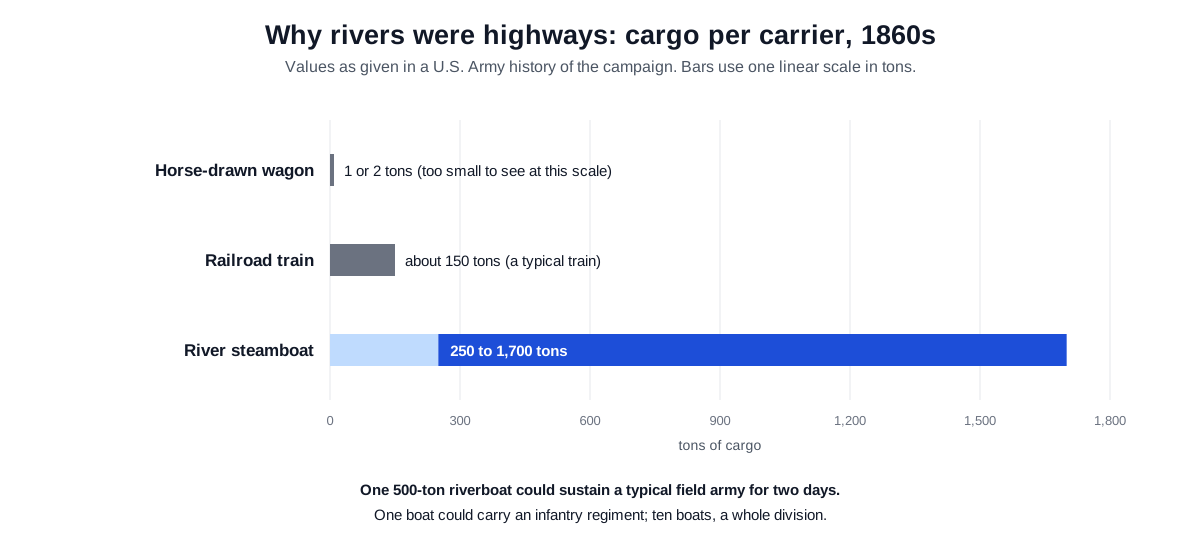
Armies usually see rivers as obstacles to cross. In the western theater, the rivers worked as highways for soldiers, supplies and guns. In a region of poor roads and few railroads, river steamboats carried the army's logistics.
The numbers make the gap plain. A river steamboat carried 250–1,700 tons, a train of the day might haul 150 tons, and a wagon pulled by horses only 1–2 tons. A single 500-ton boat held enough to keep an ordinary field army going for two days. One boat could carry an infantry regiment, and ten boats a whole division.
The boats carried firepower too. The Navy gunboats working with Grant usually carried about 200 heavy cannon between them, while the army fought large parts of the campaign with 180 lighter field guns. The Union river fleet included seven shallow-draft City Class ironclad gunboats, each named after a river town on the Ohio or the upper Mississippi.
One of them, USS Cairo, was commissioned in January 1862. On December 12 that year, on the Yazoo River north of Vicksburg, it was clearing Confederate batteries and "torpedoes" when two explosions struck it. The park's account explains these torpedoes as underwater mines. The ship sank into 36 feet of water within twelve minutes, with no loss of life.
Numbers that differ by source
The same fight can produce different numbers depending on what is counted and from when. The table below puts the figures used in this article side by side. The summaries of the Civil War Sites Advisory Commission (CWSAC) give "estimated casualties" without explaining the method.
| What | Figure | Record |
|---|---|---|
| Vicksburg (March–July 1863), estimated casualties | 37,532 (Union 4,835; Confederate 32,697) | CWSAC summary (MS011) |
| Whole 18-month campaign, casualties | over 48,000 | NPS, Vicksburg park |
| Confederates who signed parole papers | 30,000 | Army booklet (75-8) |
| Port Hudson, estimated casualties | 17,500 (Union 10,000; Confederate 7,500) | CWSAC summary (LA010) |
| Port Hudson, forces | Union 30,000; Confederate garrison 7,500 | Army booklet (75-8) |
| Length of the siege | 47 days / May 23–July 4 / May 26–July 3 | different NPS Vicksburg park pages |
| Date of Scott's proposal | March 1861 / May 1861 | Army booklets (75-2 / 75-7) |
In the Port Hudson rows, the Confederate casualty estimate and the Confederate garrison are both 7,500. In the Vicksburg row, the 32,697 Confederate figure is close in size to the 30,000 paroled. The summaries give no method, so they alone do not show whether surrendered men were counted as casualties. That is why each number should be read together with its source.
What it left, and how it is judged
With the surrender, a whole Confederate field army left the war; some of the 30,000 men on parole later came back to fight, but many deserted. Across the campaign and the surrender, the South also gave up 60,000 small arms and 260 cannon. After this, campaigns on the two sides of the Mississippi were cut off from one another. Union gunboats on the rivers also became an "internal blockade" that choked off trade inside the South.
The NPS surrender page states that the fall of Vicksburg, together with Robert E. Lee's defeat at Gettysburg on July 1–3, was the war's turning point. Yet Vicksburg was also overshadowed. An Army booklet observes that it never won the place in American memory held by the great eastern battles, partly because Gettysburg peaked just one day earlier.
Views of the Anaconda Plan differ by agency. The NPS page on Scott Circle says that although Scott retired early, the strategy in his Anaconda Plan ultimately led to Union victory. The Army's Atlantic coast booklet also judges Scott's broad strategy highly effective in the end. As evidence it points to cotton: from 1862 to 1865, the South exported only 5% as much as before the war.
The booklet on the 1862 western theater takes a different view. It says Scott promised a war with little bloodshed while ignoring that the North needed years to build a large enough navy.
A national military park was established at Vicksburg in 1899, and the national cemetery beside it is the resting place of 17,000 Civil War soldiers. Control of both passed from the War Department to the NPS in 1933. USS Cairo, raised from the bed of the Yazoo River in three sections in 1964, returned to the park in 1977 and was partly rebuilt there.
What to read next
- The American Civil War at a Glance: 1861 to 1865: where Vicksburg sits in the whole war.
- The Battle of Gettysburg: Three Days at a Turning Point: the eastern battle fought in the same week.
- Monitor and Virginia: The First Duel Between Ironclads: the ironclad story at sea.
- Railroads and the Telegraph: What Made the Civil War Industrial: the other network that moved armies alongside the river steamboats.
- Military logistics: performance must be sustainable: how supply shapes fighting, carried forward to modern forces.
- Turning points in military technology: other moments when new technology changed warfare.
- A history of laser weapons: from chemical to electric lasers: one branch of the new weapon technology that came long after steam and iron.