It is hurricane season in the Caribbean. Below the surface, a winged cylinder sinks slowly, then rises again. It has no propeller, no engine and no one inside. Now and then it pokes up at the surface and sends ocean data by satellite.
Just as drones fly without pilots, some machines travel under water with no one aboard. They are unmanned underwater vehicles (UUVs). This article looks at how UUVs are sorted, what they do for ocean science and for navies, and how they have developed since the 1960s, using public sources. The field changes quickly, so this article reflects the situation as of October 2026.
How these vehicles talk under water, how they find their position without GPS, and how they deal with power are covered in a separate article on UUVs. Here the focus is on types, uses and history.
Four branches of undersea machines
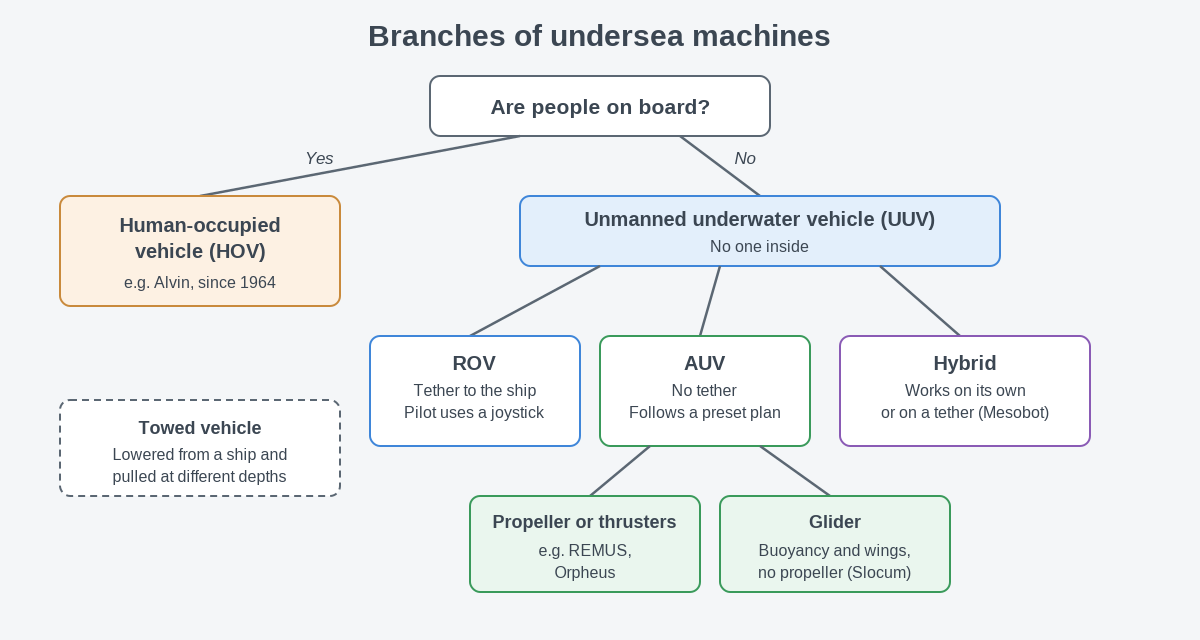
Recent missions supported by NOAA Ocean Exploration have used three kinds of submersibles: human-occupied vehicles (HOVs), remotely operated vehicles (ROVs) and autonomous underwater vehicles (AUVs). Only the HOV carries people. It carries a few scientists and pilots down to the bottom, but only for a limited stretch of time. Alvin, operated by the Woods Hole Oceanographic Institution (WHOI), has done this work since 1964.
The first unmanned branch is the ROV. A bundle of cables called a tether links the ROV to the ship and carries electrical signals both ways. A person on the ship steers it with a joystick, much like playing a video game.
The second branch, the AUV, has no tether. It follows a preset program and can drift, dive or glide without real-time control by a human. NOAA compares AUVs to the Curiosity rover that NASA sent to Mars.
The third branch mixes the two. WHOI's Mesobot is a hybrid robot that can work on its own or on a tether. It was built to quietly follow animals in the dim twilight zone for more than 24 hours. Apart from these, some vehicles hang from a research ship and are pulled along behind it at several depths.
Gliders that slide on wings
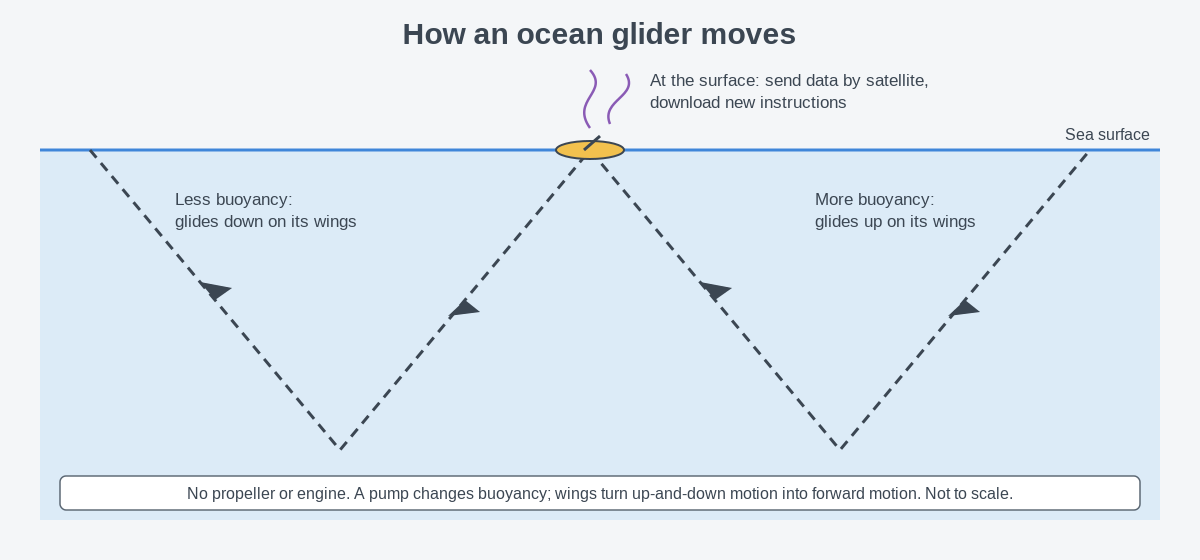
Among AUVs, the ocean glider stands out for the way it moves. It looks like a torpedo, but it has no propeller and no engine. Instead, a pump inside slowly changes its buoyancy. The glider drifts up and down, and its large side wings create lift that pushes it forward.
The idea resembles a glider in the air. The real difference is that an ocean glider rises just as easily as it sinks, and it moves forward both ways. Its path through the water therefore looks like a saw blade. WHOI describes the Slocum glider as moving both sideways and up and down in a sawtooth profile driven by changing buoyancy.
Because it uses very little energy, a glider travels farther than other AUVs. NOAA's Atlantic Oceanographic and Meteorological Laboratory (AOML) notes that a glider can cover thousands of kilometers in weeks or months while taking several kinds of ocean measurements. They can carry many kinds of sensors for temperature, salinity, currents and other conditions.
Before launch, operators load the waypoints the glider will follow. After that it surfaces at set intervals, sends its data by satellite and downloads new instructions. When the mission ends, it reports its position from the surface, and people go out to pick it up.
Gliders can go a long way. In 2009 a glider named Scarlet Knight made it across the Atlantic, starting in New Jersey and ending in Spain. The Slocum name honors Joshua Slocum, who became the first person to sail around the world on his own.
Size: from a laptop to a subway car
UUVs come in a wide range of sizes. ROVs run from the size of a small computer to the size of a small truck. Large ROVs are heavy enough to need a winch to go over the side.
AUVs range from a few hundred pounds to several thousand pounds. They can also be smaller and lighter than ROVs, so smaller and cheaper ships can carry them.
REMUS is an example at the small end. WHOI's Oceanographic Systems Lab designed it as a low-cost AUV that runs from a simple laptop, first meant for coastal monitoring. The REMUS 100 is a small, lightweight model for coastal waters up to 100 m deep. The shallow-water REMUS can go in from a small boat, a dock or even a beach.
At the large end is the U.S. Navy's Extra-Large Unmanned Undersea Vehicle (XLUUV). The Navy defines an XLUUV as a UUV more than 84 inches in diameter, and the Congressional Research Service (CRS) describes it as about as big as a subway car. Size also ties to use.
Smaller UUVs launch from crewed ships and submarines to extend their reach. Large ones are more likely to leave straight from a pier for missions that crewed ships or submarines might otherwise take.
Measuring the sea and mapping the floor
AUVs carry equipment such as cameras, sonar and depth sensors. Scientists use them to map the seafloor, record environmental information, and find navigation hazards and shipwrecks. They also use them to find what people have left behind and to study geology.
AUVs suit this work for clear reasons. They reach water too shallow for boats, and they go deeper than divers or many vehicles on a tether can manage. They cost less than research ships, yet they can repeat the same survey of an area exactly.
A working REMUS behaves like a lawnmower. It goes back and forth over an area, sampling the water as it goes. Deeper down, WHOI's Sentry dives to 6,000 m and maps the seafloor's depth, the layers beneath it and its magnetism. Sentry can work alone or alongside Alvin or an ROV to make deep-sea studies more efficient.
These vehicles also inspect structures away from the open sea. In 2004 WHOI built a Tunnel Inspection Vehicle (TIV) to check 45 miles of the Delaware Aqueduct for leaks. Another REMUS 100, fitted with cameras and called SharkCam, finds and follows tagged marine animals.
Gliders help with weather forecasts too. According to AOML, measuring the ocean under a hurricane improves forecasts of hurricane intensity. Underwater gliders have supported this work since 2014, and in the 2026 hurricane season AOML is joining 5 glider missions across the Caribbean Sea and the tropical Atlantic.
Navy uses: finding mines and large vehicles
Among navy uses, finding mines has the clearest public record. In 2003, during Operation Iraqi Freedom, the U.S. Navy searched for mines with REMUS vehicles in Um Qasr, a harbor on the Persian Gulf. Navy officers quoted by WHOI said one REMUS could take on as much work as 12–16 divers. The wider job of finding and clearing mines is covered in the article on naval mines.
Today AUVs are also used for military surveillance. Besides its large unmanned vehicles, the U.S. Navy wants to develop and buy smaller UUVs that launch from crewed ships and submarines. For the largest type, the XLUUV, the first five vehicles were funded in FY2019 from Navy research and development funds. The schedule, battery and software problems the program ran into are covered in the UUV article mentioned earlier.
From the 1960s to today
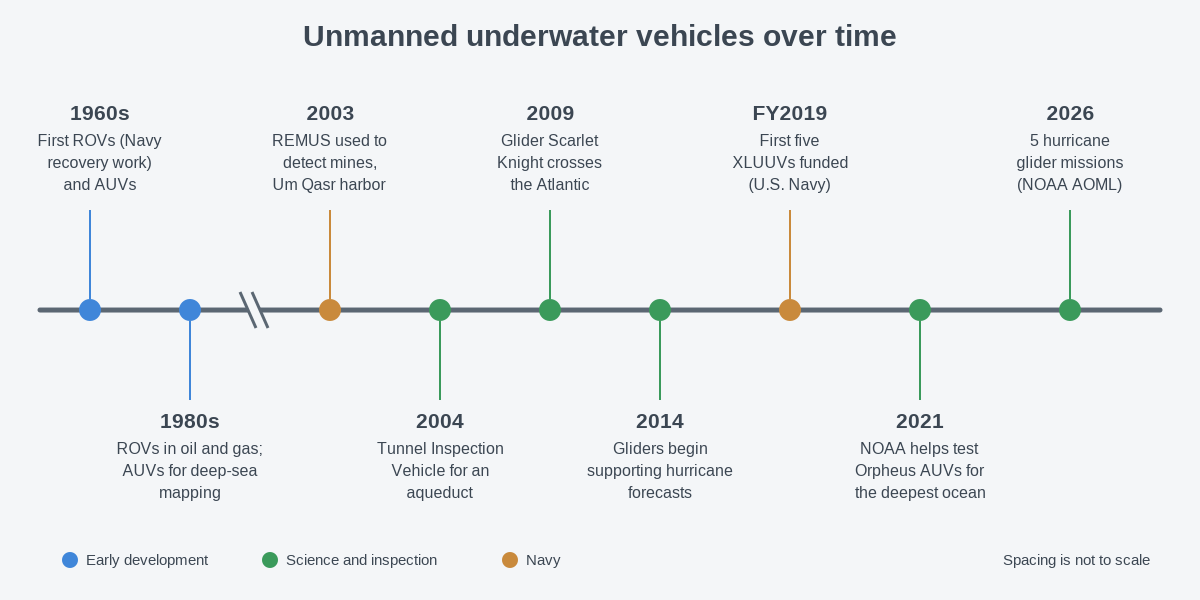
Underwater robots are older than many people think. NOAA Ocean Exploration's ROV page says ROVs were first developed in the 1960s, when the U.S. Navy put them to work on national defense and on recovering equipment under water. By the 1980s, companies were using them for oil and gas work, and today they are grouped into science-class and working-class vehicles.
Accounts of where ROVs began differ a little. Another NOAA page says ROVs were first developed for industrial work, such as inspecting underwater pipelines and testing offshore platforms, and are now used for many purposes, including science.
AUVs have also been part of ocean exploration since they were developed in the 1960s. By the 1980s, some AUVs were being built mainly for mapping the deep sea. The 2000s brought the mine search at Um Qasr in 2003 and the aqueduct inspection in 2004, and in 2009 a glider crossed the Atlantic.
Since the 2010s the uses have spread further. Gliders began supporting hurricane observations in 2014, and the U.S. Navy funded its first five XLUUVs in FY2019. In 2021 NOAA Ocean Exploration took part in tests of Orpheus AUVs, which are built to reach some of the deepest places in the sea.
People are still part of the job
The word "autonomous" does not mean people drop out. Before a dive, researchers plan the AUV's route and mission, and afterward they recover the vehicle and download its data. When a REMUS 6000 completes its dive plan, it stays put under water until it is called up and recovered aboard the ship that launched it.
Autonomy also comes in degrees. CRS notes that unmanned vehicles can run under remote control, semi-autonomously, or, as technology advances, autonomously. It is less an on-off switch than a range of how much people step in.
Keeping people out of the water is a major benefit in itself. In most cases, NOAA says, ROV work is simpler and safer than work with a crewed submersible or with divers. The operators stay safe and dry on deck. A UUV is less a machine that removes people than a tool that sends their eyes and hands to places they cannot reach or cannot stay for long.
What to read next
- Unmanned underwater vehicles: robots beneath the sea: underwater communication, navigation without GPS and the power problem.
- Sonar: why sound is used to see underwater: the sound-based principle UUVs use to map the seafloor.
- Naval Mines and Mine Countermeasures: the bigger picture of mine countermeasures that UUVs support.
- Unmanned Surface Vessels: Drones on the Water: the types and uses of uncrewed craft on the surface.