On February 15, 1989, the Soviet commander Boris Gromov crossed the Termez Bridge and left Afghanistan. A Soviet military presence that began in late December 1979, almost ten years earlier, ended that day. Estimates of the lives those ten years cost range, by source, from tens of thousands to millions. Millions of people were also driven from their homes.
Why did the Soviet Union send an army into a mountainous neighbor, and why did it stay so long? The thread begins with a coup in Kabul six years before the troops arrived. Public US and UN records and declassified documents let us follow it from there.
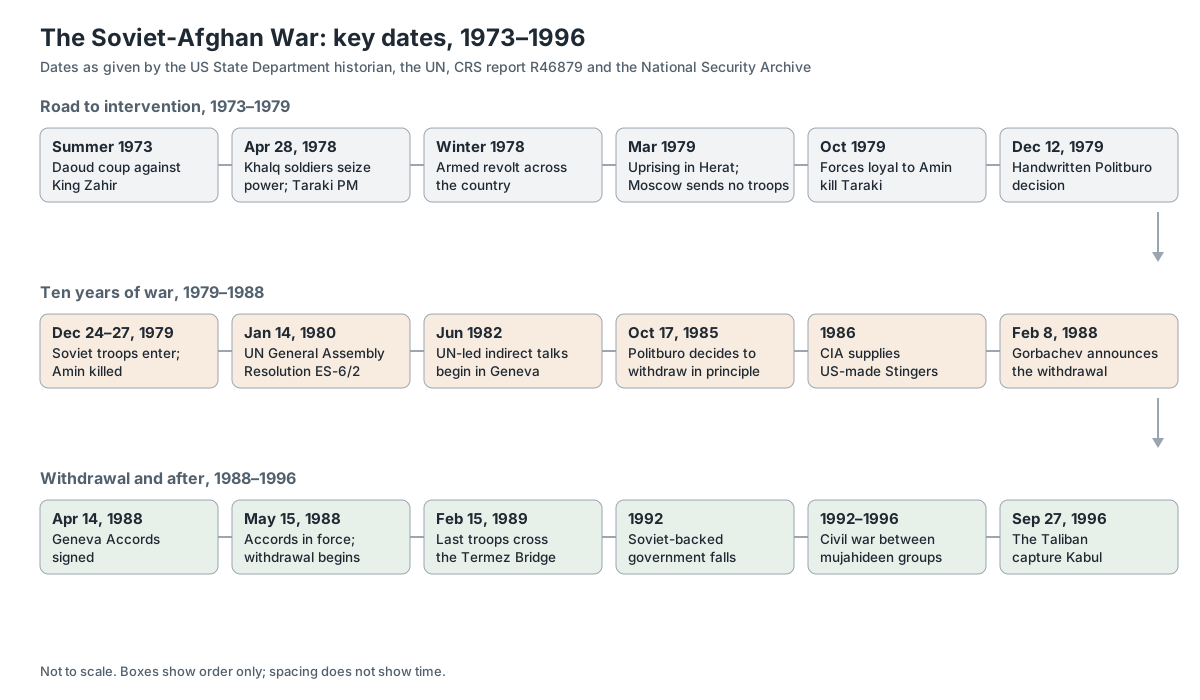
Before the troops: six years of coups and revolt
Soviet military ties with Afghanistan went back long before 1979. From 1955, Moscow supplied Afghanistan with military training and materiel. By 1973, a third of the country's active troops had trained on Soviet soil.
In the summer of 1973, former prime minister Mohammed Daoud led a coup against King Zahir. The coup depended on pro-Soviet military and political factions. Daoud was also backed by the People's Democratic Party of Afghanistan (PDPA), a party set up in 1965 on Marxist ideas and loyalty to Moscow. In 1967 the party had split into two factions: the Parcham faction led by Babrak Karmal and the Khalq faction led by Noor Taraki.
On April 28, 1978, soldiers aligned with the Khalq faction attacked the presidential palace and executed Daoud and his family. Within days Taraki became prime minister. The new government set out to carry its communist revolution into the rural tribal regions outside the capital. By the winter of 1978, armed revolt against that program had spread across the country.
Taraki and Hafizullah Amin, a longtime ally who became deputy prime minister after the revolution, traveled to Moscow and signed a friendship treaty. One clause allowed direct Soviet military help if the Islamic insurgency threatened the regime.
December 1979: a reluctant decision
In March 1979, a violent uprising broke out in Herat, and several Soviet military advisers were executed. That year alone, the Afghan leadership asked for military help more than 20 times. Yet the Politburo meeting called in March concluded that Moscow would send equipment and advisers, but no Soviet troops.
Declassified Politburo discussions show leaders who were very reluctant to send an army. Through the spring and summer of 1979, what they sent was military equipment, not soldiers.
A power struggle in Kabul changed the picture. In October 1979, forces loyal to Amin executed Taraki. Moscow was furious and began gathering combat units along its border. By that winter, mutinies and shaky leadership had left the Afghan army unable to provide even basic security for the government.
The decision to go in was made in secret by a few Politburo members, and the others approved it afterward. The military openly and strongly objected. Chief of the General Staff Marshal Ogarkov and his deputy, Akhromeev, argued that a limited force could not meet its objectives. The only documentary evidence of the decision is a handwritten Politburo paper dated December 12, 1979.
The State Department historian dates the start of the invasion to Christmas Eve, while UN records say Soviet forces entered on December 27. Soviet troops killed Amin and put the Parcham leader, Babrak Karmal, at the head of the government. According to UN records, the Soviet deployment eventually passed 100,000 troops.
The world reacts: the UN General Assembly and Washington
This was the only time the Soviet Union sent troops into a country outside the Eastern Bloc, and it drew condemnation from nearly every part of the world. In January 1980, the UN Security Council debated the issue but produced no resolution. To get around that deadlock, the matter went to an emergency special session of the General Assembly under the "Uniting for Peace" procedure.
On January 14, 1980, the General Assembly adopted Resolution ES-6/2. It strongly deplored the recent armed intervention. It demanded that foreign troops leave at once, without conditions and in full. It also voiced deep concern over the large outflow of refugees.
The US response ran along several lines. President Carter sent Brezhnev a sharply worded letter and, in his State of the Union address, announced the Carter Doctrine to protect Middle Eastern oil supplies. Economic sanctions, trade embargoes, a call to boycott the 1980 Moscow Olympics and more aid to the rebels followed. Washington had already begun non-lethal aid to the mujahideen in mid-1979, after Moscow sent combat troops to Bagram Air Base.
Even the name of the event is debated. The scale and speed of the military moves made it an "invasion." Still, the State Department historian argues that "intervention" fits better, since it capped Soviet influence that had been growing since 1973.
Views on the motive also differed. Some claimed it was part of a grand design on Persian Gulf oil fields and warm-water ports. Others saw an effort to shield a newly installed socialist government on the Soviet Union's southern border.
A longer war: from guarding cities to combat
The first mission was to guard cities and key installations. It soon grew into combat and kept growing. Reservists made up most of the troops sent in at first, and they were pulled into full-scale fighting against the rebels. Soviet troops had no anti-guerrilla training at all.
The mountains were another problem. When Soviet forces arrived, the rebels withdrew into the mountains, then returned to their villages once the troops went back to their garrisons. Troops often had to repeat operations in one area again and again. Early military reports kept stressing how hard it was to fight on mountain terrain the army had never trained for.
Soviet leaders did not foresee how much influence Islam had in Afghan society. Few experts on Islam worked in the Soviet government or universities. The Soviet military leadership saw very early that the conflict had no military solution. Pulling out came up for discussion as early as 1980, yet nothing concrete was done.
The weight of the fighting fell hardest on ordinary people. The formal mission was to protect civilians from the anti-government forces. According to the National Security Archive's commentary, however, Soviet soldiers often ended up fighting the civilians they meant to protect, which at times led to the indiscriminate killing of villagers. Inside the Soviet Union, the dissident and human rights campaigner Andrei Sakharov spoke out in public against the atrocities of Soviet troops in Afghanistan.
Militarily, too, the stalemate was plain. A 1982 analysis by the US Defense Intelligence Agency (DIA) judged that the Soviets would have to double their strength to break the stalemate. In May 1985, the CIA estimated that Soviet and allied losses were greater than those of the rebels.
Weapons and aid: what reached the resistance
US aid did not go in directly. CIA covert action worked through Pakistani intelligence to reach Afghan rebel groups, and it began after December 1979. Weapons and aid passed through Pakistan on their way to the rebels, and most of that aid came from the United States. So the Soviets sought some kind of compromise with these two countries to secure the Afghan borders.
In total, Congress provided nearly $3 billion in covert aid to the mujahideen. By 1987, military aid alone came to nearly $700 million a year, more than Pakistan itself was receiving from Washington.
Anti-aircraft weapons came in stages. In 1984, Congress added another $50 million for Afghan covert aid, and the CIA bought Swiss-designed Oerlikon anti-aircraft weapons. The purchase was aimed at the Soviet Mi-24 helicopter. How a helicopter lifts and moves is covered in Helicopter rotors and coaxial rotors.
In 1985 the CIA added Blowpipe anti-aircraft missiles made in Britain. In 1986 it supplied US-made Stinger missiles. Never before had the CIA handed over American-made weapons in a covert operation backing an insurgency.
Withdrawal: from the 1985 decision to the 1989 bridge
Gorbachev, who took power in 1985, called the war "the bleeding wound" and made ending it a top priority from the start. On October 17, 1985, the Politburo decided in principle to withdraw. Yet an actual timetable did not appear until the fall of 1987.
In a 2006 book, Gorbachev himself named at least two reasons for the delay. One was fear that withdrawal would look like a humiliating retreat. The other was the wish to leave behind a stable and friendly Afghanistan.
On the diplomatic side, the UN had long served as a go-between. Beginning in June 1982 and for the next six years, Diego Cordovez, the UN Secretary-General's personal representative, mediated indirect talks between the governments of Afghanistan and Pakistan. The talks sped up as Moscow grew more eager to pull out, and on February 8, 1988, Gorbachev announced the withdrawal publicly.
On April 14, 1988, four countries signed the accords in Geneva. The settlement had four parts. The first was an Afghanistan-Pakistan agreement on non-interference, and the second was a declaration of international guarantees signed by Moscow and Washington. The third covered the voluntary return of refugees, and the fourth set the timetable for the Soviet withdrawal.
Outside the accords, the United States held to an unwritten principle that it could aid the rebels as long as Moscow aided Kabul, and called it "positive symmetry."
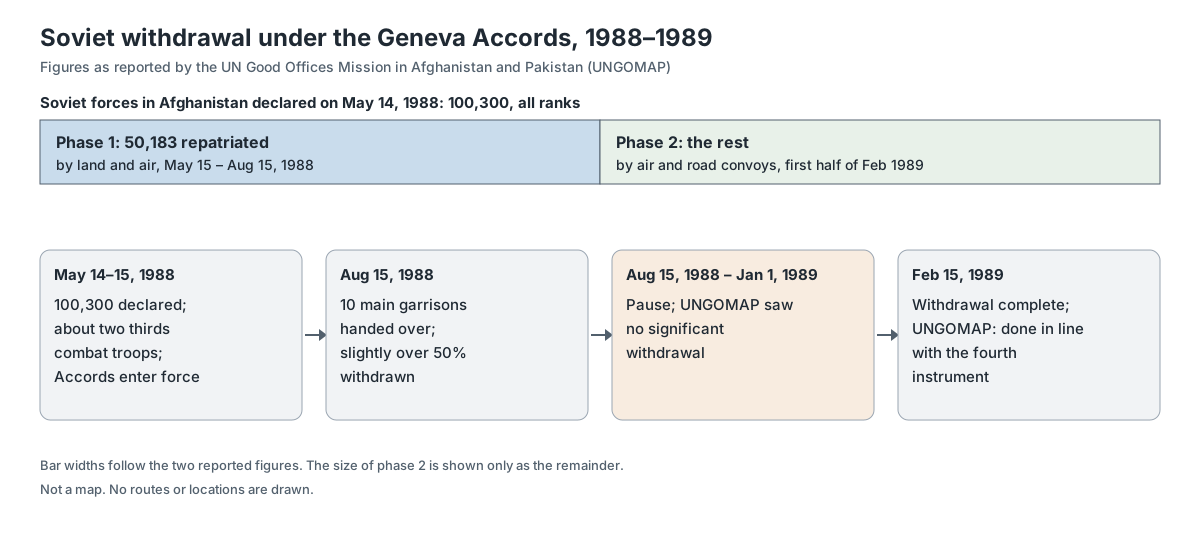
The accords took effect on May 15, 1988. The UN Good Offices Mission in Afghanistan and Pakistan (UNGOMAP), made up of 50 military officers from ten countries, monitored the withdrawal. On May 14, Soviet representatives declared a total of 100,300 personnel of every rank, roughly two thirds of them in combat units. Soviet forces were present in 17 of Afghanistan's 30 provinces and still held 18 main garrisons.
The first phase took three months. By August 15, ten main garrisons had been handed to the Afghan armed forces and 50,183 troops had gone home by land and air, slightly over 50% of the force.
UNGOMAP then observed no significant withdrawal until January 1, 1989. The final withdrawal came over a few days in the first half of February 1989, by air and road convoys. UNGOMAP concluded that it had been completed in line with the fourth instrument of the accords.
What ten years left behind
The human toll differs from source to source. The State Department historian put the cost of the decade at millions of lives and billions of dollars. Steve Galster wrote an essay as the introduction to a 1990 National Security Archive document collection. It says that between 1973 and 1990 one million Afghans died and a third of the population went into exile, and puts Soviet losses at 15,000–20,000 lives.
Refugee numbers also vary. Galster's essay counts 3 million Afghan refugees in Pakistan alone. UNGOMAP records estimate that up to 5 million refugees were living in Pakistan and Iran.
Galster counts this displacement among the most tragic results of the war. He traces the destruction and chaos that drove people out largely to heavy Soviet and Afghan government aerial bombing. Fighting went on after the withdrawal, and the number of refugees who went home stayed limited.
The withdrawal did not end the war. US attention faded, and the US embassy in Kabul was evacuated in January 1989. The CIA ended its aid in 1992.
That same year, the Soviet-backed government fell. Najibullah, who had led the Afghan government since 1986, was removed from power within three years of the Soviet exit and later killed. Four years of civil war among mujahideen groups followed, and the Taliban, formed in 1993–1994, captured Kabul on September 27, 1996.
The war also left marks inside the Soviet Union. The National Security Archive's commentary calls it one of the key factors in the loss of legitimacy of Communist Party rule. It also notes that society pushed Afghan veterans to the margins. The same commentary adds that most observers agree the war created or worsened the internal pressures that ended in the breakup of the country itself.
What to read next
- The War in Afghanistan, 2001–2021: Twenty Years in Outline: how the Taliban, who rose after the Soviet exit, became the opponent in the 2001 war.
- The Cold War Arms Race: From Bombers to Missiles to Satellites: a wider look at the superpower rivalry around this war.
- Helicopter rotors and coaxial rotors: how the helicopters often named in this war fly.