Read enough news about fighter jets and the phrase "sixth generation" keeps coming up. Coming after the fifth, it clearly means something newer. But what does an aircraft need to have to earn the label, and where is that written down?
Look through public sources and you find program announcements and candidate lists before you find any rulebook. The governments of the United States, the United Kingdom, Italy, Japan and France have named programs and target years. The Congressional Research Service (CRS) has listed technologies that "may" be included. This article uses only those sources to trace what the label actually points to.
Who decides what a "generation" is
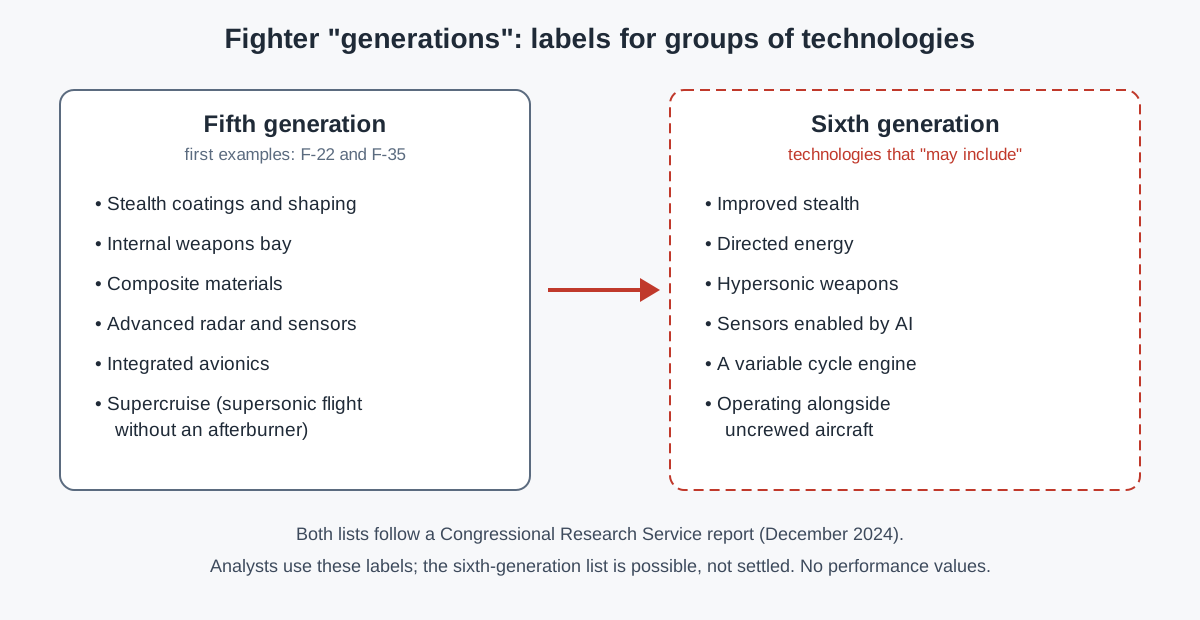
A CRS report on the F-35 from December 2024 says analysts generally treat fifth-generation fighters as a design step beyond fourth-generation or 4.5-generation fighters. The generation, in other words, is presented as a common way analysts group aircraft, not as a grade in a law or a standards document.
The fifth-generation package is fairly concrete. On the list are stealth from coatings and airframe shape, weapons carried in an internal weapons bay, composite structures, more capable radar and sensors, linked avionics, and supercruise. Supercruise means flying faster than sound without lighting the afterburner. The U.S. Air Force F-22 and the F-35 are regarded as the first fifth-generation aircraft.
Generations work a bit like "medieval" and "modern" in a history book. People look at a bundle of features that piled up and draw a period line, so the border is never ruler-straight. Fighters differ in one way: a government can launch a program and call it "sixth generation" from day one. The UK government's GCAP announcements are an example.
The technologies public sources list
Six technologies make the sixth-generation candidate list. They are better stealth, directed energy, hypersonic weapons, AI-driven sensors, an engine with a variable cycle, and teaming with uncrewed aircraft. The original text puts "may include" in front of the list. It is a list of candidates, not a finished specification.
The Air Force budget request describes the key NGAD attributes in a different way. It names better survivability, lethality and persistence, interoperability across many kinds of military operations, and crewed/uncrewed teaming. That list says what the aircraft must be able to do rather than which parts go into it.
On the engine side, a program called Next Generation Adaptive Propulsion (NGAP) is public. Under it, GE is building a prototype variable-cycle engine called the XA102, while Pratt & Whitney works on the design of another prototype, the XA103. Public sources give no values for either engine.
British descriptions use similar words. The UK government says the GCAP aircraft will draw on advanced autonomy and AI, uncrewed systems and new sensors. It is also being designed to work with capabilities such as the F-35. Three of those ideas, AI, sensors and working with uncrewed aircraft, overlap with the U.S. list.
Not one aircraft but a family of systems
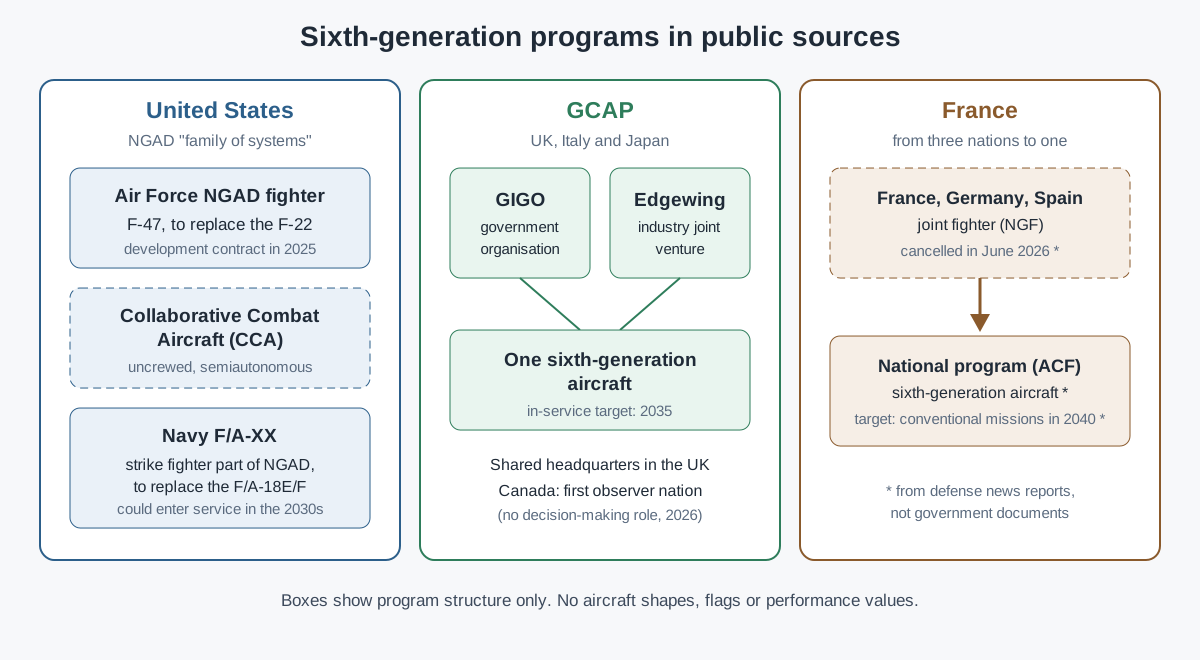
The U.S. programs and GCAP share one habit. They do not talk about a single fighter type on its own, and they bring uncrewed systems into the picture. The U.S. Air Force calls NGAD a "family of systems." That family holds the NGAD fighter program, which is to replace the F-22, and the collaborative combat aircraft (CCA) program.
CCAs are semiautonomous drones meant to fly as "loyal wingmen" beside the NGAD fighter or other fighters. The U.S. Navy uses the same frame. In testimony to Congress in April 2024, the Navy described the F/A-XX as the strike fighter part of the NGAD family. It added that the aircraft is designed for crewed and uncrewed teaming from the start.
Pairing crewed aircraft and drones as one team is called manned-unmanned teaming (MUM-T). The Air Force CCA effort and the Australian example are covered in more detail in Manned-unmanned teaming: when a pilot's wingman is a drone. The idea of tying many systems together so they act as one also connects to How weapon systems work together: a system of systems.
The United States: F-47 and F/A-XX
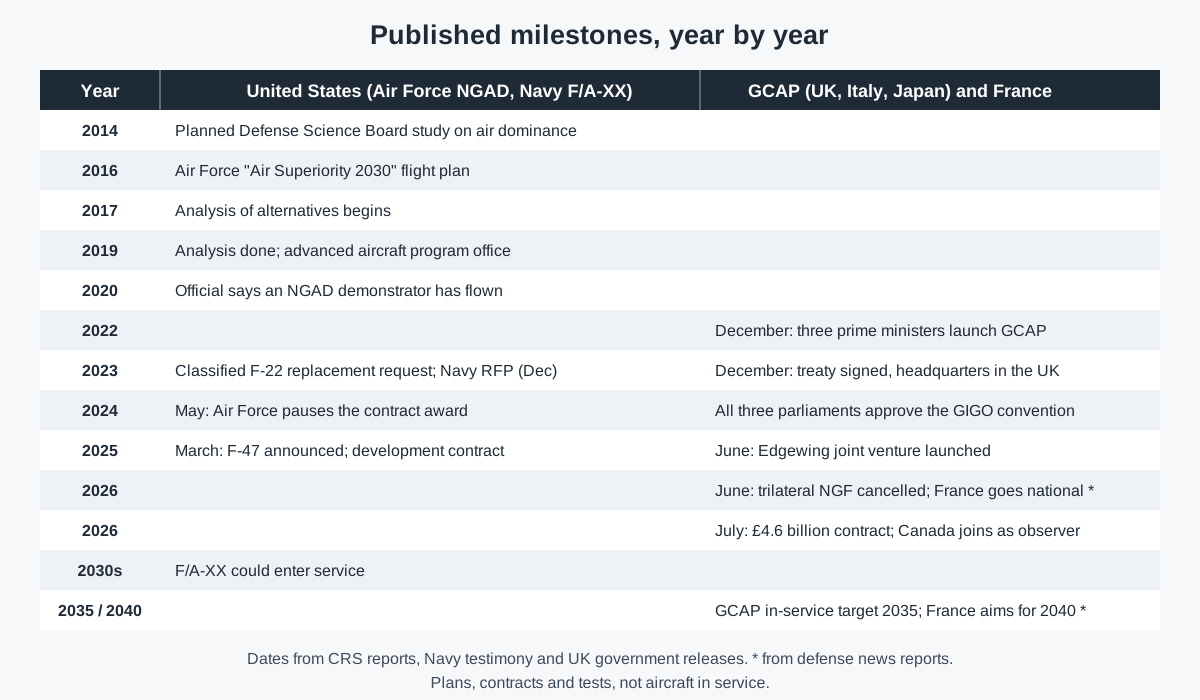
The road to NGAD is more than ten years long, starting with a Defense Science Board (DSB) study planned in 2014. The Air Force "Air Superiority 2030" flight plan followed in 2016, and an analysis of alternatives to set requirements began in 2017. In 2019 the Air Force finished that analysis and set up a program office for advanced aircraft. A year later, the Air Force's acquisition chief at the time said an NGAD demonstrator had already flown.
Boeing, Lockheed Martin and Northrop Grumman all seemed to have built demonstrators by 2023. Around then the Air Force issued a request for proposals for an F-22 replacement, and the request was classified. In May 2024 the Air Force held back the contract award so the next administration could decide.
The decision came on March 21, 2025. The President announced that the Air Force would develop the F-47 as its NGAD fighter, and the Air Force gave Boeing an engineering and manufacturing development contract. From FY2022 to FY2025, Congress provided $8.2 billion in total for NGAD fighter technologies, and the Air Force asked for $2.58 billion for FY2026.
The Navy's F/A-XX is meant to take over from the F/A-18E/F. In December 2023 the Navy sent a request for proposals for the follow-on development contract to Boeing, Northrop Grumman and Lockheed Martin. A CRS primer from November 2024 lists it as a sixth-generation fighter that might enter service during the 2030s. The Navy, as the Air Force does, intends to pair it with uncrewed CCAs.
GCAP in the UK, Italy and Japan, and France
GCAP, the Global Combat Air Programme, grew out of a December 2022 joint announcement from the British, Italian and Japanese prime ministers. The aim is to field a new combat aircraft by 2035. In December 2023 the three countries signed an international treaty and agreed to base the program headquarters in the UK.
After that the work moved along two tracks, government and industry. By November 2024, all three parliaments had approved the convention setting up the GCAP International Government Organisation (GIGO). On the industry side, BAE Systems, Leonardo and Japan Aircraft Industrial Enhancement launched the joint venture Edgewing in June 2025. GIGO and Edgewing now share a new headquarters in Reading, England.
In July 2026 the three countries signed a £4.6 billion contract with Edgewing for the next design stage. In a UK government announcement that month, Canada became the first observer nation, without a decision-making role. The UK Defence Investment Plan sets aside £8.6 billion for GCAP over its first four years and calls GCAP the core of Britain's Future Combat Air System (FCAS).
The acronym FCAS can cause confusion. A program run by France, Germany and Spain also went by that name. In December 2024, CRS wrote that those three countries were pursuing their own sixth-generation fighter.
Things changed in 2026. According to the defense outlet Janes, the three-nation New Generation Fighter (NGF) was cancelled in June 2026, and France will build a sixth-generation aircraft under a national program called ACF. Defense News reported that the French Air and Space Force chief told the National Assembly's defense committee the aim is to fly conventional missions in 2040. The French details come from press reports, not from government documents.
Where this meets lasers
Directed energy is on the CRS list of sixth-generation candidates. Laser weapons are one branch of directed-energy weapons (DEW). That does not mean a sixth-generation fighter is set to carry a laser. The whole list is framed as things that "may" be included.
One public attempt stands out: SHiELD was a prototype under development by the Air Force Research Laboratory (AFRL) and industry. The plan was to hang it as an external pod on aircraft from fourth-generation F-15s up to sixth-generation designs. Its aim was missiles fired toward the aircraft from the air or the ground. Technical issues and COVID-19 problems reportedly pushed its first flight test back from FY2021 to FY2024.
The ending is public as well. In May 2024 the program manager said SHiELD had concluded with no further testing planned. SHiELD never flew on a fighter test aircraft.
Doubts are on the record, too. A former Pentagon under secretary for research and engineering said he was "extremely skeptical" that a large laser on an aircraft could shoot down a missile. Putting any equipment on an aircraft comes down to size, weight and power (SWaP).
For the basics of laser weapons, see What is a laser weapon? Film versus reality. The carrying problem is covered in Weight and platforms: fitting on a vehicle, ship or aircraft.
What is still unknown, and the debate
Public sources leave many gaps. The request for proposals for the F-22 replacement was classified, and the CRS report notes that members of Congress may ask about the cost and schedule planned for the F-47. In 2018 the Congressional Budget Office (CBO) estimated that each NGAD airframe might cost as much as $300 million, but that estimate came before the program was chosen.
People also disagree about what kind of aircraft is needed. Some former Defense Department officials argue for a return to cheaper aircraft with shorter service lives that are easy to upgrade. Other analysts say threats may call for a larger aircraft able to operate at long range. Still others believe the era of crewed aircraft is over.
So when you see "sixth generation," it helps to read three things separately. There are the programs and dates governments have announced, the technologies reports say "may" be included, and the performance that has not been made public. The first two can be traced to sources, but the third cannot be answered from public material today.
What to read next
- Stealth aircraft: truly invisible?: explains stealth, which appears on both the fifth- and sixth-generation lists.
- Manned-unmanned teaming: when a pilot's wingman is a drone: the public plans for CCAs, the uncrewed teammates in the U.S. plans.
- What is a laser weapon? Film versus reality: the basics of directed energy, one of the candidate technologies.