In June 1864 Ulysses Grant set up his headquarters at City Point, a small village in Virginia. Almost overnight it turned into one of the world's busiest ports.
According to the National Park Service (NPS), on an average day of the siege the army stored 9,000,000 meals and 12,000 tons of hay and oats there. Trains carried that load to the front. On average, 18 trains made the round trip each day, running to published timetables.
Before this, army supply moved in wagons pulled by horses and mules. In the Civil War (1861–1865), 25,000 soldiers traveled 1,200 miles by train and steamboat, and the President in Washington read battle news that came over a wire. Some historians call it the nation's first modern war, pointing to new technology such as railroads, the telegraph, rifled muskets and ironclad ships.
How far had the rails and wires spread by 1861, and how did the army organize them? How many troops and how much cargo did trains actually move, and why did the South not run its railroads the same way? This article follows the numbers in records published by U.S. government agencies.
Rails and wires laid before the war
The North and the South had very different economies before the war began. The South grew two-thirds of the world's cotton but had little manufacturing.
In figures gathered by Benjamin Arrington of the NPS, the South in 1860 had about 29% of the nation's railroad track and 13% of its banks. That year northern states turned out 90% of the nation's factory output. The North made 20 times as much pig iron as the South and 32 times as many firearms.
The telegraph had a shorter history. Samuel Morse demonstrated his telegraph in public in 1837 and 1838. The system had a code of dots and dashes, a key to send signals, and a receiver that pressed the signals onto a moving strip of paper. In 1843 Congress gave $30,000 for a test line between Washington and Baltimore, and the line opened in May 1844.
Over the next fifteen years the network spread quickly. Wires touched every major place east of the Mississippi by 1850. In 1861 a cross-continent line got all the way to California. Along the way, operators stopped reading marks on paper and began decoding the clicks of the receiver by ear.
By the time the war began, a few companies had linked the major cities by wire, and many young men had learned Morse code. Railroads, steamboats, telegraphs and steam printing presses already existed, and the war pushed each of them further. In a sense, the war started on top of tracks and wires already in place, and on the people who knew how to run them.
The army takes over the railroads
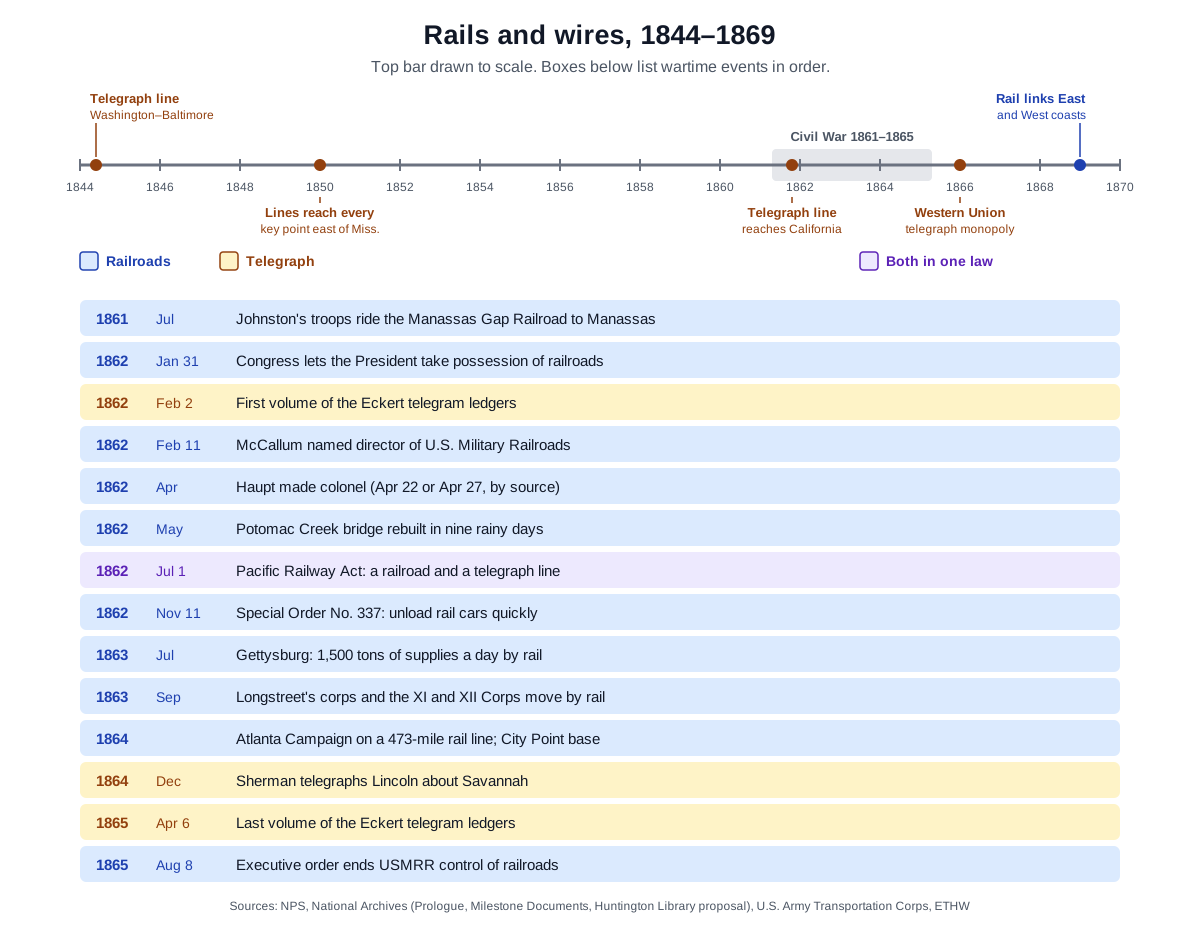
On January 31, 1862, Congress passed a law allowing the President to seize railroads whenever the nation's welfare and safety called for it. Prologue is the magazine of the National Archives and Records Administration (NARA). It counts the Civil War among the earliest wars where trains, used on a large scale, carried and fed armies fast across long distances.
The law led to the United States Military Railroads (USMRR), an agency run by the War Department. On February 11, 1862, Secretary of War Edwin Stanton named Daniel McCallum as director and superintendent. McCallum had been superintendent of the New York and Erie Railroad since 1854.
When he started, the only railroad under federal control was a seven-mile line from Washington to Alexandria, Virginia. He called his organization "a great construction and transportation machine, for carrying out the objects of the commanding generals."
The USMRR did not run every railroad. A U.S. Army Transportation Corps rail study notes that railroad companies kept running the lines inside the Union, while the USMRR operated and repaired lines seized in Confederate states. In the study's view, its main contribution was central control of the railroads and priority for military traffic.
Field work fell to Herman Haupt. A former chief engineer of the Pennsylvania Railroad, he was put in charge of military railroad operations in Virginia in early 1862 and made a colonel that April. McCallum handled administration; Haupt handled the trains and bridges on the ground.
Haupt's best-known job was the railroad bridge at Potomac Creek. In May 1862 he rebuilt it in only nine rainy days with unskilled infantry. After a visit on May 28, Lincoln described a bridge 400 feet long and 80 feet high and said there was "nothing in it but cornstalks and beanpoles." It looked flimsy and greatly impressed the President, and it carried 10 to 20 trains a day.
Haupt also came up with the idea of using prefabricated bridge trusses to speed up repairs. He organized people as well: career railroaders, soldiers, laborers and formerly enslaved people joined the Construction Corps. It had about 300 men in 1863 and close to 10,000 when the war ended.
Haupt made sure cars were unloaded and sent back promptly. McCallum set schedules for supply trains and urged the Secretary of War to issue Special Order No. 337 on November 11, 1862. Under it, officers had to give the quick unloading of rail cars their highest priority. Trains carried men and supplies to the army's rear, and wagons took the cargo from there to each corps.
Armies and supplies moved by train
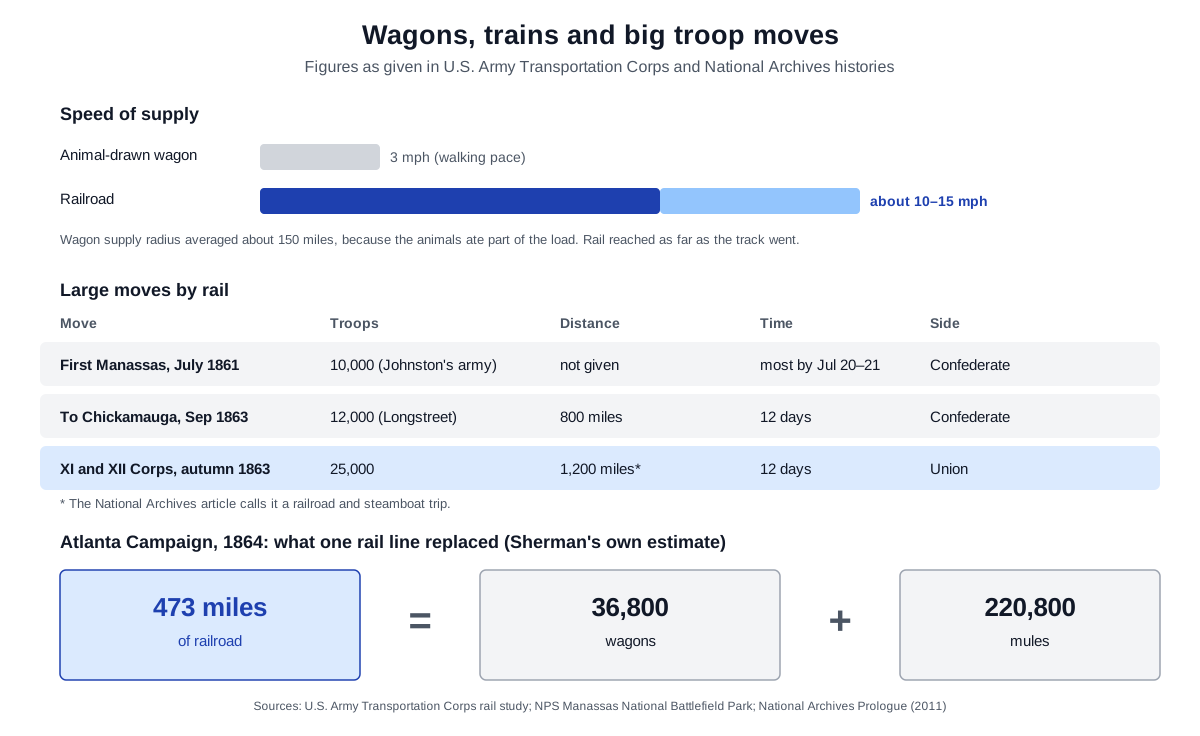
The difference shows up best next to a wagon. The horses and mules ate part of their own load. Wagon supply therefore averaged a radius of about 150 miles, at a walking pace of 3 mph. Rail raised the speed to about 10–15 mph and stretched the distance to the end of the track.
Railroads became a central means of military transport, and the great majority of battles and campaigns took place along rail lines or over who held them.
At Gettysburg in July 1863, Haupt turned the single-track, 29-mile Western Maryland Railroad between Baltimore and Westminster into a supply line for the Union army. Instead of timetables, he sent trains in convoys of five. This rail support moved a steady 1,500 tons of supplies a day and evacuated 2,000 to 4,000 wounded men.
A bigger move came that autumn. On September 24, 1863, Stanton decided to reinforce Chattanooga by sending the XI and XII Corps from northern Virginia by rail, using the 1862 law.
McCallum did the planning. Inside five days, 25,000 soldiers and their gear left on a trip of 1,200 miles that took 12 days. Part of the route was by steamboat. Historian John Hankey and others concluded of this move that "in railroad terms, that was the tipping point of the war."
Supply in the 1864 Atlanta Campaign also depended on rail. By General William Sherman's reckoning, his 473-mile line of track did as much as 36,800 wagons and 220,800 mules. This was his own estimate, not a measured figure.
Historian Thomas Weber ranked the supply of Sherman's army between Chattanooga and Atlanta as the finest work the military railroads did.
City Point, from the opening of this article, was the supply base for the siege of Petersburg. From there Grant had to feed and equip over 100,000 soldiers, along with over 65,000 horses and mules. The Construction Corps rebuilt the line toward Petersburg, and 25 locomotives and 275 cars came in by barge. The first stage was finished in 22 days.
Over the nine-month siege, 21 miles of track were laid and trains logged 2,300,000 miles. Bread was the only food not shipped from the North. A bakery on site turned out 100,000 rations of bread a day.
How the telegraph changed command
When war broke out in April 1861, protecting lines of communication quickly became a military matter. Anson Stager, a superintendent at Western Union, created a cipher system to keep message contents hidden, and the War Department adopted it.
Stager became head of the United States Military Telegraph (USMT), and Major Thomas Eckert ran the War Department telegraph office in Washington throughout the war.
Lincoln took to the telegraph eagerly. He used it to work with state governors on raising and equipping armies, to reach commanders in the field, and to follow the progress of battles. The Huntington Library holds Eckert's telegram records. It explains that the telegraph let the President affect campaigns and even battles in a way that was unthinkable a few years earlier.
Those records survive. The Eckert papers, bought by the Huntington in 2012, fill 76 volumes dated from February 2, 1862, to April 6, 1865. About 5,400 of their 15,922 telegrams (34%) are in cipher. In these ledgers alone, about one telegram in three was encoded.
The telegraph worked hand in hand with the railroad. While repairing damaged lines near Washington, Haupt also improved telegraph links along the tracks. By late 1862 a Union supply officer could wire Alexandria for a full rail car of goods. Within 12 hours it would be waiting at the Falmouth depot, a short way north of Fredericksburg.
Hankey calls this the kind of logistics the Confederacy never had, and remarkable for 1862.
Wires could also fail. During the Second Battle of Manassas (Bull Run) in August 1862, telegraph contact with General John Pope was cut, and Haupt kept Washington informed of how the battle was going.
A remark from the field shows how the telegraph was received. Assistant Secretary of War Charles Dana watched the Union Army of the Cumberland at Chickamauga in 1863. He called the telegraph "one of the most useful accessories of our army." Chickamauga and Chattanooga National Military Park describes the Civil War telegraph as proving its value at the tactical, operational and strategic levels.
In December 1864, after taking Savannah, Sherman wired Lincoln: "I beg to present you as a Christmas gift the city of Savannah." News from an army deep in the South reached the President over the wire.
Railroads in the South
The first big demonstration of what rail could do came from the Confederate side. In July 1861 the First Battle of Manassas (Bull Run) centered on the junction where the Orange and Alexandria Railroad met the Manassas Gap Railroad. General Joseph Johnston's army of 10,000 in the Shenandoah Valley used the Manassas Gap Railroad to reach Manassas Junction, with most arriving on July 20 and 21.
In the Army Transportation Corps study, this is the moment American soldiers first saw what rail could offer in war.
In September 1863 the corps of Confederate Lieutenant General Longstreet, 12,000 men, covered 800 miles in 12 days to join Braxton Bragg's army at the Battle of Chickamauga. The Union move of the XI and XII Corps came two weeks later. Both sides understood early how much the railroad mattered.
The difference lay in organization and resources. The Army study explains that the Union controlled its railroads centrally, while the South, defending each state's right to decide for itself, left railroad management to private companies. Arrington adds that a thinner industrial base, less track and a farm economy resting on slave labor made it harder for the South to mobilize its resources. As Union armies moved into the South, they captured Southern transportation and manufacturing facilities, and Sherman's army took the rail hub of Atlanta and the seaport of Savannah.
The numbers differ by source
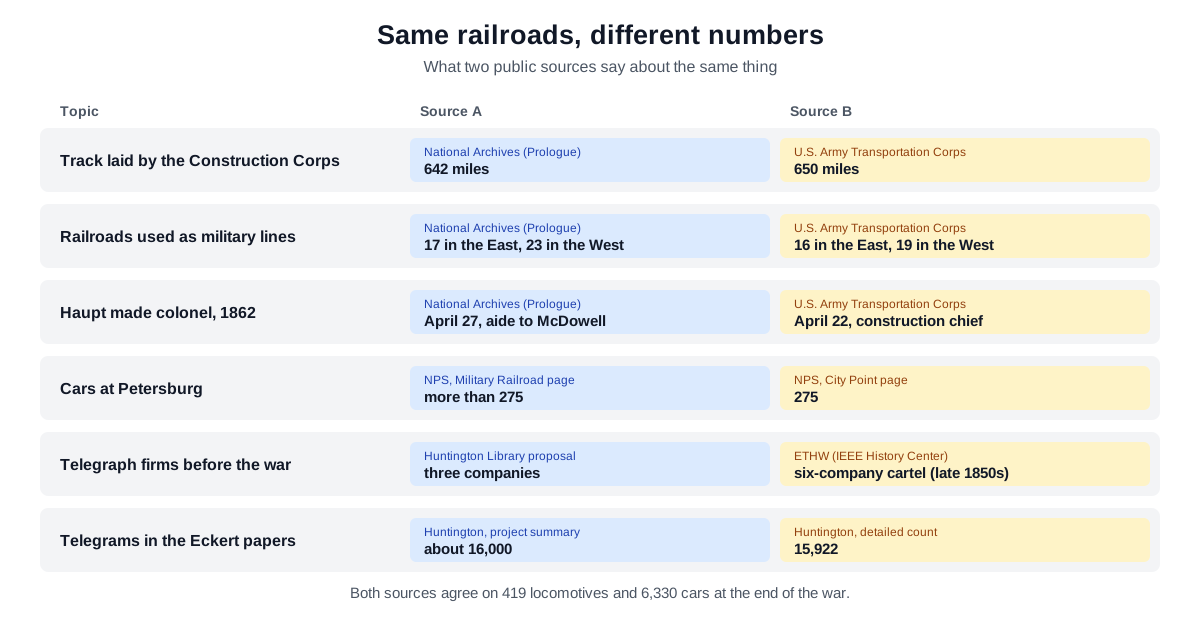
Agencies give different numbers for the same railroads. Track laid by the Construction Corps is 642 miles in Prologue and 650 miles in the Army Transportation Corps study. Prologue counts 17 railroads used as military lines in the East and 23 in the West; the Army study counts 16 and 19. Haupt's colonelcy is dated April 27 in one and April 22 in the other, with different job titles.
Even NPS pages differ. One Petersburg page says "more than 275" pieces of rolling stock, another says 275 cars.
For telegraph firms before the war, the Huntington Library material says three companies. The Engineering and Technology History Wiki (ETHW) of the IEEE History Center describes a six-company cartel in the late 1850s. The Eckert telegrams number about 16,000 in a summary and 15,922 in the detailed count.
Some numbers do match. Both sources give the USMRR 419 locomotives and 6,330 cars at the end of the war. Prologue adds 2,105 miles of railroad operated, 26 miles of bridges built or rebuilt, and a cost of nearly 30 million dollars. When the war ended, no railroad system on earth was bigger than the USMRR.
When quoting any of these numbers, it is safest to say which agency gave it.
What the war left behind
An executive order on August 8, 1865, ended USMRR control of the railroads, and Southern lines went back to their owners. The Army Transportation Corps study judges that rails and wires, used to shift forces and coordinate operations across theaters, played a large part in the Union victory. Afterward, railroad operations in the U.S. Army stayed under the engineers until the Transportation Corps was created in World War II.
A wartime law also treated rails and wires as a pair. Lincoln approved the Pacific Railway Act on July 1, 1862. It helped pay for a rail line and a telegraph line running from the Missouri River to the Pacific. The government, in turn, kept the right to use them for mail, the military and other needs.
In 1869 a railroad first connected the East and West coasts.
The telegraph business changed too. The end of the war brought a final wave of mergers, and in 1866 Western Union became the country's telegraph monopoly.
The paper trail survived as well. The USMRR records went to the Quartermaster General's Office after the war. Today the National Archives in Washington holds them: more than 100 cubic feet in 273 series.
Taken together, they document how Washington ran the wartime railroads in fairly complete detail. They include everyday records such as conductor's reports listing train numbers and times of departure and arrival. Along with Eckert's telegram ledgers, they are the traces of the wheels and wires that made this an industrial war.
What to read next
- The American Civil War at a Glance: 1861 to 1865 — the whole war on one timeline, as background for this article.
- The Rifled Musket and the Minié Ball in the Civil War — what the infantry weapons of the same era changed.
- Vicksburg and the Anaconda Plan: The Fight for the Mississippi — the fight over river and sea routes alongside the railroads.
- Military logistics: performance must be sustainable — what military logistics covers today.
- Resilient military communications: systems built to survive a lost link — what military communications must withstand since the telegraph.
- How a fiber guides light: core and cladding — the telegraph sent signals down a wire; this explains how the glass strands that carry signals today hold on to light.