A U.S. Navy destroyer today has 90, and in some ships 96, cells for missiles standing upright. Yet there is still one gun on its deck. With so many missiles, why does the gun stay?
A naval gun is a warship's gun that fires shells with the force of gunpowder. This article begins with how a gun sends out a shell, then follows the guns of the wooden-ship and ironclad era and the changes after missiles took the lead. Last, it looks at the magazine and cost problems raised in Congressional Research Service (CRS) reports to see why the gun stayed, and where it meets laser weapons.
How a gun sends out a shell
An ordinary gun fires its shell with chemical propellant, meaning a gunpowder charge. That is where it parts ways with the railgun, which uses electricity.
When the shell flies forward, the gun is pushed back. This is recoil. If the shell's movement is the action, the gun moving backward is the reaction. A NASA rocket guide uses exactly this cannon as its example of action and reaction.
The second idea is the grooves inside the barrel. Spiral grooves cut inside a gun barrel are called rifling, and a barrel without them is a smoothbore.
The National Park Service describes rifles from the American War of Independence. Their grooves set the bullet spinning on its way out, so it went farther and hit closer to the aim. Those rifles had drawbacks too. They were costly to build, and reloading one took close to a minute.
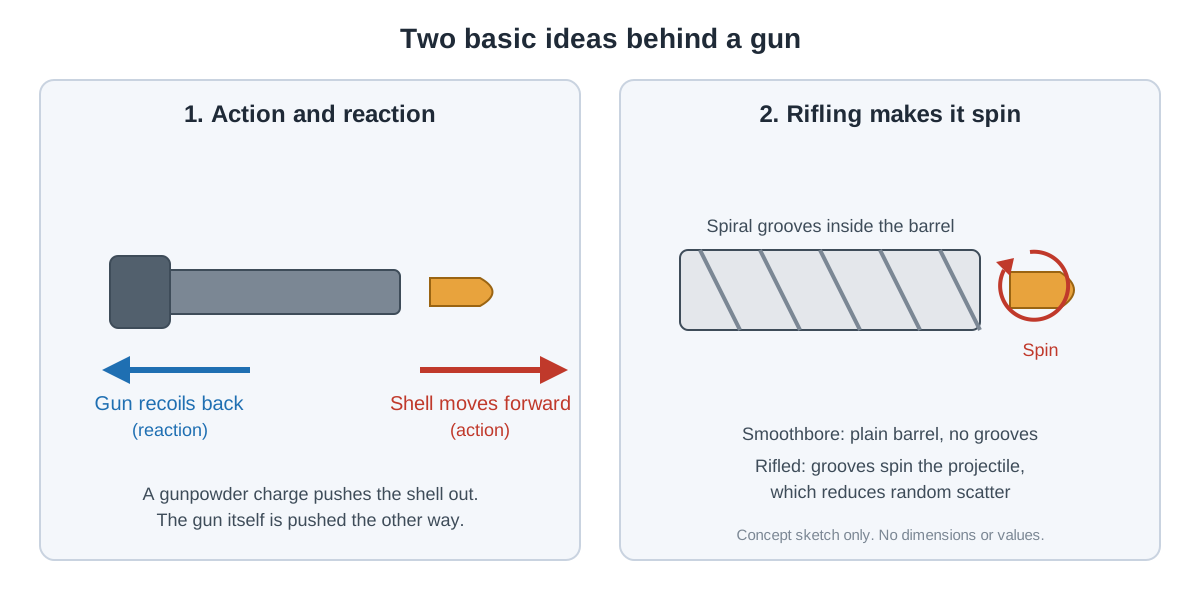
It is a bit like throwing a football with a spiral so it wobbles less in the air. The real thing is different. The grooves inside the barrel do the spinning, not a hand, and cutting and handling those grooves costs money and time. In naval guns too, rifling cuts down the random scatter of shells.
Loading is another line along which guns developed. Breech-loading cannons, loaded from the rear of the barrel, are counted as a step that made firing faster.
From wooden ships to ironclads and battleships
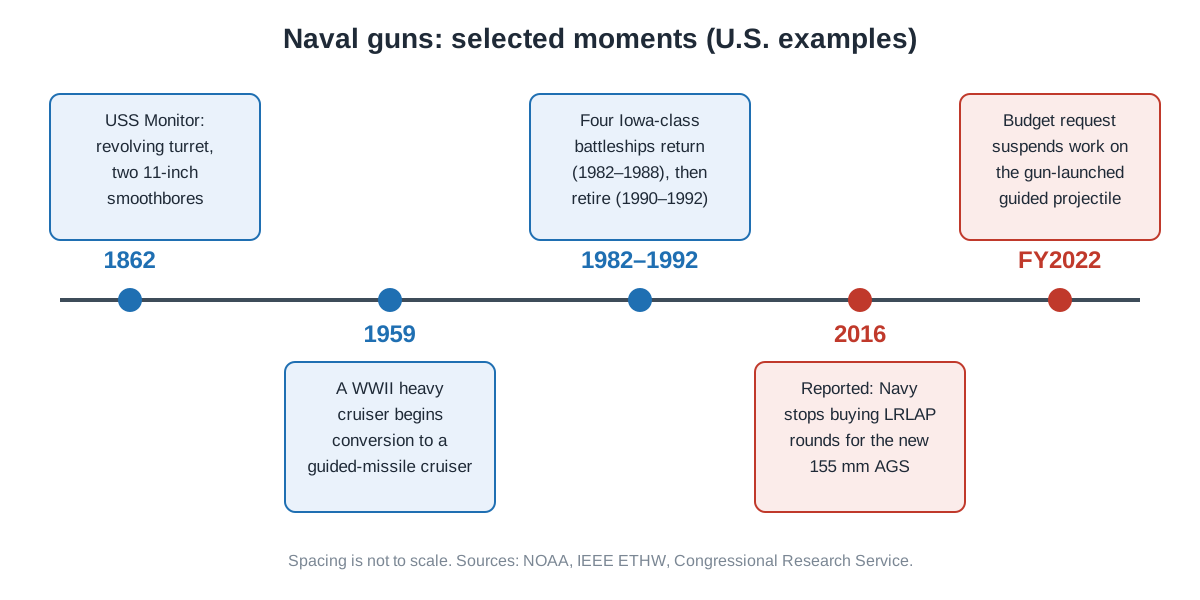
The Navy gunboat USS Cairo, which sank in 1862, shows what naval guns looked like then. Built in a hurry, she and her sister gunboats were armed with whatever guns could be found. The thirteen big guns Cairo carried when she sank were three 8-inch smoothbores, three 42-pound rifles, six 32-pound smoothbores and one 30-pound rifle. Smoothbores and rifles sat side by side on one ship.
The 32-pound smoothbore on display at Vicksburg National Military Park fired a solid iron ball. Loading, moving and firing that one gun took a crew of eleven.
A bigger change came the same year. USS Monitor, launched on January 30, 1862, was the first iron-armored warship of the Union Navy in the Civil War. It ran on steam alone, and no American warship before it had gone without masts and sails.
Its most novel feature was the revolving turret. Inside that turning turret sat two 11-inch Dahlgren smoothbores.
Less than two months later, Monitor met the Confederate ironclad Virginia at Hampton Roads. According to NOAA, neither ship took much damage. Still, it was the first time two iron ships fought each other at sea, and it signaled that the age of wooden warships was over.
As guns reached farther during the 19th century, a new problem appeared. The longer a shell flew, the more time the target had to move, and the more the wind could push the shell.
For over 40 years, Navy fire control relied on mechanical analog computers. These machines aimed large naval guns and set the fuze times on shells. You can follow that link in the article on fire control systems.
The big guns those computers aimed belonged above all to battleships. By World War II, these mechanical computers handled most of the aiming for the main guns of cruisers and battleships. A National Academies committee report calls the pre-war U.S. Navy a "battleship Navy," and describes the post-war Navy as one built around aircraft carriers and nuclear-powered attack submarines.
After missiles took the lead
The mechanical computers that aimed naval guns faded out in the 1950s. Around then, gun cruisers were also being rebuilt as missile cruisers. Chicago, a heavy cruiser from World War II, went into a San Francisco shipyard in July 1959 to be rebuilt as a guided-missile cruiser. When the work was done, long-range Talos missiles stood at the bow and stern, with short-range Tartar missiles in the middle of the ship.
Battleships with big guns came back one more time. In the 1980s the Navy brought back four World War II battleships of the Iowa (BB-61) class and updated them: Missouri, New Jersey, Wisconsin and Iowa. The ships rejoined the fleet from 1982 to 1988, and the Navy fitted them with Tomahawk missiles. Big guns and cruise missiles shared the same ship.
The battleships left service again between 1990 and 1992. CRS notes that with this retirement, the Navy lost its large-caliber naval gunfire capability.
Why the gun stayed
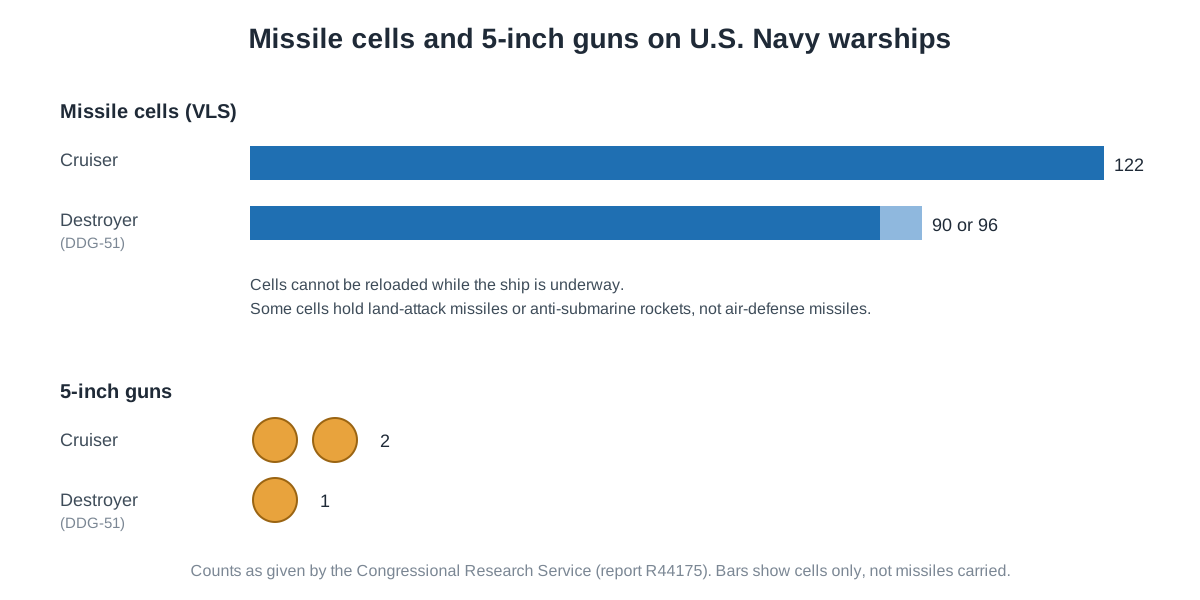
Today a U.S. Navy cruiser carries two 5-inch guns, and an Arleigh Burke (DDG-51) class destroyer carries one. This 5-inch gun is called the Mark 45. Compare that with the missile cells. A cruiser has 122 missile cells and a destroyer has 90 or 96, grouped in a vertical launch system (VLS).
One job guns have long done is supporting forces ashore. Naval surface fire support (NSFS) means using naval guns to help friendly forces operating on land. The Zumwalt-class destroyer and the railgun both started out with this job in mind.
Another question guns face is how many rounds a ship can carry and what each one costs. CRS names two key limits that surface ships face when defending against drones and anti-ship missiles: a shallow depth of magazine and a poor cost exchange ratio. A ship at sea has no way to refill its missile cells.
Once its air-defense missiles and close-in weapon rounds are used up, a ship may have to leave the fight. It may then need to sail to a safe place to reload, possibly hundreds of miles off. Depending on the type, one Navy air-defense missile costs anywhere from hundreds of thousands to a few million dollars to buy.
CRS lists the gun-launched guided projectile (GLGP), alongside lasers and the railgun, as a possible way to greatly ease these two limits. The Navy found that the guided projectile it was building for the railgun would also work in gunpowder guns such as 5-inch naval guns and 155 mm guns. A ship's magazine can hold many such projectiles, and the estimated unit cost in 2018 was reportedly about $85,000. The guns to fire them were already installed on cruisers and destroyers, which was also listed as a possible advantage.
Some guns cover the closest range. Phalanx, a close-in weapon system (CIWS), is in effect a radar-controlled Gatling gun. The article on anti-aircraft artillery looks further at the place guns hold in the missile age.
As the next section shows, this guided-shell program was stopped. The 5-inch gun itself, though, is still mounted on cruisers and destroyers. Supporting forces ashore, trying to deepen the magazine with rounds cheaper than missiles, and defense at the closest range: that is where the gun sits in the missile age.
Where new guns and new shells ran into trouble
Building a new gun turned out to be hard. The Zumwalt (DDG-1000) class destroyer was meant to replace the large-caliber gun capability lost when the battleships retired. At first the ship's emphasis was on naval surface fire support and near-shore operations, and it carried two newly designed 155 mm guns called the Advanced Gun System (AGS). The AGS was to fire LRLAP, a rocket-assisted guided shell.
In November 2016, news reports said the Navy would buy no more LRLAP rounds, since the expected price of each one had climbed to $800,000 or more. In December of the next year came reports that the ships' mission emphasis would shift from fire support to surface strike with missiles. A late-2024 CRS report says the Navy planned to remove one AGS from each ship with its below-deck gear and put in large-diameter vertical launch tubes for hypersonic missiles.
The guided shell stopped too. The Navy's FY2022 budget request proposed halting further work on the railgun and GLGP programs and asked for no research and development money for them. Firing from existing guns was an advantage, but putting GLGP into service would still have meant tying it into each ship's combat system.
Where this meets lasers: a weapon that does not run dry
Depth of magazine and cost per shot come up again in the story of laser weapons. In the same CRS report, a shipboard solid-state laser runs on the ship's power. It can keep firing for as long as the laser works and the ship can burn fuel to make electricity. The estimated extra cost per shot is $1 to less than $10, depending on beam power.
Lasers have limits, though. They can only fire along a line of sight, and absorption, scattering and turbulence in the air keep them from being all-weather weapons.
Guns and lasers are two different answers to the same question: can a ship stop more threats at a lower cost? Guns do it by carrying many rounds that are cheaper than missiles. Lasers do it by using electricity instead of rounds. How the three weapons share the work is covered in Lasers, interceptor missiles and guns.
What to read next
- Lasers, interceptor missiles and guns: how they share the work: compares the roles of guns, missiles and lasers in defense.
- Electromagnetic railguns: launching with electricity: the principle of a gun meant to fire with electricity instead of gunpowder, and why it was paused.
- Vertical launch systems: what sits below a warship deck: the missile cells that took over from guns as a warship's main weapons.