On 18 November 1812, about a month after leaving Moscow, Napoleon sent a letter to Maret. A frost of minus 16 degrees Réaumur, roughly minus 20 degrees Celsius, had left almost no horses alive. Almost 30,000 had died. With nothing to pull them, over 300 guns and a great many wagons had to be burned.
Five months earlier, when the army crossed the Niemen River, many people expected a short and fast campaign. Yet the force that crossed back in December was only a fraction of the one that set out.
The defeat is often summed up as "the Russian winter won." The records show supply, horses, disease and a Russia that would not give way, all tangled together. Dates and numbers also differ from source to source, so this account keeps those differences side by side.
Why Russia?
By the spring of 1812 the two countries were already pressing each other hard. On 8 April Tsar Alexander I instructed his ambassador in Paris, Kurakin, to demand that all French troops leave Prussia and Swedish Pomerania before any talks could begin. The chronology of volume 12 of Napoleon's correspondence, published by the Fondation Napoléon, records two ultimatums: from France on 25 April and from Russia on 30 April.
The preparations had started much earlier. On 27 January 1812 Napoleon told his brother Jérôme that assembling his armies, training them and rebuilding his equipment had taken a year. On 1 June he wrote to the Empress Marie-Louise that the war would be over in three months.
Later, on Saint Helena, Napoleon claimed he had not wanted this war and that fate did the rest. The historian Marie-Pierre Rey, who wrote the preface to volume 12, does not accept this at face value. In her view, the army that stood on the Niemen after well over a year of getting ready was there because of the emperor's wishes, not fate.
An army drawn from twenty nations
In June 1812 nearly 440,000 men lined the banks of the Niemen. This Grande Armée was organized in twelve corps, and many of its units came from outside France. The chart below shows what the allied states sent. The Duchy of Warsaw sent the most, 50,000 men; Naples, Austria and Bavaria sent 30,000 each, and Baden 8,000.
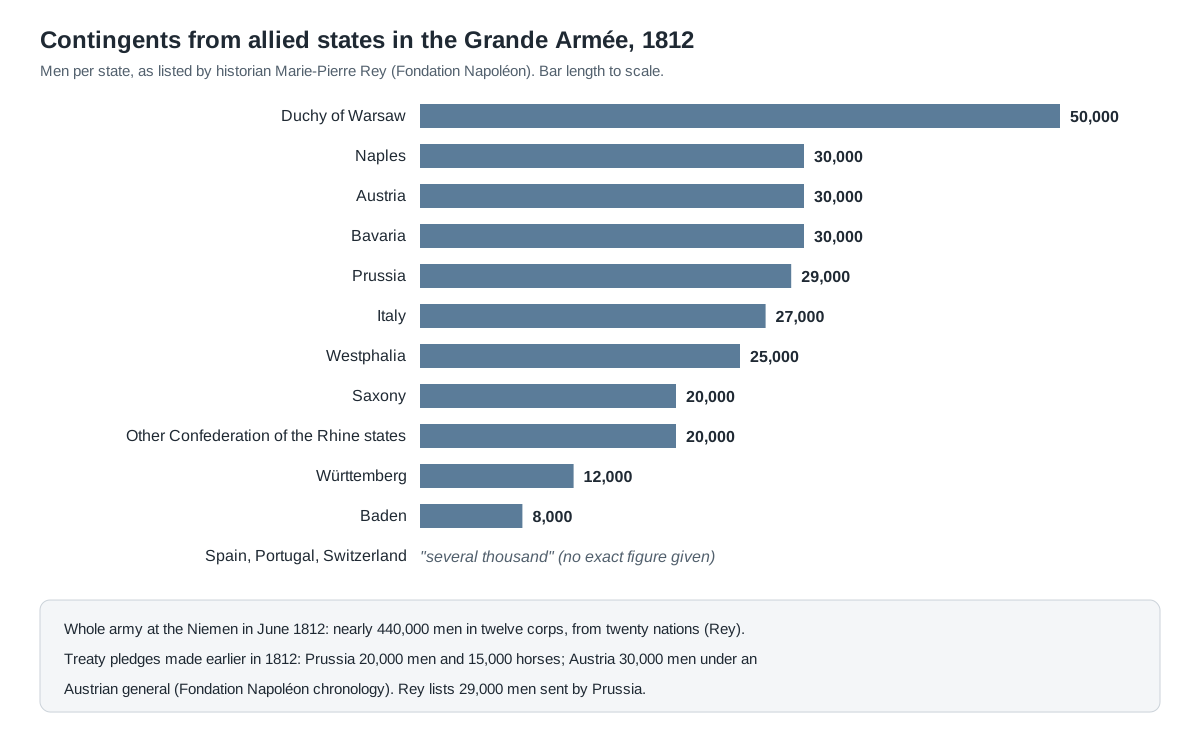
Soldiers from Spain, Portugal and Switzerland, several thousand in all, served too. Rey writes that men from twenty nations came together in one army, and that this multinational force ran into many difficulties during the campaign. Treaty figures and the numbers sent do not always match. Under a treaty signed early in 1812, Prussia pledged 20,000 men and 15,000 horses, while Rey lists 29,000 men from Prussia.
What about clothing? On 13 July, in Vilnius, Napoleon ordered 50,000 pairs of shoes, plus 6,000 each of overcoats, coats and jackets, and 6,000 pairs of trousers. Rey points out that nothing on this list was warm clothing meant for a Russian winter.
June to December on one timeline
The sources disagree from the very first day. A Fondation Napoléon dossier puts the Niemen crossing on 22 June, and the McGill University Library timeline on 23 June. The foundation's chronology of the correspondence gives 24 June to 1 July. A large army took several days to cross, so which day counts as "the crossing" can vary.
Russian records give two dates. The Borodino exhibition of the Russian Presidential Library shows the crossing as "12 (24) June" and Borodino as "26 August (7 September)." The date in brackets matches the French sources.
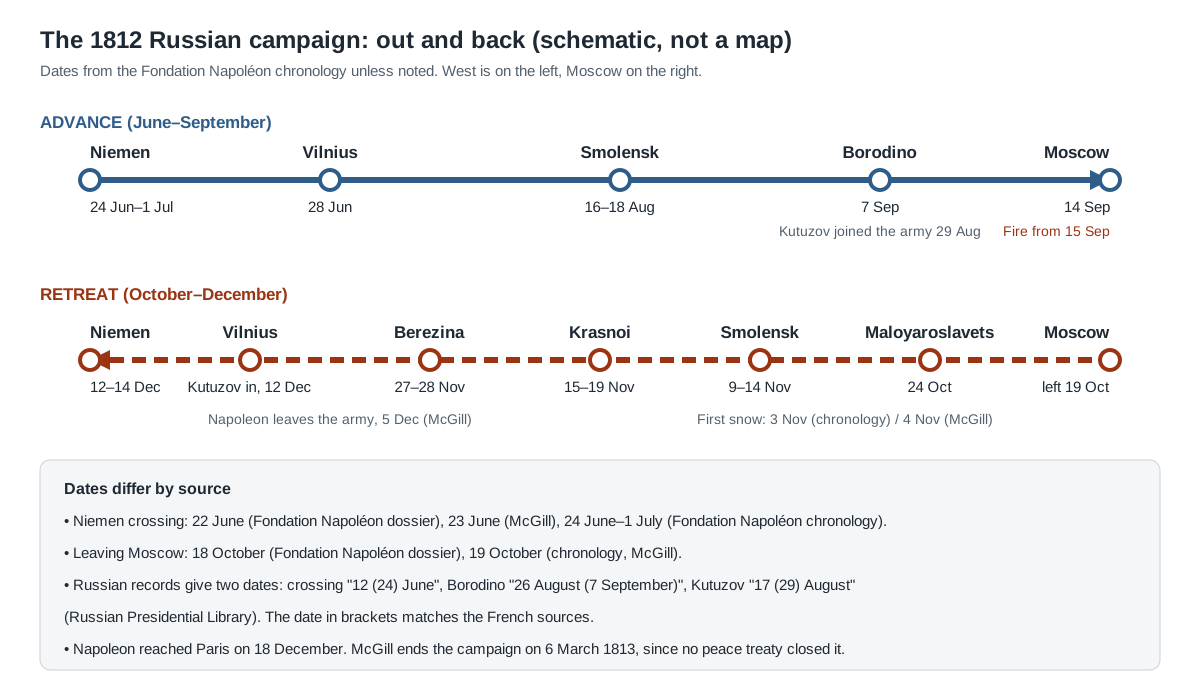
The main dates are these:
- 28 June: Napoleon enters Vilnius.
- 16–18 August: French forces win the fighting around Smolensk.
- 29 August (17 August in the Russian calendar): Kutuzov, the new commander-in-chief, reaches the army.
- 7 September: the Battle of Borodino. Moscow is entered on 14 September, and fires begin the next day.
- 19 October: the army leaves Moscow; the foundation's dossier gives 18 October.
- 24 October: the Battle of Maloyaroslavets. The chronology marks the next day as the start of the retreat.
- 27–28 November: the crossing of the Berezina.
- 5 December: Napoleon leaves the army. The remaining troops cross the Niemen again on 12–14 December, and Napoleon reaches Paris on 18 December.
Meanwhile, on 23 October, General Malet attempted a coup in Paris, and Napoleon heard of it only on 6 November. Even the end date is not fixed. No peace treaty closed the campaign, so the McGill timeline ends it on 6 March 1813, when Eugène withdrew behind the Elbe.
Ovens, flour and fodder
On 26 March Napoleon told Berthier that, up to the Niemen, the troops should live off the surrounding country. The stored supplies were not to be touched until after the crossing. Even before the campaign began, though, things went wrong.
In early June, 10,000 quintals of grain were sent from Danzig instead of flour. Napoleon was angry: he had given no such order, and flour was what should have gone. On 2 July he learned that the ovens for baking bread had not been built yet. There were no horses to haul the bricks.
According to Rey, as food and fodder ran short, foragers wandered ever farther from their units, and many fell to ambushes and Cossack raids. On 3 September, Napoleon complained to Berthier that hundreds of men were being taken prisoner every day. Borodino was four days away.
Borodino and a burning Moscow
The Russian army had been falling back since June. According to the Russian Presidential Library exhibition, the long retreat angered the public, the army and the people demanded Kutuzov as commander-in-chief, and Alexander I appointed him. Kutuzov took up a position near the village of Borodino, 120 km from Moscow. In France the fight is known as the Battle of the Moskova.
The sources do not even agree on the size of the armies. The Fondation Napoléon chronology says 124,000 French faced 104,000 Russians. The Russian Presidential Library counts 135,000 men and 587 guns on Napoleon's side, and 120,000 men and about 640 guns on Kutuzov's.
Their accounts of the outcome differ as well. The chronology says that after a day of fierce fighting the Russians withdrew and left the field to the French. The Presidential Library says the Russian army stayed intact along the whole front, and that Kutuzov ordered a night withdrawal toward Mozhaisk that went in good order. One side records a day when the enemy fell back; the other records a day when its army held together.
On losses the gap is even wider. On 9 September Napoleon wrote that the French had lost 2,000 men and the Russians 12,000. Today's estimates, as cited by Rey, are 25,000–28,000 in the Grande Armée and roughly 45,000 Russians.
The Russian Presidential Library, citing various estimates, gives up to 46,000 Russians killed, wounded or missing and 30,000–40,000 French killed. Among the Russian generals, 4 died and 23 were wounded.
Napoleon entered Moscow on 14 September. Fires broke out the next day, and according to the chronology about 7,000 of some 9,500 buildings were destroyed, with damage put at 3.5 million rubles. Rey sees this destruction, carried out by Rostopchin's will, as the turning point of the campaign, binding Russians more tightly around the tsar.
The nature of the war changed too. In Rey's words, a fight between two armies became a fight in which a whole people rose against the invader. The Russian General Staff spread German-language leaflets urging Grande Armée soldiers to desert. Napoleon's idea of stirring up a serf revolt was soon dropped in the face of strong popular patriotism.
The retreat and the Berezina
No offer of peace came, and on 19 October the Grande Armée marched out of Moscow. On 24 October at Maloyaroslavets, Davout freed Eugène's troops, but from the next day the army began to fall back along the way it had come. Rey describes how, in mid-October, Russian resistance had begun to push Napoleon's army backward, though nobody would yet call it a retreat.
The first significant snow fell on 3 November according to the chronology, and on 4 November according to the McGill timeline. In his letter of 18 November, Napoleon did not only list the horses and guns he had lost. In his account, the Russians had experience of moving on ice, and with runners and specially equipped teams they moved guns over the ice as easily as over dry ground. He contrasted this with his own army, where getting a single gun over a small ravine could cost 12 to 15 horses and as many hours.
On 25 November the army reached the Berezina at Borisov. The Russians had already destroyed the only bridge. The pontonniers of General Eblé built two bridges, and over 27 and 28 November the bulk of the army got across. The chronology puts the number who crossed at 50,000.
The next day the army decided to destroy the bridges, and close to 10,000 people, men, women and children, were left behind on the eastern bank. The Fondation Napoléon's note on a painting of the crossing says the dead there numbered 25,000 fighting men and 30,000 people who were not fighting.
After that, "Berezina" entered French as a word for disaster. Yet the same note calls it a tactical victory for Napoleon, because he led his army out of a trap that could have destroyed it. One event carries two verdicts at once.
After the Berezina, the letters grow more urgent. On 30 November Napoleon estimated that 40,000 soldiers had drifted away from their units through fatigue, hunger and cold. He asked for 100,000 bread rations to be ready in Vilnius.
By 4 December he admitted that the exhausted army could do nothing more, not even defend Paris. The next day he left the army.
Napoleon later blamed the defeat not on Russian efforts but on accidents: a capital burned by foreign hands, and a severe winter that came with startling suddenness and force. Volume 12 of his correspondence holds 2,551 letters from the year of the campaign. The stories of ovens, horses and stragglers above come from those letters.
What a grave in Vilnius says about disease
In Vilnius, Lithuania, there is a large grave of soldiers from the retreat. More than 3,000 bodies were excavated there in 2002. A team at the Institut Pasteur extracted ancient DNA from the teeth of 13 of these soldiers to look for disease-causing bacteria.
Four of the 13 carried Salmonella enterica Paratyphi C, the bacterium that causes paratyphoid fever. Two carried Borrelia recurrentis, the bacterium of relapsing fever. Relapsing fever is spread by body lice, and its fevers come and go in waves.
An earlier study had found the bacteria of typhus and trench fever. The new study appeared in the journal Current Biology on 24 October 2025.
These results do not show that disease brought the campaign down. The researchers say the sample is too small to tell how much these diseases added to the very high death rate. The 13 soldiers came from a grave of more than 3,000 bodies, and that grave holds only a part of the hundreds of thousands who marched. The researchers see the work as new support for the idea that disease played a part in the collapse, along with exhaustion, extreme cold and other hardships.
How many left, and how many came back
The figures for the whole campaign also differ. Rey puts the force lined up on the Niemen in June at nearly 440,000, and the force that crossed back less than six months later at 60,000. The Institut Pasteur press release gives 500,000–600,000 soldiers engaged in the campaign and about 300,000 deaths during the retreat.
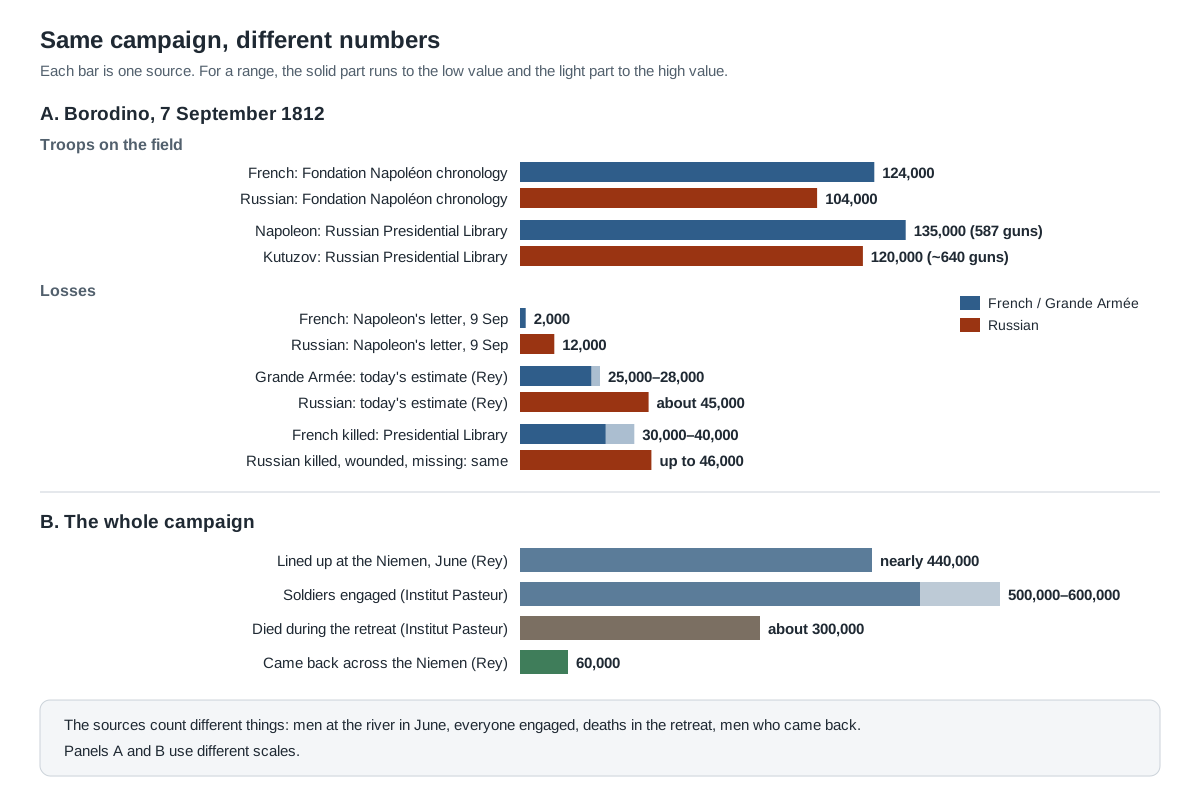
These numbers are less in conflict than they look, because they count different things. The men lined up at the river, all the soldiers engaged over the campaign, the dead of the retreat, and the men who came back are not the same group. With any figure, the first question is what it counts.
Numbers can also show how much 1812 weighs within the Napoleonic Wars as a whole. The Fondation Napoléon's article on human losses says that close to 50% of France's losses over fifteen years came in the three years 1812–1814.
What 1812 left behind
The end of the campaign led to the end of an alliance. On 30 December the Prussian general Yorck signed the Convention of Tauroggen, which, the McGill timeline notes, ended the Prussian alliance with France. Back in Paris in December, Napoleon told Murat an army of 40,000 was already standing in Berlin and along the Oder, and 1813 opened with war.
Napoleon never recovered from this campaign, in Rey's view. In March 1814 Alexander I entered Paris at the head of the allied coalition. Rey writes that Russia's growing influence shaped the Congress of Vienna, and that the borders it drew for Europe lasted a hundred years.
The campaign also left its mark on language. In Russia it is known as the "Patriotic War" (Otechestvennaya voyna), and the Presidential Library exhibition dates its start to the Niemen crossing. In French, "Berezina" came to mean disaster. One campaign left a different word in each country's language.
What to read next
- The Napoleonic Wars at a Glance: Corps and Conscription — how the corps and the conscription system behind this campaign came about.
- The Battle of Waterloo: Napoleon's Last Day — Napoleon's final battle, after 1812.
- Military logistics: performance must be sustainable — how feeding and moving an army is organized today.
- Turning points in military technology — moments since the 20th century when new technology changed warfare.
- Light through air: absorption, scattering, turbulence, thermal blooming — how weather and air blur laser light today.