By August 1914, the British Army had received only 109 of its new Vickers machine guns. So in the early part of World War I, British troops also went to war with the Maxim, a gun patented in the 1880s.
By then the machine gun was already more than half a century old. Even so, most armies before the war doubted what it was for, and used it less because of that. Within a few years it would be the weapon that pushed soldiers down into trenches.
One question runs through the history of the machine gun. Where does the power to load the next round come from? This article follows that question from the hand-cranked Gatling to the Maxim, the guns of World War I, the M2 and a new squad automatic rifle. It ends where the problem of running out of rounds meets laser weapons.
The hand-cranked Gatling
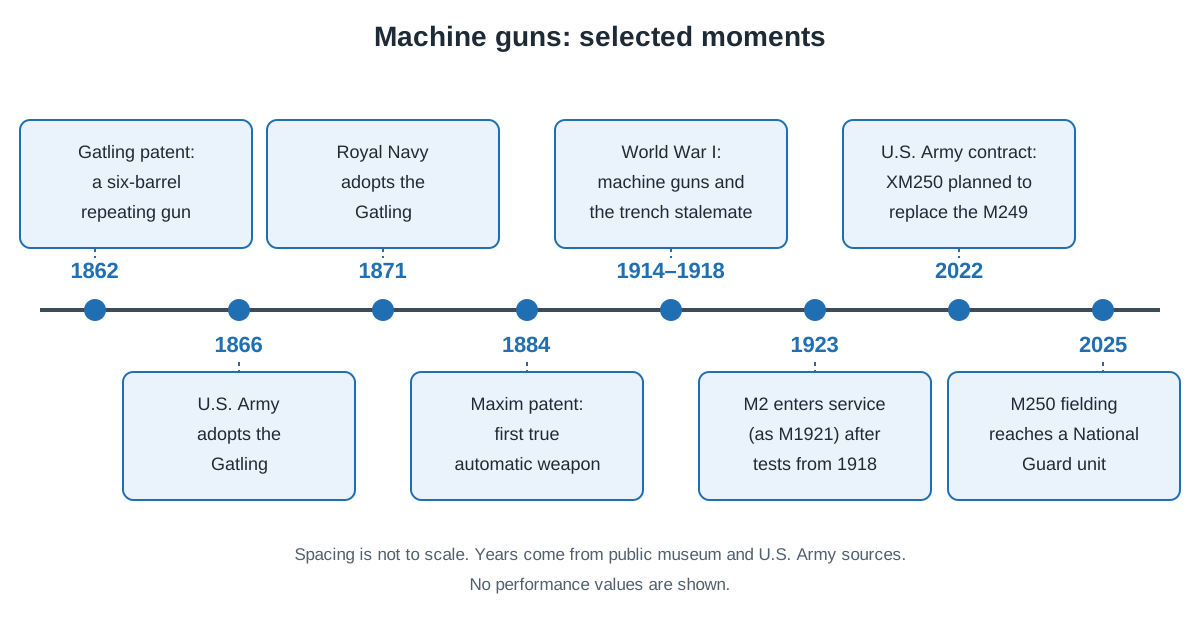
In 1862, Richard J. Gatling designed and patented a repeating gun with six barrels bundled together. A wooden patent model of it survives at the Smithsonian's National Museum of American History. The gun saw little action in the Civil War, but the U.S. Army adopted it by 1866, and other countries began buying it in a range of models and calibers.
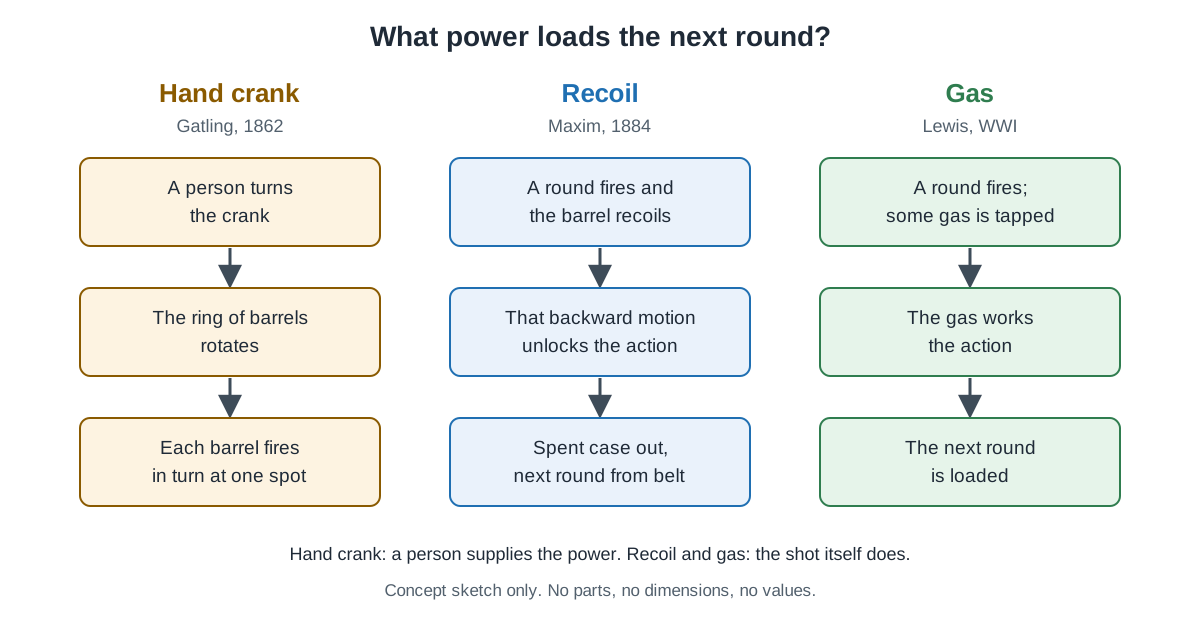
A ten-barrel Gatling at Royal Museums Greenwich shows how it moved. Ten barrels sit around a central axis, and turning a crank at the back of the gun by hand spins them around that axis. Each barrel fires once each time it reaches a set position.
Picture plates on a conveyor-belt sushi counter, picked up one at a time as they pass a diner. The real gun differs in one key way. The ring of barrels was turned by a person's arm, not a motor. The power that kept the gun firing came from outside the gun, from whoever was turning the crank.
The Royal Navy took up the Gatling in 1871. The gun saw use in the 1879 Zulu War and in Egypt in 1882–1889.
The Maxim: letting each shot load the next
In 1884, Hiram S. Maxim, an American inventor who had settled in London, patented a new gun. He patented an improved version the next year. Imperial War Museums (IWM) describes it as the first true automatic weapon, as opposed to the hand-operated "quick firers."
What changed was the source of the power. When a round fires, the barrel moves back in recoil, and Maxim used that recoil energy to work the gun. This approach is called recoil operation.
At the moment of firing, the rear of the gun stays firmly locked. Then the backward motion of the barrel unlocks it, the spent case is thrown out, and the next round comes in from the belt feeding the gun. In effect, the force of one shot gets the next one ready.
Several armies adopted the Maxim, including Britain's. From 1891, British Maxims were changed to fire the .303-inch rifle cartridge the British Army had just adopted. The gun was used in the Boer War and, as noted above, in the early part of World War I when Vickers guns were scarce.
World War I: the weapon that drove soldiers into trenches
The Canadian War Museum describes machine guns, able to fire several hundred rounds a minute, as devastating weapons, especially against troops on open ground. Before the war, opinion was different. Machine guns were common by 1914, yet most armies doubted what job they should do and how much they could achieve, and that held back their use.
Most early machine guns were heavy and hard to move. A team of soldiers worked each one. The German MG 08 Maxim had a crew of five.
Once the war began, perhaps no weapon did more than the machine gun to push soldiers off the battlefield and into fairly safe trenches, dugouts and fortifications. Finding a way past the stalemate created by this firepower challenged armies until the end of the war.
Canada's machine guns show the change that came in between. Each Canadian infantry battalion went overseas with four Colt machine guns. That gun tended to jam after firing fast, and in 1916 it gave way to the Vickers, a heavier but more dependable gun.
Heavy and light machine guns
The water-cooled Vickers was reliable but heavy, and hard to move forward during a battle. Heavy machine guns like it were later taken out of infantry battalions and gathered into machine-gun units. In the British Army, the Machine Gun Corps took charge of the Vickers.
Meanwhile, light machine guns spread among the infantry. One soldier could carry a Lewis light machine gun, and by the end of the war British infantry had two of them in each platoon.
The Lewis gun was the idea of a U.S. Army officer, Colonel Isaac Newton Lewis, yet the U.S. Army itself declined to adopt it. Its power also came from a different place than the Maxim's. It used gas operation, running on gas tapped from the barrel at the moment of firing, and its barrel was cooled by aluminum fins inside a jacket.
The Lewis did not stay on the ground. It was fitted to aircraft and, for a short time, to tanks. Throughout the war, armies used more machine guns and better ones, and machine guns kept their dominant place on the battlefield to the end.
A gun in service for over 80 years, and new ones
One machine gun first tested near the end of World War I went on to serve for a very long time. It is the U.S. Army's M2 .50-caliber machine gun. The Army first tested it in 1918, and after more tests it was taken into service in 1923 under the name M1921.
The M2 is an enlarged form of an earlier Browning design, the water-cooled M1917 .30-caliber machine gun. It has been fitted to aircraft, ground vehicles and warships. A 2009 U.S. Army article said the M2 had been adapted to many roles over the previous 80 years.
The weapon a soldier carries is changing. In April 2022, the U.S. Army announced a production contract for two Next Generation Squad Weapon designs. It named the XM250 automatic rifle as the planned successor to the M249 Squad Automatic Weapon. The two new weapons share the same 6.8 mm round.
That plan has reached real units. In September 2025, the Minnesota National Guard received the M250 during new equipment training at Camp Ripley. The Army states that the M250 replaces the M249.
The Gatling name lives on aboard warships. The Phalanx close-in weapon system (CIWS) is, in essence, a Gatling gun steered by radar. A name from an 1862 patent, paired with radar, now has a place in modern ship defense.
Where this meets lasers: running out of rounds
The machine gun's history moved toward loading the next round faster and with less human effort. But however fast the rounds go in, the gun stops when the rounds on hand run out. Ship defense today runs into the same problem.
A Congressional Research Service (CRS) report notes that surface ships can use air-defense missiles and CIWS Gatling guns against only a certain number of drones and anti-ship missiles. After that, the missiles and CIWS rounds run out. This limit is called depth of magazine.
A laser is an attempt to answer that question another way. A shipboard solid-state laser can fire again and again for as long as the laser keeps working and the ship has fuel for making electricity. If the Gatling loaded its next round by a person's arm and the Maxim by recoil, the laser uses the ship's electricity in place of rounds.
That does not mean a laser simply replaces the machine gun. A shipboard laser can only fire along a line of sight, and absorption, scattering and turbulence in the air keep it from being an all-weather weapon. How guns, missiles and lasers split the work is covered in Lasers, interceptor missiles and guns.
What to read next
- Close-in weapon systems: a warship's last layer: the place a radar-guided Gatling gun holds on a warship.
- Lasers, interceptor missiles and guns: how they share the work: how weapons that use rounds and weapons that use electricity divide the work of defense.
- Rifle Operating Systems: A History of Gas and Recoil Operation: how the recoil and gas operation seen here were used in rifles.