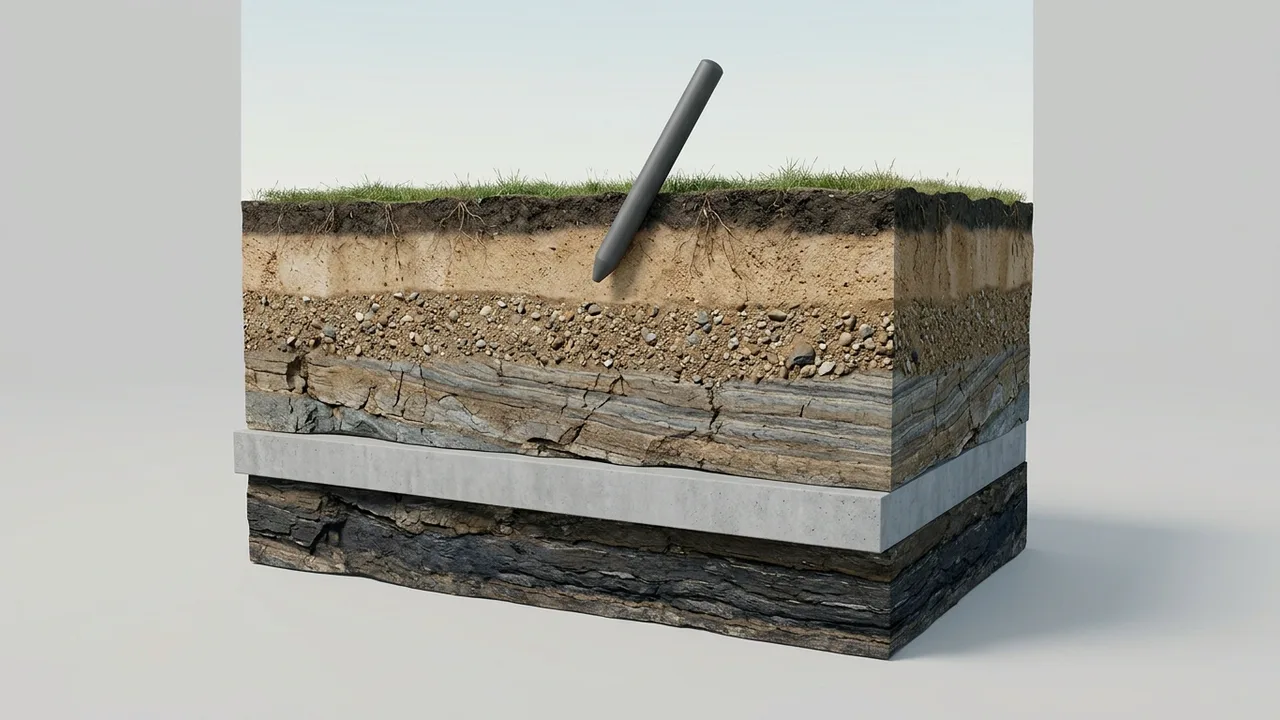
Pressing the tip of a nail against a wooden board is not the same as pressing it with a fingertip. With the same push, the nail tip digs into the wood, while the finger stops at the surface. Weapons built for sites buried deep underground, often called bunker busters, start from that simple difference.
So what exactly sets a penetrating weapon apart from an ordinary bomb? Half of the answer lies in two textbook ideas, pressure and kinetic energy. The other half lies in the record left by U.S. government papers and a study requested by Congress, and in the limits that are still there.
The problem of deep, hardened sites
A 2005 report by the U.S. National Research Council (NRC) calls these sites "hard and deeply buried targets" (HDBTs). The term covers every target that has been made hard on purpose to withstand or reduce the effects of kinetic weapons. It applies whether the site is above ground or below it.
Underground structures are also sorted by depth. If the roof of the working space lies within 20 m of the surface, the structure counts as shallow underground. If 20 m or more of soil or rock covers it, it counts as a deep underground hardened structure. The sites range from hardened bunker complexes on the surface to tunnels far below, and they tend to be large, complex and well hidden.
Such sites shelter senior leaders, house command and control, and store weapons of mass destruction, among other uses. Drawing on Defense Intelligence Agency findings, the U.S. Department of Defense put the number of known or suspected HDBTs around the world at 10,000. Many of them can survive attack by conventional weapons. Penetrating weapons are built with such sites in mind.
Needle and finger: putting force on a small area
Pressure is a force divided by the area it acts on. The same force gives a higher pressure on a smaller area. That is why a sharp needle can break the skin with a light push, while the same push from a finger cannot.
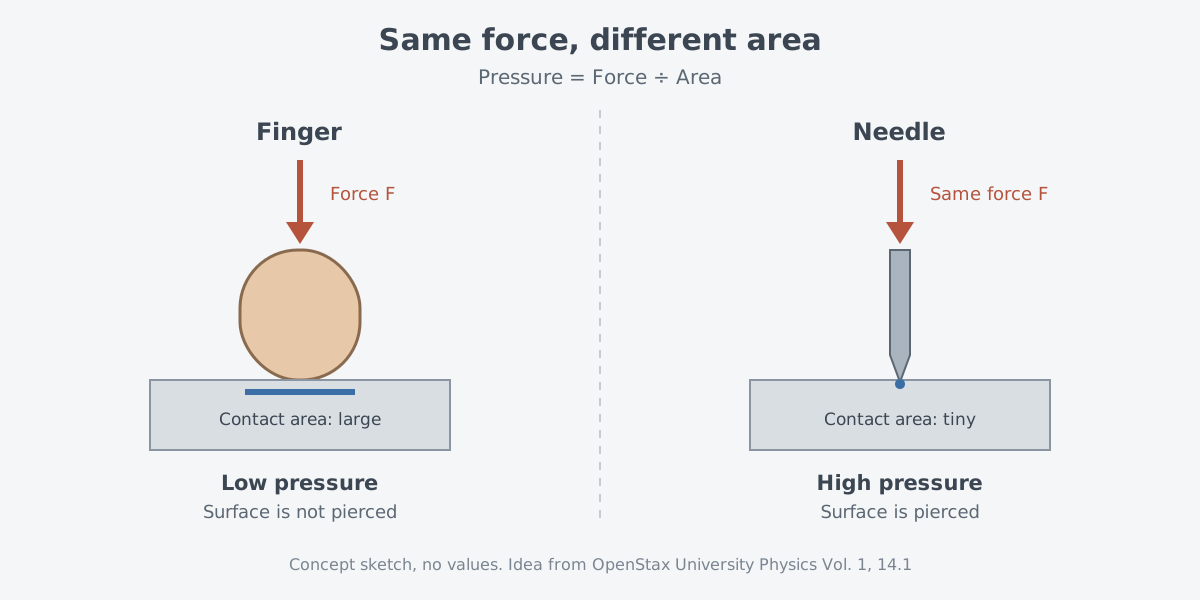
Weight and speed matter too. The kinetic energy of a moving object is half its mass times the square of its speed. So a heavier, faster body carries more kinetic energy.
A penetrating weapon uses both ideas at once. The NRC report on earth-penetrator weapons (EPWs) treats a higher cross-sectional density as helping a weapon reach deeper. Cross-sectional density is the mass divided by the area of the body seen head-on. It means more mass behind each bit of frontal area, which ties back to the idea of force per area.
The comparison only goes so far, because a needle meets soft skin while a penetrating weapon meets a mix of soil, rock and concrete. A review of the Gulf War air campaign by the U.S. General Accounting Office (GAO) quotes a Defense Intelligence Agency analysis. It lists many factors behind a warhead's penetration: impact speed, impact angle, angle of attack, the target's materials and the weapon's design. Shape and weight alone do not settle the outcome.
Going in first, then going off
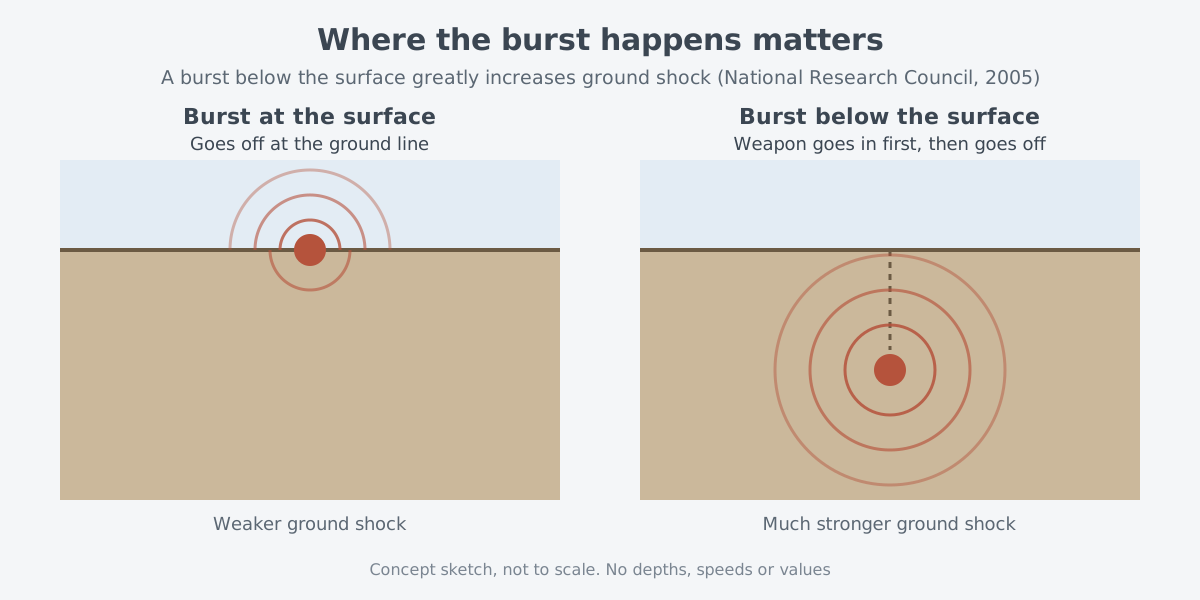
The biggest difference from an ordinary bomb is where the weapon goes off. The NRC report defines an earth-penetrator weapon as one designed to survive the extreme shock and loading of impact and penetration, and then detonate below the surface. The body has to get in first without breaking apart.
Why go to the trouble of exploding underground? A burst below the surface greatly increases the ground-shock effect, which makes the weapon more effective against deeply buried targets.
The fuze, which decides when the weapon goes off, matters too. The GBU-24 Advanced Unitary Penetrator (AUP), for example, uses a fuze that senses empty spaces inside a target so that it detonates at the right point. The force that drives it in, the body that holds together and the timing of the burst all have to work together.
The public history
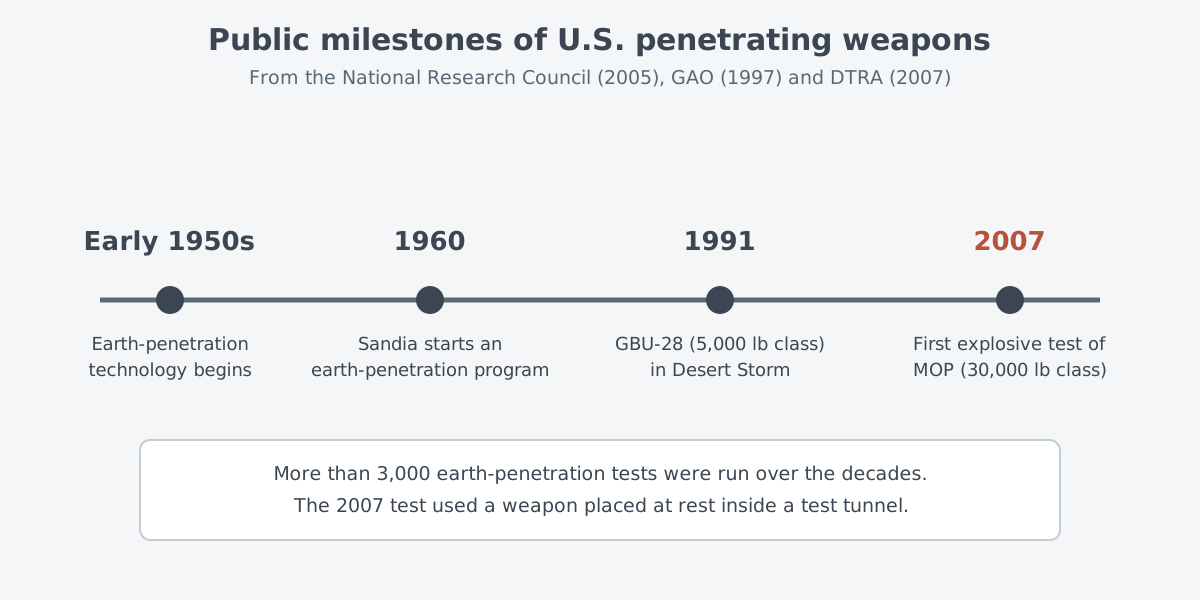
U.S. work on getting weapons into the earth goes back to the early 1950s. Sandia National Laboratories started an earth-penetration program in 1960, and more than 3,000 penetration tests followed over the decades.
The GBU-28 used in the Gulf War is one well-documented example. Operation Desert Storm centered on a 43-day air campaign from January 17 to February 28, 1991. The GBU-28 was a 5,000-pound laser-guided weapon developed to get through hardened underground command centers, and its penetrating warhead, the BLU-113, weighed 4,400 pounds.
The weapons table in the NRC report calls it, plainly, a "bunker buster." According to the GAO, the F-111F was the only aircraft that dropped the GBU-28 in that campaign.
Penetrating weapons come in more than one type, and one example is the BLU-109, a 2,000-pound penetrating warhead. The GBU-24 AUP was described as a next-generation hard-target penetrator that shares the outside shape and flight behavior of the BLU-109 but carries a heavy steel penetrating warhead. Work was also under way to turn penetrators such as the BLU-109 into low-cost JDAMs, which add an inertial and GPS guidance kit. How guidance is added to a plain bomb is the subject of "Precision-guided bombs: what gets added to a plain bomb".
Larger weapons followed. In March 2007, the U.S. Defense Threat Reduction Agency (DTRA) announced a first: a Massive Ordnance Penetrator (MOP) concept weapon had been exploded in a test. The test took place at White Sands Missile Range in New Mexico. For that test, the weapon was set in place inside a test tunnel and held still.
DTRA described the MOP as a 30,000-pound conventional penetrating bomb meant for bunkers, tunnels and other hard and deeply buried targets. It was designed to be carried by B-2 and B-52 bombers. At the time it was a $30 million technology development effort. Its goal was to show the technology so that such a weapon could be acquired in the future.
Policy sat behind these steps. To lean less on nuclear weapons, the 2002 U.S. Nuclear Posture Review asked for highly accurate conventional weapons that could stand in for nuclear systems where they could. The NRC study itself was requested by Congress through the fiscal 2003 defense authorization law.
Limits and difficulties
The ground a penetrator meets is not as uniform as a lab sample. The greatest uncertainty, both in predicting penetration depth and in whether the weapon survives until it detonates, comes from earth materials being uneven by nature. A place that seems to hold deep soil can still hide an unexpectedly hard layer.
Some problems lie outside the weapon. The report's chapter on conventional weapons names two main limits on air strikes against HDBTs. One is knowing enough about the target, and the other is being able to get through to it and destroy it. And as noted above, many sites were built to withstand attack by conventional weapons in the first place.
Where this meets lasers: concentrating on a small spot
A penetrating weapon and a laser weapon use very different kinds of energy. One relies on the kinetic energy of a heavy body, the other on light. Yet both care about how small an area the energy lands on.
For a penetrator, that measure is pressure, or force per area. For a laser, it is intensity, the power that light carries per area. The same power focused on a smaller spot gives a higher intensity. The difference between power and intensity is laid out in Power, energy and intensity.
What to read next
- Power, energy and intensity: W, J and W/cm²: the idea of power per area, from the laser side.
- Why a laser weapon does not finish "the instant it fires": why light has to build up in one spot before anything happens.
- Precision-guided bombs: what gets added to a plain bomb: the guidance that is fitted to penetrating warheads.