On 8 May 1429, the English army that had surrounded Orléans for almost seven months packed up and withdrew. People in Orléans still mark that day. Every 8 May the city honors Joan of Arc, and it counts the history of that festival as 597 years long.
About ten days earlier, someone new had entered the city. She was a young woman from the village of Domrémy: Jeanne d'Arc, known in English as Joan of Arc. The Royal Armouries in Britain sees the siege of Orléans as the point where the Hundred Years' War turned.
Why did the siege begin, and what happened over those seven months? How did Joan end up there, and what became of her afterward? This article follows the story through museum and library sources and through her own answers in the 1431 trial record.
France with two kings
In 1422, Henry V of England and Charles VI of France died in the same year. According to the French National Library (Bibliothèque nationale de France, BnF), the ten-month-old Henry VI became sole monarch of both England and France. But the Dauphin, who had taken refuge in Bourges, also proclaimed himself king as Charles VII. France now had two kings.
Fighting resumed in 1423. Charles's armies lost at Cravant (1423) and Verneuil (1424) and were pushed south of the Loire by the Duke of Bedford, regent of the kingdom of France. The victorious English laid siege to Orléans in 1428.
Seven months around the city
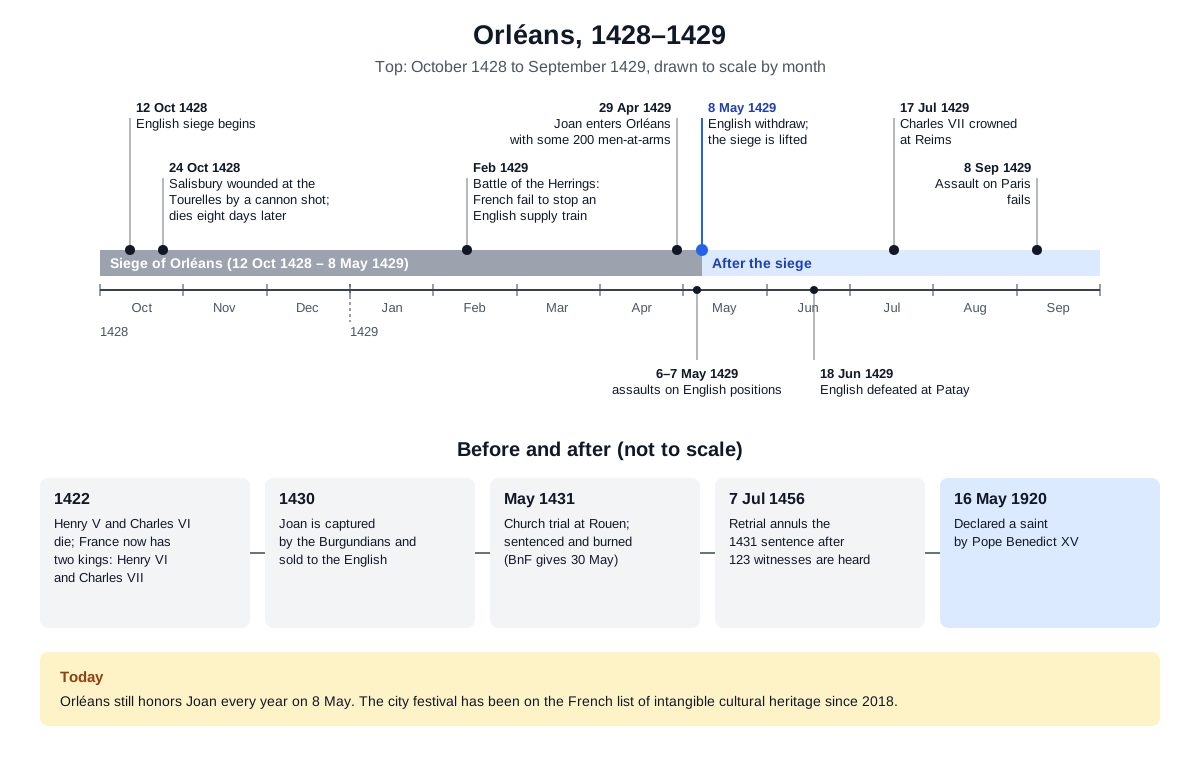
The English besieged the well-defended city from 12 October 1428. Things went badly for them almost at once.
On 24 October, their commander, the Earl of Salisbury, was looking at the city from the Tourelles, a fortification his army had just taken. A cannonball hit a wooden ledge, and a piece of wood was driven into his face. He died eight days later.
Dan Spencer, writing in the Journal of Medieval Military History, sees the death of the top English commander as a key event in how the siege turned out.
The siege went on all the same, and the garrison held out for months. In February 1429, a French attempt to cut off an English supply train failed. The fight became known as the Battle of the Herrings. By then the English looked to be winning.
The young woman from Domrémy
The fullest record of Joan's own words comes from the court that condemned her. In the 1431 trial record at Rouen (translated by W. P. Barrett), she said that at home she was called Jeannette, and in France she was called Jeanne.
She was born in Domrémy, a village joined with Greux. She named her parents as Jacques d'Arc and Isabelle.
She said she first heard a voice from God at the age of thirteen, and that it frightened her badly at first. She told the court the voice ordered her to free Orléans from the siege and to seek out Robert de Baudricourt, who commanded at Vaucouleurs. The record also has her answer that she was a poor girl who knew nothing of riding or fighting.
Baudricourt turned her away twice and gave her an escort the third time. She said she set out in men's clothing, carrying only a sword Baudricourt had given her, with one knight, one squire and four servants.
The Holy See's 1920 bull of canonization says the Dauphin Charles came to trust her greatly because of secrets she revealed to him. Even so, he treated the matter as serious and asked churchmen to judge.
According to the bull, the king sent her to Poitiers to be examined by university doctors. After three weeks, they reported finding nothing in her against the Catholic faith. Joan convinced the Dauphin that God had given her a mission to win back his crown and push the English out.
On 22 March 1429, before she reached Orléans, Joan sent a letter. The letter, printed in Fordham University's Internet Medieval Sourcebook, tells the archers and soldiers before Orléans to go home to their own country. At her trial she agreed she had sent it, but she objected that the copy read to her contained two or three words that were not in the original.
From 29 April to 8 May
Joan rode into Orléans on 29 April 1429, bringing some 200 men-at-arms. That spring she stayed ten days on the city's west side, staying with Jacques Boucher, the Duke of Orléans's treasurer. The house was destroyed by fire in 1940, rebuilt and reopened in 1965, and has been a museum about Joan since 1975.
On 6 and 7 May, Joan led attacks on English positions, and they succeeded. At her trial she said her first target was the Saint-Loup fort, and the next was the fort at the bridge. There an arrow or crossbow bolt struck her neck, but she said she had recovered within a fortnight.
On 8 May, the English accepted defeat and withdrew.
What did Joan carry into the fighting? At her trial she said she much preferred her banner to her sword. She carried it herself in attacks so that she would not kill anyone, and she had never killed anyone. The banner, she said, was white, with a field scattered with lilies.
Siege weapons: forts, cannon and arrows
Sieges mattered a great deal in this long war. The most common siege engine of the war was the trebuchet, which threw stones using a heavy counterweight. Wooden siege engines slowly gave way to cannon such as the bombard. As sieges grew more important, French towns strengthened their defenses, and defenders shot arrows down through narrow openings cut into the walls, or from the wall tops.
It was a cannonball that brought down the Earl of Salisbury. By 1428, artillery was becoming more important. Yet few records show what gunpowder weapons English armies had in the early 1400s. The main reason is that records of the Tower of London, the royal arsenal, have largely not survived.
The 1428 expedition is an exception. Exchequer documents in the UK National Archives (E101/51/27 and E101/51/30) keep artillery accounts for it. They are the oldest known artillery accounts from any English army sent overseas in the 1400s. They show that large resources went into making gunpowder weapons and that their value was recognized.
Arrows and crossbows were still part of the fight. The court asked Joan whether, before an assault, she had told her men that she herself would be struck by arrows, crossbow bolts and stones flung from catapults or cannon. She said no, and added that more than a hundred were wounded. That single question names several weapons of a siege in her time.
Other moments when weapons changed warfare are covered in Turning points in military technology.
The numbers differ by source
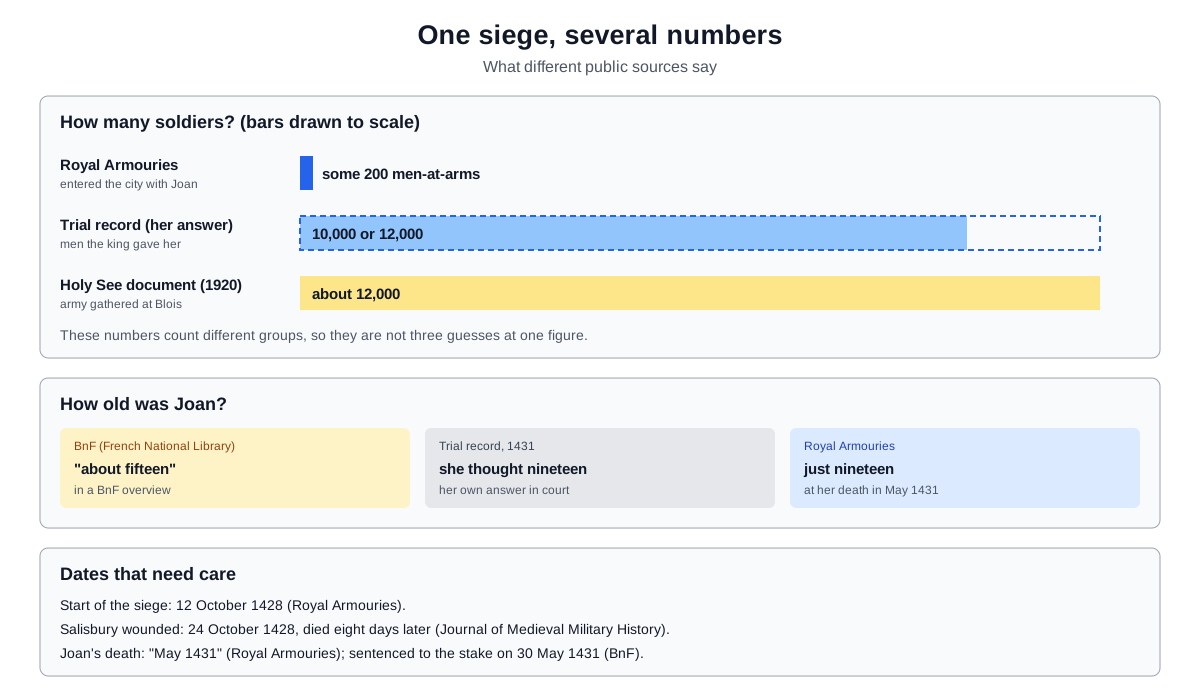
Troop numbers differ first. The Royal Armouries puts the group that came in with Joan at some 200 men-at-arms. At her trial, Joan said the king gave her 10,000 or 12,000 men. The Holy See document says an army of about 12,000 had gathered at Blois, with supplies prepared for Orléans.
These three numbers are not competing estimates of one thing. They count the group that came through the gates with her, the force placed in her hands, and the army gathered at the assembly point. That makes it hard to give one figure for "Joan's army."
Her age varies too. A BnF overview describes her as a young mystic of "about fifteen." At the 1431 trial she said she thought she was nineteen, and the Royal Armouries says she was just nineteen when she died.
After Orléans: Reims, Rouen and the retrial
The English were defeated again at Patay on 18 June. Many places surrendered to Joan, and the Dauphin entered Reims, the traditional place for crowning French kings, where on 17 July 1429 he received the crown as Charles VII. The BnF judges that the victory at Orléans gave back confidence to the Dauphin's army after years of war. By restoring Charles VII's legitimacy, her victories deeply shook English power.
Not everything went well. On 8 September 1429, the royal army, returning from the coronation, passed Paris, which was still held by the English side, and Joan's assault failed. In 1430 she was captured by the Burgundians and sold to the English. The Holy See document says that around then she was defending Compiègne.
The English passed her to a church court, which tried her for heresy. The court at Rouen condemned her; she first accepted the judgment, then was said to have gone back on it, and was handed to the secular authorities. In May 1431 she was burned to death in Rouen. The BnF gives 30 May as the date of the sentence.
That verdict was later overturned. In 1456, once Rouen was French again, a new trial was held and the 1431 sentence was annulled. According to the Holy See document, 123 witnesses were questioned in her home region, Orléans, Paris and Rouen, and the rehabilitation was pronounced on 7 July 1456. On 16 May 1920, Pope Benedict XV declared her a saint.
Orléans still keeps its 8 May. The festival mixes civic, military and religious traditions and has been on the French list of intangible cultural heritage since 2018. Joan of Arc, like Henry V and Edward the Black Prince, is still a widely known name today.
What to read next
- The Hundred Years' War at a Glance: What Happened Over 116 Years: the 116 years around Orléans on one timeline.
- The Battle of Agincourt: a Hundred Years' War battle fought before Orléans.
- Turning points in military technology: other moments when weapons changed warfare.
- A history of laser weapons: from chemical to electric lasers: the path taken by laser weapons, the core subject of this site.