On the afternoon of June 7, 1920, gunfire broke out in Fengwudong, a long valley in North Jiandao just across the Tumen River. Koreans call the place Bongodong. Four months later, in October, fighting went on for six days in the forests of Qingshanli, or Cheongsan-ri in Korean. Korean textbooks present both names as battles in which independence fighters took on regular Japanese troops and won.
Ask how many Japanese soldiers fell, though, and the answers do not agree. One record says 157 and another says 1. For Qingshanli the figures run from about 1,200 to 3,300.
This article sets two kinds of source side by side. One is the New History of Korea (Sinpyeon Hanguksa), published by the National Institute of Korean History. The other is a set of entries in the Encyclopedia of Korean Culture from the Academy of Korean Studies. Together they show why the two battles happened, how they went, and what they left behind.
Independence armies across the border
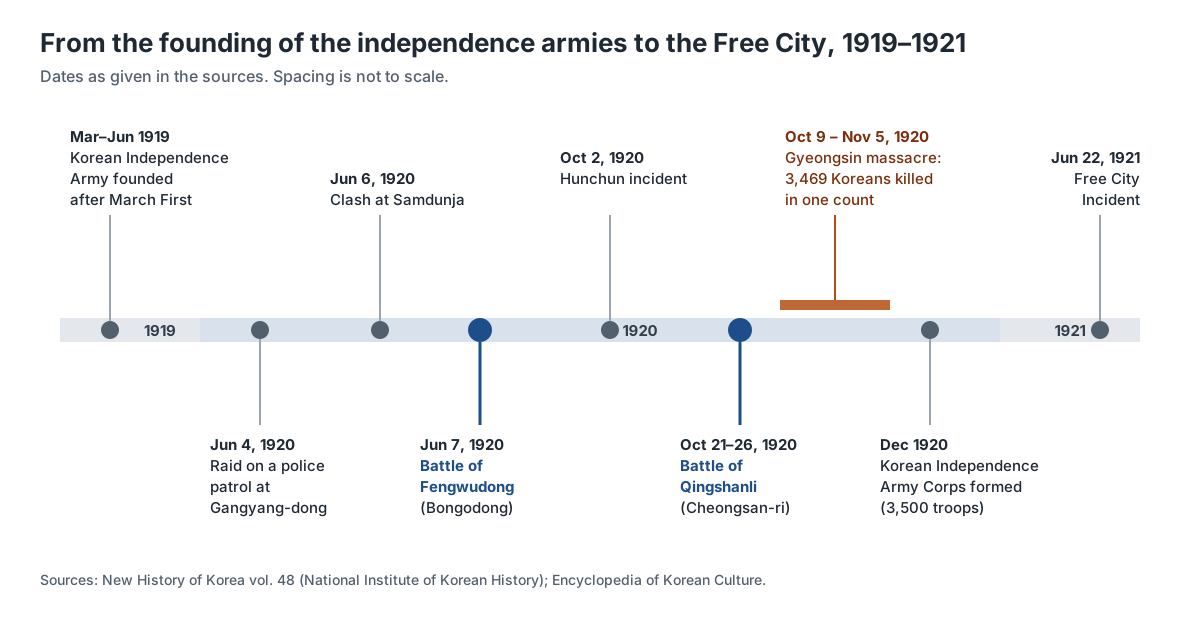
Around the time Korea lost its sovereignty, patriots who had fought in the righteous armies, along with ordinary emigrants, moved to Jiandao (Gando) and the Russian Maritime Province. They formed independence groups and set up bases to train fighters. The March First Movement of 1919 set this effort alight. From then on, the independence army units in Jiandao became far more active.
Two men stand at the center of both battles: Hong Beom-do and Kim Jwa-jin. Hong had been a hunter. In September 1907, Japan used the Firearms and Gunpowder Control Act to take hunters' guns away. That November, Hong formed a band of mountain hunters and rose as a righteous army leader.
In 1910 he crossed into Jiandao and organized a hunters' corps. Between March and June 1919, after the March First Movement, he founded the Korean Independence Army, known in Korean as the Daehan Dongnipgun.
Kim Jwa-jin entered the Korean Empire's army military academy in 1905 and became an officer in 1907. His force, the Korean Military Administration (Daehan Gunjeongseo), took that name at the request of the Provisional Government. It was usually called the Northern Military Administration (Bungno Gunjeongseo) to tell it apart from the Western Military Administration (Seoro Gunjeongseo) in West Jiandao. It kept its headquarters in the forests of Seodaepagu in Wangqing County and ran an officer training school.
In these years, independence units kept crossing the Tumen to strike Japanese military police and police posts on the border, then returning. Such raids were called home-entry operations. The battle at Fengwudong began with one of them.
Fengwudong, June 1920
Before dawn on June 4, a small unit of about 30 independence fighters crossed the Tumen from Samdunja. They defeated a Japanese military police patrol at Gangyang-dong in Jongseong County, North Hamgyeong, and came back after dark.
A Japanese company and military police crossed the river in pursuit and killed innocent Korean villagers at Samdunja. The independence fighters then attacked them. The Battle of Fengwudong on June 7 grew out of this clash at Samdunja the day before.
The Japanese 19th Division, which guarded the Tumen, formed a "river-crossing pursuit battalion" and entered North Jiandao, which was Chinese territory. It had two infantry companies, a machine-gun platoon, and military police and police detachments. Early on June 7 the force crossed the river at Hatan-dong in Onseong and headed for Fengwudong, a main independence army base.
Fengwudong is a valley 15 ri northwest of today's Tumen City, running for 25 ri. Three Korean villages sat inside it: Lower, Middle and Upper Village. A combined force under Hong Beom-do, made up of the Korean Independence Army, the Sinmindan and the Gunmu Dodokbu, moved the villagers into the hills ahead of time. The fighters then waited on the heights around the valley.
Japanese troops who entered Lower Village killed the old and the weak who had not managed to flee, and ravaged the village. In the afternoon, as the main Japanese body neared Upper Village, Hong fired the signal flare for a full attack. Trapped in the valley, the Japanese held on for three hours and then withdrew.
Accounts of who was in command also differ a little. The New History of Korea names Hong Beom-do as overall commander. In the encyclopedia entry on the battle, the reorganized force had Choe Jin-dong as commander and Hong as regiment commander. The entry adds, though, that this was a formality and that Hong was the one who actually led the victory.
The Hunchun incident and the march into Jiandao
The defeat at Fengwudong came as a shock to Japan. The Provisional Government's Military Affairs Ministry declared the victory "the first round of the war of independence," and the fighters' morale rose sharply. Japan had already tried to hunt down the independence armies jointly with Chinese authorities, but in North Jiandao this did not work. Some Chinese officials, including the governor of Jilin Province, opposed the joint searches and warned the independence armies about Japanese moves in advance.
By August 1920 Japan had drawn up a plan to wipe out the independence armies in Jiandao. What it still needed was a pretext for crossing the border. The New History of Korea describes the Hunchun incident of October as one Japan staged on purpose. On this account, the Japanese army paid and armed a Chinese bandit leader, Jang Gang-ho, so that his men would attack Hunchun, home to a branch of the Japanese consulate.
Before dawn on October 2, about 400 bandits attacked the walled town of Hunchun. More than 70 Chinese soldiers and 7 Koreans were killed, and the empty Japanese consulate branch was burned. There is also a record that the family of a Japanese policeman and 9 Japanese women were killed.
From that same day, Japanese troops moved into Jiandao without first consulting Chinese authorities. The main body of 9,000 from the 19th Division was joined by 4,000 from the 14th Division at Vladivostok, 1,200 from the Kwantung Army and others, for 20,000 in all. Heavy weapons such as machine guns and artillery came with them.
Qingshanli: six days in October 1920
Chinese troops had passed on word of the coming Japanese "punitive" campaign. So the independence units moved into the forests around Idogu and Samdogu in Helong County. Kim Jwa-jin's Northern Military Administration reached the Qingshanli area of Samdogu in mid-October.
The encyclopedia entry dates its arrival to around October 10, and the New History of Korea to October 12–13. Nearby, at Idogu, was Hong Beom-do's combined force.
At first the commanders decided to avoid battle. They feared a large fight would turn the Chinese government against them and draw in even more Japanese troops. The New History of Korea places this meeting at Myoryeong on October 10, while the encyclopedia entry dates it to October 19. As Japanese troops closed in, Kim's force judged that it could not shake off the pursuit and decided to fight.
The Qingshanli valley stretches about 25 km from east to west. The forest on both sides was so thick that people and horses could hardly pass. Around 9 a.m. on October 21, a Japanese pursuit unit came along the narrow valley path into Baegunpyeong, where the Northern Military Administration lay in ambush and opened fire.
The main Japanese body that followed also fell back. The encyclopedia entry on Qingshanli says it left more than 200 dead.
That afternoon, at nearby Wallugu, Hong Beom-do's force was surrounded by Japanese troops and broke out. According to the same entry, one Japanese unit of about 400 men was wiped out in fighting that lasted until the next morning. The entry gives the reason: the two sides' uniforms were almost the same color, so Japanese troops mistook their own unit for independence fighters.
Japanese reports give very different numbers. The figures are set out source by source in a later section.
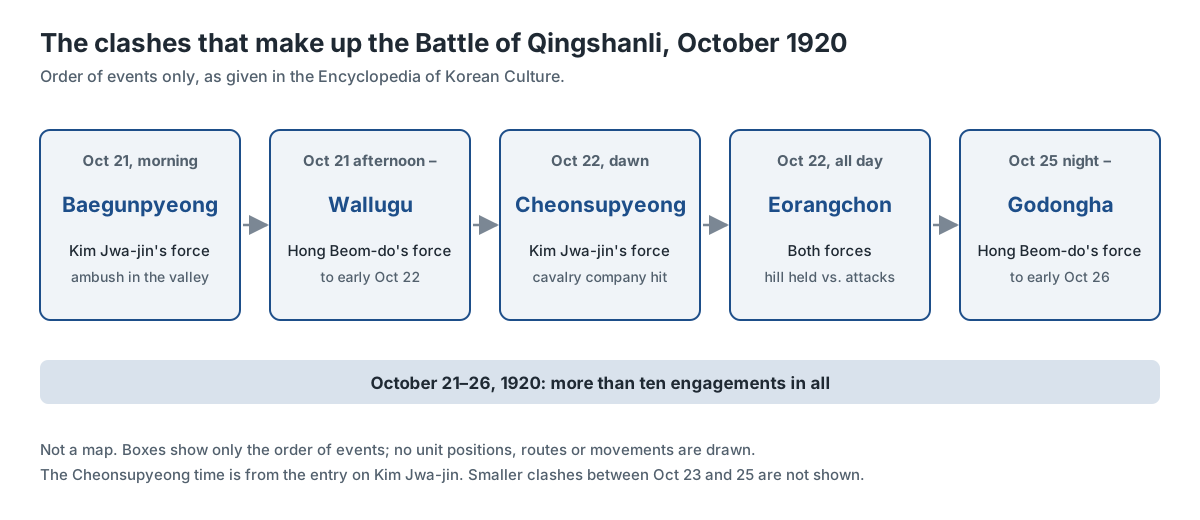
At dawn on October 22, Kim's force struck a Japanese cavalry company at Cheonsupyeong. It then held a hill near Eorangchon against Japanese attacks all day, and Hong's force came to help. After that the independence fighters pulled back along the Godongha River, fighting small clashes on the way. On the night of the 25th their camp in the Godongha valley was attacked, but they struck back and left for Antu County at dawn.
These more than ten clashes, fought from October 21 until the early hours of October 26, are together called the Battle of Qingshanli, or the Great Victory at Qingshanli.
How the independence armies were armed
The independence fighters did not fight empty-handed. With donations from Koreans at home and abroad, they bought large numbers of modern weapons from Siberia. The Northern Military Administration received war funds from Daejonggyo, a Korean religious movement, and had a training unit that had finished the officer school.
The encyclopedia entry on Qingshanli puts the Northern Military Administration at about 1,600 troops, including 298 who had graduated from the officer school that year. Their weapons came to 1,300 rifles, 150 pistols and 7 machine guns. Hong Beom-do's force joined seven groups, including the Korean Independence Army, the Korean National Association Army and the Uigunbu, and numbered about 1,400.
The New History of Korea first notes that the records are too limited to pin down troop strength. It then adds up eight units and puts the total at about 2,000.
The Korean community in Jiandao kept these weapons and supplies coming. The Korean National Association collected 10 won from each household, plus a tenth of its property, as war funds. Made up mostly of poor farmers, the community paid for weapons, supplied food and clothing, and reported on Japanese movements, even though it had little to spare.
It was not a well-supplied army. In a report to the Provisional Government, Seo Il, head of the Korean Military Administration, wrote that during three days of fighting the food supply was cut off. The men filled their empty stomachs with only five or six potatoes each.
Facing them was a regular army equipped with machine guns and artillery.
As direct reasons for the independence armies' success, the New History of Korea first names the fighters' will to fight on whatever the cost. It then points to how they used the forests and valleys and took the high ground first. It treats the backing of the Korean community in Jiandao separately, as a deeper underlying cause. It is best read as one interpretation among several.
How to read the casualty figures
For Qingshanli, the New History of Korea says Korean, Japanese and Chinese records differ so much that the real results are hard to pin down. Even so, it finds that they broadly agree in recording a clear win for the independence armies. Where they part ways is in the numbers.
For Fengwudong, the Military Affairs Ministry announced 157 Japanese killed and about 200 badly wounded, with 4 independence fighters killed. The New History of Korea suggests these figures were somewhat inflated in spreading news of the victory. It still says that reports in The Independent (Dongnip Sinmun) and a Shanghai newspaper confirm that about 150 Japanese were killed. The Japanese battle report, by contrast, lists 1 Japanese killed and 1 wounded, and says about 30 independence fighters were "killed."
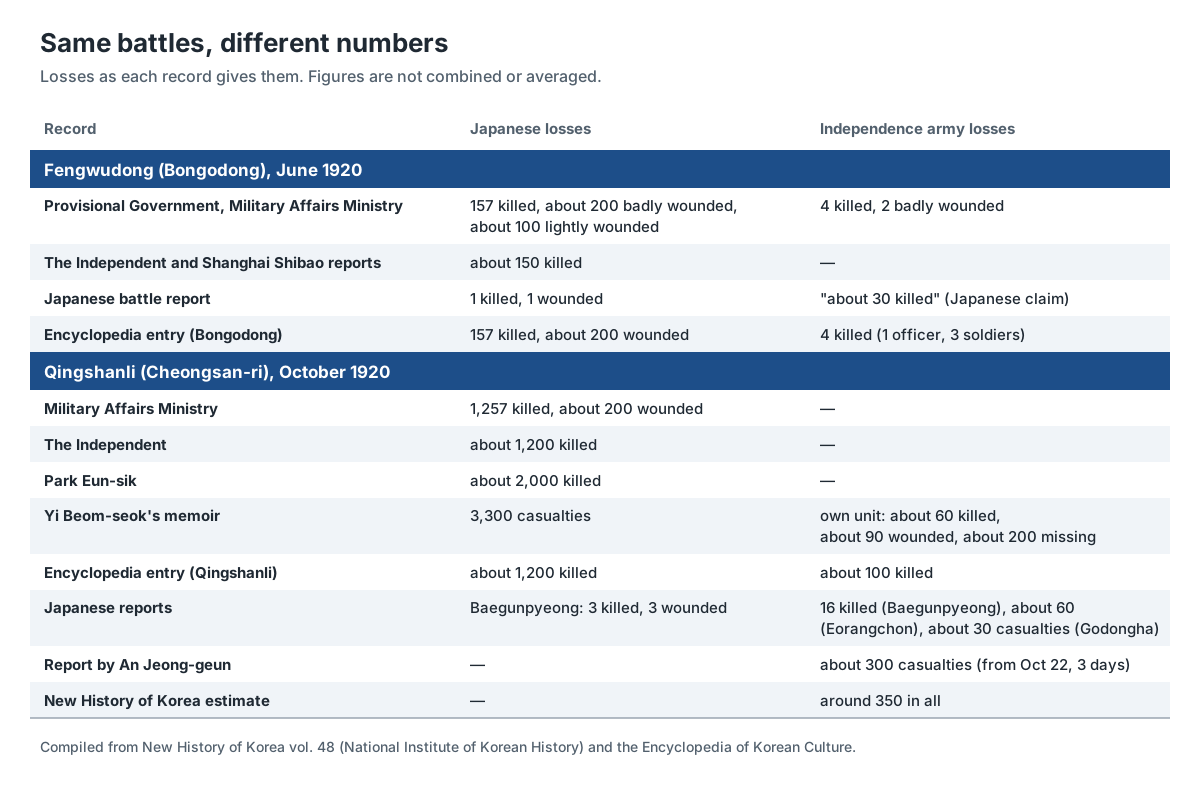
For Qingshanli the gap is wider. Japanese dead number 1,257 in the Military Affairs Ministry's announcement, about 1,200 in The Independent, and about 2,000 in Park Eun-sik's account. Yi Beom-seok, who fought there, counted 3,300 Japanese casualties in his memoir.
Japanese reports list 3 soldiers killed at Baegunpyeong. The New History of Korea takes this as a sign that the Japanese records hid the defeat and played down their losses. Yet the Japanese consul general in Jiandao admitted in a secret cable home that the campaign could hardly escape criticism as "something of a failure."
Losses on the independence side also vary. The encyclopedia entry gives about 100 dead, and Japanese intelligence records give 16 dead at Baegunpyeong and about 60 at Eorangchon. Yi Beom-seok lists about 60 killed, 90 wounded and 200 missing for his own unit alone. Drawing on the report of An Jeong-geun, an envoy of the Provisional Government, and other records, the New History of Korea estimates the total at around 350.
Every one of these numbers was written down by someone with a purpose. The side announcing a victory may have counted high, and the side hiding a defeat may have counted low. Rather than memorizing one figure, it is more accurate to keep the name of whoever recorded it right beside it.
The Gyeongsin massacre and what came after
While the fighting went on and after it ended, what came to the Korean villages of Jiandao was no celebration. In 1920 the Japanese army carried out mass killings of Koreans living in Jiandao. This is known as the Gyeongsin massacre.
The encyclopedia entry on the massacre begins with the Japanese troops who entered Jiandao on the pretext of the Hunchun incident. In the name of wiping out the independence armies, they carried out a scorched-earth campaign. It then adds that, after their heavy defeat at Qingshanli, Japanese troops took revenge by killing without distinction.
Villages were left in ruins, their houses burned and their livestock seized. Foreign missionaries working in Manchuria made the killings known to the outside world. The entry says that Jang Deok-jun, a Dong-A Ilbo reporter who had gone to cover the events, was assassinated by the Japanese army.
The full toll was never counted. The entry gives 3,469 Koreans killed in the 27 days from October 9 to November 5. It judges that the number killed over three or four months of massacres was far higher. Each of those numbers was a person who had lived in Jiandao.
The independence armies moved north to Milsan to escape the Japanese army. In December 1920, ten units joined to form the Korean Independence Army Corps, about 3,500 strong. Its leaders crossed the border into Siberia in the first month of 1921. Kim Jwa-jin opposed going to Soviet Russia.
On June 22, 1921, in the Free City (today's Svobodny in Russia), the Soviet Red Army ordered the independence fighters to disarm, then shot or captured those who resisted. This is called the Free City Incident. Behind it lay talks between the Bolsheviks and Japan, which wanted the independence armies broken up, and a split between two factions of the Goryeo (Korean) Communist Party.
Neither commander had an easy end. Kim Jwa-jin refused to serve under Russian command and returned to Manchuria, where he organized the Sinminbu in 1925. In January 1930 he was shot dead at a rice mill at Sanshi station.
Hong Beom-do was moved to Kyzylorda in Kazakhstan during the 1937 forced relocation of Koreans. He worked as a theater guard, among other jobs, and died in 1943 at age 76. His remains were brought home on Liberation Day in 2021 and buried at Daejeon National Cemetery.
What to read next
- Turning points in military technology: how weapons changed in the century after Fengwudong and Qingshanli
- A history of laser weapons: from chemical to electric lasers: from the age of rifles and machine guns to weapons that fire light, another branch of weapons history