A shell fired by an artillery crew leaves human hands the moment it clears the muzzle. After that, the angle set before firing, the push of the propellant, and the wind and air decide where it goes. There was no way to tell it "a little to the left" on the way.
What if that shell carried a small rudder and something to find its way? Guided shells grew out of that question.
The first ones followed a spot of light on the target. Later ones worked out their own position from satellite signals, and later still came a way to keep the shell as it was and change only the fuze. This article follows that path and the problems along it.
A round that leaves your hands
An ordinary shell's path is set once it leaves the barrel. In a 2008 U.S. Army article, a battery commander in the field said that fire generally gets less accurate the farther you are from the target. He added that ordinary rounds may miss with the first few shots, so the crew has to adjust. In effect, they fire, watch where the rounds land, and correct.
Some artillery rounds and rockets are unguided. A guided munition, by contrast, can alter its flight path to fix aiming errors or the effect of weather. A primer from the U.S. Congressional Research Service (CRS) notes that this raises its chance of a hit. The parts a precision-guided munition (PGM) relies on include an inertial measurement unit (IMU), a GPS receiver, a laser seeker and a millimeter-wave radar seeker.
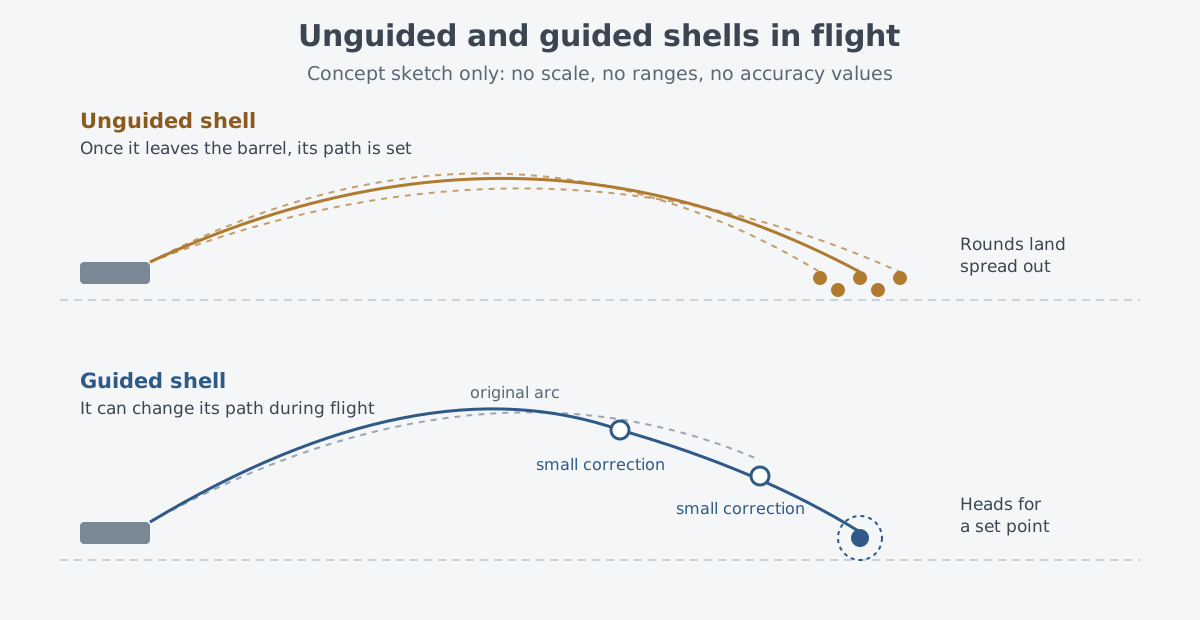
Think of a thrown ball and a remote-controlled toy plane. Once the ball leaves your hand, you cannot correct it, but the toy plane can turn as it flies. A real guided shell is different in one way: no person flies it. A device inside the round makes small corrections on its own, using information it was given beforehand or signals from outside.
People often describe accuracy with the circular error probable (CEP). Draw a circle around the target so that half of the rounds fired land inside it. The smaller that circle, the more tightly the rounds gather near the target.
The gun barrel is hard on electronics
A bomb is dropped from an aircraft, but a shell is driven out of the barrel by burning propellant. At that moment, everything inside the round takes a huge jolt all at once. Any guidance device has to survive that moment first.
The U.S. Army's Picatinny Arsenal has a machine for studying just this problem. The Soft Catch Gun is a research system built on a 155 mm howitzer, and it catches the fired round without breaking it. Engineers take the round out, pull it apart and check how the electronic parts, fuzes and precision-guidance systems held up under the intense G-forces of being fired from a cannon.
Whether the gun is a self-propelled howitzer that drives itself or a gun that is towed, every guided shell in this article is fired from a 155 mm gun. The guns themselves are covered in Self-propelled howitzers: guns that move themselves.
Copperhead and the laser spot
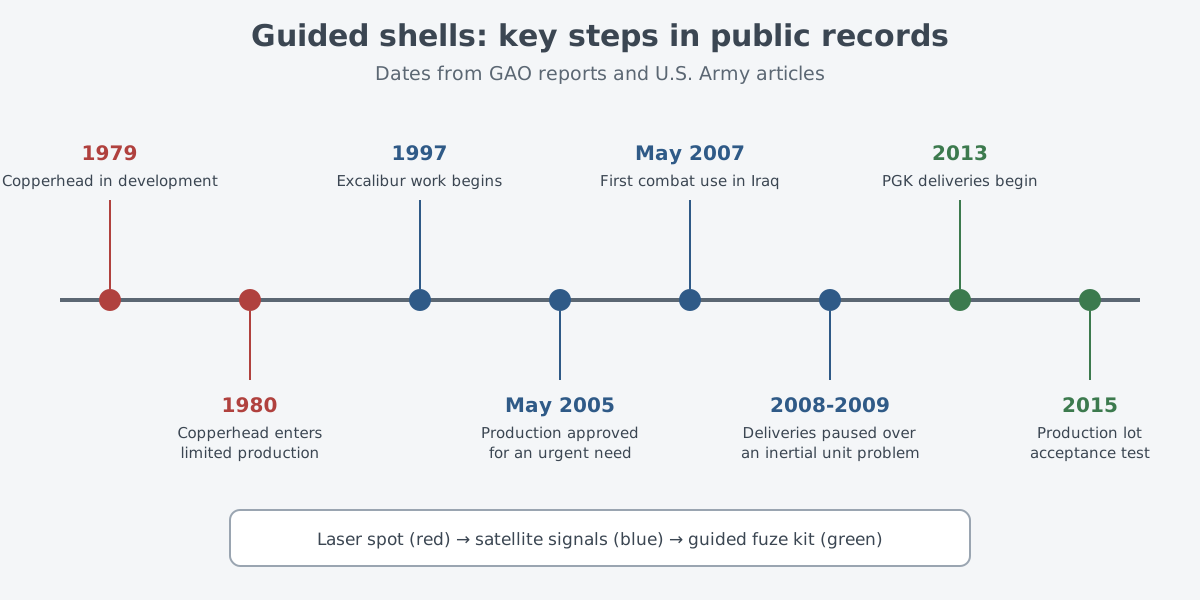
Copperhead is a guided shell that appeared in U.S. congressional audit reports in the late 1970s. A 1979 report by the U.S. General Accounting Office (GAO) described it as a precision guided munition. It was built to home in on laser light bounced off a target that a laser designator had lit up. It was called the XM712 155 mm projectile and was being developed for the standard 155 mm howitzers the Army already had.
The key idea is a division of labor. A separate designator does the job of shining the light, and the shell only looks for the light coming back from the target. This is called semi-active laser guidance. At the time, Copperhead's primary designator was a ground laser locator designator.
A GAO report from November 1980 says this laser-guided round, meant for use against armor, went into limited production that year. The review covered four things: visibility, response time, development improvements and reliability.
GAO advised keeping production limited until two things were shown. One was a quicker response that would help against moving targets. The other was the required reliability.
A shell that follows satellites: Excalibur
The next big step came from satellites. Excalibur is a family of GPS-based precision rounds for 155 mm cannon artillery. A 2010 GAO weapon program assessment called it "fire-and-forget," meaning the crew does not have to guide it after firing. The same assessment named three critical technologies: the airframe, the guidance system and the warhead.
Development began in 1997. In May 2005, the program won approval to start producing its first increment. The trigger was an urgent call from Iraq for more precise artillery that would cause less collateral damage. The round was expected to come down almost straight, which would limit collateral damage and suit it to urban areas.
The first combat firing took place in Iraq on May 5, 2007, by a unit of the U.S. Army's 1st Cavalry Division. Excalibur combined U.S. guidance expertise with Swedish airframe experience. An Army article the next year said it had become the Army's first precision-guided artillery round that could be used in any weather. It was first used in Afghanistan in February 2008.
So what happens in flight? The battery commander in that article explained it simply. Once the round leaves the gun, it runs a self-test, picks up its signal and uses it to find the target.
The round could be fired from M109A6 Paladin self-propelled howitzers and M777A2 howitzers. How satellite signals and an inertial unit pair up to tell a round where it is is covered in Inertial and satellite navigation: knowing where you are.
Changing just the fuze: the Precision Guidance Kit
Excalibur is a whole new round. Is there a way to keep using the ordinary shells already in storage? The answer was the Precision Guidance Kit (PGK). Every shell has a place for the fuze, the part that decides when the round goes off, and PGK was built for that exact spot.
In March 2013, Picatinny Arsenal began delivering the XM1156 PGK to troops. It goes into the fuze well of ordinary 155 mm high-explosive shells (M549A1 and M795) in place of the standard fuze. After firing, this fuze uses satellite position data to move small fins called canards and steer the round toward the target.
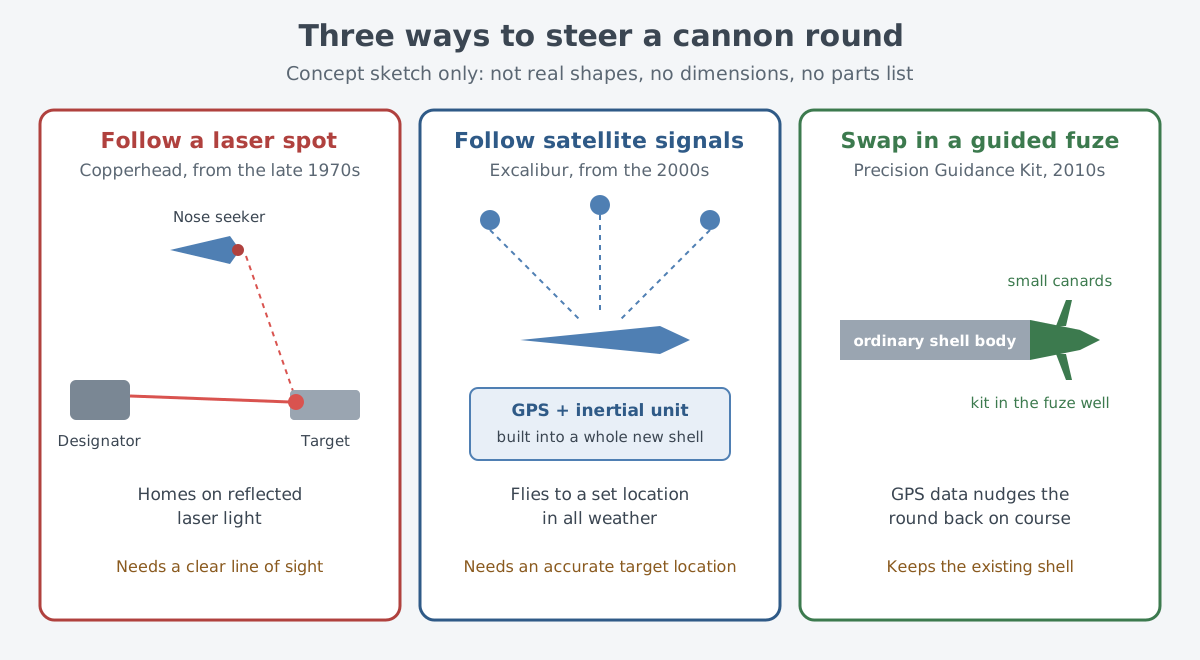
PGK is a new fuze that turns 155 mm rounds already in the stockpile into low-cost precision weapons guided by GPS. In flight, it reads GPS signals and nudges the round's path so that it keeps heading for the programmed location. At the target, it works in whichever of two modes was selected: point detonating or proximity fuze mode. How the proximity mode works is explained in Proximity fuzes: working without a direct hit.
It can look like adding a navigation app to an old car. The difference is that it does more than suggest a route: the fuze moves the fins itself and changes the round's path. There is a safety feature, too. According to the 2013 article, a round fitted with PGK will not go off unless it comes near the target; otherwise it simply lands along its path.
Better accuracy was expected to cut the number of rounds needed to hit a target, and with it collateral damage and the risk to civilians. PGK first reached troops in 2013 under an Urgent Materiel Release. In 2015 it passed its first production lot acceptance test, and a decision on full-rate production was expected later that year.
Limits: coordinates, weather and cost
A guided shell goes to the location it was given. The battery commander who fired Excalibur said that as long as he had an accurate target location, he got an accurate hit. Turn that around: if the location is wrong, the round goes precisely to the wrong place. The round itself cannot tell whether that location holds the right target.
Laser guidance comes with other conditions. In this method, the designator's light must reach the target, and the shell must find its reflection.
An earlier GAO report on Copperhead, cited in the 1979 one, left issues open: how weather and terrain would affect the round, and whether it was worth its cost. Visibility was also the first of the four items in the 1980 review.
Steadily making parts that survive a cannon launch was not easy either. The 2010 GAO assessment records that the Army stopped taking Excalibur deliveries between November 2008 and August 2009. The cause was trouble with the inertial measurement unit that helps steer the round. Over the years after work started in 1997, the program was restructured four times, its planned quantities shrank and each round grew more expensive.
Cost cannot be left out. In its 2015 article, the Army pointed to price as a strength of PGK. It turns existing rounds into "smart" ones for far less than typical precision munitions cost.
Where this meets lasers
In Copperhead, the laser was a pointing finger, not a weapon. The designator sends the light that marks the target, and the shell follows its reflection. The CRS primer lists laser guidance, introduced in the 1960s, among the advances that improved a munition's ability to hit a target more accurately.
Two articles on this site go further into bombs that follow reflected light and the gear that shines it. They are "Laser-Guided Bombs: Following a Reflected Laser Spot" and "Laser Designators: Pointing Out a Target with Light." On the way to the target and back, the light has to pass through air. Why light weakens and spreads out in air is explained in Light through air: absorption, scattering, turbulence, thermal blooming.
Pointing at a target with light is not the same as using light itself as a weapon. That difference is the subject of What is a laser weapon? Film versus reality.
What to read next
- Self-propelled howitzers: guns that move themselves: how the guns that fire guided shells move and shoot.
- Laser Designators: Pointing Out a Target with Light: who shines the light Copperhead followed, and how.
- Jamming and spoofing: interference versus deception: the difference between blocking satellite signals and faking them.