On the morning of 7 August 1942, U.S. Marines came ashore on the north coast of Guadalcanal in the Solomon Islands of the South Pacific. Their target was a single airfield that Japan had almost finished at Lunga Point. The Naval History and Heritage Command (NHHC) records it as the first time the U.S. Navy went on the offensive in the Pacific with a landing from the sea.
For six months after that, the fight over that airstrip went on by land, by sea and in the air. There were seven major naval battles alone, and sunken ships piled up in the waters around the island. Why did one small runway matter so much? The story runs from the reasons Japan came to the island to the Japanese withdrawal in February 1943.
An island between Rabaul and Australia
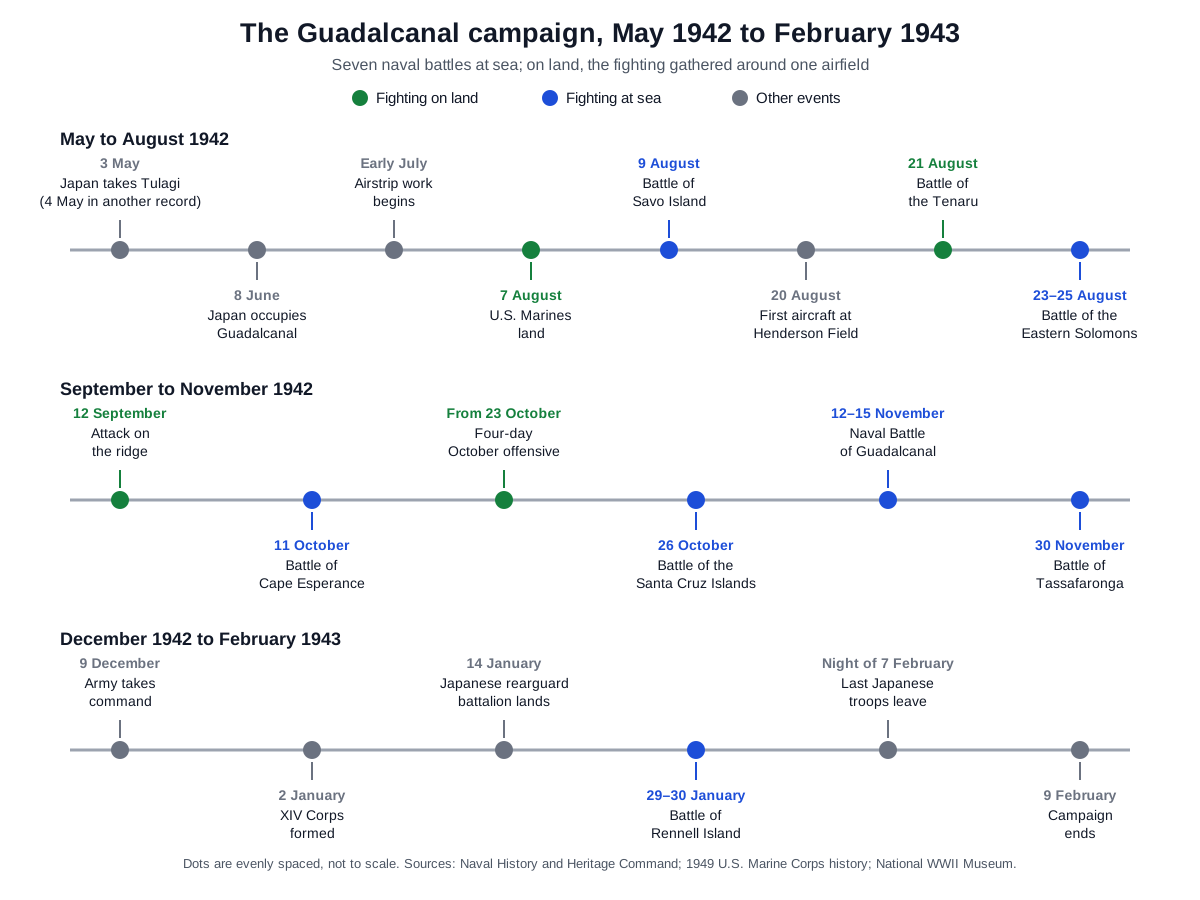
In the spring of 1942 the Solomon Islands were under British administration. To protect its strategic base at Rabaul on New Britain, Japan took Tulagi on 3 May and occupied nearby Guadalcanal on 8 June. A 1949 U.S. Marine Corps history gives 4 May for Tulagi, so the records differ by a day.
Japan wanted Guadalcanal for a support base and an airfield. The survey ended in late June, and serious work on the airstrip at Lunga Point began in early July. These footholds also supported Japan's push south toward New Guinea and Australia.
The United States knew about the plan. Coastwatchers near the island reported it first, and American reconnaissance aircraft confirmed their reports. Japan was planning an airfield on the Lunga Plains.
A counterstroke planned in under a month
Admiral Ernest King led the U.S. Fleet and also served as Chief of Naval Operations. After the victory at Midway in June 1942, he put the Navy in the lead in the Pacific and overcame the Army's resistance to an immediate offensive. The result was Operation Watchtower, which went from idea to finished plan in less than a month and used only the Navy and the Marine Corps.
The haste left many gaps. Major General Alexander Vandegrift, who led the 1st Marine Division, hoped to train for six months or more first. Good maps of the island were hard to find, and so were sea charts for the difficult Solomons waters.
King pushed ahead and said the landing would go "even on a shoestring." The Marines mocked it with a nickname of their own: Operation Shoestring.
The operation got its code names. The whole operation was Watchtower, and Guadalcanal as a place was CACTUS. Almost 19,000 Marines sailed in 19 transports and four transports converted from destroyers.
The landing and the night off Savo Island
The 1st Marine Division went ashore on Guadalcanal on 7 August. Most Japanese on the island were construction troops, and, caught off guard, they offered little resistance. The Marines seized the half-built airstrip and dug a defensive line around it. The landing relied on a new type of landing craft from the New Orleans firm Higgins Industries.
Across the water, the fighting on Tulagi and Florida Island was fiercer, and the Marines had cleared both by 9 August. Meanwhile, things went wrong at sea. Admiral Frank Jack Fletcher, who led the carrier force, worried about his carriers in the narrow Solomons waters and pulled them back on 8 August.
Just before 2 am on 9 August, seven Japanese cruisers and one destroyer came down New Georgia Sound from Rabaul and Kavieng. This was the sea lane also known as "the Slot." The Australian War Memorial (AWM) blames lapses in Allied intelligence and alertness for letting the force guarding the landing ships be caught by surprise near Savo Island.
The Allies lost four cruisers, one Australian and three American. In all, 1,023 Allied personnel died and 709 were wounded, while Japan's ships came away only lightly damaged. The Battle of Savo Island is counted as the worst defeat the U.S. Navy has suffered in a single fleet action.
The Australian heavy cruiser Canberra led that force. She took 24 hits in under two minutes and soon lost all power, so she could not fire a single shot. Eighty-four of her crew died, including Captain Frank Getting. Seventy-three died on the spot, and 11 survived at first but died later.
After the survivors were taken off, Canberra was sunk by a torpedo from a U.S. destroyer. The AWM encyclopedia says this happened "the next day," while an AWM media release gives about 8 am on 9 August. By the encyclopedia's count, 84 Australian and 939 American sailors were killed or died of wounds in the battle.
The Japanese force turned for home without attacking the transports. NHHC suggests that had Vice Admiral Mikawa Gunichi wrecked the transports too, the course of the campaign, and perhaps of the war's next stage, could have changed. With the carriers and their air cover gone, the Navy stopped all transport to the island. Cut off, the Marines got by on rice and dried fish taken from Japanese stores.
Four months holding Henderson Field
Vandegrift named the airstrip for Major Lofton R. Henderson, a Marine aviator of the Battle of Midway. The work used equipment the Japanese had left behind. It was old but mostly undamaged, and there were 400 drums of fuel that Japan had stored for its own planes, due on 7 August.
On 19 August, despite daily air raids, the airstrip was finished. The next day, 19 Marine fighters and 12 dive bombers took off from the carrier Long Island, 200 miles south of the island, and landed at Henderson Field. This was the start of the island's air unit, the CACTUS Air Force. It mixed Marine, Navy and Army aircraft.
The first big fight on land was the Battle of the Tenaru on 21 August. The Marines met the force of Colonel Ichiki, which had landed near Taivu on 18 August. The Japanese group of about 900 men suffered almost total casualties, and 15 were taken prisoner. The Marines lost 34 killed and 75 wounded.
On 12 September, Kawaguchi's brigade attacked a low hill just south of Henderson Field. Over two days the attackers came on again and again, and Marine rifles, machine guns and mortars drove them back. A National WWII Museum article puts the attackers' casualties at over 700 and the Marines' at 135. The rise later became known as Edson's Ridge, or Bloody Ridge.
A larger offensive came in October. Before it, the Navy landed its biggest troop convoy since the first landing, bringing in most of the Army's 164th Infantry Regiment. From 23 October the Japanese Seventeenth Army hit the defenses around the airfield at several places across four days, and Marines and soldiers held them off.
The museum article puts Japanese losses in this fighting at 3,500 men. After that, the Japanese never again came so close to Henderson Field.
Aircraft by day, warships by night
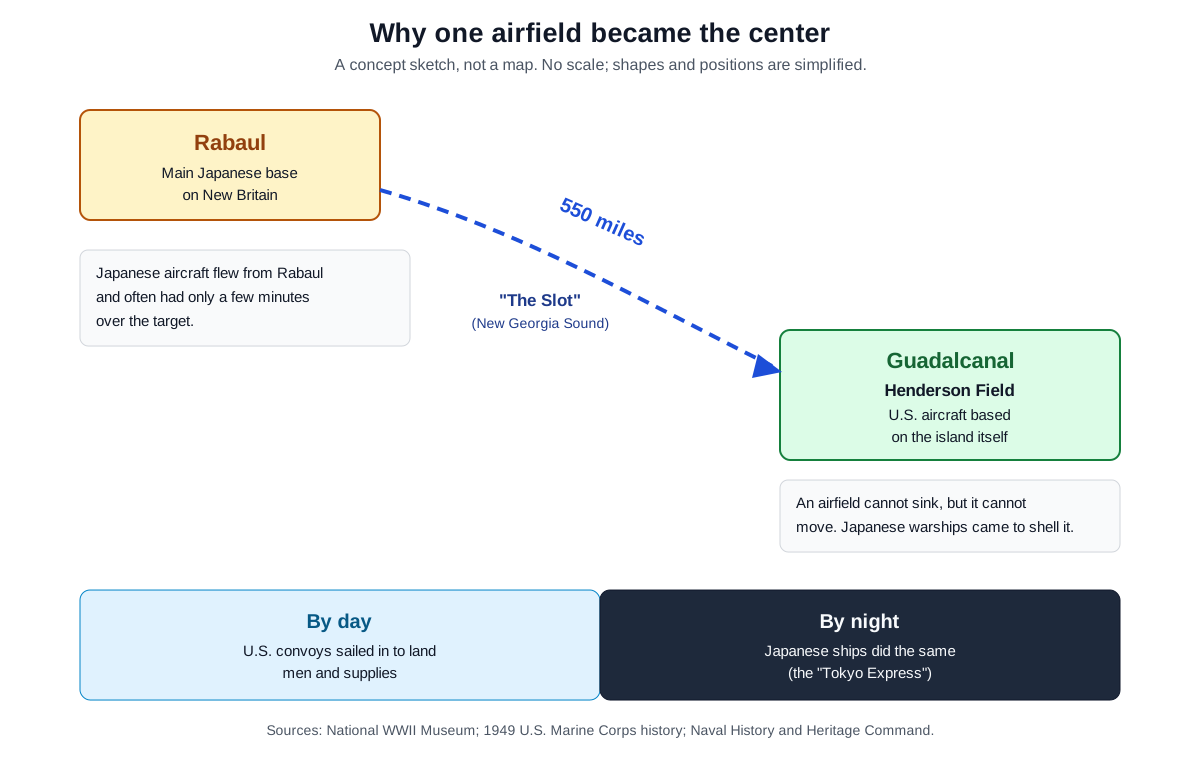
The fight at sea around Guadalcanal looked different by day and by night. On most days, U.S. convoys arrived and put troops and supplies ashore. At night, Japanese ships did the same job. The 1949 Marine Corps history calls the Japanese ships that brought troops by night the "Tokyo Express."
In the Battle of the Eastern Solomons on 23–25 August, the two sides' ships never saw each other. Every attack came from carrier-based or shore-based aircraft. Neither side won clearly, but Japan lost many aircraft and experienced aircrew, and its reinforcements for the island were delayed.
Off the Santa Cruz Islands on 26 October, the United States lost the carrier Hornet, and another carrier was badly damaged. It also lost 81 aircraft. Japan lost 99 aircraft and pulled back with both of its carriers damaged. NHHC sums it up: Japan could claim a tactical victory but never made up for its lost veteran aircrew, and its carriers played no further major part in the campaign.
At night, cruisers and destroyers did the fighting. In the Battle of Cape Esperance on the night of 11 October, Rear Admiral Norman Scott's four cruisers and five destroyers surprised a Japanese force coming to shell Henderson Field. Japan lost one cruiser and one destroyer, and the United States lost one destroyer.
Meanwhile, a Japanese supply convoy reached the island. The strategic result was unclear, but the battle gave the U.S. Navy a big lift in morale after the defeat at Savo Island.
The Naval Battle of Guadalcanal on 12–15 November was a series of air and sea fights over several days. Japan sent a convoy carrying 7,000 troops and planned to shell Henderson Field. The U.S. Navy stopped the shelling and sank most of the troop transports, but two rear admirals, Daniel J. Callaghan and Scott, were killed.
In this battle the United States lost two light cruisers, four destroyers and 35 aircraft. Japan's losses were two battleships, a heavy cruiser, three destroyers, 11 transports and 64 aircraft, and its last major attempt to drive the Allies off the island ended here.
Behind the numbers are people. The five Sullivan brothers, serving together on the light cruiser Juneau, were all lost with the ship after this battle. One of them, George, survived the sinking but died at sea five days later.
The Battle of Tassafaronga on 30 November had a mixed result. The U.S. force sank one Japanese destroyer, but Japanese torpedoes sank one U.S. cruiser and badly damaged three others. The Japanese ships escaped, yet they could not land the supplies and troops they carried.
So many ships went down that the waters around the island became known as Ironbottom Sound. The name means a sea with a floor of iron.
The tools of the time: airfield, landing craft, radar and radio
Holding Henderson Field let the United States keep its aircraft right on the island. Japanese planes had to make the 550-mile trip from Rabaul and often could stay over their targets for just a few minutes.
An island airfield can be compared to an aircraft carrier at sea. In fact it differs. An airfield cannot sink, but it cannot move either. At Cape Esperance and in the November Naval Battle of Guadalcanal, the Japanese warships' task was to shell Henderson Field.
Higgins landing craft carried the men from ship to shore. Yet this was the first amphibious landing in the Pacific, and there were many mistakes. At first there were not enough means to move men and supplies inland from the beaches.
Radar was still new. At Tassafaronga, the U.S. force used its still fairly new surface-search radar to find the Japanese ships first. Even so, it took heavy damage from Type 93 "Long Lance" torpedoes that the Japanese ships fired quickly. Finding the enemy first was not the same as winning the fight.
Supply was a technical problem at sea as well. From around the time of Tassafaronga, the Japanese navy supplied the island with destroyers carrying strings of supply drums to be cut loose close to shore. U.S. air attacks blocked several of these runs.
Some of the smallest tools mattered a great deal. Most coastwatchers had spent their lives in the area. They went into the bush and used secret radios to watch and report Japanese movements by land, sea or air. They were also the first to report Japan's airfield plan, before American aircraft confirmed it.
Malaria and supply
Along with the enemy, Americans fought heat, mosquitoes, disease, thick jungle and unfamiliar ground. Malaria first appeared in the third week of August, and by the second week of October more than 700 cases had been reported in the 1st Marine Division alone. An order of 10 September started preventive doses of atabrine, but full cooperation in taking it could not be obtained from either officers or men.
The admissions table of the 1st Marine Division in the 1949 Marine Corps history puts that burden in numbers. Admissions went from 900 in August to 2,630 in October and 2,413 in November, for a total of 8,580 by 10 December. The figures leave out the 2nd Marine Division, aviation units and the Army.
In the end, the Army was chosen to relieve the Marines. By then the Marines were badly infected by malaria and showed clear effects of a restricted diet. On 9 December, command on the island passed from Vandegrift to the Army's Major General Alexander M. Patch, and that same day the 1st Marine Division started to leave for Australia.
On 2 January 1943, every ground unit on the island was placed under XIV Corps, commanded by Patch.
The withdrawal and reading the numbers
At the end of December 1942, Japan's Imperial High Command reluctantly accepted advice to pull its forces off Guadalcanal. The withdrawal, Operation Ke, was set to begin in late January 1943, and on 14 January the Japanese navy landed a fresh battalion to act as a rearguard.
In the Battle of Rennell Island on 29–30 January, the U.S. cruiser Chicago was sunk by Japanese aircraft. It was Japan's last tactical success in the eastern Solomons. On the island, the U.S. Army took the Japanese movements for preparations to attack and did not pursue at once.
The last Japanese troops left by destroyer on the night of 7 February. A postwar U.S. government appraisal dates the campaign from 7 August 1942 to 9 February 1943.
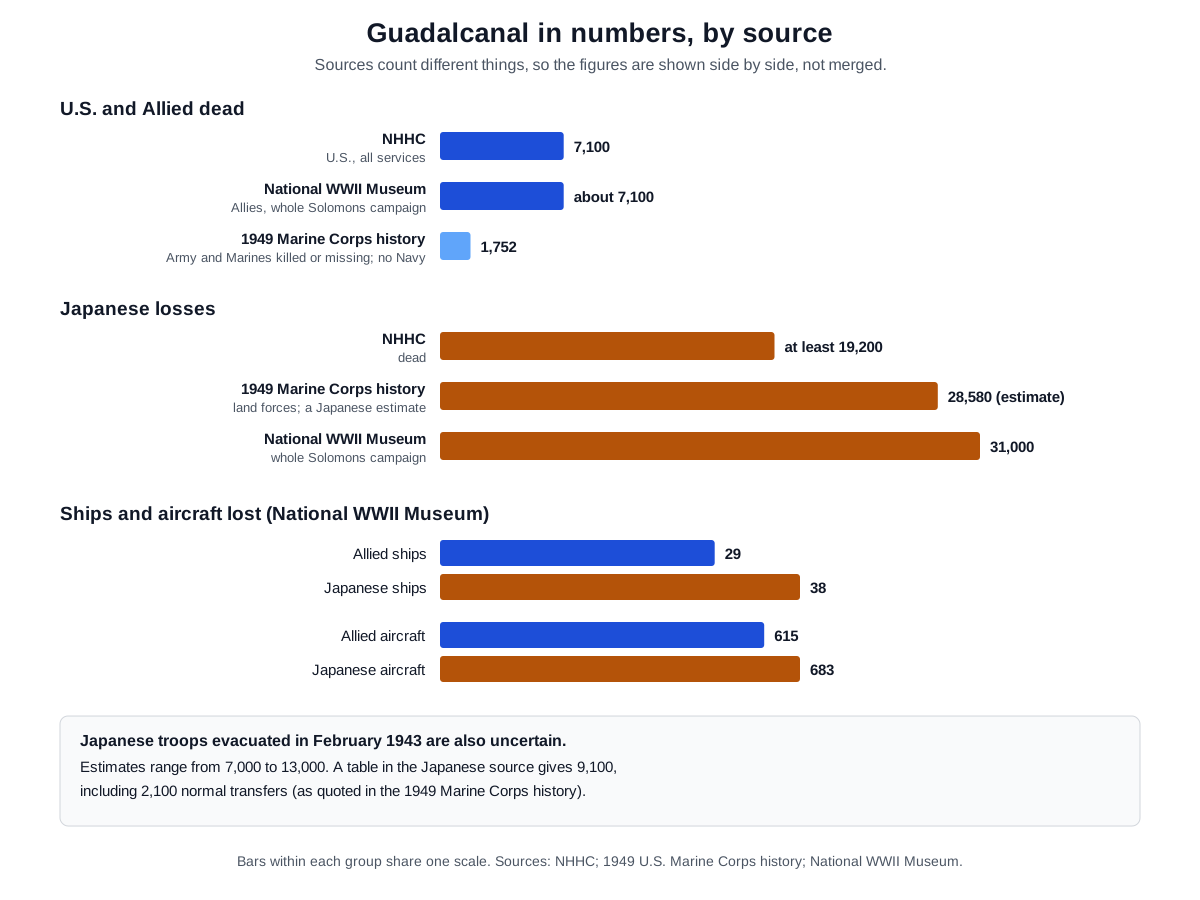
Human losses differ by source. NHHC gives 7,100 U.S. dead and nearly 8,000 wounded, and at least 19,200 Japanese dead. The 1949 Marine Corps history counted only the Army and Marine Corps and gave 6,111 U.S. casualties, including 1,752 killed or missing. Navy figures had still not been worked out by March 1949.
The National WWII Museum gives about 7,100 Allied and 31,000 Japanese losses for the Solomon Islands campaign as a whole. It also lists 29 Allied and 38 Japanese ships, and 615 Allied and 683 Japanese aircraft.
The Japanese figures are especially uncertain. The 1949 Marine Corps history says no accurate figure for enemy casualties will ever be reached, and it quotes estimates from a Japanese source. In that table, 37,680 Japanese ground troops came to the island, 9,100 left, including 2,100 normal transfers, and 28,580 were lost. Estimates of the evacuation alone range from 7,000 to 13,000.
What it left
NHHC judges that the Allied win on Guadalcanal, along with Midway, was probably where the Pacific War turned. After it, Japan was on the defensive.
After the war, Japanese leaders said similar things. The 1949 Marine Corps history quotes a postwar interrogation of Fleet Admiral Nagano Osami. He named the operations on Guadalcanal and Tulagi as the point where Japan shifted from attack to defense. He traced it to Japan's inability to build up forces as fast as the United States.
Hoshino Naoki, Chief Secretary of the Tojo Cabinet, said the calendar of Japan's war economy should be dated "After Guadalcanal." One Japanese officer is quoted as saying, "This was the fork in the road."
Some see it as a fight neither side was ready for. The 1949 history judged that the United States was not fully ready to sustain such an offensive. Japan, it added, was even less ready after Midway and with its lines stretched very far. In the two and a half years that followed, U.S. forces went on to take the Gilbert Islands, the Marshall Islands, the Mariana Islands, Iwo Jima and Okinawa.
The records also keep the part played by the islanders. Islanders from Guadalcanal and nearby islands gave the Americans vital help. They served in the native police force, worked as laborers, and acted as scouts and helpers for the coastwatchers. Sergeant Major Vouza, who had served 25 years in the constabulary and retired in April 1941, was one of them.
When the Japanese caught him, Vouza would not tell them anything about the Americans. He was tortured and left to die. Moving by night, he got through the Japanese force and reached the mouth of Alligator Creek, which the Marines held.
What to read next
- Pearl Harbor: The Start of the Pacific War: how the Pacific War that led to Guadalcanal began.
- The Battle of Midway: Codebreaking and Four Carriers: the June 1942 battle just before the Guadalcanal counterstroke.
- Aircraft carriers: turning a ship into an airport: how an airfield at sea works today.
- Radar: measuring distance and motion with radio waves: the principle behind the radar used at Tassafaronga to find ships.
- Heavyweight torpedoes: how they differ from lightweight ones: what the kind of weapon that threatened big ships in these waters looks like today.
- Military logistics: performance must be sustainable: the weight of supply seen at Guadalcanal, carried forward to modern logistics.