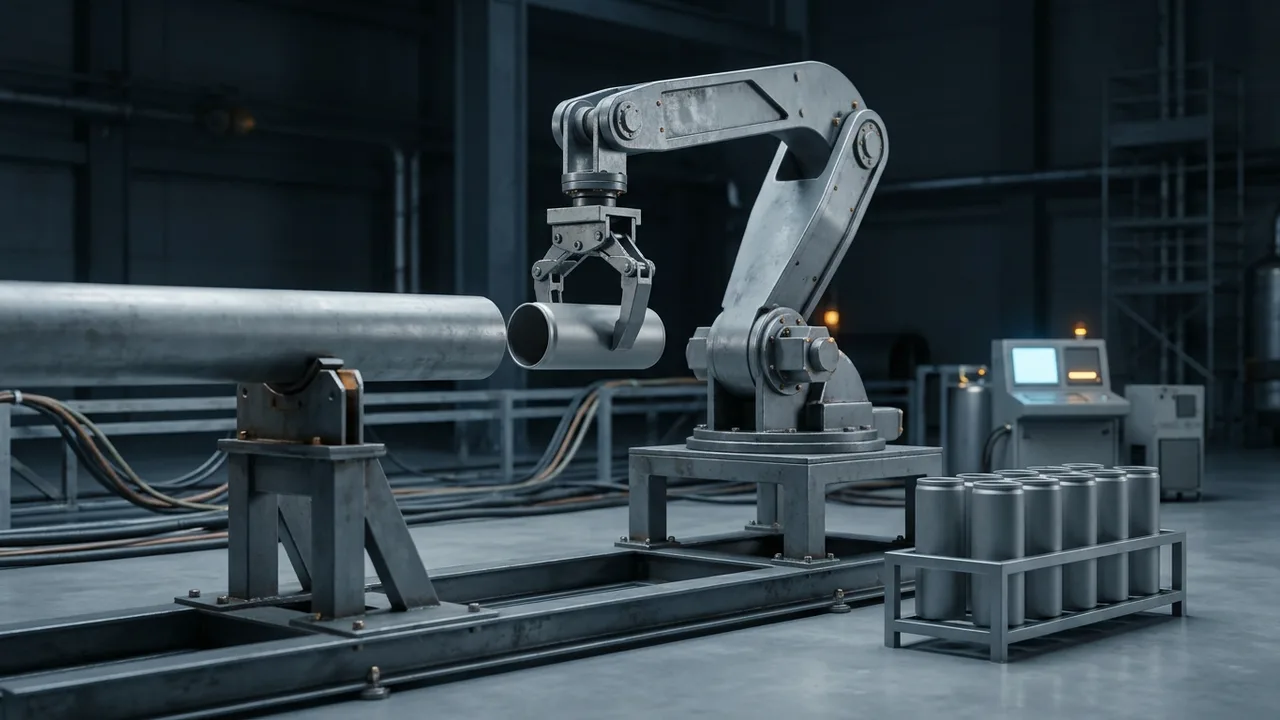
To fire a gun, someone has to put a round into it. For a long time that job fell to human hands. A person can load the first few rounds quickly, but people soon get tired.
An autoloader is a device that hands this job to a machine. What gets faster when a machine does the loading, how many crew members remain, and why is it hard to build? This article looks at each question through U.S. Army reports on howitzer tests and a Congressional Research Service (CRS) report on the next U.S. tank.
The person who loads: the loader
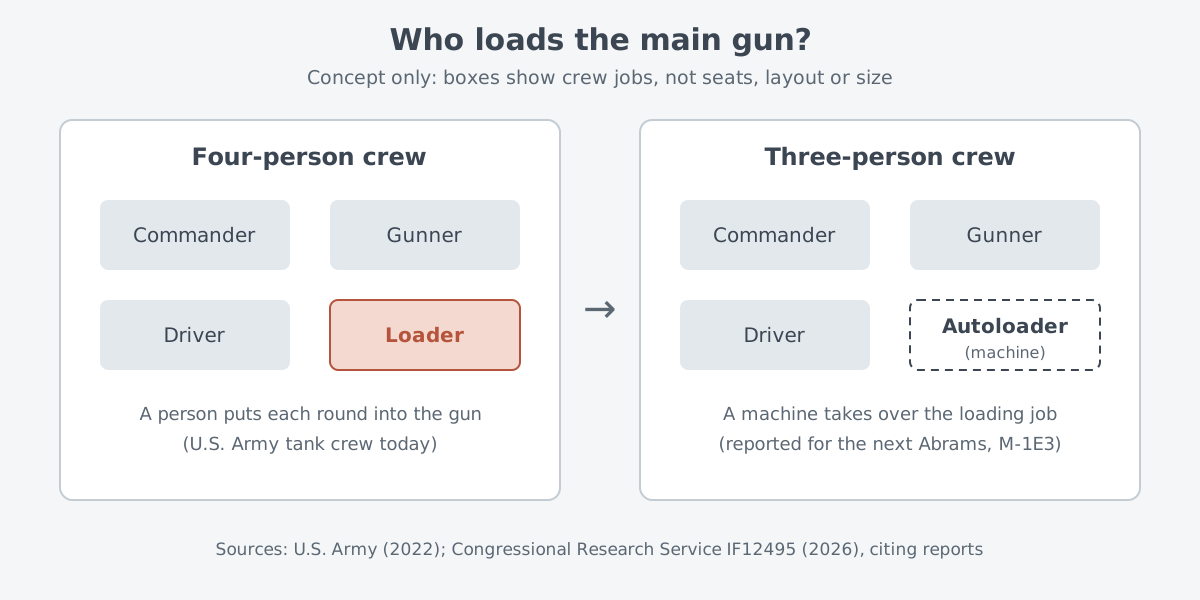
Four people ride in a U.S. Army tank: the tank commander, the driver, the gunner and the loader. The loader, as the name says, is the person who puts rounds into the main gun. How the tank as a whole balances firepower, protection and mobility is covered in Main battle tanks: is it all about the gun?.
On a self-propelled howitzer, loading takes several steps. The fuze is set, the projectile and the propellant go into the barrel, and the breech is closed before the gun is ready. For a long time, these carefully ordered tasks have been done by the cannon crew.
What an autoloader takes over
An autoloader does this loading work with a machine. The U.S. Army tested one in its Extended Range Cannon Artillery (ERCA) program, a self-propelled howitzer effort. It sets the fuze, loads the projectile and the charges, and closes the breech in turn, timed with the pointing of the barrel. The machine takes over the order of work that people used to follow.
Picture a robot arm in a factory taking over a repetitive job from a worker. The real case is different. A factory robot works on a quiet floor. A gun's autoloader works where each shot releases a sudden burst of energy in the breech that shakes everything close by, and some things farther away.
People tire, machines keep the pace
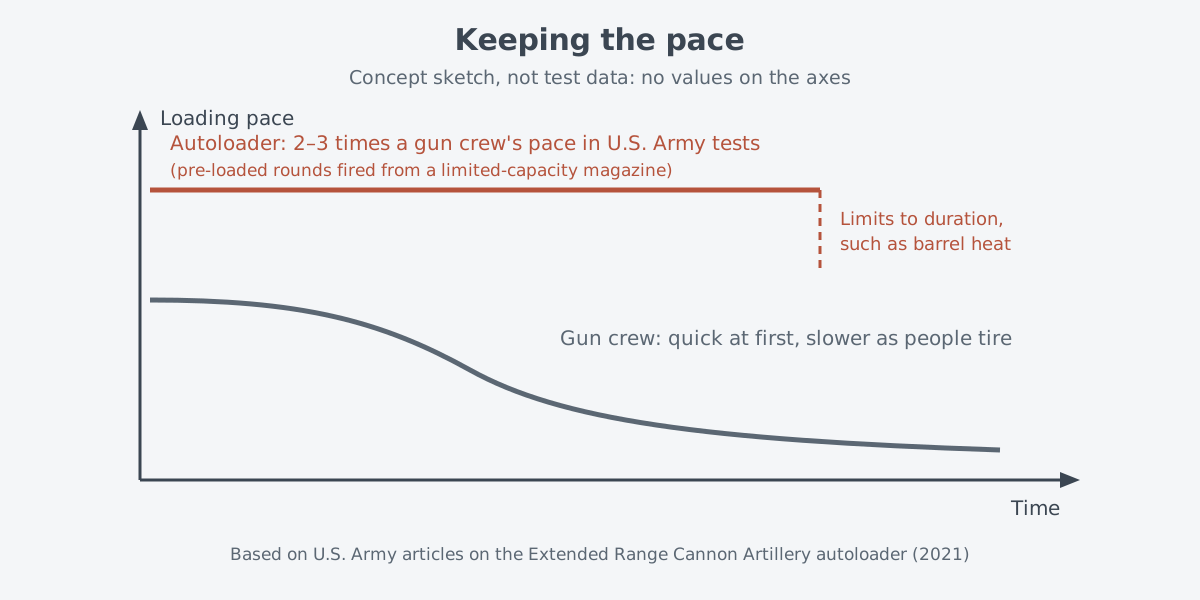
Hand loading is quick at the start, but it slows down once the crew gets tired. Automation helps hold that pace by taking the person out of the job, and it keeps people safe.
There are test results as well. According to a 2021 U.S. Army article, ERCA has shown it can fire 2–3 times as fast as a gun crew, using rounds loaded in advance into a limited-capacity magazine. Still, there is a limit to how long that pace can last, and barrel overheating is one example. The machine may not tire, but the barrel still heats up.
How it changes the crew
If a machine does the loading, does the vehicle still need a loader? On the howitzer side, a 2021 U.S. Army article says the autoloader may lead toward future artillery battery setups. In those setups, fewer soldiers, or possibly none, would need to be at the cannon while it fires.
On the tank side, the story comes from the Army's next Abrams tank program, the M-1E3. The reports cited in the CRS paper fit together like this. The Army signed a contract with GDLS (General Dynamics Land Systems), the builder, in early May 2024, and the two then set out to mature several technologies over 18 months.
One of them is an autoloader for the main gun that would allow an unmanned turret. Other reports expect an autoloader that allows a three-person crew, and the Army Chief of Staff reportedly said in September 2025 that the new tanks need a smaller crew.
There is a reason a new tank came up at all. The program executive quoted by the Army said the Abrams can no longer gain new capabilities without adding weight, and its logistics burden must shrink. A study by the Army Science Board in 2019 reportedly proposed a "fifth generation combat vehicle", and its list of capabilities included an autoloader and a new main gun. Autoloading sits inside this wider discussion of a new design.
What makes it hard
Adding a machine does not settle the matter. The Army has said that fitting an autoloader into the M-1E3 may take extra time because of development challenges.
On the howitzer side, those challenges are easier to see. The first, limited-capacity autoloader worked with a single kind of projectile and a single kind of charge. The next one has to handle the fuzes, charges and projectiles the Army already uses, plus new ones, which makes the machine more complex. These items differ in shape, size and weight.
The hardest part was named as coordinating the motion controls and testing the software. Work always began in software emulators, then moved from virtual tests to tests with real hardware in the loop.
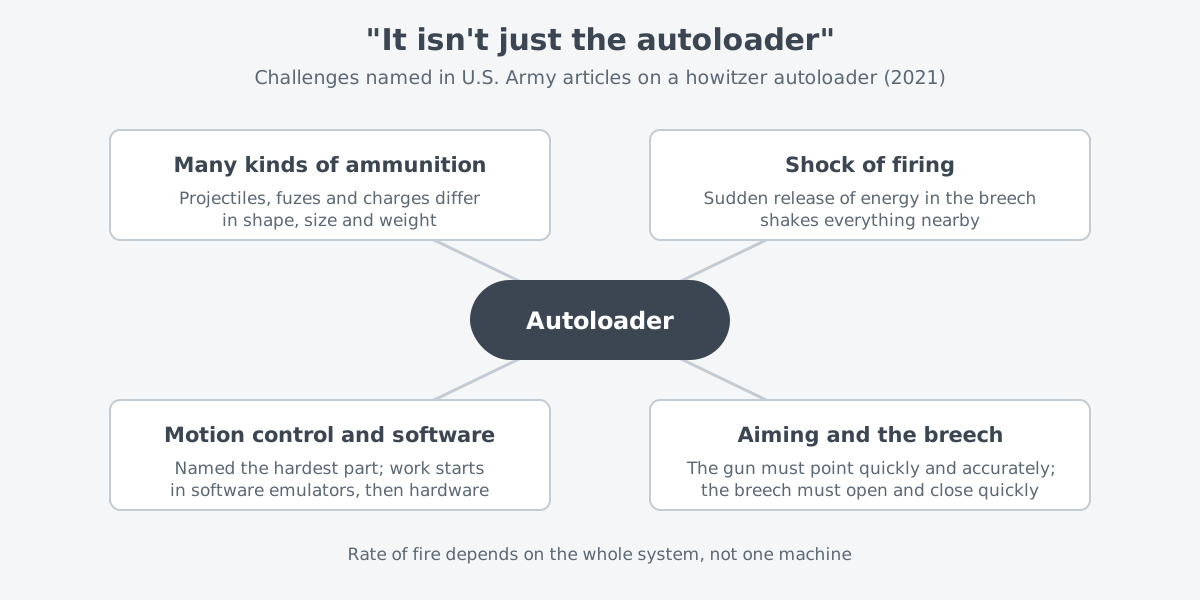
Josiah Fay, the ERCA project officer, called rate of fire "a system level effort" that is not only about the autoloader. The system that raises the gun has to point it quickly and accurately, and the breech has to open and close quickly while the gun is raised. A fast loading machine does not raise the overall pace if the rest of the system cannot keep up.
Where this meets lasers: the ammunition question
An autoloader helps put rounds in faster and for longer. Even so, the weapon still carries its rounds with it. When the rounds run out, someone has to refill it.
At sea, this is known as the "depth of magazine" problem. A surface ship can shoot down only a set number of drones and anti-ship missiles with its surface-to-air missiles and close-in Gatling guns before the ammunition runs out. A shipboard solid-state laser is different. It draws power from the ship and can fire again and again, as long as the laser keeps working and fuel is on board to make electricity.
A tank and a warship are very different weapons, but they share one question: how many rounds are on board, and how fast are they used? How weapons that carry rounds and lasers divide the work continues in Lasers, interceptor missiles and guns: how they share the work. That article also covers the limits of lasers.
What to read next
- Main battle tanks: is it all about the gun?: how a tank with a loader on board balances firepower, protection and mobility.
- Self-propelled howitzers: guns that move themselves: what kind of weapon the autoloader in this article was tested on.
- Lasers, interceptor missiles and guns: how they share the work: weapons that carry rounds and lasers, measured with the same yardsticks.