When a roller coaster swoops through the bottom of a dip and climbs again, your body sinks hard into the seat. Fighter pilots feel the same push, only much stronger. According to the Federal Aviation Administration (FAA) pilot safety brochure, the acceleration forces in military fighters and high-performance aerobatic aircraft can climb to as much as 9 Gs.
As that force grows, a pilot can lose vision bit by bit and may even pass out. The body is unhurt, so why does the mind switch off? The answer lies in the weight of blood. This article looks at what a G is, where the blood goes, and how the anti-G suit was made to hold that blood in place.
What a "G" measures
People are built to live at 1 G on the surface of the Earth. A G tells you how many times that pull of gravity your body is feeling. A pilot in a steep turn can feel forces equal to many times gravity, and any aircraft, civilian or military, can put people on board under more than 1 G.
How does an aircraft create G? An object moving along a circle accelerates toward the center of that circle. This is called centripetal acceleration, and a turning aircraft gets it too, because it is flying along part of a circle.
A worked example in the OpenStax physics textbook sums it up. To give the pilot more than 1 g of acceleration, a jet must tighten the radius of its turn, fly faster on the same path, or do both. A tighter, faster turn means more G.
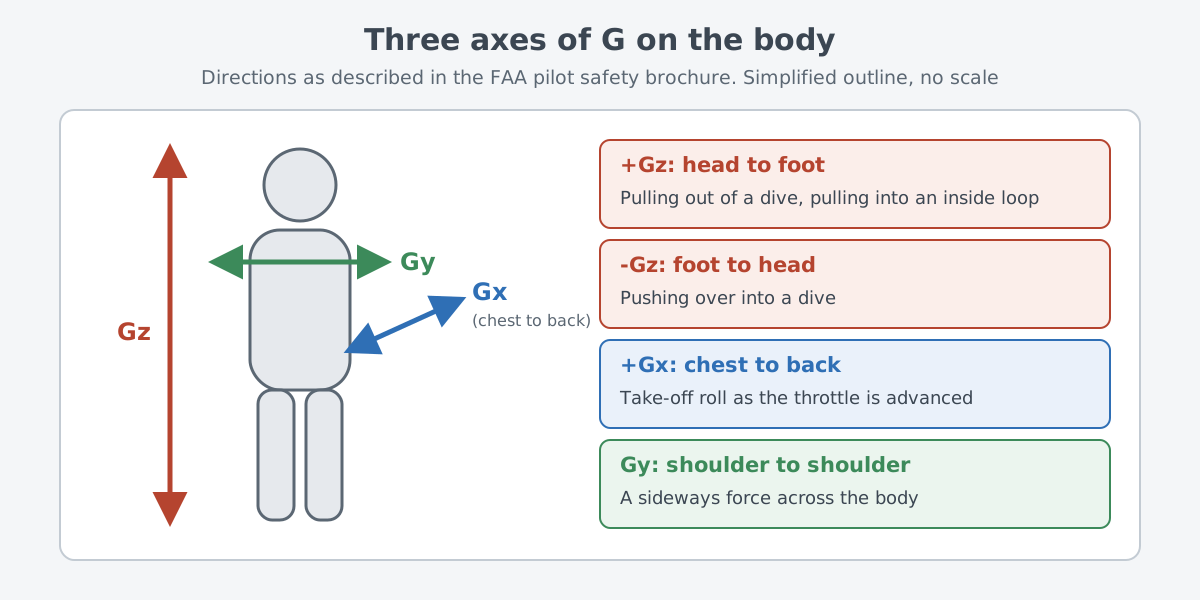
G gets a different name depending on which way it acts on the body. Gx acts from chest to back; it is the force that presses you into the seat during the take-off roll. Gy acts sideways, from shoulder to shoulder.
The axis that causes the most trouble is Gz, along the length of the body. When it acts from head to foot it is +Gz, which happens when a pilot pulls out of a dive or pulls into an inside loop. When it acts from foot to head it is -Gz, which happens when a pilot pushes over into a dive.
Blood has weight too
The danger of Gz starts with the weight of blood. For someone on their feet, the weight of the blood makes the pressure higher at the feet than at the heart. In a textbook example, with 1.4 m between heart and feet, a still column of blood makes the pressure in the feet 108 mm Hg higher than at the heart.
Even at 1 G this difference leaves a mark. Standing for a long time lets blood collect in the legs and causes swelling. That is why soldiers who must stand still for long periods have been known to faint.
+Gz also acts from head to foot. Under +Gz, the heart and blood vessels must react quickly to keep blood flowing to the brain and keep the pilot conscious. The heart beats harder and faster and the vessels tighten to push blood up toward the head.
Vision goes first
If the heart cannot keep up with the G, the eyes notice first. The eyes are very sensitive to low blood flow. When the vessels fall behind, the retina does not get enough blood.
The FAA brochure describes the order. First, side vision is lost, giving tunnel vision. Next the view shrinks further into gun barrel vision. Gray out and blackout may follow soon after.
If strong G keeps building quickly, the end result may be G-induced loss of consciousness (G-LOC). At that point the pilot can pass out and become unable to fly the aircraft. The FAA links it to far too many deaths in both military and civil aviation.
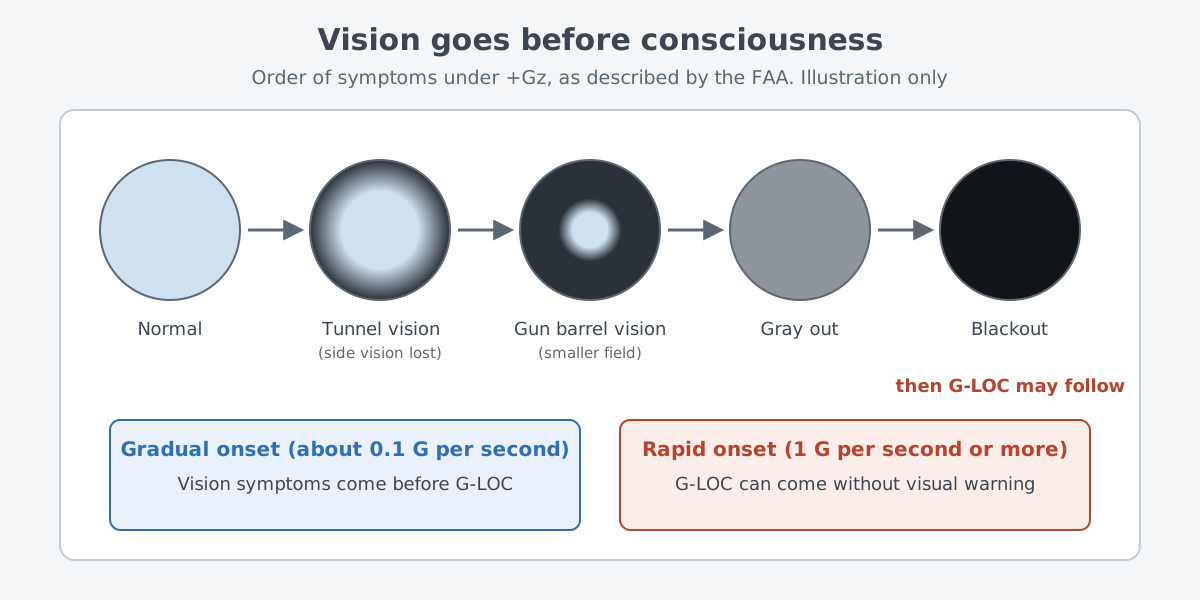
Vision does not always give a warning. The symptoms depend on how fast the G builds. With a gradual onset of about 0.1 G per second, vision symptoms come before G-LOC. With a rapid onset of 1 G per second or more, G-LOC can happen with no visual warning.
G in the other direction
-Gz works the other way. The human body copes with -Gz even less well than with +Gz.
Under -Gz, blood cannot flow back down the jugular veins to the heart, while arterial blood flow to the head increases. Because the retina is very sensitive here as well, the result is a loss of vision called red out.
A suit that squeezes the legs and belly
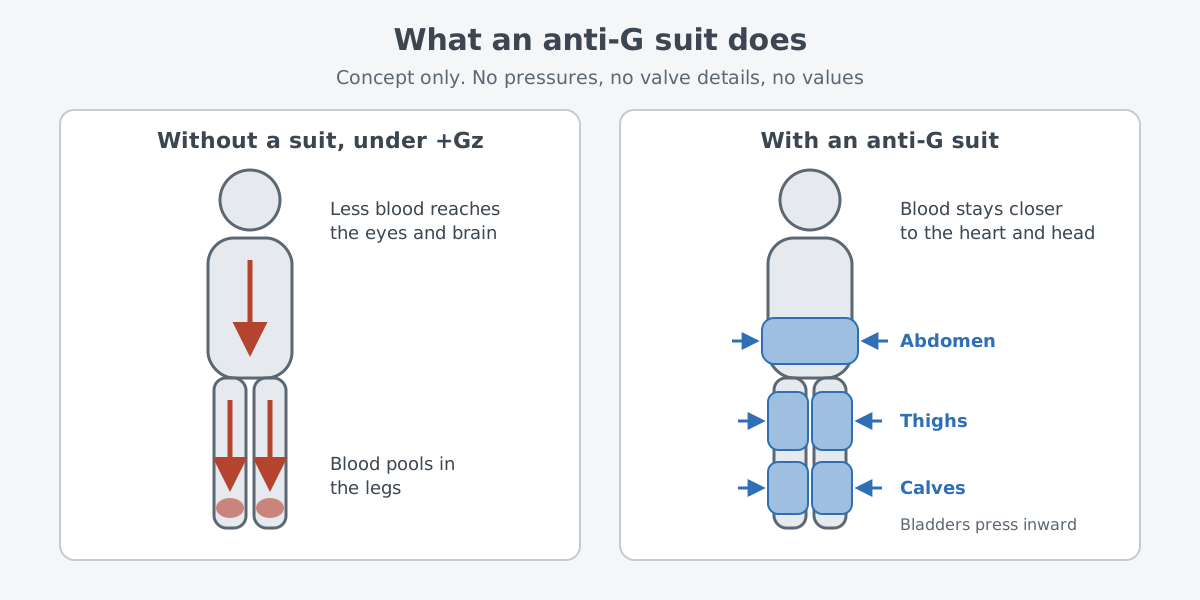
If blood rushes to the legs, why not press on the legs from outside? That is the idea behind the anti-G suit. The suit W.R. Franks built in Canada in the late 1930s squeezed the calves, the thighs and the abdomen so that blood would not pool in the veins there.
According to the collection record of Ingenium, a Canadian science and technology museum, the suit stopped pilots from blacking out or losing consciousness and put off fatigue.
Today's G-suits do the same job. They use bladders filled with air to stop blood collecting in the legs. NASA has relied on them for a long time to help its test pilots stay conscious under very high acceleration.
Think of squeezing the bottom of a toothpaste tube so the paste stays near the top. The real body is different: blood keeps circulating, and the heart still has to pump it upward. The suit cannot do the heart's work. It only reduces how much blood pools low in the body.
The same idea exists on the ground. Elastic bandages wrapped around the calf can help stop blood from collecting in the legs and add pressure that helps the veins send blood back to the heart.
From water bladders to air bladders
Dr. W.R. Franks, a professor in medical research at the University of Toronto, studied acceleration problems in Canada from the late 1930s into the 1940s. His first prototype was made of thin cotton and cut to fit Franks himself. Thin rubber bladders inside surrounded the whole body with a thin layer of water.
Franks tested the suit himself in a biplane. He then saw that not every part of the body needed the same protection and changed the prototype. Because the suits had to be tested in a controlled, repeatable setting, a centrifuge for people to ride was also built, which the record calls the R.C.A.F. accelerator.
The Ingenium record describes the Mark III model of the suit (F.F.S.) as the first anti-G suit in the world to be worn on real air operations.
An American suit survives as well. The Smithsonian National Air and Space Museum lists a G3A anti-G garment of the U.S. Army Air Forces (USAAF) under World War II. It is made of olive nylon. Laces run along the back of the legs and the waist, and zippers sit on the inside of the legs and at the waist.
A suit that began with a film of water now uses air-filled bladders. Its uses have grown too. Astronauts wear G-suits during re-entry, which press on the arms and legs and move blood up toward the head.
The suit has even left the aircraft. In 1969, NASA's Ames Research Center was asked for help with a woman who had kept bleeding for weeks after childbirth. The Ames team adapted a G-suit to give several pressure levels and rushed it to the hospital. After she wore it at low pressure for 10 hours, she began to recover.
The suit is not enough
Even with a suit, the body still has work to do. Military pilots practice the anti-G straining maneuver (AGSM). It is a physical technique in which the pilot pushes air out of the lungs against a closed glottis while tightening the muscles of the calves, thighs and shoulders.
This resistance keeps blood from draining away from the brain and raises the pressure in the carotid arteries, which can increase G tolerance. The FAA warns, however, that it should not be tried at 1 G with 100% effort, to avoid injury.
The state of the body matters as well. Dehydration, fatigue, hunger and medications lower G tolerance, and the same person's tolerance can change from day to day. A pilot who drinks enough water has more blood in circulation, which makes it easier for the heart to keep oxygen-rich blood flowing to the brain.
Most civilian aircraft are not equipped for G-protective clothing. So for civilian pilots, rest, water and fitness come first. The FAA brochure notes that a well-rested, hydrated and fit pilot can withstand higher G forces.
Where this meets lasers: the retina
In this story, the eyes were the first part of the body to suffer. When blood runs short, the retina reacts first and the field of view shrinks.
In laser safety, too, the eyes are the first thing to protect. The cause is different. Under G, the retina is short of blood; with lasers, the risk is the light entering the eye. How to read laser classes and eyewear labels is covered in Laser safety: classes and how to read eyewear labels.
What to read next
- Thrust vectoring: steering with the engine: another way an aircraft changes direction sharply.
- Laser safety: classes and how to read eyewear labels: a different set of rules for protecting the eyes.
- Helmet-Mounted Displays: Information in Front of a Pilot's Eyes: the story of the eyes in the cockpit continues.