In early September 1870, at Sedan, a small fortress town in northeastern France, Napoleon III sent a letter to King Wilhelm I of Prussia. "Having been unable to die in the midst of my troops, all that remains is for me to place my sword in Your Majesty's hands." Less than two months after the war began, the emperor of France was a prisoner.
How did it end so fast? The usual answer is the Prussian general staff and the railways. This article follows why the Franco-Prussian War (called the German-French War in Germany) began and how it unfolded, and it asks how far that answer holds. It also covers what mobilization and weapons alone cannot explain, and the numbers that differ from one source to another.
After 1866: why France and Prussia clashed
On 3 July 1866 Prussia defeated Austria at Königgrätz, which the French call Sadowa. Austria was pushed out of the German Confederation, and Otto von Bismarck joined the German states north of the Main River into the North German Confederation. Southern states such as Bavaria, Württemberg, Baden and Hesse then made secret alliances with Prussia.
France watched Prussia's growing power inside Germany with worry and feared losing its leading place on the European continent. According to the German Historical Museum (Deutsches Historisches Museum, DHM), Bismarck was convinced that a military conflict with France could not be avoided in the long run. He saw a war as the means to complete German unification.
The armies were also preparing differently.
In Prussia a large army reform bill went to parliament in 1860, and Bismarck pushed the reform through without parliamentary approval. The dispute ended after the 1866 victory, when the lower house approved all past army spending after the fact. In France, Marshal Niel put forward a reform bill on 1 February 1867. Parliament passed only a law, on 14 December 1868, that cut military service from seven years to five.
The Ems Dispatch: one telegram lights the fuse
The spark was the Spanish throne. On 2 July 1870 it became known that Prince Leopold, from a branch of the Hohenzollern family, was a candidate for the vacant throne of Spain. For France, this was bound to feel like a threat on its southwestern flank. After French protests, Leopold withdrew on 12 July.
The French government did not stop there. On 13 July, at the spa town of Bad Ems, the French ambassador Benedetti asked Wilhelm I for a guarantee that he would never again allow a Hohenzollern candidacy. The king refused and sent an account of the conversation to Bismarck by telegram.
That same day Bismarck shortened and edited the telegram and released it to the newspapers. As the Fondation Napoléon explains it, the edited version made it look like an exchange of insults between king and ambassador. The telegram set off national outrage in both Germany and France.
In the French parliament, some deputies led by Adolphe Thiers objected that the army was not ready. Even so, the mobilization order was signed on 14 July, and the next day a majority voted for war funds. France declared war on Prussia on 19 July. The DHM writes that European public opinion then saw the French emperor as the one who had broken the peace.
Against French expectations, the southern German states sided with Prussia without hesitation and placed their armies under Prussian supreme command in 1870. Germany's neighbors stayed neutral. France had discussed cooperation with Austria in the winter of 1868 and in June 1870, but no agreement came of it.
From July 1870 to May 1871 on one timeline
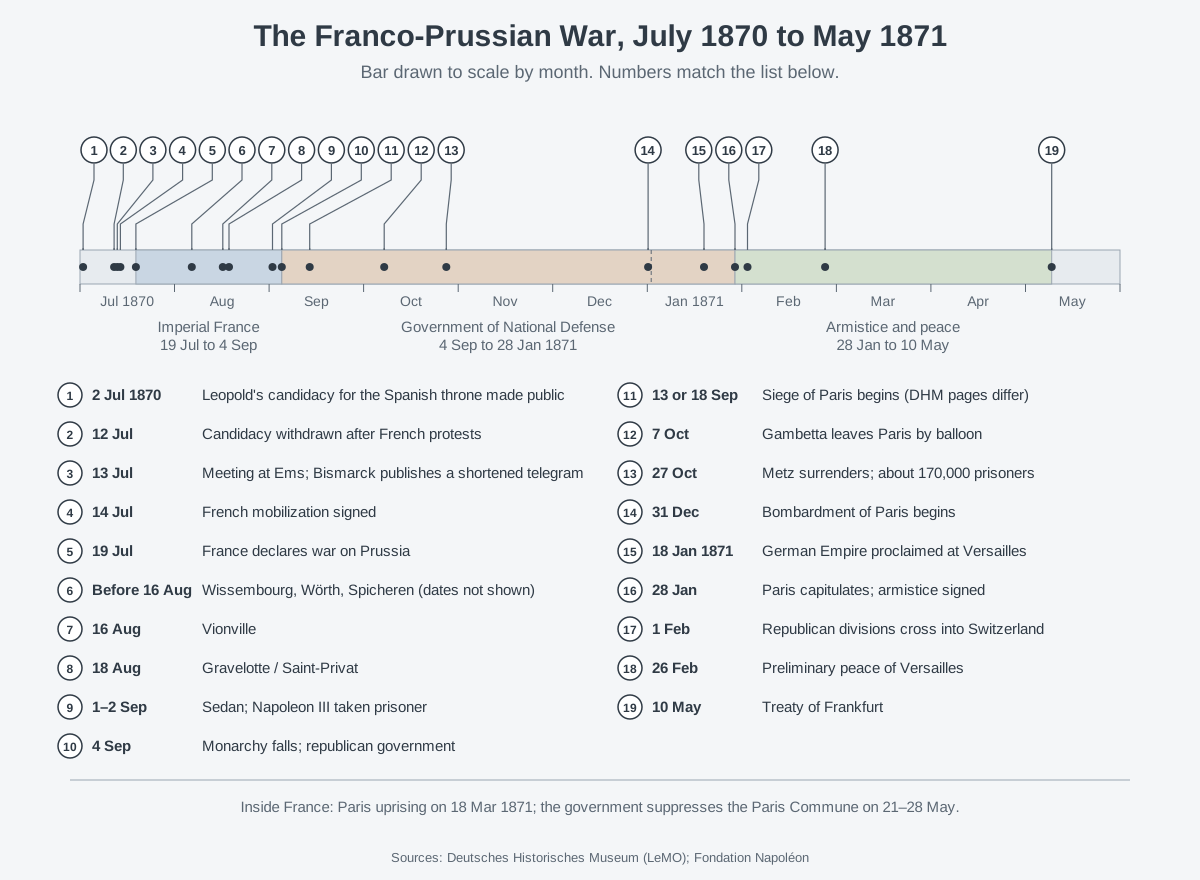
The first fighting took place near the border. German troops won at Weißenburg (Wissembourg) and Wörth, and they stormed the heights of Spicheren.
On 16 August the first major decisive battle was fought at Vionville, and two days later, on 18 August, Gravelotte saw the largest battle of the whole war. The French call it the Battle of Saint-Privat. The losing side, Marshal Bazaine's Army of the Rhine, fell back into the fortress of Metz.
Marshal Mac-Mahon set out to relieve Metz, but the attempt ended in defeat at Sedan on 1–2 September. After the emperor's capture, the monarchy in France fell on 4 September and a republican Government of National Defense took over. The new government kept fighting.
Here the war moved into a second phase. German troops surrounded Paris in mid-September, but the start of the siege is given as 13 September on the DHM war page and 18 September in its chronicle. In the provinces, hastily raised republican armies fought on stubbornly.
On 27 October the Army of the Rhine at Metz surrendered. On 31 December German guns began bombarding Paris, and the city capitulated on 28 January 1871. An armistice was signed the same day. French resistance finally ended on 1 February, when hard-pressed republican divisions crossed into Switzerland and were disarmed.
The general staff and the railways: an army planned before the war
In this war, armies of several hundred thousand men faced each other. Railways, industry and modern technology such as long-range artillery shaped the course of the campaigns. At the head of the German war effort stood Helmuth von Moltke (1800–1891), chief of the Prussian general staff. The German deployment to the western border moved quickly thanks to the railways.
This was not Moltke's first use of the railways. In 1866 telegraph and rail let him move large formations from several directions into northern Bohemia at unheard-of speed. Three Prussian armies met at Königgrätz. Yet the victorious Prussian army soon suffered from supply problems and cholera.
A fast deployment did not also solve the logistics that came after it.
The rail network had already grown large. Between 1840 and 1850 the railways of the German Confederation grew tenfold, to about 5,700 km. Because each state was sovereign, though, no one planned the routes for Germany as a whole. After the empire was founded in 1871, the states began buying up private railways, and the railways' greater military importance was one of the reasons.
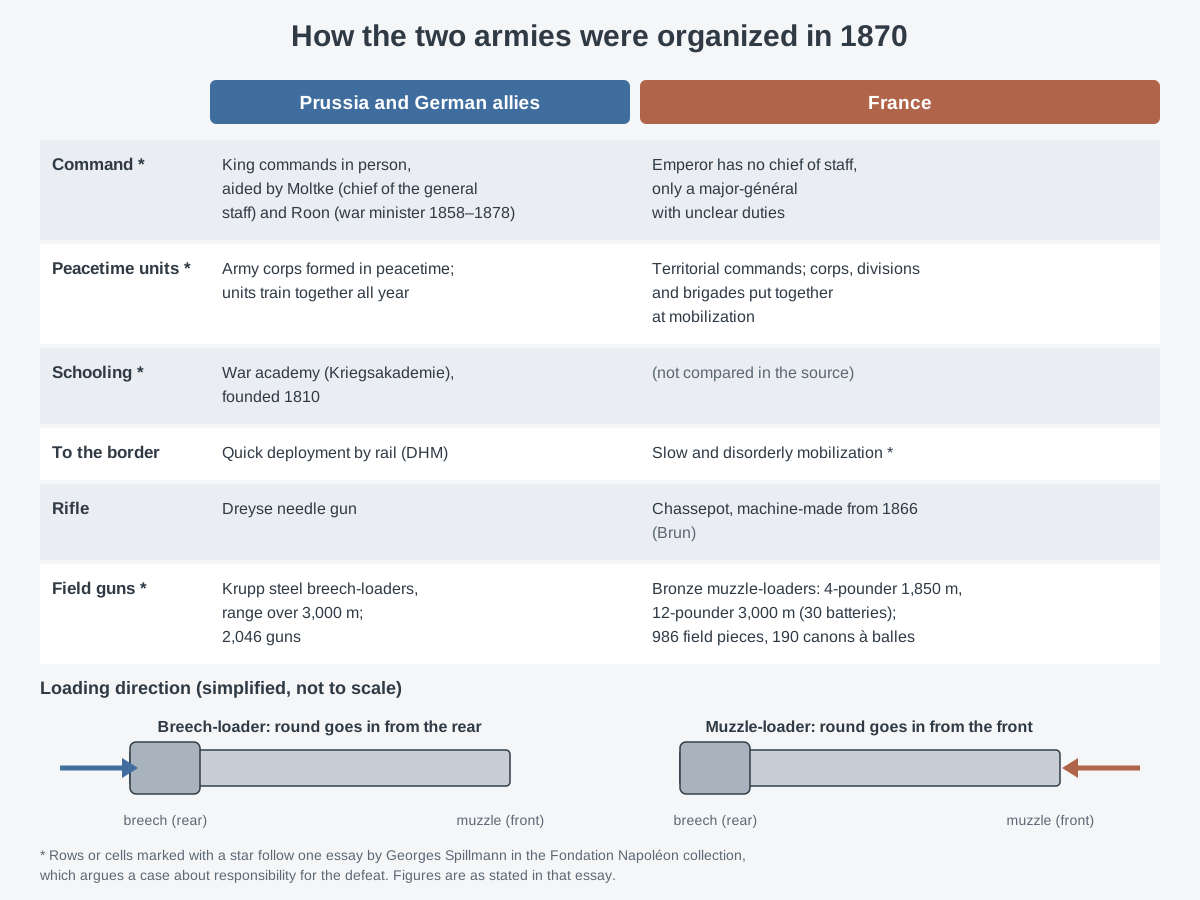
The way the two armies were organized is laid out in detail in an essay by Georges Spillmann in the Fondation Napoléon collection. The essay argues that the blame for defeat should not fall on Napoleon III alone, so this article takes only its descriptions of institutions and its numbers.
On the German side, the king of Prussia commanded the federal army in person, aided by Moltke and the war minister Albrecht von Roon. Moltke handled strategy. Roon, war minister from 1858 to 1878, ran the army, supplied its equipment and prepared the shift from peace to war, which is mobilization. A war academy (Kriegsakademie) founded in 1810 provided advanced military education.
The units were also organized in peacetime. Every German army corps already existed before the war, and the units were used to maneuvering together all year. The French peacetime organization was territorial, not built around fighting units. Under the emperor there was no chief of staff, only a major-général whose duties were poorly defined.
After Niel died, his organization plan went into a drawer. Only once mobilization had started were the corps, divisions and brigades thrown together, in disorder.
The result shows in the numbers. French mobilization was slow and disorderly, and the Army of the Rhine gathered 222,000 men at first and never went beyond that figure. Facing it, three German armies totaled 506,000 men.
The German Historical Museum counts the same period as about 519,000 in the combined German armies against 336,000 in the French professional army. The figures depend on what is counted, but by either count the German side had more troops.
The Chassepot, the Krupp gun and the mitrailleuse
Weapons alone do not tilt the picture to one side. French infantry carried the Chassepot rifle. An essay by Jean-François Brun in the Fondation Napoléon collection notes that making arms with machines only began with this rifle, in 1866.
The Prussian infantry rifle was the Dreyse needle gun. Spillmann judges that the Chassepot was far ahead of the Dreyse in range, accuracy and rate of fire.
Artillery was the reverse. French field guns were made of bronze with rifled barrels, but they were still loaded through the muzzle, at the front. German Krupp guns were made of steel and loaded through the breech, by opening the rear.
The French 4-pounder had a range of 1,850 m, and there were only 30 batteries of the 12-pounder, which could reach 3,000 m. The Krupp gun's range was over 3,000 m.
The numbers differed too. Against 986 French field pieces, Germany set 2,046 guns. Looking at range, numbers and loading, Spillmann sees the French artillery as heavily outclassed by the German.
France did have one new weapon: 190 "canons à balles," usually called the mitrailleuse, built from a bundle of infantry rifle barrels. They were made in great secrecy and not tested before the war, and the emperor paid for them from his own funds after parliament refused the money. About the size of a 4-pounder gun, they were easy to spot and were often destroyed by German batteries soon after they opened fire.
Today a museum at Gravelotte, devoted to the Franco-Prussian War and the annexation that followed, shows a model 1858 4-pounder field gun and a Reffye cannon. Both are lent by France's army museum, the Musée de l'Armée. The museum opened in April 2014 where the Saint-Privat fighting took place, and its labels are in French, German and English.
Sedan, Metz and the siege of Paris
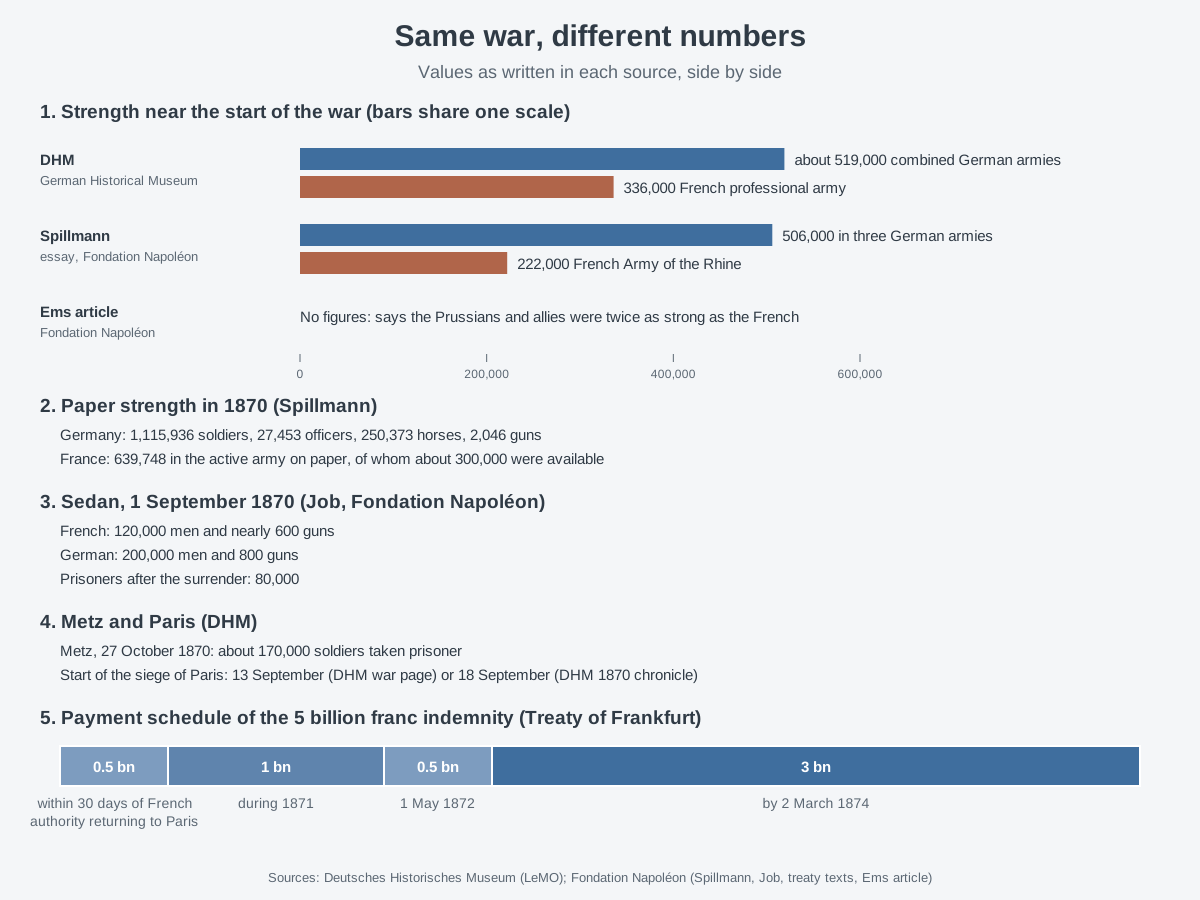
At dawn on 1 September 1870, the emperor was dug in at Sedan. An article by Eymeric Job in the Fondation Napoléon collection puts the French at 120,000 men and nearly 600 guns. It gives the German force that Moltke drew up as 200,000 men and 800 guns. The emperor had come to the troops by rail to lift their morale after the heavy losses at Vionville and Gravelotte.
That morning Mac-Mahon was badly wounded by a shell fragment and had to leave command. After that, the French army received orders from three commanders in turn and was thrown into confusion. In the evening the emperor sent the letter quoted above, and around noon the next day the French general Wimpffen and Moltke signed the surrender. The 80,000 prisoners were taken to the Iges peninsula, and the emperor had to leave France on 3 September.
The surrender at Metz was larger. On 27 October the Army of the Rhine, shut in at Metz, surrendered, and about 170,000 soldiers became prisoners.
Paris held out for four months. On 7 October the interior minister Léon Gambetta left the besieged city by balloon to organize a relief force in the provinces. The bombardment began on 31 December, and Paris capitulated on 28 January 1871.
Versailles and Frankfurt: what the war left behind
The war made Germany a single state. During the war the southern German states joined the North German Confederation, and on 18 January 1871 the Hall of Mirrors at Versailles saw Wilhelm I proclaimed German emperor. For the French, both the proclamation at Versailles and, above all, the loss of Alsace-Lorraine were a humiliation.
The preliminary peace of Versailles on 26 February ended the fighting, and the Treaty of Frankfurt followed on 10 May. France gave Germany Alsace without Belfort and northern Lorraine with the fortress of Metz, and it had to pay an indemnity of 5 billion francs.
The treaty also set a schedule. France would pay 500 million within 30 days of its government regaining authority in Paris and 1 billion during that year. Then came 500 million on 1 May 1872 and the last 3 billion by 2 March 1874. German troops were to leave occupied areas step by step as the payments came in.
The story of Alsace-Lorraine did not end in 1871. On the German side, military concern for a secure border with France and national demands to take back formerly German lands played a central role in the annexation. Anger swept across France, and by the deadline of 1 October 1871 about 10% of the population chose French nationality.
Regaining the region became a central aim of French foreign policy until the First World War, and on 6 December 1918 the regional parliament voted to join France. Its people changed nationality four times within three generations.
Inside France, the war did not end quietly either. On 18 March 1871 an uprising broke out in Paris, the government fled to Versailles, and the Paris Commune was set up. The French government crushed the Commune by force on 21–28 May.
Other treaties in Europe were shaken as well. The 1856 Treaty of Paris, which ended the Crimean War, banned fortifications along the Black Sea coast. On 31 October 1870 Tsar Alexander II of Russia declared that ban void. Bismarck backed him, and in return Russia promised to stay neutral in the Franco-Prussian War.
So did the general staff and the railways win this war? Fast deployment and army corps formed in peacetime clearly played a large part.
But diplomacy stood alongside them: the southern states joined at once and the neighbors stayed neutral. So did far more German troops and guns, and a French command that wavered at Sedan. No single cause explains the victory.
What to read next
- The Crimean War: The War of the Telegraph, the Camera and Nightingale — the war that ended with the 1856 Treaty of Paris and its Black Sea clause.
- Railroads and the Telegraph: What Made the Civil War Industrial — how railways and the telegraph were used across the Atlantic in the same 1860s.
- Military logistics: performance must be sustainable — supply and maintenance after deployment, seen through today's idea of logistics.
- Self-propelled howitzers: guns that move themselves — what field guns like the Krupp gun have turned into today.
- Turning points in military technology — moments since the 20th century when new technology changed warfare.
- A history of laser weapons: from chemical to electric lasers — how laser weapons, another branch of weapons technology, developed.