On Friday, June 29, 1453, three Cretan sailing ships came into port on the island of Crete. They had sailed from Constantinople. Their crews brought news from a month earlier: on the morning of May 29, the troops of Mehmet had entered the city and killed the emperor.
A short note added to a Greek manuscript records what happened next. Crete was left in grief and tears.
How did the capital of the Byzantine Empire fall after a siege of less than two months? This article follows that spring through three records set side by side. Two men were inside the city: George Sphrantzes, a close servant of the emperor, and Nicolo Barbaro, a Venetian surgeon. The third, Kritovoulos, was a Greek official who served Mehmed II.
The three men watched the same days from different places. Their numbers, their times and their final scenes do not always match. The sections below look at what the records kept from a siege in which very old walls met gunpowder artillery on a large scale.
A shrunken empire and a growing neighbor
By the mid-1400s, Byzantium was only a faint outline of the empire it had once been. John VIII, the second-to-last emperor, ruled little beyond Constantinople. The imperial seals exhibit at Dumbarton Oaks, part of Harvard University, lists the rest as some of Thrace, a few islands, and the Morea. The empire had shrunk to one city and scattered pieces of land.
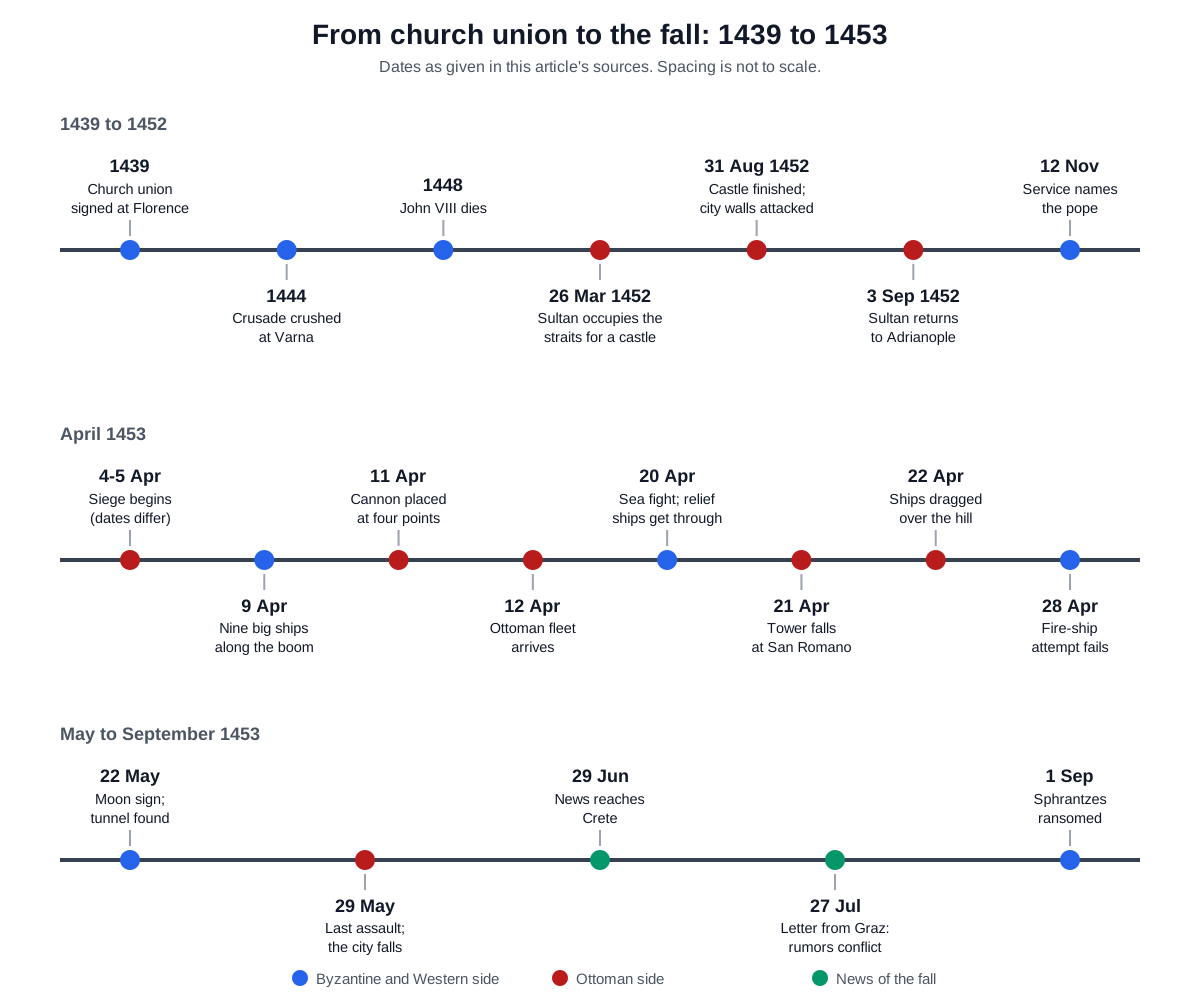
For most of his time on the throne, John tried to win help from the West. In 1439, in Florence, he signed an act of union that placed the Byzantine church under the pope's authority. The crusade that came of it met a crushing defeat at Varna in 1444, and the exhibit sees the last real hope of Western aid dying with it. John died in 1448, five years before his empire ended.
The last emperor was his successor, Constantine. In Sphrantzes' count, he was the eighth emperor of the Palaiologos dynasty.
On March 26, 1452, the Ottoman sultan Mehmed II occupied the straits to build a castle. With the castle complete, he set out on August 31, striking at the city's fortifications as he went. On September 3, he returned to Adrianople.
In Sphrantzes' chronicle, the emperor agreed, out of necessity, to honor the pope by name in church services, hoping this would bring aid. Those services were held on November 12.
Six months later, Sphrantzes wrote, the help received from Rome equaled what the sultan of Cairo had sent. It was a bitter way of saying that nothing came, and he added that other Christians sent no help either.
Land walls and a chain across the harbor
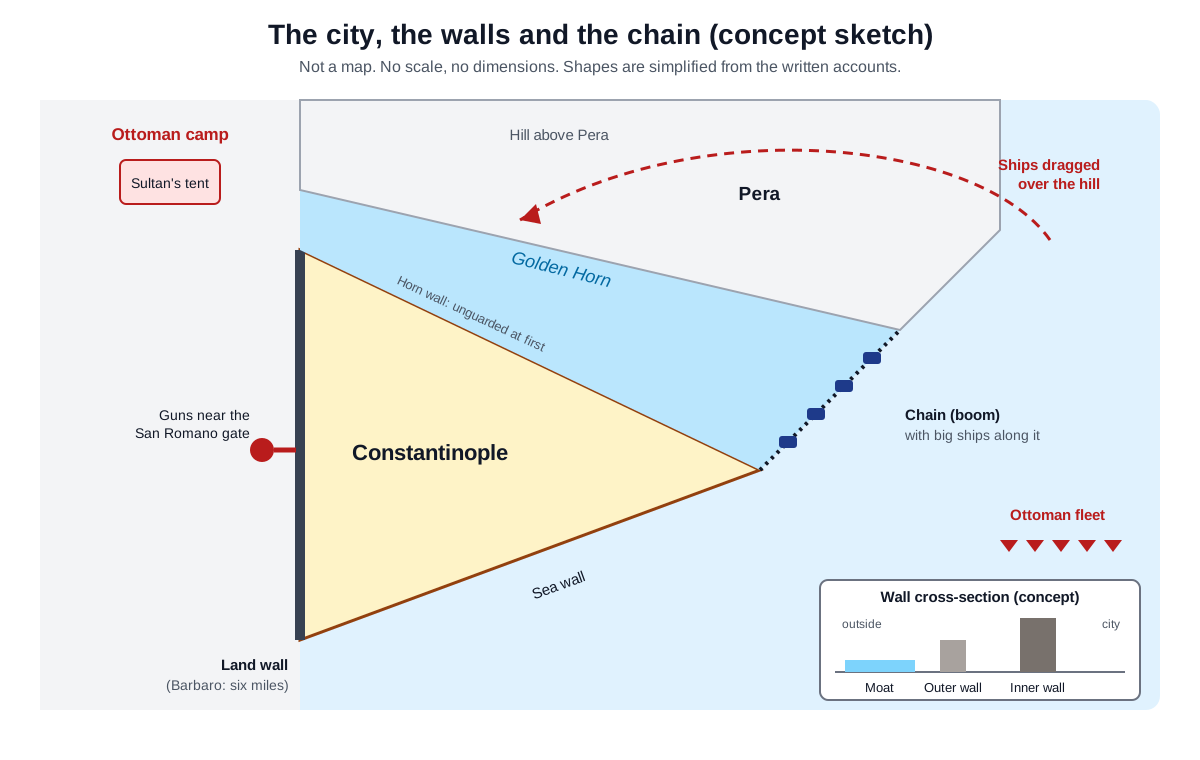
Constantinople touched land on one side and water on the rest. On the land side stood the Theodosian Walls. Along the water ran sea walls and a wall following the Golden Horn.
These walls had survived a crisis before. A scholarly book review summarizes the story: a series of large earthquakes brought the walls down in 447, and the people of the city rebuilt them within three months. The rebuilt walls grew beyond the original structure until the city had three lines of walls. By 1453, that rebuilding was 1,006 years old.
Kritovoulos names the lesser outer wall, the main wall and the moat separately in his account of the siege. Seen from outside, the order is the moat, the lower outer wall, then the main wall.
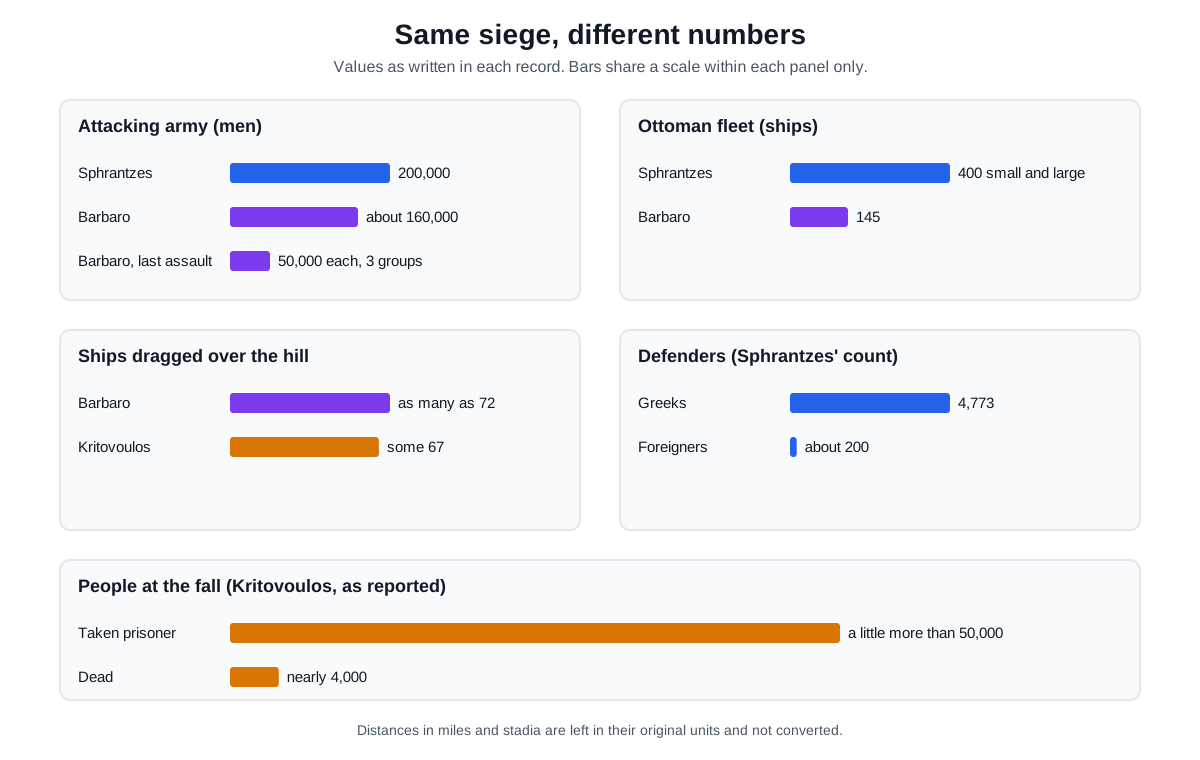
In April 1453, the sultan came back. Sphrantzes gives April 4; Barbaro gives April 5, one hour after daybreak. In Barbaro's diary, the Ottoman army spread out on April 7 along the full length of the land wall, a line six miles long.
On the water, a chain held the harbor shut. On April 9, the defenders lined up nine of their biggest ships along the boom that crossed the harbor. The ships stretched from Constantinople to Pera on the far shore, and a tower stood at each end of the boom.
The Ottoman fleet arrived on April 12. According to Kritovoulos, it blocked about 43 stadia of sea wall, from the Golden Gate to Galata. The whole circuit of the besieged city was about 126 stadia, and the one stretch left without guards was the Horn wall behind the chain.
The real problem was people. The emperor had his district officers count every man fit to hold the walls, and every weapon. Sphrantzes totaled the lists in secret at his home. The count came to 4,773 Greeks and just about 200 foreigners, and only he and the emperor knew the true figure.
Kritovoulos describes the same shortage. Even with the Horn side left empty, there was only one defender for every two or three battlements on the rest of the wall.
The great guns: a new weapon at old walls
In Kritovoulos' account, after deploying his army and fleet around the city, the sultan called in his cannon-makers and asked how to bring down the walls. They answered that one more gun, added to those he already had, would be strong enough to break the wall. To Kritovoulos, the result was a thing fearsome to see and hard to believe when you only hear about it.
The guns went into position on April 11. The sultan set them at four places near the weakest parts of the wall.
| Where | Number of guns |
|---|---|
| Near the emperor's palace | 3 |
| Pigi gate | 3 |
| Cressu gate | 2 |
| Gate of San Romano | 4 |
To Barbaro, San Romano was the most vulnerable spot in the entire city. One gun there threw a stone ball weighing about 1,200 pounds, and another threw one of 800 pounds; these two were the largest. The rest came in many sizes, from 500 pounds down to 200 pounds and smaller.
Kritovoulos describes the layout a little differently. The sultan had the three largest and most powerful guns set up facing the central part of the wall, near his own tent. The rest went to weak points here and there. He judged it best to strike the wall at many points at once.
The bombardment wore the wall down piece by piece. In Kritovoulos' account, no part of the wall was strong or thick enough to withstand those stone balls. On April 21, a full day of fire at San Romano brought down a tower and several yards of wall. Kritovoulos adds a limit in the same passage: the force of the powder also often burst the bronze guns themselves.
The defenders patched the gaps as fast as they opened. At first they pushed beams out from the top of the wall and hung bales of wool on ropes to soften the blows. When that did not last, they drove huge stakes into the ground outside the damaged sections to make a palisade and built it up with stones, timber and brush. On top they set lines of wooden casks packed with earth.
This earth barrier held up surprisingly well. In Kritovoulos' account, even a hard-flying stone ball just buried itself in the loose soil, instead of smashing a gap as it would in solid stone. A hammer cracks a stone wall, but it sinks into a pile of sand.
The real barrier, built of stakes, stones, timber, brush and casks filled with earth, was far rougher than a pile of sand. Barbaro's diary also records that as soon as the walls broke, the defenders set to repairing them, plugging the gaps fast with barrels and whatever else was at hand.
How did people at the time see this weapon? To Kritovoulos, it was something the kings and generals of old neither had nor knew of. In his telling, it was something the Germans or Kelts had come up with roughly 150 years before, or slightly more. Because it had no old name, people simply called it an "apparatus."
The sultan also had tunnels dug under the wall. In Kritovoulos' account, he later judged them a useless expense, since the cannon were doing everything. Barbaro's diary records tunnels found under the wall on May 22 and May 24. Put side by side, the two records show tunnel work going on into late May.
Ships over the hill
On April 20, a large fight broke out at sea. Big ships came to help the city, and the Ottoman fleet moved to stop them. Kritovoulos says there were three large galleons sent from Italy by the pope with food and help. Barbaro says there were four large ships, thought to have come from Genoa.
The two records agree on the result: the big ships got through. Kritovoulos credits a strong south wind that suddenly filled their sails. His figures are 22 killed on the galleons, with more than half wounded, and a little more than 100 killed and over 300 wounded in the sultan's fleet. Barbaro writes that the fight lasted two to three hours and that the ships survived an attack by 145 vessels.
In Kritovoulos' account, the walls of Galata blocked shots at the ships by the chain. The sultan had a different gun built that threw stones high into the air. After it sank one galleon, the other ships pulled back to a safer place.
The Golden Horn, behind the chain, was still closed. On April 22, the sultan decided to put part of his fleet inside the harbor. In Barbaro's diary, the Ottomans leveled a three-mile way over the hill above Pera and laid down many rollers greased with fat. Small ships called fuste went onto the rollers and were hauled by large crews, as many as 72 of them into the harbor.
Kritovoulos gives a different distance. In his account, the road from sea to sea was about eight stadia, and some 67 vessels gathered in a bay just past Galata known as Cold Waters. It was, in his words, a strange sight, hard to believe for anyone who had not seen it.
Once ships were inside the Horn, the city's arithmetic changed. The defenders now had to guard the Horn wall they had left empty, and they were forced to pull men from other battlements. Too few people had to be spread even thinner.
The defenders struck back. On April 28, they tried to burn the Ottoman ships inside the Horn. In Barbaro's diary, the fusta that led the way took a cannon ball through the middle and sank at once.
The last assault on May 29
On the night of May 22, something strange appeared in the sky. According to Barbaro, the full moon rose looking like a moon only three days old. He added that the Greeks had a prophecy: the city could not fall before the full moon showed a sign.
On May 28, the sultan had trumpets sounded across his camp to announce a general assault the next day. In Barbaro's diary, the assault began on May 29, three hours before daybreak, and the sultan split his army into three groups of 50,000 men each.
Kritovoulos tells the timing differently. In his account, the signal to attack came as the day declined toward evening, and the first assault lasted two or three hours until sunset. For most of the night, the defenders held their ground well. The sultan then sent in his reserve troops, along with the Janissaries.
At some point, the Genoese commander Giustiniani left the fight. The emperor had made him captain of his forces. The records disagree on how he left, and the next section sets them side by side.
The three records roughly agree that the city was entered in the morning. Barbaro writes that at sunrise the Ottoman troops came in near San Romano, where their cannon had flattened the walls, and that fighting went on from dawn until noon. Sphrantzes wrote that the sultan took the city early in the day on Tuesday, May 29. In Kritovoulos' account, too, the day was already breaking.
The flags on a tower changed. The flag of Saint Mark (Venice) and the emperor's flag came down, and the sultan's flag was raised on the same tower.
The same day, different records
To read the records, it helps to know where each writer stood.
Sphrantzes was a Byzantine courtier who served several emperors as a diplomat and envoy, and late in life he wrote a chronicle that is partly an autobiography. Barbaro was a surgeon from a Venetian noble family. The editors of De Re Militari, a society for medieval military history, call his diary possibly the fullest and most reliable account by anyone who saw the siege firsthand. They also note that it often centers on his fellow Venetians, sometimes unfairly to the Greek and Genoese defenders fighting alongside them.
Kritovoulos was a civil servant who worked for Mehmed II and from 1456 to 1466 served as governor of Imbros, the island where he was born. The same society's introduction describes his account as kinder to the Ottomans than anything else written in Greek, with close detail on the attackers' methods and their cannon. Eyes from inside and outside the walls are mixed here.
| What | Sphrantzes | Barbaro | Kritovoulos |
|---|---|---|---|
| Siege begins | April 4 | April 5 | — |
| Attacking army | 200,000 men | About 160,000; three groups of 50,000 each for the last assault | — |
| Fleet | 400 small and large vessels | 145 ships | — |
| City size | 18 miles around | Land wall six miles long | About 126 stadia around |
| Ships over the hill | — | As many as 72, over three miles | Some 67, over about eight stadia |
| Big ships on April 20 | — | Four, thought to be from Genoa | Three galleons sent by the pope |
| Start of the last assault | — | Three hours before daybreak | Signal near evening |
A dash (—) means the excerpt used for this article has no value for that cell.
Giustiniani's last moments also come down in two versions. Kritovoulos wrote that a crossbow bolt struck him in the chest and wounded him mortally, and that his men carried him off in haste to the galleons. Barbaro wrote that he left his place on the wall and ran to his ship. This is a passage to read with Barbaro's harsh view of the Genoese in mind.
On the death of Emperor Constantine, all three records differ. In Kritovoulos' account, the emperor fell fighting together with everyone around him. Sphrantzes says only that the emperor was killed, adding that he was elsewhere at that hour, checking on a different section of the city. Barbaro wrote that no one could learn what the emperor had done or whether he was alive or dead, and that many stories went around.
What the fall left behind
The fall weighed most heavily on the people of the city. In Kritovoulos' account, the whole army and navy flooded into the city and plundered it from first light until evening. Men, women and children who had taken refuge in Hagia Sophia were led away as captives all together. Barbaro wrote that from sunrise, when the Ottoman troops entered, until midday, they killed whoever they met, and that merchants who had hidden were later found and sold as slaves.
By the figures that reached Kritovoulos, nearly 4,000 people died in the fighting and the capture, counting Byzantines and foreigners, men, women and children. A little more than 50,000 were taken prisoner. Each of those numbers was someone's family and neighbor.
Sphrantzes was one of the captives. He was taken prisoner and endured hard slavery, and on September 1, 1453, he was ransomed and left for Mistra.
Kritovoulos says the sultan wept when he entered the city and saw its size and beauty, the dead and the ruined buildings. The words he gives the sultan are: "What a city we have given over to plunder and destruction!" It is worth remembering that this scene comes from a writer friendly to the Ottomans.
The empire ended there as well. Sphrantzes counted that the Palaiologos dynasty held Constantinople for 194 years, ten months and four days in all.
The news spread slowly, and in conflicting forms. It reached Crete a month later, on June 29. According to the Cretan note, the sailors said Mehmet's troops entered the city at 9 a.m. on May 29, counted then as the third hour of the day. A letter written in Graz on July 27 by Aeneas Silvius Piccolomini shows that rumors still clashed.
First came a terrible rumor: Constantinople had been destroyed. Less grim news followed, saying the city had been defended. The emperor Frederick III sent messengers to find out the truth.
Modern historians give the guns a large role in this siege. According to the book review, Stephen Turnbull counts the Ottomans' adoption of better artillery as one of the decisive factors in the conquest. David Nicolle holds that the sultan came up with a new kind of long-range mortar while the siege was under way. The phrase "one of the decisive factors" also signals that artillery is not the whole explanation.
A large gun of that era can still be seen today. At the entrance to the gallery at Fort Nelson, part of the Royal Armouries, stands the bronze Great Turkish Bombard.
Bombards like this fired huge stone balls, and in the Middle Ages they were the big guns for knocking down walls. Sultan Mehmet II commissioned this one from Munir Ali, the display text says. The display text does not say that this gun was used in the siege of 1453.
The modern side of the story, with guns mounted on tracks and engines, continues in Self-propelled howitzers: guns that move themselves.
What to read next
- The Fourth Crusade: The Expedition That Took Constantinople Instead: the story of how the same city fell earlier to a Western army.
- Byzantium and Greek Fire: A Weapon That Stayed a Secret: another weapon that guarded this city from the sea.
- A history of laser weapons: from chemical to electric lasers: how long it takes a new weapon to find its place, seen from the laser side.