A pulsed laser sits under pumping and quietly gathers energy. Inside its optical resonator, or cavity, a small crystal blocks the path so light cannot travel back and forth. The moment the voltage on that crystal changes, the path opens, and the stored energy leaves as one short, strong flash of light.
The part that acts as this door is a Pockels cell. It belongs to a wider family of parts called electro-optic modulators (EOM). With voltage alone and no moving parts, it changes the light's phase, its polarization, and in the end its brightness.
The story starts with how a voltage can touch light at all. After that come the jobs this part does inside and outside lasers, where it shows up in high-power fiber lasers, and what makes it hard.
An electric field changes the refractive index
The starting point is an effect first reported in 1875. A material whose optical behavior is the same in every direction turns birefringent once a strong electric field is applied. That means its refractive index now depends on the direction of polarization. This is the Kerr effect, and the change in index goes with the square of the applied field strength.
About 20 years later, an effect was found in certain crystals where the change is directly proportional to the field. It is called the Pockels effect, also known as the linear electro-optic effect. Double the field and the index change doubles too. Lecture notes from an optoelectronics course at the University of Illinois point out that this linear behavior is what makes the Pockels effect better suited to modulation.
The Pockels effect, then, is a shift in a crystal's refractive index caused by an electric field from outside. It lets that field act directly on the light's phase, intensity, or polarization. It does not show up equally in every crystal, though. The coefficients that set its size are zero along directions of inversion symmetry, and the crystal's symmetry decides what form those coefficients take.
A new index shifts the phase
Light travels more slowly in a material with a higher refractive index. So light that crosses a crystal whose index has risen a little comes out slightly behind light that did not. That lag is a change in phase.
A Pockels cell is a crystal with electrodes attached. Changing the voltage on the electrodes changes the refractive index inside the crystal, and the phase delay of the light passing through changes with it. The Pockels effect means that this change is directly proportional to the electric field.
Picture a running track where the floor of one lane turns to sand whenever a voltage is on. Only the runner in that lane finishes a little late. The real difference is that light spends a very short time in the crystal. What moves is the timing of the wave, its phase, and a shift of just a fraction of a wavelength can change the result a great deal.
Shaking only the phase is a useful job in itself. When the phase of light wobbles over time, the range of frequencies in the light grows wider, as Seed Lasers and Phase Modulators explains in detail.
A wave plate turned by voltage
What happens if the index changes more for one polarization direction in the crystal than for the other? The two polarization parts fall behind by different amounts, so the shape of the polarization changes. That is exactly what a wave plate does.
The optics company Coherent describes its electro-optic modulators as voltage-controlled wave plates that can work at nanosecond speeds. Under a strong field the crystal turns birefringent, by an amount that grows in step with the field. For this reason, electro-optic modulators are often called Pockels cells.
In Polarization, a half-wave plate had to be turned by hand to change how far it rotates the light. A Pockels cell stays where it is, and only the voltage changes.
A key reference point is the half-wave voltage. This voltage delays the light going through by π, which is half a wavelength, and in practice that turns linear polarization by 90°.
Linear polarization entering at 45° to the crystal axes splits into two parts, and a phase difference builds up between them. When that difference is an odd multiple such as π, 3π, or 5π, the light leaves with its linear polarization turned 90°. When it is an even multiple such as 2π or 4π, the original polarization comes back.
This voltage scales in direct proportion with wavelength. Longer wavelengths need a higher voltage to do the same job.
Two ways to turn phase into brightness
Eyes and light detectors cannot see a change in phase or polarization directly. Only a change in brightness shows. There are two ways to turn the phase change made by the electro-optic effect into a change in intensity: through polarization, or through interference.
The first way uses a polarizer. A polarizer that passes only one polarization component goes after the Pockels cell. This polarizer is also called an analyzer. As the cell turns the polarization from 0° to 90°, the transmitted intensity changes from its maximum down to zero.
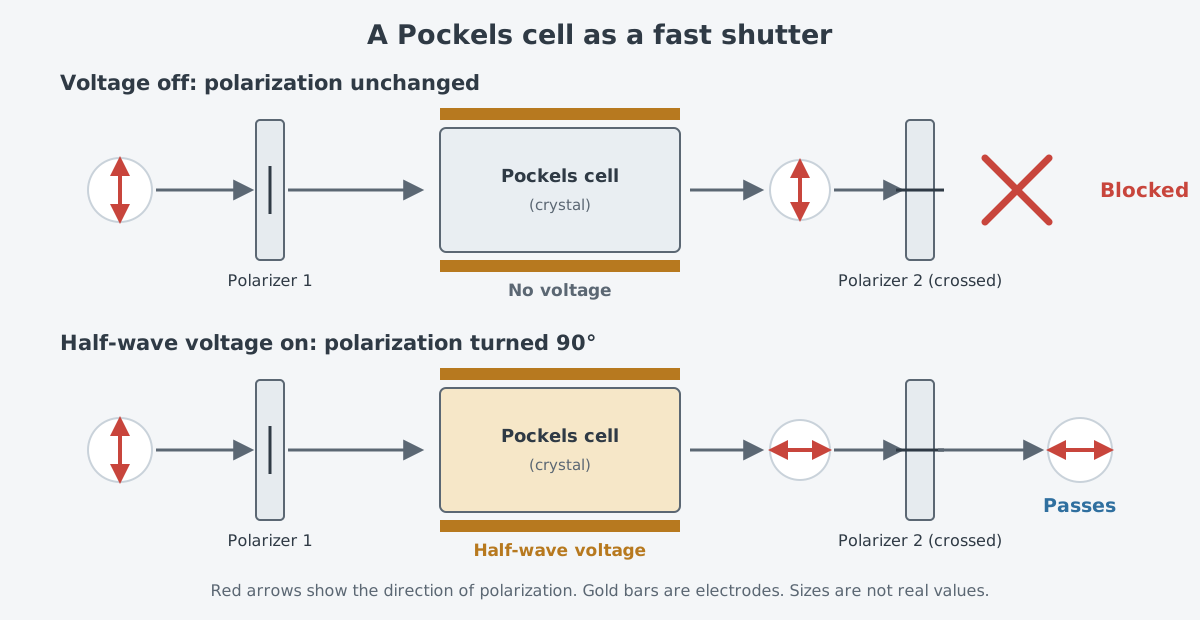
If the two polarizers before and after the cell are set at right angles, light is blocked when there is no voltage. With the half-wave voltage applied, the polarization turns 90° and the light passes. Because the polarization can be turned 90° within nanoseconds, this setup makes a very fast optical shutter.
The second way is interference. A Mach-Zehnder modulator splits light into two arms and then joins them again. If the optical paths of the two arms differ by a whole number of wavelengths, the two waves meet in step, interfere constructively, and go out through the output. If the phase difference is π, they interfere destructively and no light leaves.
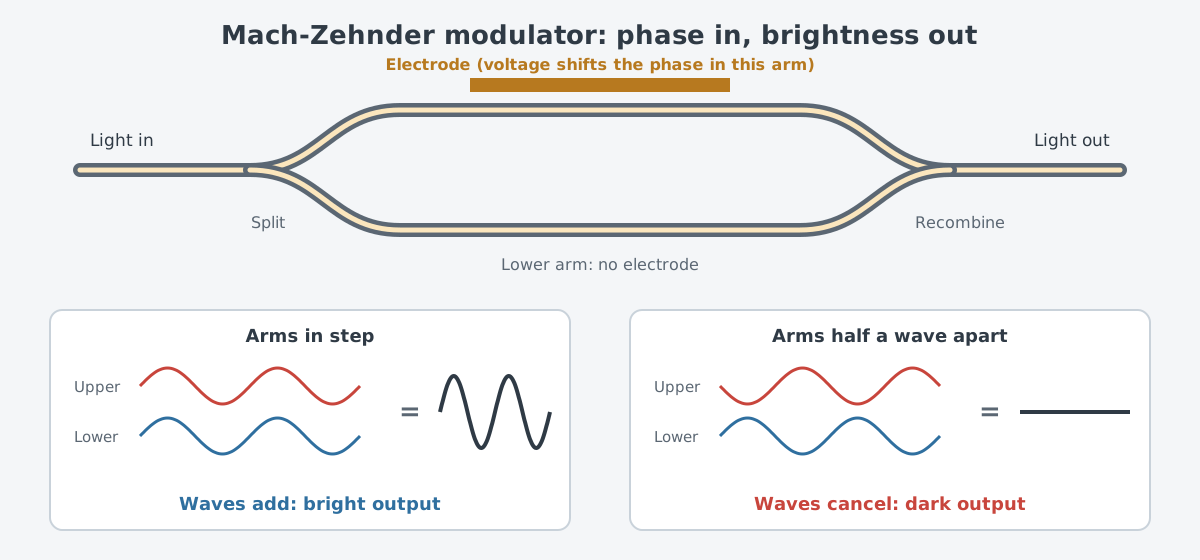
The phase difference between the two beams is set by the voltage on the electrode. With the right choice of crystal axes, the same field raises the index of one arm while lowering the index of the other. That changes the phase difference between the two beams when they meet again. How waves add and cancel is covered in Interference and diffraction.
Pockels cells and Q-switching
Back to the opening scene. In Q-switching, the cavity is blocked during pumping so no stimulated emission can happen, and a large inversion builds up. When the block is removed, the loss drops sharply.
The stored inversion sits far above the steady level for the now low-loss cavity, so stimulated emission grows very fast. The result is a short, strong pulse, typically somewhere from microseconds to nanoseconds long.
The optical switch that suddenly lowers the loss can be a rotating mirror or prism, an electrically controlled Kerr or Pockels cell, or an acousto-optic switch. The shutter setup above, placed inside the cavity, takes on the role of the door.
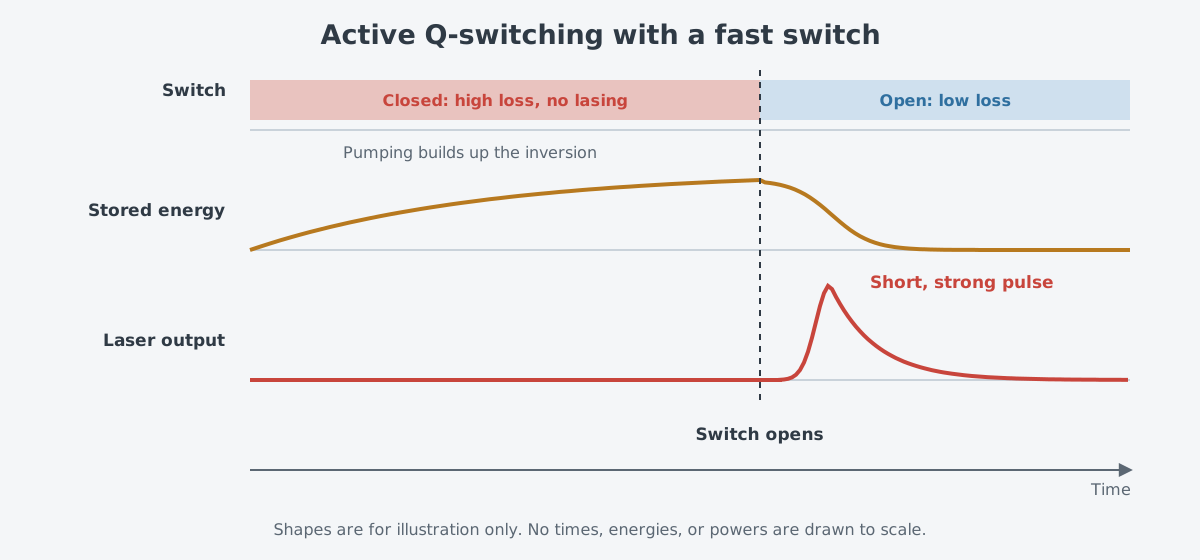
There is a reason the switch has to be fast. Keller's textbook Ultrafast Lasers explains that the switching speed of an optical Q-switch ultimately limits the pulse duration. Only electro-optic switches, typically around 10 ns, and acousto-optic switches, typically around 50 ns, are fast enough. A saturable absorber can make an even faster switch, because the pulse itself changes the loss.
Coherent titles its Pockels cell page "Electro-Optic Q-Switches" and says it makes the cells from crystals such as BBO, KDP, and KD*P. According to the company, the cells serve inside and outside the cavity in lasers for materials processing, medicine, and aesthetic treatments.
Pockels cells also work on the amplifier side, where pulses are made bigger. The regenerative amplifier is one example. In the record of ultrafast laser performance, the pulse repetition rate of regenerative amplifiers was held back by their high-voltage Pockels cell and by the onset of chaotic instabilities. Large-mode-area Pockels cells improved the records, but pushing the repetition rate higher is still harder than with other techniques.
Jobs that need fast shaking
Opening and closing is not the only job. When the voltage swings back and forth, the light swings with it.
In active mode locking, an outside signal drives an optical loss modulator inside the cavity. This modulator usually relies on the acousto-optic or the electro-optic effect, and its loss repeats once per round trip of light in the cavity. An electro-optic modulator can also swing the phase instead of the loss. A laser can be mode-locked with either amplitude modulation or phase modulation.
The same part appears in feedback control that holds a laser's output steady. Common control knobs include the laser temperature, a piezo element that moves a mirror, the injection current of a diode-pumped laser, and an acousto-optic or electro-optic modulator inside the cavity. Temperature is very slow, and a piezo element moving a heavy mirror is slow too, but an electro-optic modulator counts as fast.
The effect also works the other way around, as a way to measure voltage. In the 1980s, picosecond mode-locked pulses in the near infrared served as sampling pulses to measure high-frequency voltage signals through the electro-optic effect. This method is called electro-optic sampling.
Phase modulators in high-power fiber lasers
Electro-optic modulators also appear in designs that combine several fiber lasers to raise the output. The photonics company Exail explains that, among the many ways to combine lasers, two need phase modulators: spectral beam combining (SBC) and coherent beam combining (CBC).
One job is to hold back stimulated Brillouin scattering (SBS). In Exail's description, each laser in a spectral combining setup gets frequency modulation from an electro-optic phase modulator. Widening the laser linewidth is a proven way to suppress the Brillouin effect, and the phase modulator does that widening.
The other job is to keep the phases matched. In coherent combining, a seed laser is amplified several times and fed into an array of lithium niobate (LiNbO3) phase modulators, one modulator per beam. Each beam gets its own phase correction, and that correction runs slowly, at frequencies around the kHz range.
The aim is to control the relative phases in real time so the beams always interfere constructively. The principle is in Coherent beam combining.
The outside environment matters as well. Exail says it tested its modulator over temperature because such laser systems are likely to run outdoors in harsh conditions. In the company's words, a modulator for coherent combining must be insensitive to temperature changes and must not cause any nonlinear effects.
Limits and trade-offs
Handling light with a single voltage is convenient, but it is not free. The University of Illinois lecture notes point out that turning polarization to change intensity is not widely used, for several reasons.
The first is the crystal's own birefringence. Most of the crystals that suit this job may carry their own natural birefringence as well, and it can swamp the Pockels effect.
The second is temperature. The refractive index of these crystals changes with temperature, so the polarization slowly drifts. Third, putting polarizers into a small integrated optical circuit is difficult.
Speed has a ceiling too. In the phase modulator example from the lecture notes, the electrode's capacitance sets the limit on bandwidth. Changing the voltage means charging and emptying a small capacitor formed by the electrode and the substrate.
Even when only the phase is meant to change, the intensity wobbles along with it. When the refractive index changes, absorption changes too, so the applied field in practice modulates both phase and intensity. Fortunately this absorption change is small, and it shrinks for wavelengths farther from the material's absorption edge. Exail also lists low residual amplitude modulation as one of the things it looks for in a phase modulator.
The size of the voltage is a burden as well. Since the half-wave voltage rises in proportion to wavelength, longer wavelengths call for higher voltages. It was also the high-voltage Pockels cell that held back the repetition rate of regenerative amplifiers.
Still, the speed advantage is clear. An acousto-optic modulator is tied to how fast sound moves through its crystal, while the electro-optic interaction can act almost as fast as light travels. Acousto-optic modulation always needs a traveling or standing sound wave, but a plain DC field is enough to produce the electro-optic effect.
What to read next
- Polarization: the basics of birefringence, wave plates, and polarizers.
- Q-switching and mode locking: the two pulse methods where a Pockels cell can act as the door.
- Seed Lasers and Phase Modulators: why shaking the phase widens the linewidth.
- Coherent beam combining: why each beam's phase has to be matched.
- "Acousto-Optic Modulators: Using Sound Waves to Steer and Switch Light": a neighboring part that does similar jobs with sound waves.