A camera shutter opens only when someone presses a button. Fast switches inside a laser usually move on an electrical signal too. Yet there is a door that needs no signal at all. It opens by itself, based only on how strong the passing light is.
That door is the saturable absorber. It absorbs a lot of weak light and much less of strong light. With this one property, a pulsed laser can make short, strong pulses without any outside signal.
The sections below first cover the numbers that describe an absorber, the two kinds of absorber, and the two jobs it does inside a laser. They then follow the road from the 1966 dye absorber to the 1992 semiconductor mirror, which took more than 25 years. The last section looks at problems new materials have not yet solved.
Swallowing weak light, passing strong light
A saturable absorber is a material that absorbs less light as the light intensity and the pulse fluence go up. Pulse fluence is the pulse energy spread over the area the laser beam covers. When the light is strong enough that all the saturable absorption is gone, the absorber is said to be bleached.
Saturable absorption itself is not rare. Most materials show some of it, but often only at very high fluence. To be useful in a laser, an absorber has to show the effect at the normal intensities inside a laser optical resonator. It also must not cause the Q-switching instabilities described later.
The shutter in the title is only a comparison. A real absorber is not a door that snaps open and shut. It is a material whose absorption falls gradually as the light gets stronger, and unlike a shutter, it still keeps a little loss even when fully open.
Four numbers that describe an absorber
The first condition when choosing an absorber is its wavelength range. It has to absorb at the wavelength of the laser it goes into. Within that range, four numbers sketch the absorber's character.
The first is the saturation fluence, the fluence at which absorption starts to drop noticeably. The second is the recovery time, how fast a bleached absorber returns to its absorbing state.
When the absorber is built onto a mirror, the other two come from the reflectivity curve. As the absorber saturates, the mirror's reflectivity rises. The gap between the reflectivity for very weak light and the reflectivity with all absorption bleached is the third number, the modulation depth.
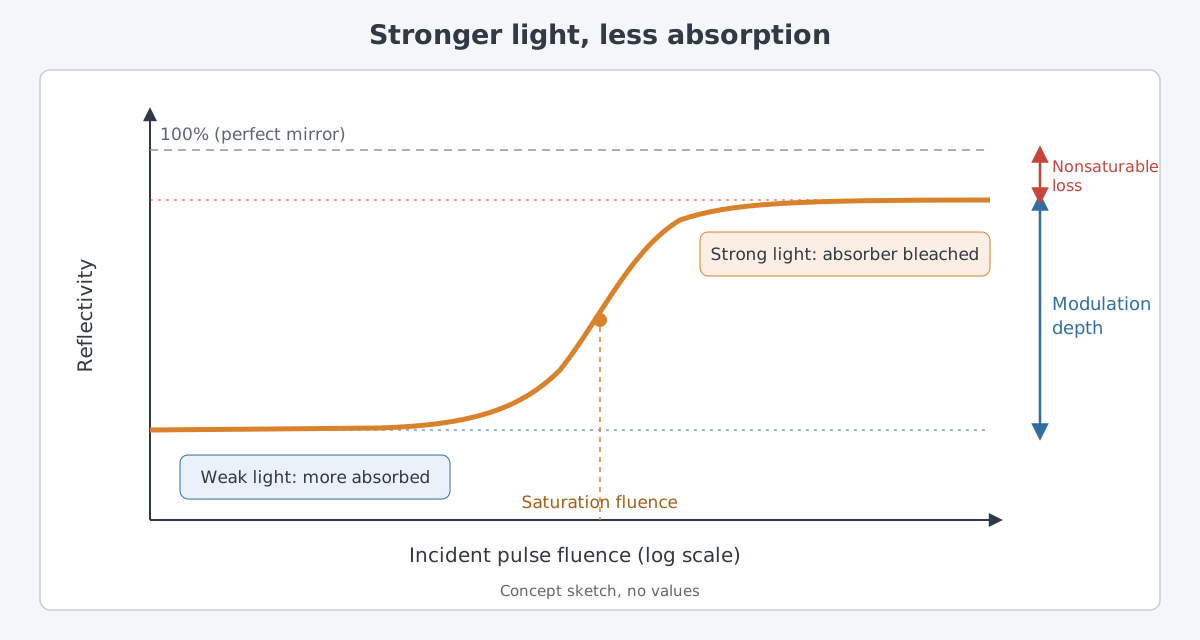
The fourth is the nonsaturable loss. It is the loss that remains below 100% even when the absorber is fully bleached, and it should be kept as small as possible. In principle, all these numbers can be measured without knowing the microscopic details inside the absorber. That makes it possible to compare any material on the same scale.
Slow and fast absorbers
Comparing the recovery time with the pulse length splits absorbers into two groups. A slow absorber is one whose recovery during the pulse can be ignored. Once the front of the pulse opens the door, the door does not close again until that pulse has passed.
In a fast absorber, the absorption follows the incoming power at each instant. It absorbs less at the peak of the pulse and more again in the tail, where the intensity falls. The door opens and closes along the shape of the pulse.
Real materials can have both characters. In a semiconductor absorber, charges excited by light disappear through recombination and trapping within a few ps to a few ns, depending on how the defects are engineered. For pulses around 100 fs, more than one recovery time has to be considered, and the slow part usually helps the first pulse form.
A Q-switch that opens itself
Q-switching keeps the resonator loss high to store energy, then drops the loss suddenly to release a short, strong pulse. When an electrical signal opens and closes the loss, it is active Q-switching. There, the speed of the switch ultimately limits the pulse duration, and only electro-optic and acousto-optic switches are fast enough.
In passive Q-switching, a saturable absorber takes over that door. Because the pulse creates the loss change by itself, a saturable absorber can make a switch faster than these active ones. One cycle can be split into four phases.
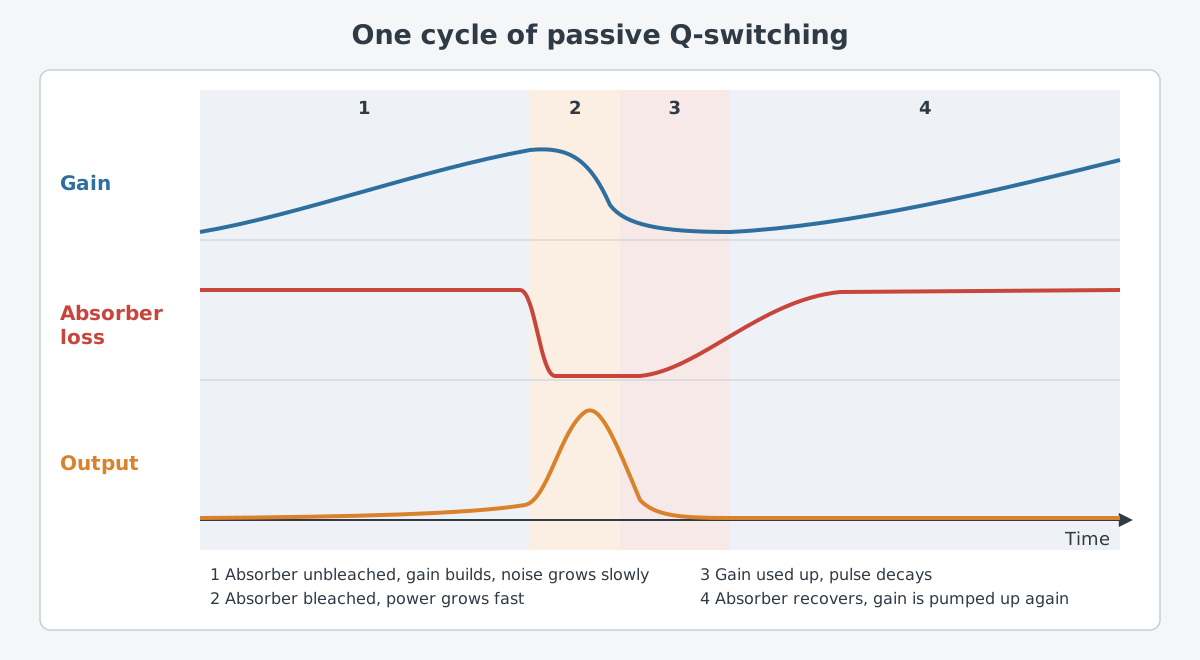
At first the absorber is unbleached and the loss is high. Then the pump lifts the gain to the level of the loss. From there, the light in the resonator grows slowly out of spontaneous emission noise until it can bleach the absorber. When the absorber is fully bleached, the power grows much faster, and the pulse peaks when the gain equals the loss.
As the gain drops further, the pulse dies away. The absorber then recovers, and the gain has to be pumped back to threshold before the next cycle can start. This last phase takes much longer than the absorber recovery time.
Passive Q-switching is much easier in lasers whose excited laser level has a long lifetime, such as solid-state lasers. The shortest Q-switched pulse reported in Keller's textbook came from an Nd:YVO₄ microchip laser with a very short resonator and a semiconductor saturable absorber mirror. With a 185 µm thick crystal, it gave 37 ps pulses with 53 nJ of pulse energy.
The absorber does not have to be a semiconductor. Crystal absorbers made of Cr⁴⁺:YAG have reached much higher pulse energies. Bulk absorbers like Cr⁴⁺:YAG, however, work only in certain wavelength regions, while a semiconductor absorber can have the bandgap of its absorbing layer matched to the laser wavelength.
One noise spike grows into a pulse: passive mode locking
Mode locking gathers the light circulating in the resonator into one very short pulse. In passive mode locking, a saturable absorber applies self-amplitude modulation (SAM) to the light inside the resonator. No outside modulation signal is needed.
When a short pulse passes through the absorber, the strong light at the peak saturates it more than the weak wings do. The peak sees less loss and the wings see more. Weak light circulating outside the pulse sees more loss than gain and dies out over the following round trips.
So where does the first pulse come from? Ideally, from the laser's normal noise. If one noise spike is strong enough to cut the absorber loss noticeably, it is amplified more on the next round trip, cuts the loss further, and keeps growing. A laser that has grown into continuous mode locking gives one pulse for each round trip of the resonator.
Passive mode locking usually gives much shorter pulses than active mode locking, which changes the loss with an electrical signal. The absorber can recover very quickly, so the loss also changes that quickly.
A problem that lasted 25 years
Passive mode locking came early. In 1966, six years after the first laser in 1960, De Maria and coworkers put a dye absorber inside the resonator of a flashlamp-pumped Nd:glass laser and got picosecond pulses. It was the first passive mode locking.
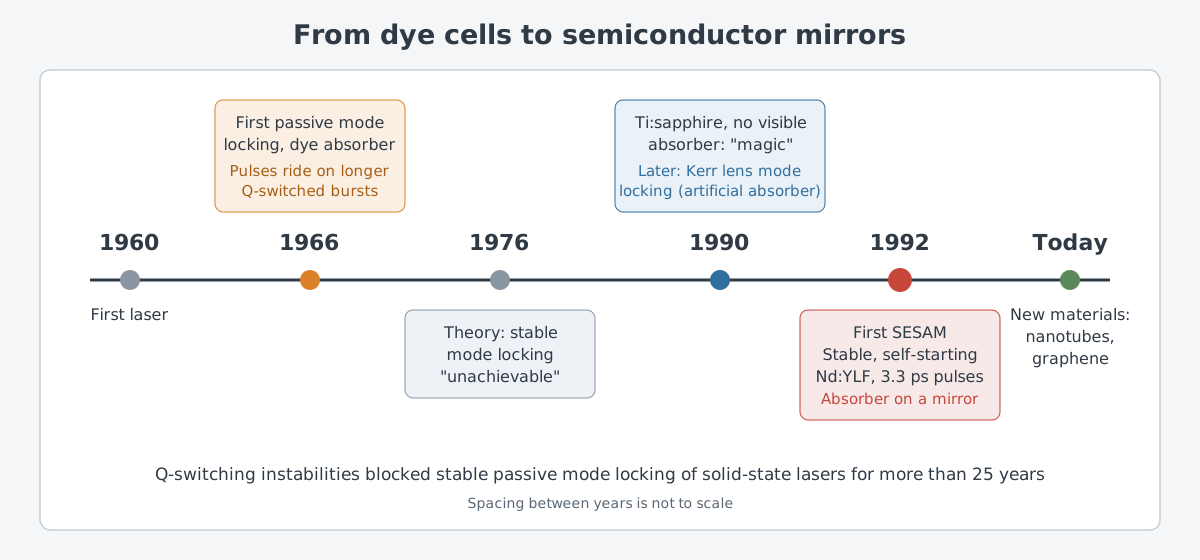
The pulse train, however, was not even. The picosecond pulses sat under much longer Q-switched bursts, as if the laser switched itself off at regular intervals. This is called Q-switched mode locking. Passively mode-locked solid-state lasers carried this problem for more than 20 years.
Theory was not hopeful either. Early theory held that continuous passive mode locking of solid-state lasers without this self-Q-switching would be hard or even impossible. In 1976, a theoretical model by Haus predicted that "stable modelocking is unachievable."
Meanwhile, dye lasers held the lead. Passively mode-locked dye lasers reached pulses of 27 fs at a center wavelength of 620 nm. But the dye liquid changes its chemical makeup within a short time, so its nonlinear properties degrade fast, and these lasers were used mostly in research labs.
In the 1980s, solid-state lasers pumped by diodes drew new interest, but the absorbers could not keep up. The absorbers available were either destroyed by the strong light inside the resonator or added too much loss. Experts in the field assumed that solid-state lasers could not be passively mode-locked, so they used active mode locking.
An absorber that absorbs nothing: Kerr lens mode locking
One breakthrough came from an unexpected place. In 1990, Sibbett's group got short pulses from a Ti:sapphire laser, but no saturable absorber could be seen in the resonator, so the result was first called "magic mode locking." Ti:sapphire has a broad gain bandwidth that can support pulses shorter than 10 fs.
The group had found a new fast saturable absorber by accident. Through the Kerr effect, the refractive index of a material rises as the light gets stronger, so the material the beam passes through acts like a lens. Suppose the resonator is designed so that this Kerr lens shrinks the mode area of strong light at an aperture. Then strong light loses less and weak light loses more, which makes a fast absorber.
This is what is now called Kerr lens mode locking (KLM).
The Kerr effect alone causes no absorption, so this kind of absorber is called "artificial." Its response time is estimated at about 1 fs, which meets the condition for a fast absorber. KLM Ti:sapphire lasers have produced pulses as short as 5.8 fs at an average power of about 300 mW.
The limits were clear too. KLM usually does not start by itself and needs a demanding resonator design with very small position tolerances for some parts. It is also very weak for picosecond pulses, which matter in industry. So the search for other absorbers for solid-state lasers went on.
A semiconductor built into a mirror: the SESAM
In 1992, the semiconductor saturable absorber mirror (SESAM) appeared.
U. Keller and coworkers at AT&T Bell Laboratories published the first paper in Optics Letters, volume 17, in 1992. In it, a low-loss semiconductor absorber inside the resonator started mode locking in a continuously pumped Nd:YLF laser and kept it stable. The results given in the abstract were a pulse duration of 3.3 ps, a repetition rate of 220 MHz and an average output power of 700 mW.
The reason semiconductors fit lies in how strongly they absorb. A semiconductor's absorption cross-section is about 100 times larger than a dye's, so much less energy is needed to saturate it. A low saturation energy is a big advantage for mode-locking solid-state lasers stably.
Being built into a mirror mattered as well. Epitaxial growth builds semiconductor crystal layer by layer. It can place the absorbing layer in or on a highly reflective mirror structure across a whole wafer, and this mirror serves as one end mirror of the resonator.
Changing the material and structure lets designers set the operating wavelength, modulation depth, saturation fluence and recovery time over a wide range. The same kind of device can do both passive Q-switching and mode locking.
SESAMs grown from standard semiconductor materials cover the infrared from 800 nm to 1.5 µm. The Ultrafast Laser Physics group at ETH Zurich, which has worked on these devices, also shares research on GaSb-based SESAMs for 2–2.4 µm.
What changed after the SESAM is recorded in the words of the textbook's author. In her textbook, Keller writes that the SESAM solved a 25-year-old challenge: stable passive mode locking of diode-pumped solid-state lasers. She adds that it let ultrafast lasers move from complicated lab setups to reliable turnkey systems for industry. The same book holds that most, if not all, commercial ultrafast lasers today use SESAM technology, and that the approach has spread to fiber lasers and optically pumped semiconductor lasers.
As uses for such lasers, the textbook lists precision material processing, multiphoton imaging, tissue removal in corrective eye surgery and precision measurement. Ultrashort pulse machining in factories is covered separately in "Ultrashort-pulse laser processing: why less heat is left behind."
New materials and open problems
Research on new saturable absorber materials continues today. Carbon nanotubes (CNTs) and graphene draw particular interest. So far, though, no other material has matched the operating values of the SESAM, and most suffer from large nonsaturable loss, high saturation fluence or a low damage threshold.
A single-wall carbon nanotube absorber that Keller's group built onto a mirror recovered quickly, in 600 fs. But with a modulation depth of 0.5%, it also had a nonsaturable loss of 1.1% from scattering, which is too much for ultrafast solid-state lasers. In a test with a single layer of graphene on a mirror, the damage threshold never rose above the device's saturation fluence. In other words, it could be damaged before it was fully saturated.
How heavy this problem is depends on the laser. Ultrafast fiber lasers send out a much larger share of their light as output, so they are less sensitive to large nonsaturable loss. Diode-pumped solid-state lasers have much lower gain than fiber lasers, so the same loss weighs more on them. In the end, an absorber is a part that has to be matched to the laser it goes into.
What to read next
- "Q-switching and mode locking: two ways to make short pulses": the two jobs of a saturable absorber, set side by side with the active methods.
- "Continuous-wave and pulsed lasers": what pulse length, repetition rate and peak power mean.
- "Ultrashort-pulse laser processing: why less heat is left behind": the uses of the ultrashort pulse lasers that the SESAM brought to factories.
- "Acousto-Optic Modulators: Using Sound Waves to Steer and Switch Light": the electrically driven switch used for active Q-switching and mode locking.