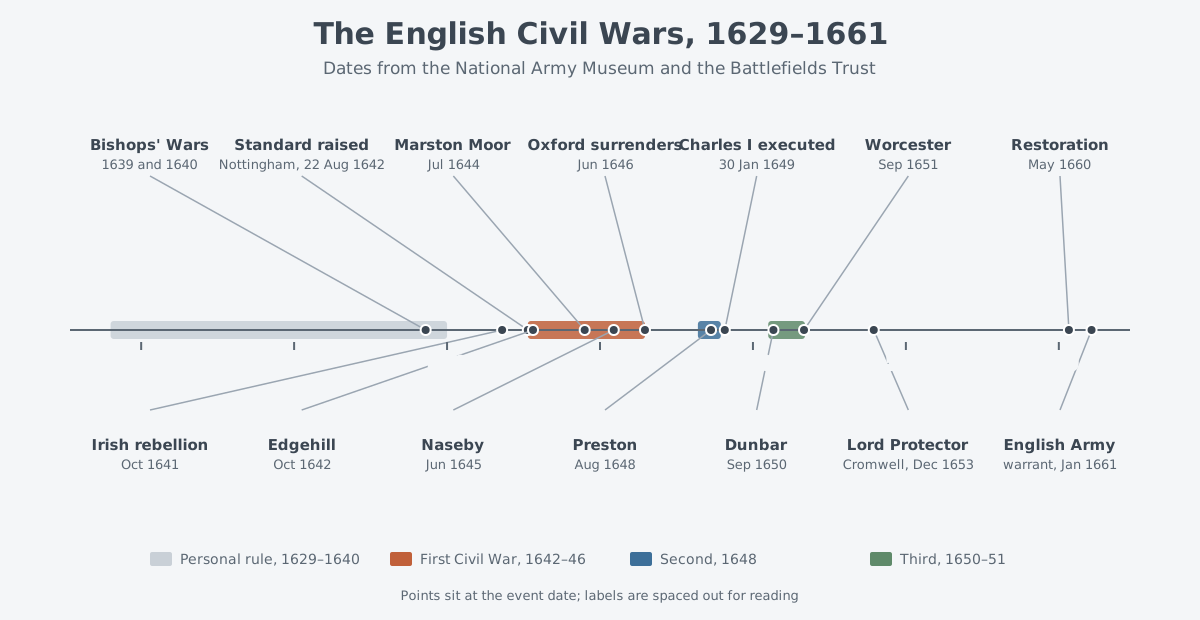
On 22 August 1642, King Charles I raised his royal standard at Nottingham, in the English Midlands. With that ceremony, a war began between a king and his own Parliament. The fighting came in three rounds and went on until 1651.
How did a king end up at war with his Parliament? This article traces where the English Civil War came from and how armies of muskets and pikes fought. It also follows what was left after a royal execution and a republic.
The name says "English," but the fighting did not stay in England. Scotland, Ireland and Wales were drawn in too, which is why the National Army Museum calls the conflict the "British Civil Wars." English Heritage places it inside a larger struggle that historians call the Wars of the Three Kingdoms.
Eleven years without Parliament
King Charles I, born on 19 November 1600, was the younger of James I's two sons. His older brother Henry Frederick died first, so Charles inherited the throne in March 1625. His coronation took place at Westminster Abbey on 2 February 1626. From the start he quarreled with Parliament over money, politics and religion.
From 1629 to 1640, Charles did not call Parliament at all. That kept Parliament out of making laws and approving taxes. When he needed money, he turned to unpopular methods. The best known was ship money, a tax collected to keep up the Royal Navy.
With no Parliament sitting, people had nowhere to take their complaints. Religion deepened the mistrust. England was then mostly Protestant, and many people feared Roman Catholicism, which they linked with oppression and with old enemies, France and Spain.
Charles married a Catholic, the French princess Henrietta Maria. He also brought practices into the English Church that critics called "popish."
Crisis from Scotland and Ireland
The first sparks came from the north. In 1637 Charles tried to force religious changes on Scotland, and resistance came at once. He sent armies north in 1639 and 1640, in campaigns now called the Bishops' Wars. Both times the Scots beat him, and their army then held northern England.
Short even of money to pay his soldiers, the king finally recalled Parliament. Charles hoped the Parliament of 1640 would give him money, but it began by passing laws to cut back his powers. On 7 December that year it ruled ship money an illegal tax. It also tried, through a Militia Bill, to take command of the country's armed forces.
In October 1641, an uprising broke out among Catholics in Ireland, and Protestants in Ulster were massacred. Exaggerated atrocity stories reached England and sharpened the political crisis. Raising an army for Ireland became a fight between king and Parliament over who would control it. Some feared Charles would turn that army on his critics at home.
In January 1642, Charles tried and failed to seize five MPs who were leading the opposition. He then moved from London to York, and on 23 April the gates of the arsenal at Hull stayed shut to him. On 22 August the standard at Nottingham started the war.
The First Civil War: Edgehill to Marston Moor
Early in the war, the map was fairly clear. Parliament soon held most of eastern and south-eastern England, while the king's support lay mainly in the west, the north and Wales. The Royalists made Oxford their base. Most of the fighting happened in the divided areas in between.
The Battle of Edgehill on 23 October 1642 ended without a winner. On 13 November, a Royalist march on London was stopped at Turnham Green.
1643 was a Royalist year. When Prince Rupert took Bristol on 26 July, Royalist fortunes reached their high point. Then the siege of Gloucester failed, and in September the battle at Newbury was a draw.
In 1644 Scotland stepped in. That spring the Scottish Army of the Covenant crossed into England to fight for Parliament. The Battlefields Trust credits these Scottish troops with a major share in Parliament's final victory. On 2 July 1644, Rupert lost at Marston Moor near York, and the Royalist hold on the north collapsed.
This battle made Oliver Cromwell's name. He owned a modest amount of land in Huntingdon and had sat as an MP, and he was already past 40 when he first took up soldiering. At Marston Moor he led the cavalry on the left wing, and his well-drilled troopers delivered the charge that settled the battle near its close. Even so, Parliament's side was often slowed by jealousy and rivalry among its commanders.
The New Model Army and Naseby
Parliament's answer was to rebuild its army. In 1645 it formed the New Model Army by merging what was left of three earlier Parliamentarian armies. Sir Thomas Fairfax took command, and Cromwell became his lieutenant-general in charge of the cavalry. On paper the army had around 24,000 men, but regiments rarely reached their planned size of 1,200 foot or 600 horse.
The New Model Army was unlike the armies before it. It was a national force, not tied to one region, and its soldiers served full time and were paid regularly. Officers rose by ability, not by family. The National Army Museum describes it as the pattern for the permanent army Britain would later keep.
The decisive battle came on 14 June 1645 at Naseby in Northamptonshire. The two armies formed up facing each other across a shallow valley, each with infantry in the center and cavalry on the wings. Rupert's cavalry broke through Parliament's left wing and rode on toward the guns and supply wagons behind it. In the center the Royalist foot seemed to be winning at first, but Cromwell's cavalry on the right wing routed the Royalist left and then struck the Royalist infantry.
How many men fought depends on which page of the same museum you read. The National Army Museum's Naseby page gives around 10,000 Royalists, including 4,000 cavalry, against 12,000 Parliamentarians. Its overview page on the Civil Wars gives 9,000 Royalists against 13,500 Parliamentarians. Either way, Parliament had more men.
The outcome was clear. Roughly 1,000 Royalists died and up to 5,000 were captured, and the army lost its supplies and guns. The king's papers were captured too, including letters showing that the queen had sought help from Catholic powers in Europe. Charles gave himself up to the Scottish army at Newark on 5 May 1646, and the First Civil War ended when the Royalist headquarters at Oxford surrendered in June.
Muskets, pikes and horse: how armies were built
In 1642 England had no standing army. A research guide from The National Archives (UK) explains that armies until then were gathered for one particular job and sent home afterward. Even so, both sides raised large armies and kept them going for years.
Officers from England and Scotland who had served in the Thirty Years' War (1618–48) brought experience. The local militia, the Trained Bands, often did not want to fight far from home.
Infantry, called the Foot, was organized in regiments. In each regiment, roughly two men in three carried the matchlock musket, and the rest carried a steel-tipped pike 16 feet (about 4.9 m) long. Muskets were wildly inaccurate but deadly at close range.
Pikemen guarded the musketeers against cavalry, because no horse would charge into a tight hedge of pike points.
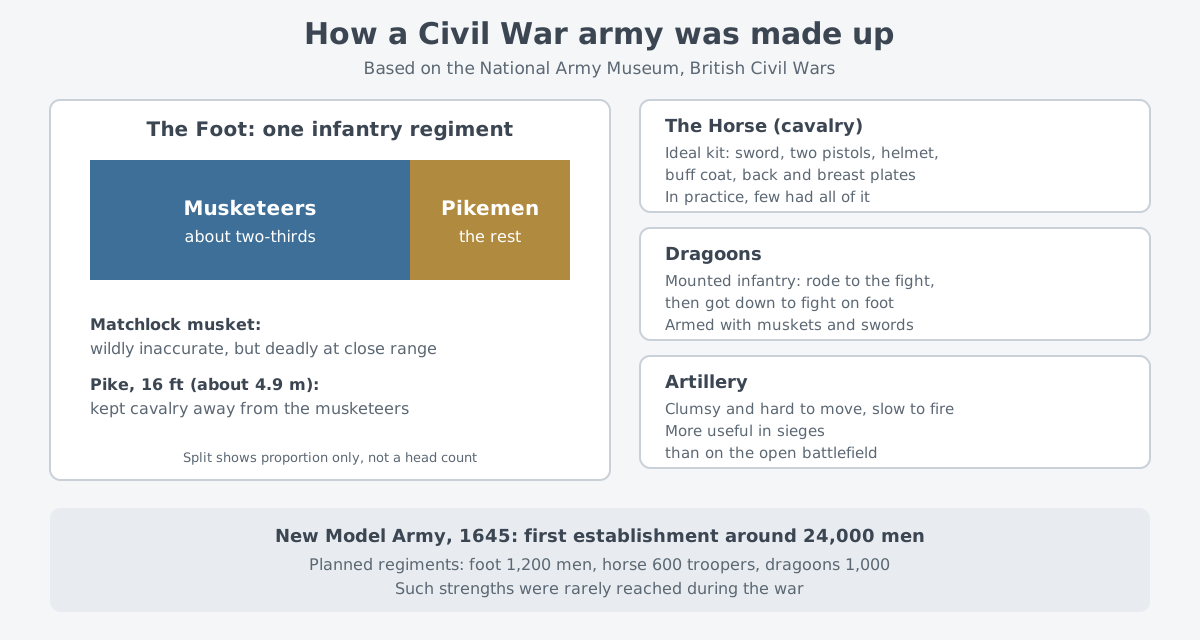
The ideal cavalry trooper, in the Horse, carried a sword and two pistols and wore a helmet and a buff coat. He also had armor for his back and chest, with a steel glove on the hand that held the reins. In practice, few had all of that. Dragoons were mounted infantry who rode to the fight and got down to fight on foot, carrying muskets and swords.
Cannon were clumsy and hard to move. They did more good besieging castles and towns than on an open battlefield.
Sieges were a large part of this war. During the first war alone, cities, towns and small garrisons were besieged more than 300 times. In 1646 Parliament won the siege of Goodrich Castle with the help of a huge mortar called Roaring Meg.
English Heritage explains that the ruined state of many castles seen in England today goes back to these events. Some castles were badly damaged in sieges, and others were deliberately pulled down after the fighting.
The war was also a contest of money. Neither side ever had enough, and both got by on taxes, forced loans, gifts and plunder. Royalist soldiers were paid, equipped and trained much like Parliament's.
But Parliament held the main ports on the Channel and big armories such as the Tower of London, so the Royalists fought under tighter logistics limits. As the war went on, Parliament's money-raising became well organized and kept the New Model Army going.
A common picture shows Cavaliers in big feathered hats and Roundheads in round metal helmets. The National Army Museum calls this a myth that grew up in the 19th century. Soldiers on the two sides looked much the same, and the quality of a man's clothes depended on his rank, not his side.
Friend and foe were hard to tell apart. Soldiers tucked a scrap of white paper into their hats as a field sign, or used passwords, yet mistakes were common and sometimes fatal. The New Model Army later adopted red uniforms.
The king's trial and the republic
Even after losing the first war, Charles would not settle. In 1648 Royalist risings broke out across England and Wales, and a Scottish army invaded northern England on the king's behalf. This was the Second Civil War. The New Model Army defeated all of it, and the Scots lost at Preston on 17 August.
The army now stood at the center of politics. Back in 1647, radical soldiers had aired their views on the country's future at the Putney Debates. On 6 December 1648, "Pride's Purge" removed moderate MPs from Parliament. That opened the way to the king's trial and execution the next January.
In January 1649 Charles was tried in Westminster Hall and found to have "traitorously and maliciously levied war against the present Parliament and the people." Cromwell was one of those who signed the death warrant.
On 30 January Charles was beheaded in Whitehall, in front of the Banqueting House. No other English monarch has been put to death for treason. A committee of Parliament would not allow a burial in Westminster Abbey, so he was laid to rest at St George's Chapel, Windsor, on 8 February.
On 19 May 1649 Parliament declared England a Commonwealth. That August, Cromwell crossed to Ireland to crush support there for Charles II, the dead king's son and heir, who was living in exile.
The National Army Museum writes that the campaign began with massacres at Drogheda and Wexford, in which large numbers of Catholic soldiers and civilians were killed. Cromwell defended this as lawful under the rules of war of his day, arguing it would bring faster surrenders elsewhere and so save lives. The invasion destroyed Ireland's native Catholic landowning class, and its land passed to Protestant settlers with a British identity.
The Third Civil War began in Scotland. In 1650 Charles II landed there, and on 3 September Cromwell beat a Scottish army at Dunbar. Charles then led a second army into England himself, but he lost at Worcester on 3 September 1651 and fled abroad again. That battle ended the wars in England.
The people and numbers the war left behind
The war of 1642 split friends, families and towns. There was no "typical" Royalist or Parliamentarian. Faith, distrust of the crown, quarrels between neighbors, money troubles, and loyalty to the king, a landlord, family or friends all shaped which side people took. Many who filled the ranks had little real choice and followed their landlord or local gentry, and captured men were often drafted into the other army.
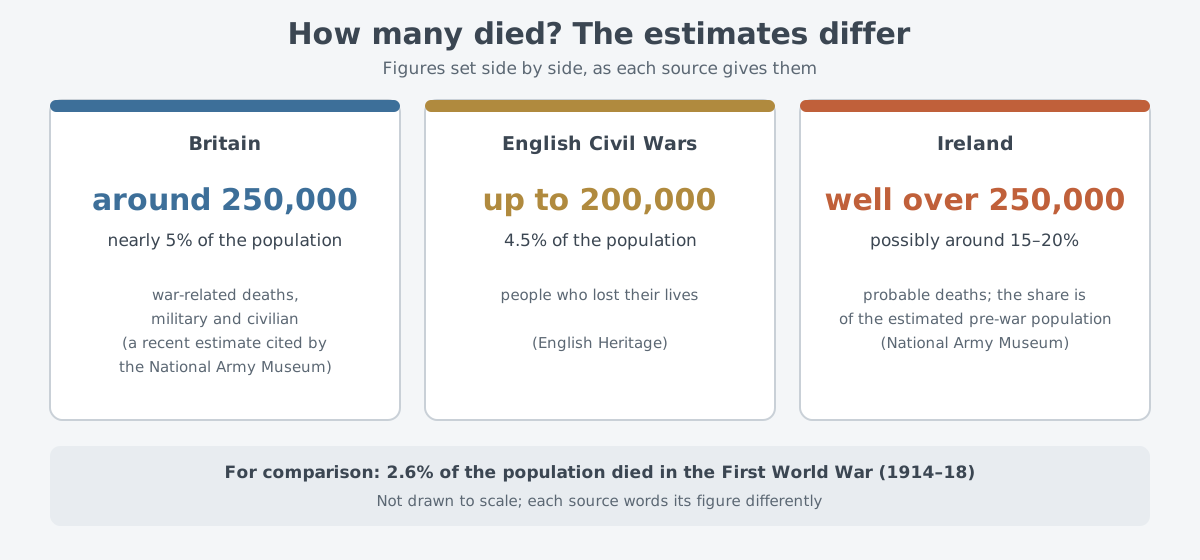
How many died depends on the source. A recent estimate cited by the National Army Museum puts war-related deaths in Britain, military and civilian, at around 250,000, nearly 5% of the population. English Heritage gives a figure of up to 200,000, which it puts at 4.5% of the population.
The two figures differ, but both sources say that in proportion the loss matched or exceeded that of the First World War. In that war, 2.6% of the population died.
In proportion, Ireland is thought to have suffered far more. The National Army Museum estimates that Ireland probably lost well over 250,000 people, perhaps 15–20% of its population before the war. Records on the soldiers' side have gaps too: The National Archives notes that no service record survives for each individual soldier, even for the Civil War.
For those who survived, the war did not simply end. Thousands of men came home crippled. On 24 December 1643 the House of Commons ordered money to be collected in all of London's parish churches to help wounded soldiers, widows and children.
The governments of the war years and after paid pensions and one-off grants to wounded soldiers and to the families of the dead. A literate acquaintance often wrote the petition for the claimant, but the claimant still had to stand up in open court and swear it was true. Civil War Petitions, a project run by historians at Oxford, Nottingham, Cardiff and Southampton universities, collects and publishes these petitions.
The Restoration and what remained
The republic's Parliament did not last long either. In 1653 Cromwell sent in the New Model Army to dissolve Parliament and took the title of Lord Protector, which he held until he died in 1658. He fell out with the Parliaments of the Protectorate as well, sent them home, and ran the country through major-generals. The National Army Museum writes that England became a military dictatorship, and that this left the public wary of permanent armies for a long time, into the 19th century.
Cromwell died in September 1658 and his son Richard succeeded him, but Richard was forced to resign in May 1659. Political order then fell apart. In February 1660, General George Monck led his troops south from Coldstream in Scotland. Charles II promised, in the Declaration of Breda, to pardon past enemies and to rule together with Parliament, and on 1 May 1660 Parliament invited him to take the throne.
Cromwell, who had been given a state funeral and buried in Westminster Abbey, was dug up in 1661.
English Heritage describes the 11 years from 1649 to 1660 as the one stretch of British history when the country was a republic, known as the Interregnum. The monarchy came back, but not as before. The National Army Museum's view is that after these wars kings and queens were never again supreme in British politics. In its account, any chance of absolute monarchy ended with Charles I.
The Glorious Revolution of 1688 settled that Parliament stood above the monarch and gave it control of the army, a question that had helped start the civil war.
The army remained too. On 26 January 1661 Charles II signed the warrant that founded the English Army, and many New Model soldiers went on serving the new king after 1660. English Heritage sees the New Model Army as England's first national army of trained, professional soldiers and the point where the modern British Army's tradition began. The National Army Museum presents it as the direct forerunner of today's British Army.
What to read next
- The Thirty Years' War: A Religious War That Reshaped Europe: the war on the European mainland where officers of the English Civil War gained their experience.
- The Gunpowder Revolution: How Muskets and Cannon Changed Armies: how armies of muskets, pikes and guns came about.
- Military logistics: performance must be sustainable: the side that held the armories and ports lasted longer, and this article carries that thread into modern military logistics.
- Turning points in military technology: other moments when new weapons and new organization changed the shape of war.