The circuits etched inside a phone's chips, and the eye surgery that lets some people put their glasses away. The two jobs look unrelated, yet the same kind of laser does both. It is the excimer laser, which fires invisible ultraviolet light in very short pulses.
An excimer laser is not a weapon laser. Still, it has a place on this site. Few lasers show as clearly how changing the wavelength changes what light can do, or what it means for light to remove material while leaving almost no heat behind.
This article starts with how the light is made and then follows the gas pairs and their wavelengths and the first demonstration in 1970. From there it moves to the work done in chip factories and eye clinics, and to the hazards that people who handle these lasers watch for, using public sources.
A molecule that holds together only when excited
For a laser to build up light, more particles must sit in the upper, ready-to-emit state than in the lower state. This condition is called population inversion. When the lower state gets crowded, light is more likely to be absorbed again than amplified.
"Excimer" is short for "excited dimer." When the pair is made of two different atoms, it is also called an exciplex, an excited complex. This kind of molecule exists only in the excited state.
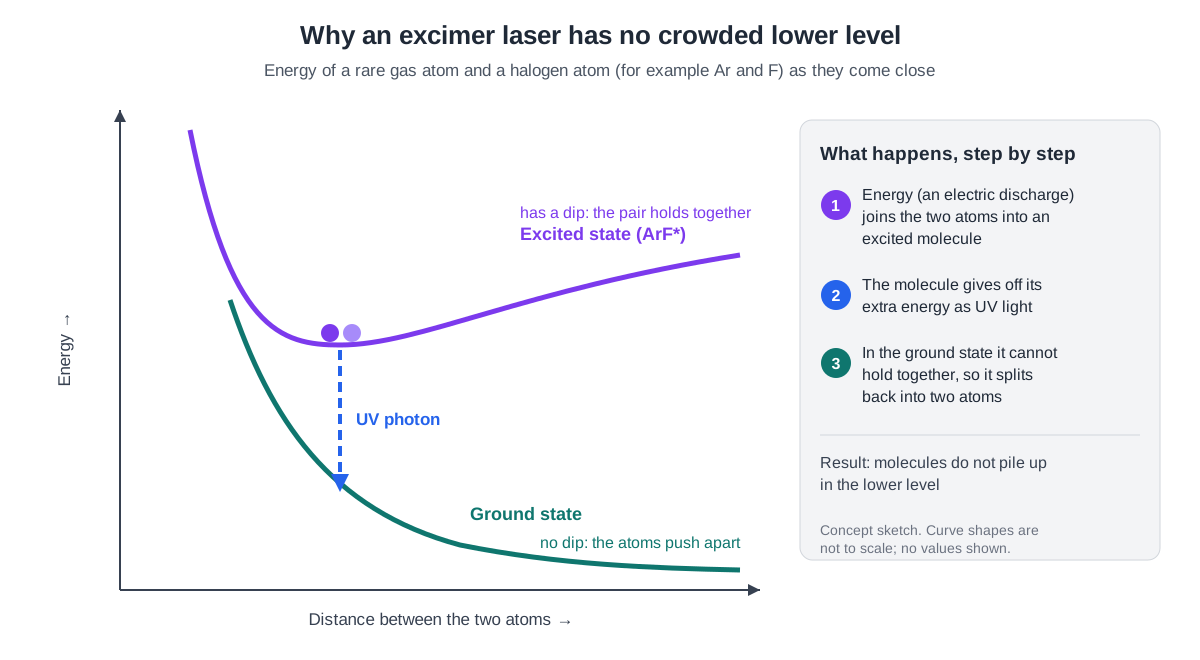
Mix two gases that do not normally combine, add enough energy, and two atoms briefly join into an excited molecule. The molecule then releases its extra energy as light. What happens next is the key point. In the ground state the two atoms cannot stay together, so they fly apart right away.
A molecule that has just given off light has no chance to wait in line in the lower state. So the problem of emptying the lower state is mostly solved from the start. Light given off this way, as a bound pair drops to an unbound one, comes from what is called a bound-free transition.
Picture two people who count as a pair only while holding hands. The moment they let go, the pair is gone and each walks off. In the real molecule, no one decides anything; the shape of the energy curve against the distance between the atoms does the work. The upper curve has a dip that holds the atoms together, and the lower curve has none.
The gas pair sets the wavelength
An excimer laser is usually named after the chemical symbols of the gas pair inside it. ArF is argon and fluorine, KrF is krypton and fluorine, and XeCl is xenon and chlorine. F2 is not a pair but a single fluorine molecule. Change the pair and the energy released by the excited molecule changes, and that energy sets the wavelength of the light.
University laser physics lecture slides list typical values of XeCl 308 nm, KrF 248 nm, ArF 193 nm and F2 156 nm. The F2 line appears as 156–157 nm depending on the source. All of these are ultraviolet, shorter than visible light. Across gas lasers as a whole, wavelengths stretch from the excimer's ultraviolet to the mid-infrared of the carbon dioxide (CO2) laser.
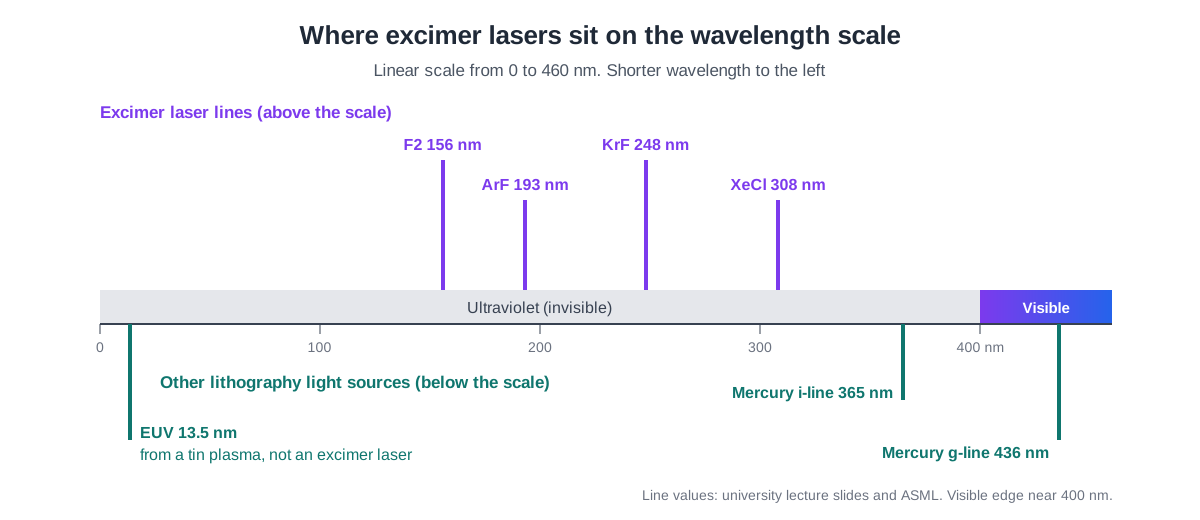
A shorter wavelength also means each photon carries more energy. In the two uses ahead, this short wavelength does a different job in each.
Short pulses and optics made for ultraviolet
An excimer laser is a pulsed laser that sends light in short bursts rather than shining nonstop. The pulse duration, the time each burst lasts, varies by source. The lecture slides give a typical 10–50 ns, while one maker's installation document lists 3–15 ns. A span of 1 ns is a billionth of a second.
Energy goes in through pumping, done by an electric discharge as in most gas lasers. The share of electrical power turned into light, the wall-plug efficiency, is under 20%. That puts it in the same bracket as the CO2 laser and below the diode laser, which is under 40%.
Ultraviolet light is also hard on optical parts. The lenses and windows of excimer lasers use crystals chosen for the job. Calcium fluoride (CaF2) is common in excimer laser optics because of its low absorption and high laser-induced damage threshold (LIDT). Magnesium fluoride (MgF2) has a record of use around fluorine, which makes it a good fit for lenses, windows and polarizers.
The light that started in Moscow in 1970
The first excimer laser ran in 1970 at the Lebedev Physical Institute of the USSR Academy of Sciences in Moscow. Built by Nikolai Basov, V. A. Danilychev and Yu. M. Popov, it looked different from today's factory machines. It used liquid xenon rather than gas, and an electron beam rather than an electric discharge supplied the energy. The light came from Xe2, a molecule of two bound xenon atoms.
Basov had already shared the 1964 Nobel Prize in Physics with Charles Townes and Aleksandr Prokhorov. The Nobel Foundation cites fundamental work in quantum electronics that led to oscillators and amplifiers built on the maser-laser principle. At the time of the prize he was also at the Lebedev Physical Institute.
A 2023 review in the journal Physics-Uspekhi, written for the 100th anniversary of Basov's birth, says in its abstract that this Xe2 laser opened a new chapter for laser physics. High-power excimer lasers followed, reaching from visible light to the vacuum ultraviolet. Excimer lasers that repeat their pulses quickly came into use in medicine, microelectronics and materials processing. Ultraviolet excimer lasers became commercial products in 1980.
The light that prints circuits on chips
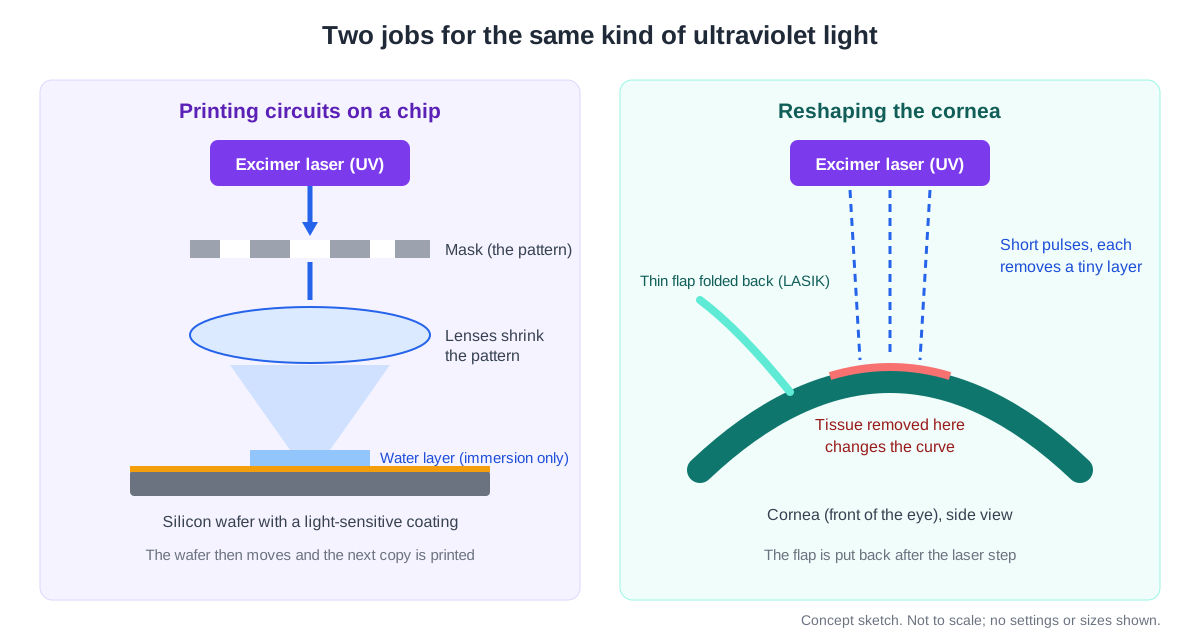
A chip is built up layer by layer as circuit patterns on a silicon wafer. The machine that prints these patterns, a photolithography system, is at heart a projector. Light picks up the pattern as it passes through a mask, also called a reticle, and optics shrink that pattern onto a wafer coated with a light-sensitive layer. After each print, the wafer shifts a little and the next copy goes down.
Smaller patterns called for shorter wavelengths. The first machines from ASML, a lithography equipment maker, used the g-line of a mercury lamp at 436 nm, then soon moved to the i-line at 365 nm. When the mid-1980s called for shorter wavelengths again, the way of making the light itself had to change. The answer was the deep ultraviolet (DUV) excimer laser.
The first DUV machines used KrF lasers at 248 nm, and the next generation used ArF lasers at 193 nm. ASML says ArF made it possible to print features as small as 38 nm.
The next step was hard. In the early 2000s the industry tried to move from 193 nm ArF to 157 nm F2 light sources. But when CaF2, the lens material chosen for that wavelength, went into real prototype machines, the material itself caused so much double refraction that patterns would not image properly. The way forward was immersion, which places a layer of purified water between the lens and the wafer, and it let 193 nm lithography stay in use much longer.
Some layers of a chip are also printed with EUV, extreme ultraviolet, lithography. EUV uses 13.5 nm light, which does not come from an excimer laser; it comes from a plasma made by hitting molten tin droplets with laser pulses. That does not mean excimers have lost their place. Of a chip's many layers, EUV handles one or two of the most demanding, and the rest are often printed with older methods.
ASML still offers dry KrF and ArF machines as well as ArF immersion machines.
The light that reshapes the cornea
The eye surgery story starts at IBM's Thomas J. Watson Research Center in the United States. Rangaswamy Srinivasan, a chemist who joined the center in 1961, worked there with colleagues James Wynne and Samuel Blum. Once UV excimer lasers reached the market in 1980, he began to study what UV pulses do to organic solids.
Late in 1981, just after Thanksgiving, the three aimed an excimer laser at cartilage from a leftover turkey leg. The laser removed tissue precisely and left no heat damage around the cut. A green laser used for comparison left rough marks charred by heat, while the excimer laser's marks were clean. Instead of burning, the ultraviolet light broke chemical bonds and removed a thin layer at a far lower temperature.
In 1983 Srinivasan began working with eye doctors on using this method for surgery on the cornea. That line of work led to the refractive procedures PRK (photorefractive keratectomy) and LASIK (laser-assisted in situ keratomileusis). The National Inventors Hall of Fame inducted him in 2002.
The cornea, the clear tissue that forms the front surface of the eye, does two-thirds of the work of focusing light. That is why the shape of the cornea sets how the eye focuses. A LASIK patient booklet in the records of a U.S. Food and Drug Administration (FDA) approval walks through the procedure.
First, a microkeratome, a blade tool that works somewhat like a woodworker's plane, slices a thin flap in the outer cornea, and the flap is folded back. The excimer laser then takes away a little tissue from the cornea's outer surface to flatten its curve, and the flap is put back. Each pulse is over within a few nanoseconds. Every pulse removes a very thin bit of tissue, makes little heat and leaves the tissue beneath unchanged.
The booklet is just as clear about risks. LASIK can create vision problems that were not there before or make existing ones worse, with dry eye, halos and glare as examples. A doctor can judge whether the surgery is suitable, the booklet says, but only the patient can weigh whether the hoped-for gain justifies the risks.
One more line stands out for readers of this site. Certain jobs set vision standards that these surgeries (RK, PRK and LASIK) cannot satisfy, and military pilots are the example given. Because this comes from a booklet attached to an approval record, current standards should be checked in each military's official rules.
Two hazards: ultraviolet light and the gas
People who work with excimer lasers watch for two main hazards. One is the light, and the other is the gas.
The light comes first. For the retina, a university laser safety handbook names one band of greatest concern. It runs from roughly 400 nm, which is violet, up to 1400 nm in the near-infrared. Every excimer line is shorter than that.
That does not make them safe. In the far ultraviolet, laser energy is soaked up by the cornea, which can be injured, and stray UV outside the beam can also burn the skin and cornea.
The International Commission on Non-Ionizing Radiation Protection (ICNIRP) set out laser exposure guidelines in 2013. They explain that short-wavelength UV is absorbed in the cornea and conjunctiva, while long-wavelength UV is absorbed mostly in the lens. Short-wavelength UV laser light can trigger acute photochemical effects: erythema (reddened skin), photokeratitis (an inflamed cornea), conjunctivitis and cataract (a clouded lens). Photokeratitis is most likely around 270 nm.
The light brings one more issue. High-power excimer lasers pumped by an electron beam can produce significant X-ray levels, so they need a radiation check when installed.
Next is the gas. Excimer lasers contain halogen gases such as fluorine. One maker's installation document says to wear chemical-resistant safety glasses and gloves when handling equipment that holds halogen gas, and to follow the gas supplier's Material Safety Data Sheet (MSDS).
To keep halogen gas under its exposure limit even if things go badly wrong, the laser's exhaust must run into an air extraction system. Even with the laser switched off, steps must be in place so that no gas escapes. The equipment in that document is a Class 4 laser under the laser safety class system, and the skin must be covered whenever UV exposure is possible.
What to read next
- "Why wavelength matters: visible and invisible light": a wider look at how short and long wavelengths shape both uses and hazards.
- "Continuous-wave and pulsed lasers": what changes when light comes in short bursts.
- "Laser safety: classes and how to read eyewear labels": safety classes and exposure limits in more detail.
- "CO2 Lasers: The Gas Laser That Ran Factories for Decades": a gas laser at the far side of the spectrum, in the mid-infrared.