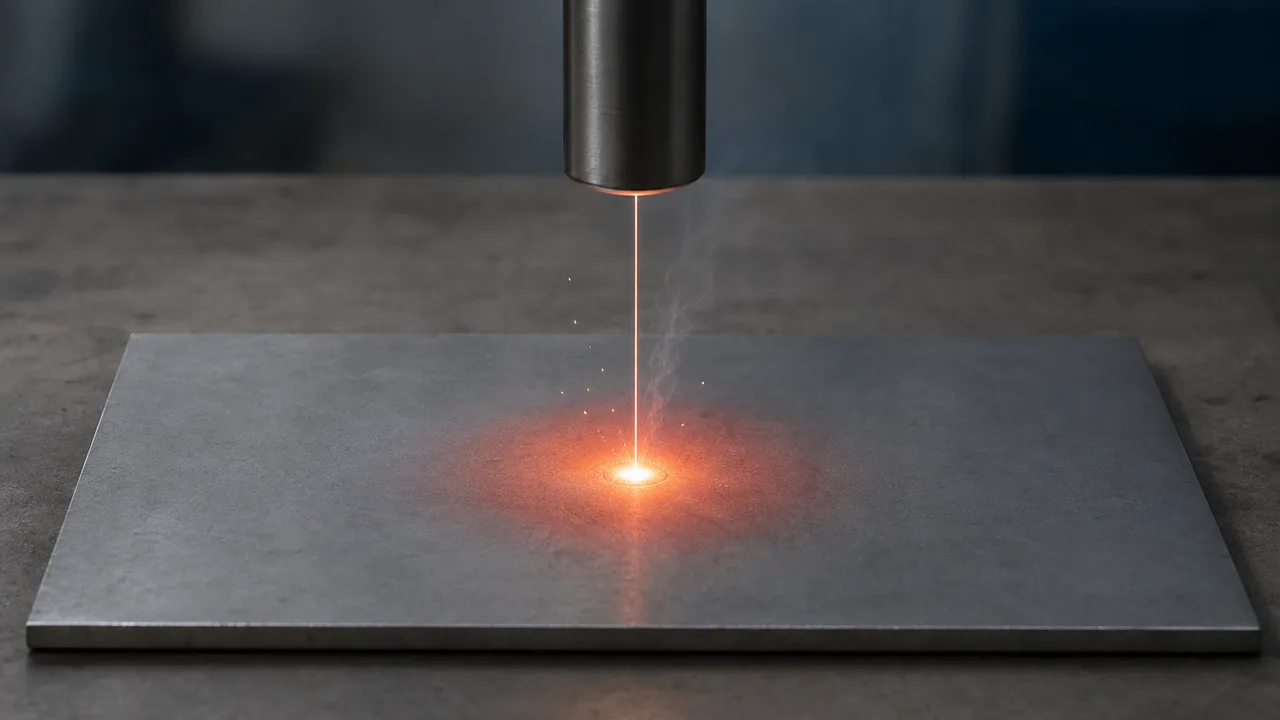
Watch a laser slice through thick steel plate and the light seems to cut like a blade. Yet the light does not cut the material the way a blade does. The material takes the light in, and the energy it takes in heats and melts that spot.
So why does the same laser melt one material easily while its light passes straight through another? This article follows the path from light to heat inside a material, in the order absorption, heating and melting. It also looks at how the material, the wavelength and the area the light is gathered onto change the result.
When light meets material: reflected, absorbed, passed through
Light that reaches the surface of a material has three paths. Some of it is reflected, some passes through, and the rest is absorbed by the material. Which share is largest depends on the material and the light.
Glass lets visible light through but absorbs ultraviolet and infrared light. Of the three shares, the absorbed one is what heats the material.
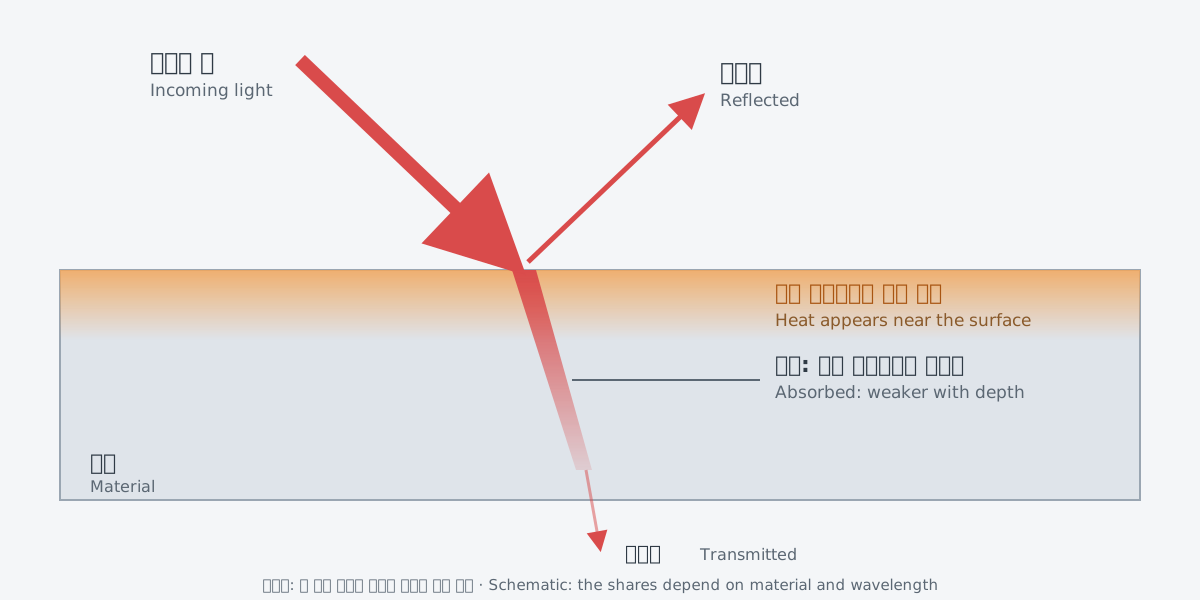
Absorption does not happen all at once at the surface. Light grows weaker as it travels deeper and is absorbed a little at a time. Physics describes how far it gets before fading with a term called the absorption length. In a material where light fades quickly, the energy piles up in a thin layer near the surface.
Think of water poured onto a sponge, soaking in from the top. The real difference is that light does not sit and pool like water. It hands its energy to the material at the very spot where it is absorbed.
Absorbed light turns into heat
Laser processing uses that handed-over energy as heat. An application note from Newport (MKS Instruments) explains that laser materials processing usually removes only the desired material through localized heating. The more tightly the energy is packed into a small spot, the hotter that spot gets.
The catch is that heat does not stay put. Heat made where the light lands moves out into the surrounding material. A band damaged by heating can therefore form around the processed spot, and it is called the heat-affected zone (HAZ).
Removing only the wanted material while keeping the HAZ in the rest small is a major challenge in laser processing. As medical stents get smaller, damage from heating becomes hard to remove afterward, and the HAZ starts to become a limiting factor.
Absorption depends on the material and the wavelength
How much of a given light a material absorbs differs from material to material, and for one material it differs with wavelength. A dielectric, a material that does not conduct electricity well, typically absorbs ultraviolet and infrared light strongly and visible light hardly at all.
Factory examples show the difference clearly. Metals absorb light from solid-state lasers such as Nd:YAG better than light from CO2 lasers. Even so, the CO2 laser used to be the workhorse of metal cutting, and Newport puts that down mainly to price. Since low-cost disc and fiber lasers arrived, they have pushed CO2 lasers out of many applications.
Plastics and wood are the opposite case. These organic materials strongly absorb the 10.6 μm light of a CO2 laser, and Newport goes as far as saying there is no alternative to the CO2 laser for them.
| Material | Light it absorbs well | What happens in processing |
|---|---|---|
| Metals (cutting) | Light from solid-state lasers such as Nd:YAG is absorbed better than CO2 laser light | CO2 lasers were once the workhorse mainly on price; since low-cost disc and fiber lasers arrived, they replace CO2 lasers in many applications |
| Plastics, wood | Strong absorption of 10.6 μm CO2 laser light | CO2 lasers are used for these materials |
| Clear plastic | Absorbs CO2 laser light, does not absorb diode laser light | Diode laser light passes through |
| Colored plastic | Also absorbs diode laser light | The lit side melts |
| Most materials | Absorb visible and ultraviolet light more readily | Shallow absorption depth and a much smaller HAZ |
Plastic welding uses this difference on purpose. Diode laser light is absorbed only by colored plastics. So light sent through a clear part onto a colored part behind it melts the colored side, and the two parts join.
The same idea shows up at shorter wavelengths. Visible and ultraviolet light are absorbed more readily in most materials, so they reach only a shallow depth and the HAZ shrinks a great deal. That is why short wavelengths help in micromachining, where very small shapes are cut.
Heating, melting and vaporizing
Absorbed energy first heats and then melts the material. When even more energy is packed in, the material can turn to vapor and leave. Processes look different depending on which of these they use.
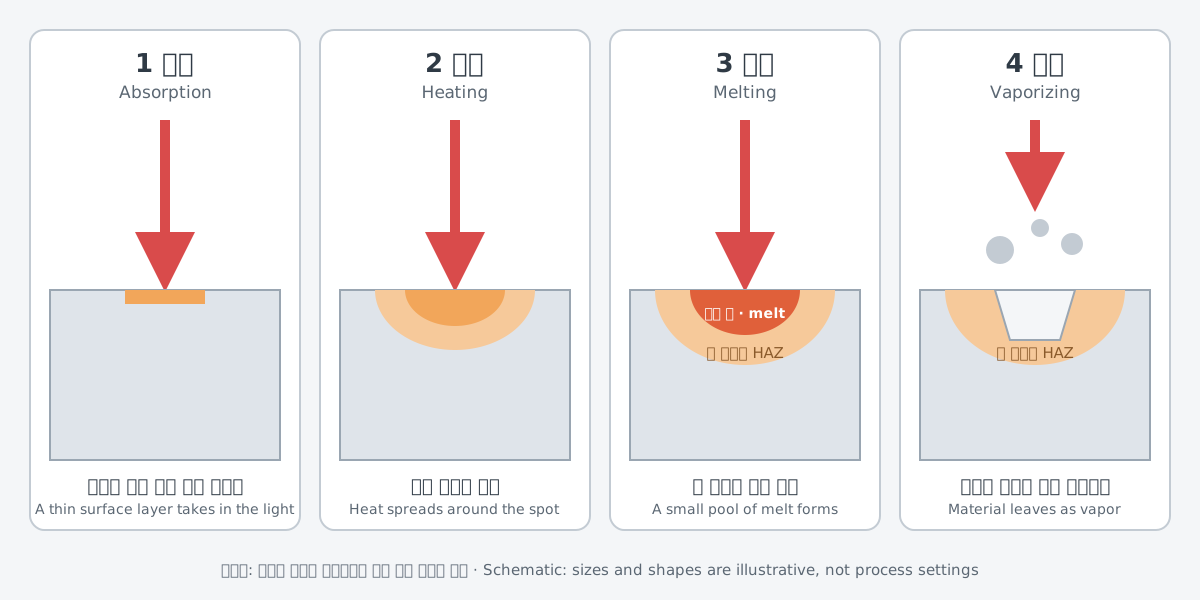
Laser machining is often split into two groups. By Newport's definition, macroprocessing works on metal parts thicker than 1 mm to make features several mm in size, and it relies on the thermal action of heating and melting. Microprocessing, which makes finer features, adds non-thermal routes such as instantaneous vaporization to the thermal ones. This non-thermal vaporization is the case where very short pulses blast the material away at once, covered in the pulse section below.
Welding is the simplest example of the melting stage. The parts to be joined melt at the joint, mix, and become one solid part as they cool. Additive manufacturing, which builds parts by melting or fusing metal powder with a laser, works on the same principle, and these processes are called selective laser melting or laser sintering.
The HAZ follows here too. Because a laser beam can be controlled precisely, a laser can leave a smaller HAZ than traditional welding that relies on electrical discharges.
Intensity and fluence: how tightly and how much
The same energy spread over a wide area leaves less for each spot. So processing looks at "how much per area" rather than power or energy alone. Two terms describe this.
Intensity (irradiance) is power per area, usually written in W/cm². Fluence (energy density) is energy per area: the energy of one pulse divided by the area the beam covers. Its usual unit is J/cm².
Here is a simple example. Spread 1 J of energy evenly over 1 cm² and the fluence is 1 J/cm². Double the spot diameter and the area becomes four times larger, 4 cm², so the same 1 J gives a fluence of only 0.25 J/cm².
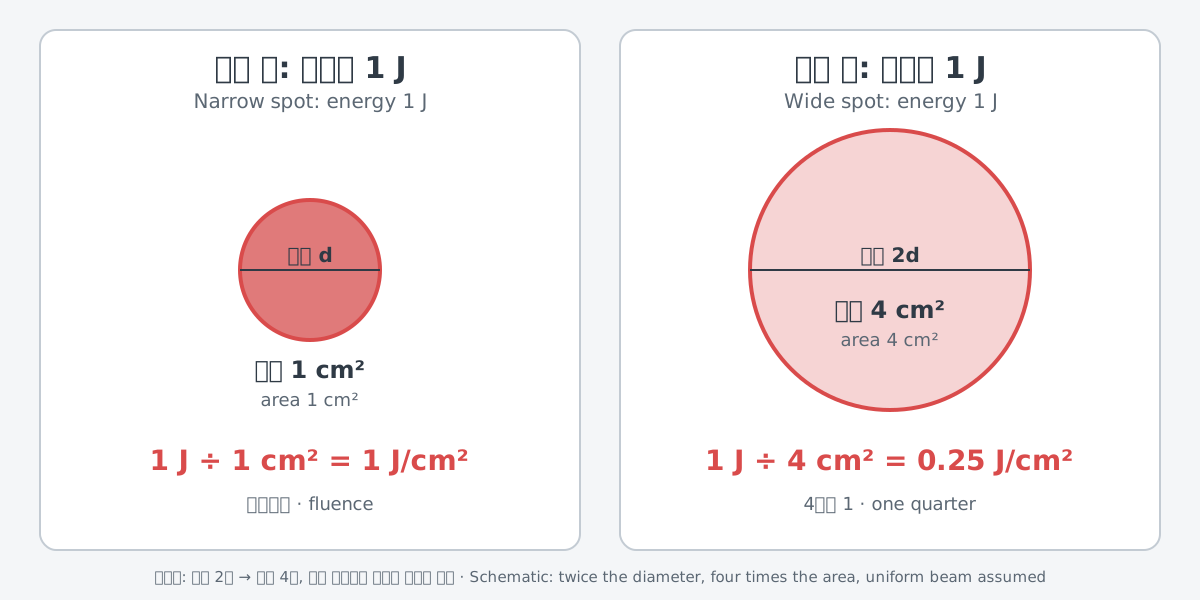
When the focus position shifts, the spot size changes, and so does the power density, that is, the intensity. A Newport note includes a figure showing that doubling the focused beam diameter cuts the power density by a factor of four.
More is not always better, though. In micromachining, and especially with very short pulses, a fluence outside the right range removes material less efficiently. Part of any excess stays in the material as heat and lowers throughput and quality, while too little removes less material.
Macroprocessing, which cuts, joins and builds thick metal parts, uses infrared lasers with kW-class output. Most of these are continuous-wave (CW) lasers that emit light without breaking it into pulses.
When the pulses get shorter
A pulsed laser emits its light in short bursts. In a short pulse all the energy is packed into a very brief time. So very high peak intensities can be reached. Peak intensity is the intensity at the strongest moment of the pulse.
Keller's textbook gives this as a reason short pulses matter for material processing.
Short times matter for heat as well. Material processing has traditionally used nanosecond pulses, but it has been moving to picosecond and femtosecond pulses for higher precision and less thermal damage. The reason is that material at the lit spot is removed faster than heat can move into the surroundings.
This kind of processing is often called cold ablation. Ablation means removing material from the surface, and in this regime the HAZ around the removed material becomes very small. The high peak power of ultrashort pulses causes nonlinear absorption that vaporizes the material instantly. This is the "non-thermal vaporization" mentioned earlier.
Why less heat is left behind is covered in more detail in "Ultrashort-pulse laser processing: why less heat is left behind."
The same fiber lasers, other uses
Fiber lasers and disc lasers are typically used for metal welding in factories. IPG Photonics lists the wavelength of its high-power fiber laser line as 1007–1070 nm. This wavelength of just over 1 μm is roughly ten times shorter than the 10.6 μm of a CO2 laser.
High-power fiber lasers like these are also used outside the factory. Exail's photonics division says high-power fiber lasers are used in industrial machines, lidar systems and very high-energy laser facilities. More recently, Exail adds, they also go into optical systems that deliver very high power for defense uses.
FiberBridge Photonics, based in Hannover, Germany, describes itself as covering everything from fiber components to high-power laser systems. Its home page lists fiber delivery parts for multibeam processing next to high-energy laser systems for directed energy.
What to read next
- "Ultrashort-pulse laser processing: why less heat is left behind": continues with short-pulse processing that removes material before heat spreads.
- "Why a laser weapon does not work 'the instant it fires'": looks at the time it takes for light to turn into heat and build up, from another angle.
- "Where industrial lasers are used: cutting, welding, marking, cleaning": goes through the jobs lasers do in factories, one type at a time.