South of the road into the village of Prokhorovka, a victory memorial tower rises 52 m above the fields. In front of a nearby museum complex, a sculpture shows two Soviet T-34 tanks crushing two German Tiger tanks. Neither the tower nor the sculpture dates from 1943. They went up in the 1990s, as the people who remembered the battle were growing fewer.
The fighting around Kursk in Russia in July 1943 is often called "the largest tank battle in history." Open the records, though, and the numbers of troops and tanks differ from source to source. The loss figures for its most famous scene, Prokhorovka, were heavily revised decades later. That does not mean the outcome flipped.
This article follows why Germany aimed at Kursk and waited for months, what the Soviets prepared, and how the ten-odd days of July and the counterattacks that followed played out. It draws on the U.S. Army's official histories, a German national museum, and journal articles. At the end, it compares where memory and record part ways.
Spring 1943: a bulge in the front
By 1943, the German army on the Eastern Front was fully on the defensive. It had lost heavily at Stalingrad in February, and further Soviet offensives followed. By spring it was back on a line it had already held in the winter of 1941. Germany was looking for a move that could win back the strategic initiative in the east.
The obvious spot was a bulge in the Soviet line around Kursk. Its size varies by source. One gives a front bulge 150 km long, and another gives 160 miles north to south and about 100 miles east to west. German forces held the shoulders of the bulge, near Orel in the north and Belgorod in the south.
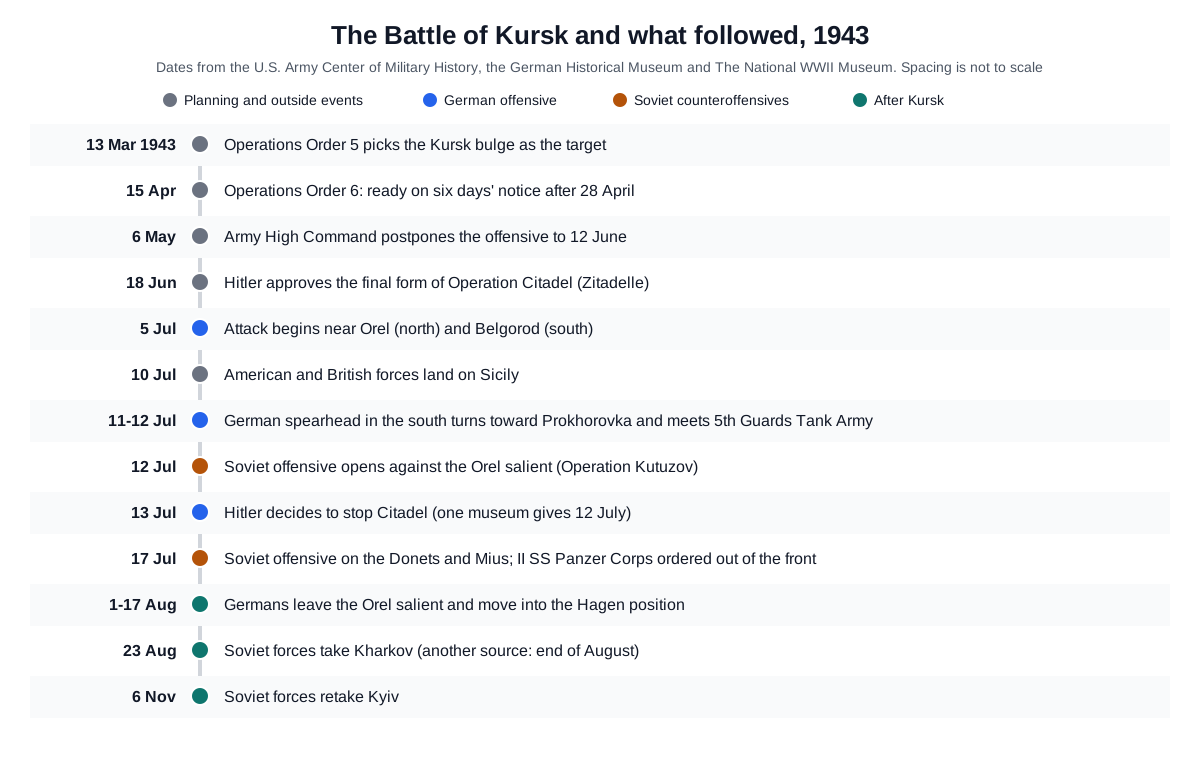
On 13 March, Hitler chose this bulge in Operations Order 5. Strike from north and south like a pair of pincers, meet near Kursk, and the Soviet forces inside would be encircled. The German leadership hoped that a win here would straighten the front and keep the Soviets off balance for a while.
An offensive that kept slipping
The plan got the code name Zitadelle, or Citadel. Operations Order 6, issued on 15 April, said to be ready to start on six days' notice after 28 April. The date kept slipping, though, and on 6 May the Army High Command announced a postponement to 12 June.
New tanks were one reason for the wait. Hitler decided to hold off for them, especially the Ferdinand self-propelled guns, 90 of which he would have in June. General Kempf in the south believed the delay would help the defender more than the attacker. Guderian even asked Hitler why he wanted an offensive in the east at all in 1943.
Hitler approved the final form of Operation Citadel on 18 June. The basic picture had not changed for months: Ninth Army would strike south along the Orel–Kursk line, and Fourth Panzer Army would drive north from Belgorod.
Earl F. Ziemke, who wrote the official history for the U.S. Army Center of Military History, judges the plan logical to a fault, with not the slightest chance of surprise. The other side had been expecting this attack for a long time.
The German leadership tried to hide the limits of the offensive. Jodl told Wehrmacht propaganda to present Citadel as a counteroffensive rather than an offensive. The aim was to cover up that Germany could now mount only a limited offensive, and to build an alibi in advance in case it failed.
The side that waited
Two Soviet fronts held the bulge: Rokossovskiy's Central Front in the north and Vatutin's Voronezh Front in the south. Both fronts massed about two-thirds of their artillery and tanks where they expected the German attacks.
The ground itself changed. The Central Front alone, using troops and local civilians, dug over 3,000 miles of trenches, fortified villages and hills across the steppe, and had its engineers lay 400,000 mines. Behind the three defensive belts of each army, the fronts added two more of their own.
There was one more layer. Konev's Steppe Front, the strategic reserve, stood across the open eastern end of the bulge with over 1,600 tanks. Its job was to stop any breakthrough and then add weight to the counterattacks.
The Soviets did not plan only to hold. They built two counterattacks into the defensive plan. The first would hit the Orel salient to the north while the German offensive was still going. The second would strike German forces south of Kursk once their advance there had stalled.
Were they that confident? David M. Glantz of the U.S. Army Combat Studies Institute points the other way in a 1986 report.
The Soviets were trying something they had never done: stop a German strategic offensive before it won tactical or operational success. Their own doubts, he writes, drove them to prepare such immense defenses.
Forces on both sides, and numbers that differ
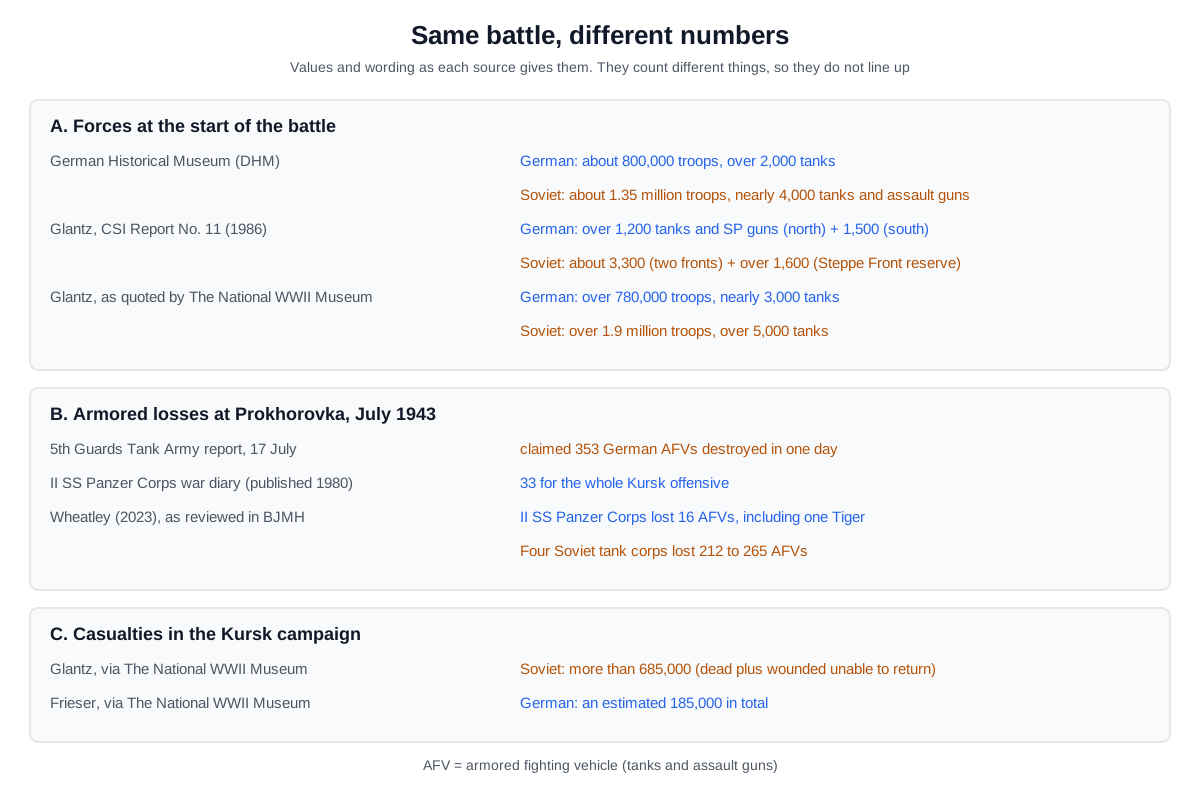
How much each side brought depends on the source. By the German Historical Museum's count, Germany fielded about 800,000 troops, 1,400 aircraft, 10,000 guns and over 2,000 tanks. Those tanks were about 70% of all German tanks on the Eastern Front. The Soviets gathered about 1.35 million troops and nearly 4,000 tanks and assault guns.
Glantz's 1986 report counts tanks and self-propelled guns instead of people. In the north, over 1,200 tanks and self-propelled guns were to strike on a front of less than 30 km. About 900 of them were in units ready to fight at once.
The southern attack force had 1,500 tanks and assault guns. The two Soviet fronts had about 3,300, and the Steppe Front over 1,600.
Another set of Glantz figures, quoted by The National WWII Museum, is larger. It puts the Soviet side at over 1.9 million troops and over 5,000 tanks, against over 780,000 German troops and nearly 3,000 tanks. Some figures count tanks and assault guns together, and some count the Steppe Front reserve separately.
In the air, the German air force had about 2,500 first-line combat planes in the east and planned to commit about half of them directly to Citadel.
5 July: north and south
On 5 July 1943, the German army opened its last major offensive on the Eastern Front near Orel and Belgorod. German artillery began firing at 03:30. Hours earlier, the Soviet side had already fired a massive bombardment of its own.
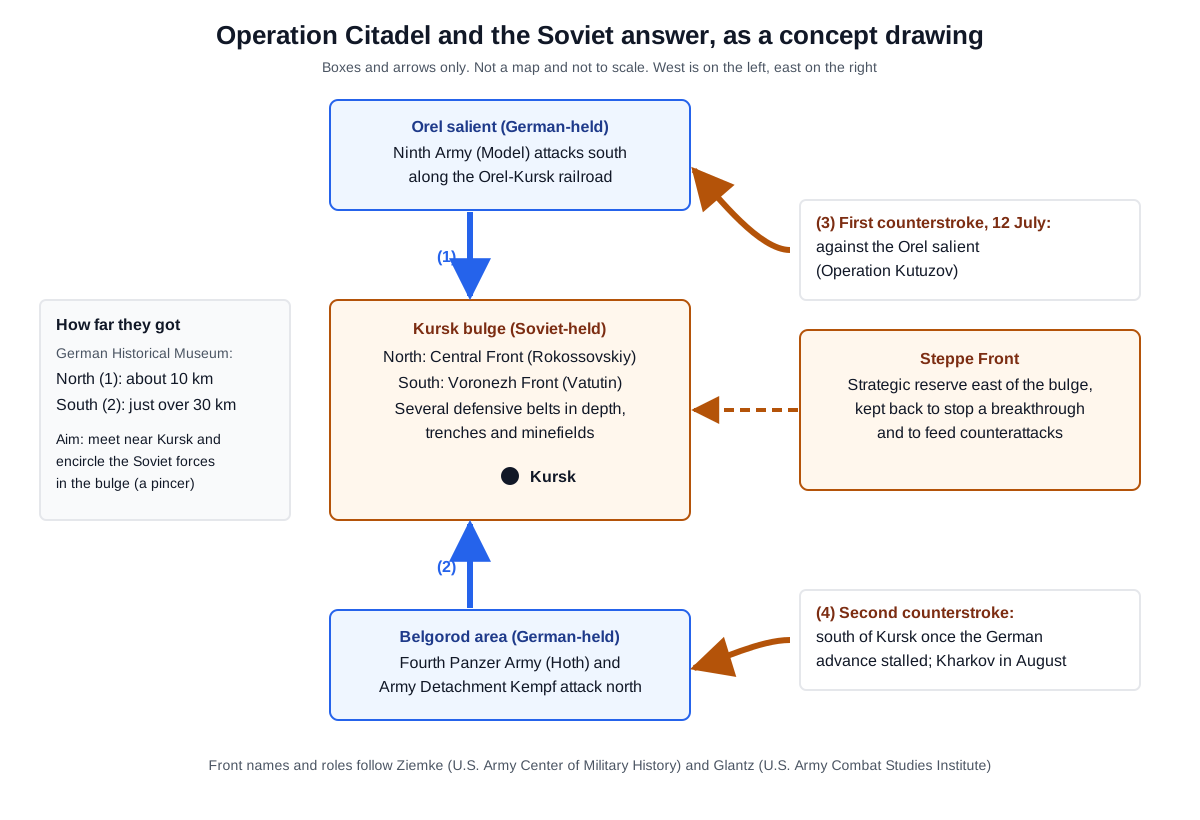
In the north, Walter Model's Ninth Army pushed south toward the Orel–Kursk railroad. Ziemke, working from German war diaries, says that by nightfall on 6 July it had gained about 13 miles except on its right flank. On 8 July it ran into a heavily fortified ridge southwest of Ol'khovatka, and Model called the fight ahead a "rolling battle of attrition."
The northern push did not last. On 12 July, 2–12 km into the Central Front's defenses, the German advance ran out from sheer exhaustion.
The south went somewhat differently. Hermann Hoth's Fourth Panzer Army and Army Detachment Kempf struck north, and by nightfall on 6 July the lead elements of II SS Panzer Corps had advanced nearly 25 miles. By the German Historical Museum's figures, the total gain was 10 km in the north and just over 30 km in the south. Either way there was no decisive breakthrough, and the fighting became a huge battle of attrition in which both sides used up their last reserves.
Prokhorovka
By 11 July, II SS Panzer Corps had a bridgehead north of the Psel River. The spearhead of the southern attack turned northeast toward Prokhorovka and ran into Rotmistrov's 5th Guards Tank Army. Vatutin threw that army, from the reserve, and the 5th Guards Army, from the Steppe Front, into a counterattack.
This clash around 12 July is the scene remembered as the heart of "the largest tank battle." In his 1986 report, Glantz wrote that the huge tank battle at Prokhorovka broke the back of the German assault. By 13 July the fighting had ebbed.
How many tanks were wrecked on those fields comes up again below. It is where the numbers were revised the most.
The halt order and the Soviet counteroffensive
On the morning of 12 July, the first Soviet counterattack opened in the north. The Bryansk Front and the left wing of the West Front struck the north face of the Orel salient in three prongs. The offensive was named Operation Kutuzov, for Kutuzov, the Russian commander who pushed Napoleon's army out of Russia in 1812.
Two days earlier, on 10 July, American and British forces had landed on Sicily. On 13 July, Hitler called Manstein and Kluge to his headquarters and told them he had decided to stop Citadel. There were three reasons. The Orel salient was in danger, Soviet buildups near the Donets basin worried him, and his greatest worry was Sicily.
Manstein protested that the operation was just reaching its turning point. Hitler did not change his mind, and on 17 July he ordered II SS Panzer Corps out of the front. The German Historical Museum also dates the halt to 13 July. The National WWII Museum, however, says Hitler told his generals on 12 July that he wanted to shift forces away from Kursk to Italy.
On that same 17 July, the Soviet Southwest and South Fronts opened a new offensive at Izyum on the Donets and on the Mius. In the north, the Germans gave up the Orel salient. They began pulling back on the night of 1 August, and the last troops entered the Hagen position on the night of 17 August. As they left, they drove some 250,000 civilians, with their cattle, carts and belongings, down the side roads.
In the south, Kharkov fell. Some sources date the Soviet capture of Kharkov, which closed the campaign, to 23 August, and others say only the end of August. The Germans in the south were pushed back about 250 km west by November. On 6 November, Kyiv, occupied since September 1941, was back in Soviet hands.
New tanks, minefields, and the sky
What was the new equipment Germany had waited for? The Panther was lighter and more mobile than the Tiger and was due to start coming off the assembly lines in late spring. German tank output rose to 621 in April 1943 and 988 in May, and the May figure included 300 new Panthers.
The Ferdinand put a long 88 mm gun on a Tiger chassis. Guderian thought it a mediocre weapon because of its low speed, fixed turret and lack of machine guns for close combat. Its heavy armor and powerful gun, however, won Hitler over. Germany was betting that blitzkrieg methods and new equipment such as Panther and Tiger tanks and Ferdinand assault guns would let the smaller force win.
The battlefield told a different story. Around 7 July, the Grossdeutschland Division had only 80 of its 300 tanks still fit for combat. Most of the disabled tanks were new models laid up in the workshops with mechanical trouble.
The defenders used the ground. Antitank obstacles added to natural barriers, and mines were laid generously. The trench and mine figures above show the scale.
The sky belonged to neither side. The German air force flew 3,000 sorties a day during the offensive but did not have air superiority over the battlefield. Close support for front-line units was more urgent, so it could not seriously challenge the Soviets in the air.
Counting wrecked tanks was a problem of its own. German armored units reported total losses separately from tanks under repair, and repairs were split into short-term and long-term, meaning six days or more.
On the German side, recovering and repairing knocked-out tanks worked very well until late 1943. Where Germans held the ground for several days, as at Prokhorovka, they could pull back and fix many vehicles. A "knocked-out tank" and a "lost tank" are therefore not the same count.
Record and myth
The National WWII Museum calls Kursk the largest tank battle in history, and the German Historical Museum calls it the largest tank battle of the war. Parts of the established story have been strongly challenged in recent years, though, and one of them is the losses at Prokhorovka.
The old story goes like this. On 12 July, Hausser's II SS Panzer Corps suffered catastrophic armored losses when Rotmistrov's 5th Guards Tank Army counterattacked. A 5th Guards Tank Army report of 17 July claimed that 353 German armored vehicles had been destroyed in one day on the Prokhorovka fields. Yet the II SS Panzer Corps war diary, published in 1980, gave a figure of just 33 across the whole Kursk offensive.
Historians such as Klink and Frieser in Germany and Zamulin in Russia went back over the story. Research by Ben Wheatley, presented in a 2023 review in a British military history journal, cross-checked Russian and German records against aerial reconnaissance photos. It found that the three divisions of II SS Panzer Corps lost 16 armored vehicles, including one Tiger. The four Soviet tank corps in the battle lost 212 to 265.
Jumping from there to "so Germany won" would create a new myth. Wheatley also accepts that Prokhorovka was a Soviet win. He credits massive artillery superiority, a strong antitank screen and a large number of tanks. After the fighting, 5th Guards Tank Army still had over 400 armored vehicles ready for action.
In a 2024 article, Wheatley goes a step further. Western historians, he argues, have often fixed on the lower German losses without looking at the battle as a whole. The claim that no Tiger was lost at Prokhorovka is also wrong. German original records show one Tiger recorded as a total loss in that area on 12–13 July.
Myth was not on one side only. The German leadership ordered Citadel dressed up as a counteroffensive. The Soviet report's one-day figure was more than ten times the loss the German war diary recorded for the whole offensive. And because the Tiger was the most recognizable symbol of German armor, it is the Tiger that gets crushed in the Prokhorovka sculpture.
What Kursk left behind
Losses were heavy on both sides. By the figures quoted by The National WWII Museum, the Soviets lost more than 685,000, counting dead and wounded unable to return, as calculated by Glantz. German losses came to an estimated 185,000, as calculated by the German historian Frieser. Soviet losses in Operation Kutuzov alone exceeded 429,000.
The weight of those losses was not equal. The German Historical Museum judges that dead and captured soldiers and wrecked tanks weighed less on the Soviets than on the Germans for the rest of the war. German industry built about 22,000 tanks in 1943, but supply problems left only 2,300 ready at the front by autumn. In the summer offensive, the Soviets had 8,400 tanks to Germany's 2,300, and deep reserves besides.
Many sources treat Kursk as a turning point. The German Historical Museum writes that the initiative finally passed to the Red Army. Glantz sees Kursk and the Kutuzov counteroffensive as the point where Germany lost the strategic initiative for good.
The same sources also warn against treating the result as fixed from the start. Glantz notes that hindsight leads today's observer to take the outcome of Kursk for granted. Ziemke likewise points out that the German divisions were in excellent shape and had many new tanks, so Citadel was not doomed from the outset.
Numbers this large can hide the people. The National WWII Museum wrote about the Kursk diorama at Moscow's Great Patriotic War Museum. Its article ends by saying the scale of the battle only starts to make sense when each of the hundreds of thousands of casualties is seen as an individual. The 250,000 civilians driven down the side roads from Orel with their cattle and carts belong to that scale as well.
What to read next
- How the Panthers and Tigers of 1943 compare with today's main battle tank (MBT) continues in Main battle tanks: is it all about the gun?
- To see what thick armor has become today, read Composite and reactive armor: the blocks on a tank
- To compare the gap between tanks built and tanks usable with today's maintenance and supply, read Military logistics: performance must be sustainable
- To line up the technologies that changed warfare, as tanks did, read Turning points in military technology
- To follow another line of weapons technology, read A history of laser weapons: from chemical to electric lasers
- Also in progress in this series: "The Battle of Stalingrad: The City That Turned the War" and "Operation Barbarossa: Germany's Invasion of the Soviet Union"