It is just after sunrise on 25 October 1944, off the east coast of the Philippine island of Samar. Six small escort carriers, three destroyers and four destroyer escorts suddenly face four Japanese battleships, six heavy cruisers, two light cruisers and 11 destroyers. At that moment the American fast carriers and fast battleships were far to the north, chasing a Japanese decoy fleet.
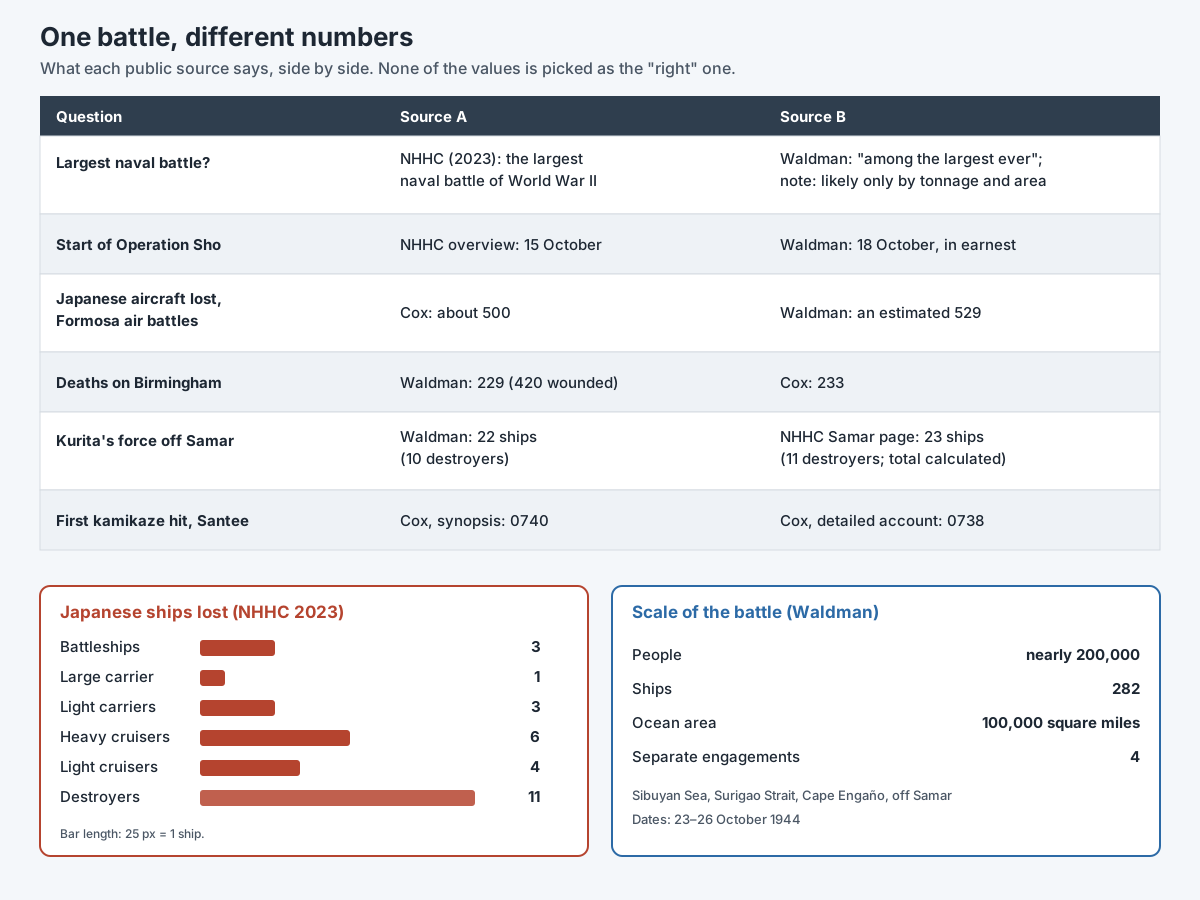
The Battle of Leyte Gulf is the name for four separate fights in the seas around the Philippines from 23 to 26 October 1944. Nearly 200,000 men and 282 ships fought across 100,000 square miles of ocean. The Japanese navy committed most of its remaining fleet, and after this battle it never again posed a serious threat, at least with surface ships.
Why did the strongest American fleet leave only its weakest units in the way? The answer lies in a Japanese decoy plan, an American command split in two, and a few messages that arrived hours late.
Why the Philippines, and why October 1944
At the Battle of the Philippine Sea on 19–20 June 1944, Japan lost two aircraft carriers and 350–450 aircraft. Japan's leaders could see they were short of both time and means to stop the Allied advance before it reached the Home Islands.
The Allies had three goals in the Pacific at this point. They wanted to cut Japan's supply lines to the East Indies and prepare for an invasion of Formosa (Taiwan) and the east China coast. They also wanted bases from which to strike Japan's home islands. The assault on Leyte was also where two great advances met: Admiral Chester Nimitz's drive across the central Pacific and General Douglas MacArthur's approach from the south.
The choice of the Philippines had critics. MacArthur persuaded President Roosevelt to allow a push to Leyte, then to Luzon and the capital. Some commanders objected, among them Ernest J. King, the Navy's top officer, who preferred to skip the Philippines entirely and head for Japan.
The date also moved forward. Carrier strikes led by Admiral Marc Mitscher exposed unexpected weaknesses in the Japanese defense, and in mid-September the landing was moved up from December to October. Kinkaid's planners had only five weeks to build a workable plan.
Operation Sho-1: a decoy and a pincer
The Japanese navy drew up four contingency plans, one for each route the Allies might take. Together they were called Shō-Go ("Operation Victory"), and each one staked most of the remaining fleet on a single battle. The plan for defending the Philippines was Sho-1.
Its target was not the enemy fleet but the troop transports and supply ships of MacArthur's landing force. Samuel J. Cox, director of the US Naval History and Heritage Command (NHHC), sees this aim as clashing head-on with decades of Japanese naval doctrine, which put fleet-against-fleet battle first. The US Navy held the same doctrine.
There were four forces.
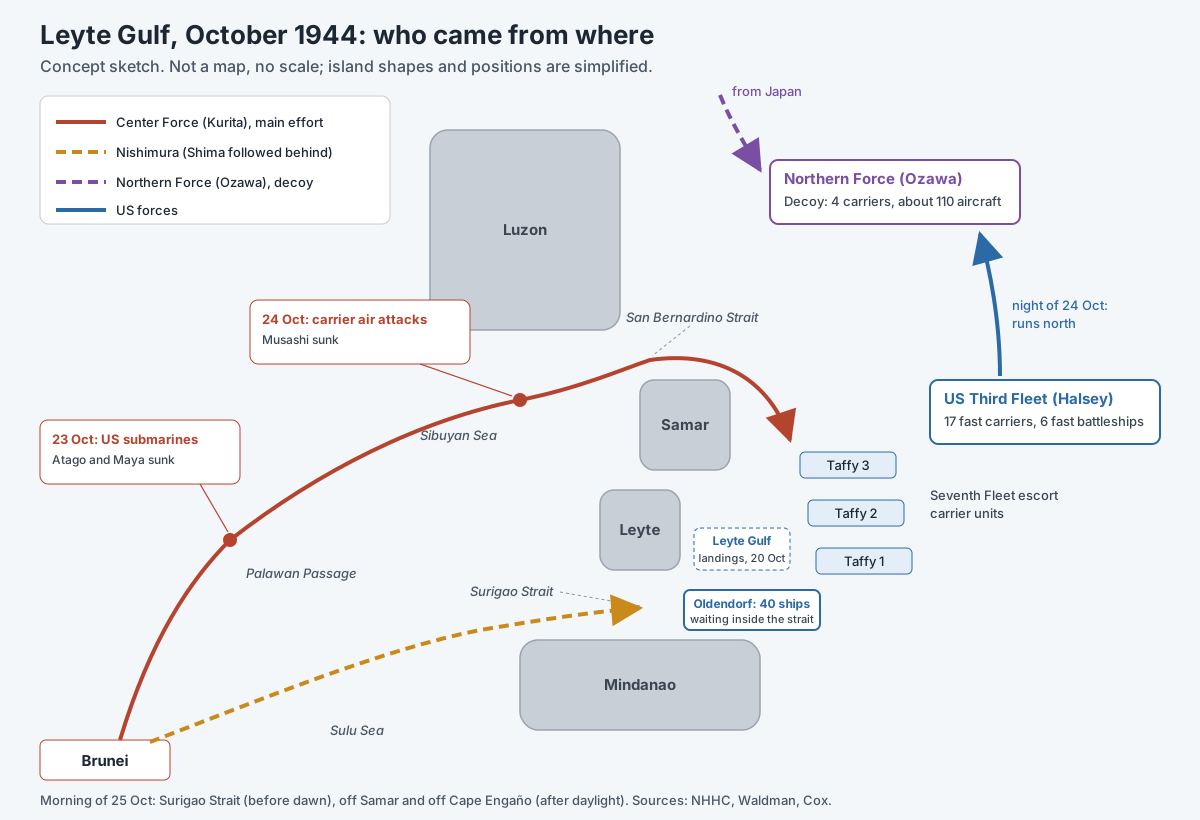
- Center Force: Vice Admiral Takeo Kurita. From Brunei it would cross the central Philippines and strike Leyte Gulf from the north. Its core was five battleships, including Yamato and Musashi, and ten heavy cruisers.
- Southern Force: Vice Admiral Shoji Nishimura. Two battleships and a heavy cruiser would enter from the south through Surigao Strait.
- Shima's force: Vice Admiral Kiyohide Shima. It included two heavy cruisers but was never really tied into the plan, and Shima chose to follow Nishimura through Surigao Strait.
- Northern Force: Vice Admiral Jisaburo Ozawa. Four carriers and two hybrid battleship-carriers would appear northeast of Luzon and pull the US Third Fleet away from Leyte Gulf. It was the decoy.
Even the decoy commanders had doubts. After the war, Ozawa told interrogators he had little faith in his role as bait but saw no other choice than to try it. Before the battle, Kurita asked his crews, "Would it not be a shame to have the fleet remain intact while our nation perishes?"
Fuel was tight as well. Submarine attacks on tankers had already badly drained fuel stocks in Japan, so Kurita's force was based near Singapore to stay close to its fuel.
Two fleets, two chains of command
The American side was not one force either.
Vice Admiral Thomas C. Kinkaid's Seventh Fleet served under MacArthur and supported the landings directly, with six prewar battleships, 18 escort carriers and about 450 Navy aircraft. Admiral William F. Halsey's Third Fleet served under Nimitz, with 17 fast carriers and 6 fast battleships.
The Third Fleet's job was to cover the landings, but it also had the authority to pursue and fight the main Japanese fleet if the chance came. Halsey's orders carried a caveat: "In case opportunity for destruction of major portions of the enemy fleet offers or can be created, such destruction becomes the primary task."
Communications were another obstacle. MacArthur barred Kinkaid from talking directly with Nimitz or Halsey and routed all traffic through a radio station on Manus Island. NHHC historian Martin Waldman writes that, as a result, some very critical messages arrived many hours after they were sent, which deeply affected the decisions of both Halsey and Kinkaid.
The two admirals saw this setup differently. Halsey said that under one commander, with a single chain for control and intelligence, the battle might have gone differently and ended differently. Kinkaid disagreed: "One head would not have been better than two," he said, since each of them had a clearly stated mission.
23–24 October: Palawan and the Sibuyan Sea
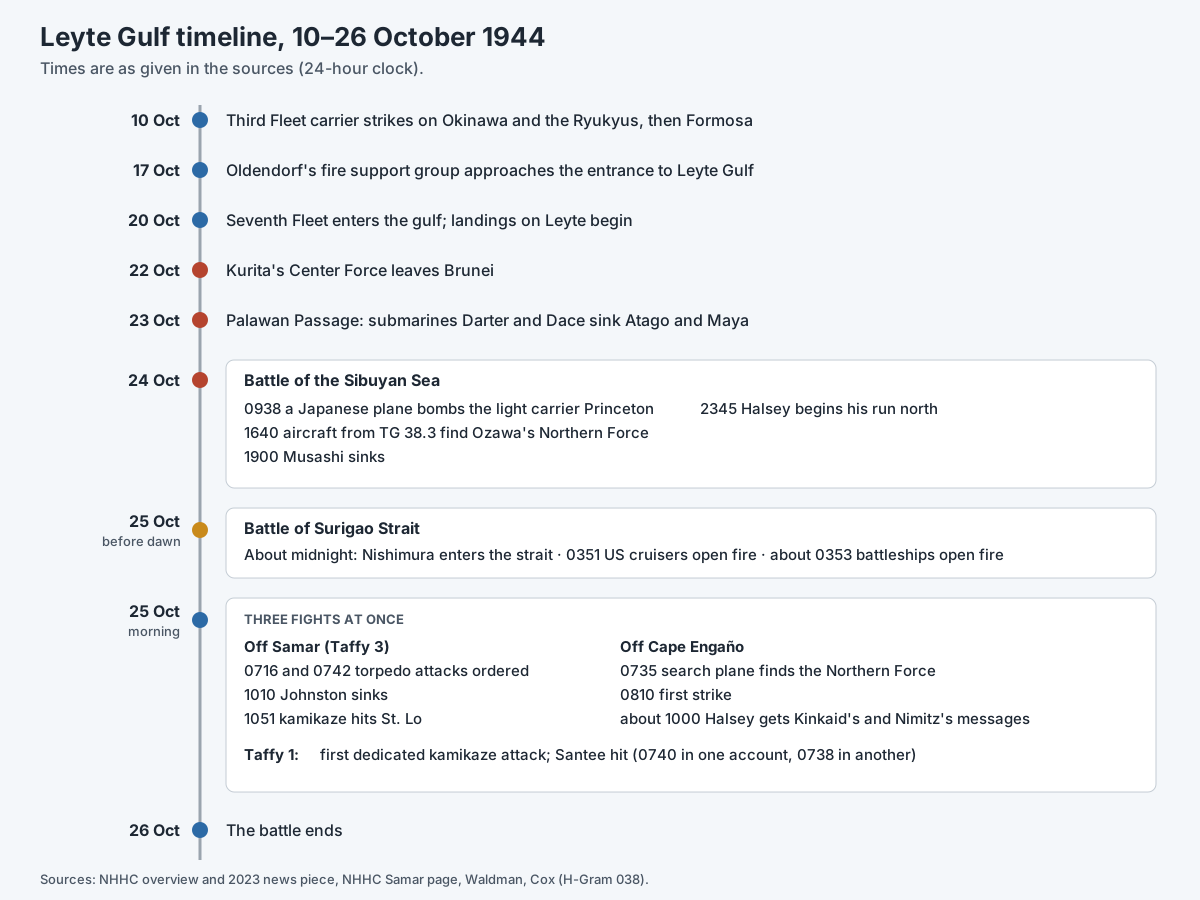
Before the fight at sea came a fight in the air. On 10 October, four carrier task groups of the Third Fleet, with more than 1,000 aircraft, struck Okinawa and the Ryukyu Islands and then Formosa. Japanese aircraft losses in the air battles that followed are given as about 500 in Cox's account and an estimated 529 in Waldman's.
The cost showed at Leyte. Ozawa's carriers were left with little more than 110 aircraft, and the Japanese surface forces fought the whole battle without air cover.
On 17 October, Rear Admiral Jesse B. Oldendorf's fire support group approached to secure the entrance to Leyte Gulf, and on 20 October the Seventh Fleet entered the gulf and began the landings. Compared with other Pacific landings, Japanese defenses were thin and US losses stayed low. That day MacArthur broadcast from the beach to tell the people of the Philippines that he had returned.
Records differ on when Japan started Operation Sho. NHHC's overview of the battle gives 15 October, while Waldman writes that Sho-1 was only put into effect in earnest on 18 October. Kurita left Brunei on 22 October.
On 23 October, in the Palawan Passage, the US submarines Darter and Dace struck Kurita's force. Darter sank his flagship, the heavy cruiser Atago, and badly damaged Takao, while Dace sank Maya. Before the battle had even begun, Kurita had lost three of his ten heavy cruisers and had to tread water himself until he was rescued. Darter later ran aground, and Dace took off her whole crew.
On 24 October, as Kurita's force crossed the Sibuyan Sea, wave after wave of Third Fleet aircraft came at it. The American planes attacked the same ship again and again: the super-battleship Musashi. She took 20–30 bomb and torpedo hits and sank at 1900 with 1,100 sailors. Rear Admiral Toshihira Inoguchi, on board Musashi, deeply regretted having trusted so heavily in big guns and big ships.
The Americans lost a ship too. At 0938 a single Japanese plane bombed the light carrier Princeton, and at 1523 a fire inside her set off her torpedo stowage, mortally wounding the ship. Deaths on the light cruiser Birmingham, which had come alongside to help, are given as 229 (with 420 wounded) by Waldman and 233 by Cox.
At 1600 Kurita turned west. He still had 22 ships: four battleships, six heavy cruisers, two light cruisers and ten destroyers. At 1800 the Combined Fleet's commander in chief, Admiral Soemu Toyoda, signaled him: "Trusting in Divine guidance, resume the attack." Inflated damage claims and this turn led Halsey to believe Kurita's force had been beaten and was retreating.
Surigao Strait: the last battleship duel
The southern door to Leyte Gulf is the narrow Surigao Strait. Nishimura's seven ships tried to come through it, and Oldendorf's 40 ships were waiting inside. Oldendorf put his destroyers along both sides of the strait and formed a line of cruisers and battleships across it.
This arrangement is called "crossing the T." The side coming in as a column can fire only its forward guns, while the side lined up across its path can fire with its whole battle line. Japan had won the Battle of Tsushima in 1905 this way; this time Japan was on the receiving end.
Nishimura's force entered the strait around midnight and was swarmed almost at once by PT boats. Then destroyer torpedoes came from both sides.
Those torpedoes sank three Japanese destroyers and the battleship Fuso and left the flagship Yamashiro badly damaged. It all happened before the Japanese ships were even within range of the US battleships. The American cruisers opened fire at 0351 and the battleships at about 0353.
Six US battleships were lined up at the end of the strait. All but Mississippi had been damaged in the 1941 attack on Pearl Harbor and later returned to service. The Royal Australian Navy also took part in this night action. It was one of the few Pacific naval battles in which aircraft played no significant role.
Japanese losses were heavy. On the two battleships alone, 3,500 men went down. Shima, following behind, judged that pushing on was futile and turned back south, and in the end the destroyer Shigure was the only ship to survive.
There was tragedy on the American side as well. The destroyer Albert W. Grant, stopped by engine trouble, was caught in the crossfire between Yamashiro and the American battle line. By the time the firing stopped, 34 men were dead or dying.
The battle is famous as the last battleship-against-battleship action in history. Cox adds that the Japanese ships were trapped in the narrow strait, so crossing the T was almost a foregone conclusion. In his view, the night is better remembered as the US Navy's most successful surface torpedo action ever.
Views of Nishimura also differ. Many accounts say he blundered into an American trap. Cox writes instead that he knew what he faced, and knew he was on a sacrificial mission, which Japanese sources called a "special attack." In a note, Waldman explains that no document states outright that it was a suicide mission, but the historian Tully argues it was planned that way.
Halsey turns north: Cape Engaño
Until the afternoon of 24 October, Halsey's staff did not know where the Japanese carriers were. Ozawa broke radio silence again and again to be found, and at 1640 aircraft from TG 38.3 finally spotted the Northern Force.
Halsey had to choose. Should he strike the carriers to the north, or guard San Bernardino Strait?
He was convinced the Center Force was too badly damaged to win a decision. Splitting the fleet also went against the principle of the time that forces must always be concentrated. At 2345 Halsey gathered his forces and began his run north.
Waldman stresses that the decision was not a bad one in itself, nor unworkable. The trouble was a single line in a message.
Earlier, Halsey had signaled that TF 34, made up of his fast battleships, "will be formed." He meant it as a contingency, but Nimitz and King read it otherwise. Kinkaid, who picked up the message, also assumed TF 34 had stayed behind to guard San Bernardino Strait.
At 0735 on 25 October a search plane found the Northern Force, and at 0810 the first strike went in. In this Battle of Cape Engaño, Halsey's carrier air wings all but destroyed the decoy force. The carriers Zuikaku, Zuiho and Chitose were sunk by aircraft, and the damaged Chiyoda was sunk near dusk by US cruiser gunfire, so all four were gone. Zuikaku had been the last carrier still afloat from the force that struck Pearl Harbor.
Yet those carriers had only about 110 aircraft among them. Meanwhile, urgent messages kept coming from the south, but because of the tangled communications setup Halsey did not receive Kinkaid's messages about Taffy 3's desperate situation until almost 1000.
At 1000 a message from Nimitz arrived as well: "WHERE IS RPT WHERE IS TASK FORCE THIRTY FOUR THE WORLD WONDERS." The last phrase was padding that a junior communications officer had added to make Japanese decryption harder, but it was never removed before the message reached Halsey.
By then Halsey's battleships were 42 miles from the Northern Force. He swung his fast battleships back toward San Bernardino Strait, aware that they could no longer catch Kurita before he slipped through. The futile run of the battleships, first north and then south, was later mocked as "Bull's Run."
"Taffy 3" off Samar
This is where the opening scene took place. The decoy had drawn off the Third Fleet, so when Kurita's force came out of the strait early on 25 October, it faced only three Seventh Fleet escort carrier units.
These units had been giving the landings close air support and an antisubmarine screen. The one farthest to the northwest was Rear Admiral Clifton A. F. Sprague's TG 77.4.3, radio call sign "Taffy 3."
Escort carriers (CVEs), also called "jeep carriers," were small ships about 500 feet long, able to carry no more than 27 aircraft. They were not built to fight surface fleets. Their job was to support convoys and landings.
Sprague sent his escorts in on torpedo attacks twice, at 0716 and at 0742. The destroyer Johnston, in the lead, hit the heavy cruiser Kumano with a torpedo. Johnston sank at 1010, and of her 327 crew, 186 were lost, including her commanding officer, Ernest E. Evans.
The fight went on in the air as well. Some of the escort carrier planes took off low on fuel or even without ammunition. Kurita's force stayed under uncoordinated but heavy air attack throughout, and Kurita believed he was being hit by land-based aircraft rather than by planes from the carriers he was chasing.
Then Kurita turned away. He had judged the escort carriers' speed at about 30 knots, when in fact it was 18 knots.
As the delays grew, so did his worry about fuel and American reinforcements, and in the end he turned north toward San Bernardino Strait. Vice Admiral Matome Ugaki was one of the subordinates who doubted Kurita's stated reasons. In his diary he wrote that, on the same bridge, he felt irritated by the staff's lack of fighting spirit and promptitude.
That day Taffy 3 lost the destroyers Johnston and Hoel and the destroyer escort Samuel B. Roberts, and the escort carrier Gambier Bay was sunk by gunfire. Japan in turn lost the heavy cruisers Chikuma, Chōkai and Suzuya, and Kumano was heavily damaged. Taffy 3 received the Presidential Unit Citation, and Evans was awarded the Medal of Honor after his death.
The same morning, to the south, Taffy 1 came under the first dedicated kamikaze attack of the war. These planes took off with the specific purpose of suicide attacks. The escort carrier Santee became the first ship hit by a kamikaze; the time is given as 0740 in Cox's synopsis and 0738 in his detailed account. Earlier, on 21 October, a damaged Japanese aircraft had deliberately crashed into the foremast of the Australian warship HMAS Australia, killing 30 people, including her captain.
St. Lo had survived the earlier fighting. But at 1051 a Zero dove into her flight deck, and within 15 minutes she was gone, with 141 men lost. She was the first US warship of the war sunk by a kamikaze attack.
Numbers and interpretations
"The largest naval battle in history" needs a yardstick. NHHC's 2023 news piece calls Leyte Gulf the largest naval battle of World War II.
Waldman writes in his text that it was "among the largest naval battles ever fought." In a note he adds that it is often called the largest ever, but this is likely true only in terms of tonnage and geographic area. Measured by the weight of the ships and the size of the sea, it is likely first; by other measures, that is hard to say.
The numbers also differ a little from source to source.
- Start of Operation Sho: 15 October (NHHC overview) / put into effect in earnest on 18 October (Waldman)
- Japanese aircraft lost in the Formosa air battles: about 500 (Cox) / an estimated 529 (Waldman)
- Deaths on Birmingham: 229 (Waldman) / 233 (Cox)
- Kurita's force off Samar: 22 ships with 10 destroyers (Waldman) / 23 ships with 11 destroyers (NHHC Samar page)
- Date of the Battle of Cape Engaño: the NHHC overview gives 24 October, but Cox writes that Cape Engaño, Samar and the attack on Taffy 1 all began at daylight on 25 October
Ship losses are clearer. According to NHHC 2023, Japan lost three battleships, one large carrier, three light carriers, six heavy cruisers, four light cruisers and 11 destroyers. American ships lost included the light carrier Princeton, the escort carriers Gambier Bay and St. Lo, the destroyers Johnston and Hoel, and the destroyer escort Samuel B. Roberts.
Interpretations vary.
Waldman holds that Halsey's decision was not bad in itself. Yet in his summary, a questionable decision at Cape Engaño nearly derailed the operation and exposed weaknesses in command structure and communications procedures. Cox gives Halsey credit for recommending that the Leyte invasion be moved up, which caught the Japanese before they were ready. After the war, when Halsey's autobiography put the blame on Kinkaid, the argument became a public fight.
The same goes for Kurita. Sprague wrote that the Japanese main body could have, and should have, finished off Taffy 3.
Cox, by contrast, thinks Kurita might have sunk only 20 or so transports even if he had entered the gulf. Most of the 200 present at the start of the landings had already left. Cox's reading is that Kurita knew from the start that his mission was doomed, and that his withdrawal probably saved more than 10,000 Japanese lives.
What it left
Japan's plan nearly worked, yet the outcome was a decisive US Navy victory. According to NHHC, taking Leyte completely removed the strategic threat that the Imperial Japanese Navy had posed.
A different kind of fight took its place. According to Cox, kamikaze aircraft later struck more than 400 Allied ships, sank 47 and killed nearly 5,000 US sailors. Leyte Gulf is also where that long campaign began as an organized effort.
The fight on land was long too. The campaign on Leyte became another bloody slog that cost more than 3,500 US Army lives. The National WWII Museum puts the toll of the whole war on the Philippines at up to one million civilian dead, plus tens of thousands of soldiers.
MacArthur's choice is still argued over. Historians still disagree on whether he was right to insist on the Philippines instead of islands nearer to Japan. They also debate how far his own experience and feelings shaped that call.
The sea held another tragedy that had nothing to do with fleet battles. On 24 October a US submarine, probably Shark, sank the Japanese transport Arisan Maru without knowing she carried more than 1,700 US prisoners of war. Most of the prisoners survived the sinking but were left in the water, and in the end only nine lived.
Waldman sums up the battle in three parts. At the Sibuyan Sea and Surigao Strait, plans were carried out almost perfectly. At Cape Engaño, one decision shook the whole operation. At Samar, individual courage and sacrifice made the difference between defeat and victory.
What to read next
- Aircraft carriers: turning a ship into an airport: today's carriers, the heirs of the fast carriers and escort carriers.
- Turning points in military technology: a timeline of moments that changed military technology, ending with where laser weapons fit.
- The Battle of Midway: Codebreaking and Four Carriers: the Pacific battle two years earlier in which carriers fought carriers.
- Iwo Jima and Okinawa: the last islands on the road to Japan: the next chapter of the Pacific War after Leyte.