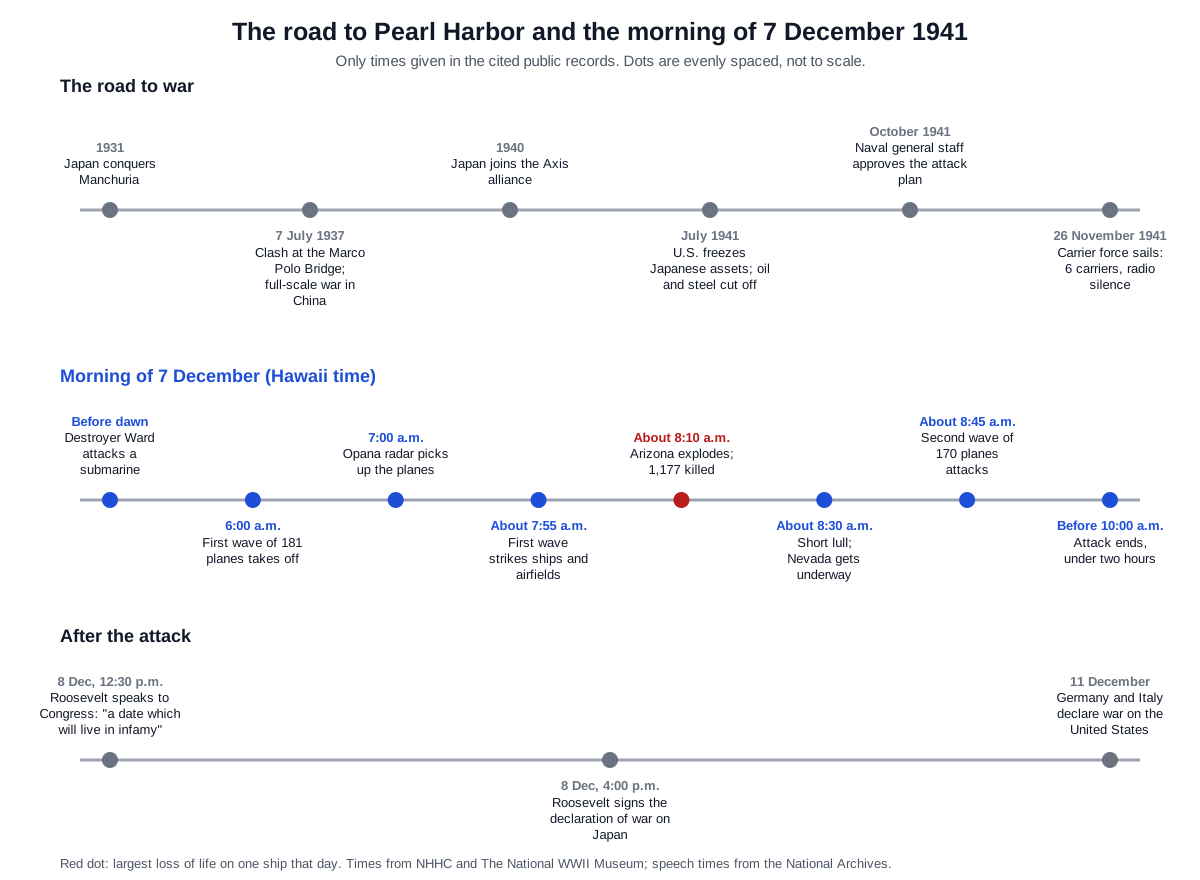
At 7:00 a.m. on Sunday, 7 December 1941, a U.S. Army radar operator at Opana, on the Hawaiian island of Oahu, spotted approaching aircraft. The officers who heard the report took it for American planes due to arrive that morning. In less than an hour, those aircraft were over the U.S. Pacific Fleet at Pearl Harbor.
Planes from six Japanese aircraft carriers struck Pearl Harbor and the airfields around it in two waves. Congress declared war on Japan the next day, and three days later Germany and Italy in turn declared war on America. Why did Japan strike a much larger country first? Why did the United States miss the warning signs, and what was destroyed and what was left in those two hours?
China, oil and stalled talks
The two countries drifted apart over China. In 1931 Japan conquered Manchuria, and on 7 July 1937 Chinese and Japanese troops clashed at the Marco Polo Bridge near Beijing, starting a full-scale war. The State Department's Office of the Historian notes that the chance of U.S. aid to China grew after that. In 1940 Japan joined Nazi Germany in the Axis alliance, and the next year it occupied all of Indochina.
The United States raised its military and financial aid to China and built up its forces in the Pacific. It also began to cut off oil and raw materials bound for Japan. The United States had been the main supplier of the oil, steel and iron that the Japanese military needed. In July 1941, Roosevelt's government froze Japan's assets and, in effect, shut Japan off from American oil and steel.
Japan was poor in natural resources, and its government saw these steps, above all the oil embargo, as a threat to the nation's survival. Talks went on but made little headway. Pro-Chinese feeling in the United States made it hard to accept any deal without a Japanese withdrawal from China, and Japan's military leaders would not accept that condition.
The Office of the Historian sets out how each government saw the moment. Japan's leaders faced serious shortages, felt unable to back down, and believed Washington did not want more talks, so they decided they had to move fast. American leaders still hoped for a deal at the table, and they doubted Japan was strong enough militarily to strike U.S. territory. War with the United States was certain to follow, but Japan's leaders chose to seize the resource-rich lands of Southeast Asia.
Yamamoto's plan and the North Pacific voyage
The obstacle was the U.S. Pacific Fleet at Pearl Harbor. Admiral Isoroku Yamamoto, commander of the Japanese fleet, planned a surprise attack to put the American fleet out of action at the very start of the war. The National WWII Museum explains that he wanted to give Japan time to secure strategic resources and hold on to the land it had taken.
The plan rested on three things: careful preparation, surprise, and the use of aircraft carriers and naval aviation on an unprecedented scale. From the spring of 1941, Japanese carrier pilots trained for the special tactics the plan called for. In October the naval general staff gave its final approval.
Vice Admiral Chuichi Nagumo led the strike force. At its core were six large carriers, Akagi, Kaga, Soryu, Hiryu, Shokaku and Zuikaku, with 24 supporting ships. A separate group of submarines was to deal with any American warships that escaped the carrier force.
The force gathered in remote Tankan Bay in the Kurile Islands and left in deep secrecy on 26 November. It crossed the North Pacific away from normal shipping lanes and kept strict radio silence. By dawn on 7 December it had come, unseen, to a point slightly more than 200 miles north of Oahu. Talks in Washington had broken down by then, but Japan had not yet formally cut diplomatic ties.
The missed signals
There were signals even that morning. Before dawn, an unknown submarine periscope was seen near the harbor entrance, and the destroyer Ward and a patrol plane attacked it and reported it sunk. At 7:00 a.m. the Opana radar picked up the first wave. The submarine report was handled as routine business, and the radar contact was taken for a flight of American planes expected that morning.
Earlier signals existed too. In early 1941, Joseph Grew, the U.S. ambassador to Japan, passed on to the State Department something the Peruvian minister had told American diplomats. In case of trouble with the United States, it said, Japan's military planned a surprise mass attack on Pearl Harbor. There were no intelligence assets in Japan to check the report and no independent agency to weigh civilian and military reports, so the warning was not acted on.
In the summer of 1940, American analysts broke a Japanese diplomatic code called PURPLE and began reading diplomatic messages. But decoding and translating took time. The Japanese army and navy each had their own codes, separate from the Foreign Ministry's and from one another.
Over the months before the attack, the Japanese navy also switched to new codes several times. With the attack only days away, Navy intelligence analysts at Pearl Harbor told Admiral Husband E. Kimmel, commander of the Pacific Fleet, that they did not know exactly where four Japanese carriers were.
An article from The National WWII Museum counts Pearl Harbor among the worst intelligence failures in American history and quotes the historian Roberta Wohlstetter. In her words, it was an attack that came after many and varied signals, yet still achieved complete surprise.
The morning of 7 December: two waves
At 6:00 a.m. the six carriers launched a first wave of 181 planes. It mixed torpedo bombers, dive bombers, horizontal bombers and fighters. The first wave reached Oahu shortly before 8:00 a.m., at about 7:55 a.m. by the museum's timing, and took the defenders completely by surprise.
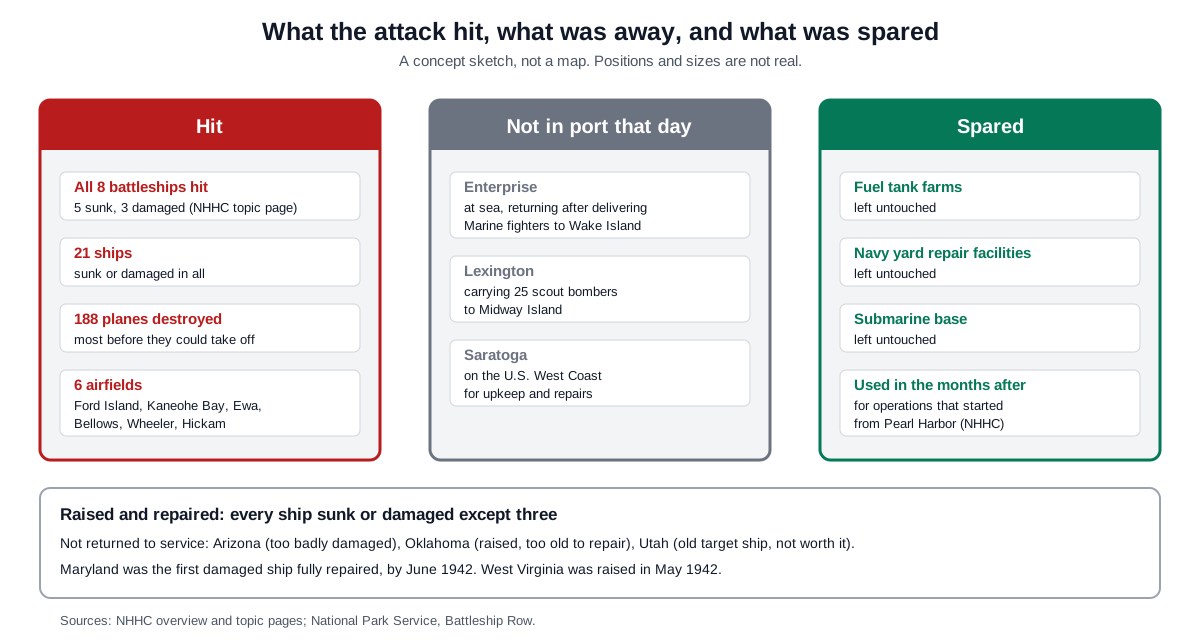
The airfields were hit along with the ships. The Navy air bases at Ford Island and Kaneohe Bay were bombed and strafed. So were the Marine field at Ewa and the Army Air Corps fields at Bellows, Wheeler and Hickam, all at the same time. The aim was to destroy American planes before they could take off.
More than 90 ships lay in Pearl Harbor, and the main targets were the eight battleships. Seven were moored along the southeast shore of Ford Island on "Battleship Row," while Pennsylvania sat in drydock across the channel. Within the first minutes, every battleship next to Ford Island had been hit by bombs or torpedoes.
Oklahoma took eight torpedoes on her port side and rolled over in less than twelve minutes. Hundreds of men were trapped inside; 429 died, and only 32 of those trapped were rescued. Six torpedoes and two bombs hit West Virginia, and she sank with the loss of 106 crew. Across Ford Island, the former battleship Utah was also torpedoed and soon capsized, and 58 of her crew died.
At about 8:10 a.m., Arizona was hit by an armor-piercing bomb. It went through her armored deck and set off the forward ammunition magazines. The blast and fire killed 1,177 men aboard. It was the greatest loss of life on any ship that day and about half of all the Americans killed.
Around 8:30 a.m. the attack briefly let up. In that gap the damaged battleship Nevada got underway and headed down the channel toward the sea. She was the only battleship to move that day.
Soon a second wave of 170 planes appeared. The Naval History and Heritage Command (NHHC) says it was launched 30 minutes after the first, and the museum says its attack began around 8:45 a.m.
The second wave went after the moving Nevada. The aim was to sink her in the channel and block the narrow harbor entrance. On orders from the harbor control tower, Nevada ran herself aground at Hospital Point, and the channel stayed open. The attack ended shortly before 10:00 a.m., less than two hours after it began.
The tools of that day: carriers, torpedoes and radar
The aircraft carrier was at the center of the attack. The fleet was struck not by battleships with big guns but by planes launched far across the sea. That is why using carriers and naval aviation "on an unprecedented scale" was a key part of Yamamoto's plan.
Each type of plane had its own job. Torpedo bombers dropped torpedoes that ran through the water, bombers dropped bombs from above, and fighters supported them. Battleships hit in the side by several torpedoes, like Oklahoma and West Virginia, rolled over or sank quickly. Arizona blew up when one bomb dropped from above reached a magazine.
Radar was already in Hawaii. The Opana station picked up the incoming planes about an hour before the attack. The equipment saw them, but the signal was read as friendly aircraft.
American anti-aircraft guns fired back quickly. According to the NHHC, the Japanese were astonished at how fast and how hard U.S. anti-aircraft fire came. The same page says the reason more Japanese planes were not shot down lay in guns that were too few and not capable enough, not in the crews' skill. In its view, Japan achieved technological surprise as well, with planes and weapons far better than expected.
Reading the numbers: what was lost and what was left
Sources give slightly different numbers for the American dead. The NHHC lists 2,403 killed or missing (Navy 2,008, Marine Corps 109, Army 218, civilians 68) and 1,178 wounded. The National Park Service (NPS) puts the dead at 2,390 (2,341 service members and 49 civilians), and The National WWII Museum says "more than 2,400." The National Archives gives "more than 3,500" Americans killed or wounded.
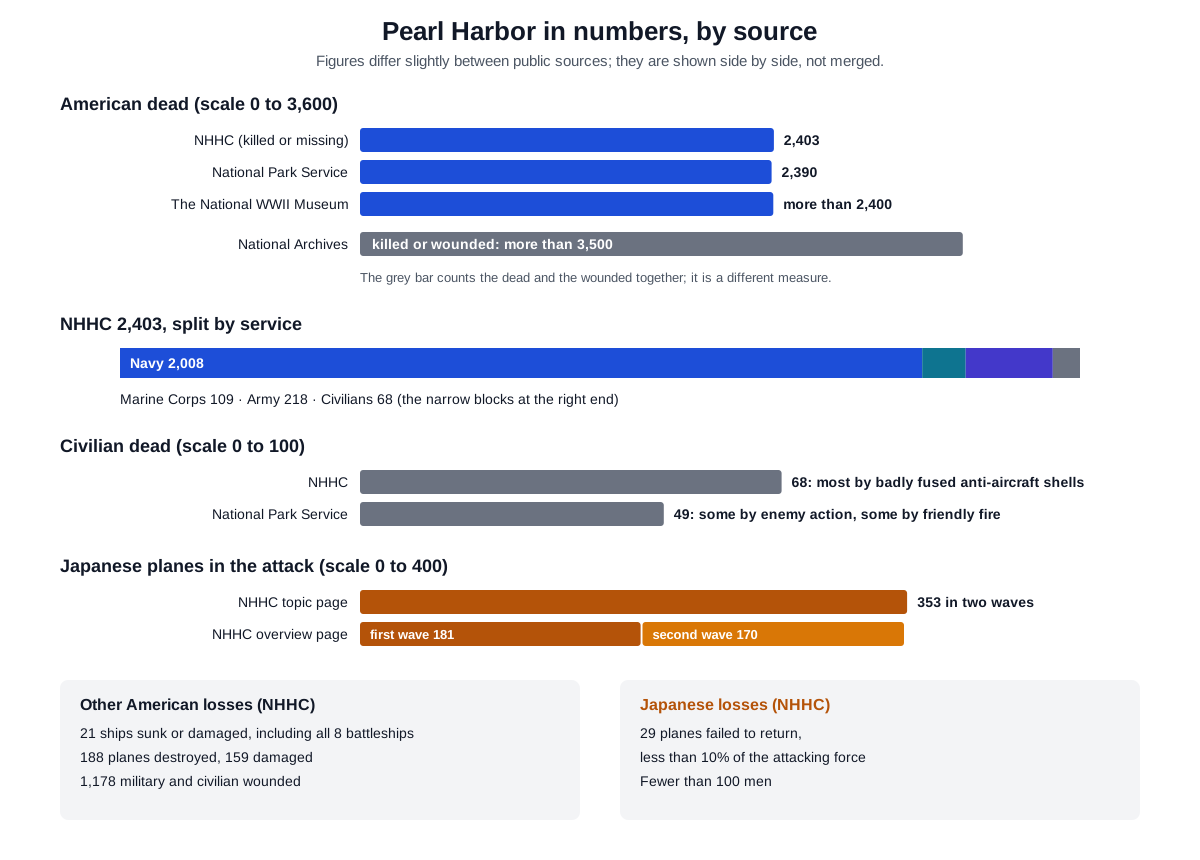
The sources also describe civilian deaths differently. The NHHC says most of the 68 civilians were killed by badly fused anti-aircraft shells that landed in Honolulu. The NPS says some of the 49 civilians died from enemy action and others from friendly fire. For Japanese planes, one NHHC page gives 353, while another gives a first wave of 181 and a second wave of 170.
Here is the damage to equipment. Twenty-one ships of the Pacific Fleet were sunk or damaged, including all eight battleships. Of the planes, 188 were destroyed and 159 damaged, most of them before they could take off. Japan lost 29 planes that never returned, under 10% of the attacking force, and fewer than 100 men.
Yet the attack did not destroy everything. None of the Pacific Fleet's three carriers was in port that day. Enterprise was on its way back after delivering Marine fighter planes to Wake Island. Lexington was carrying 25 scout bombers to Midway Island, and Saratoga was on the West Coast for upkeep.
By focusing on ships and planes, the attack left the fuel tank farms, the navy yard repair shops and the submarine base untouched. According to the NHHC, these facilities were vital for the operations launched from Pearl Harbor in the months that followed. It adds that the carriers, with their cruisers, destroyers and fleet oilers, proved crucial in those months.
Most of the sunk or damaged ships came back: all but three, Arizona, Oklahoma and Utah, were raised and repaired. Maryland was fully repaired by June 1942, the first damaged ship to return to duty. West Virginia, which had sunk, was raised in May 1942 and was later present at the Japanese surrender in Tokyo Bay. Nevada served as flagship at the Normandy landings on 6 June 1944, the only ship to fight at both Pearl Harbor and Normandy.
From the next day on
Early in the afternoon of 7 December, President Franklin D. Roosevelt heard about the attack in a phone call from Secretary of War Henry Stimson. At about 5:00 p.m. he dictated to his secretary, Grace Tully, a message asking Congress to declare war. In the typed draft, his biggest change was to the first line, which first read "a date which will live in world history."
At 12:30 p.m. on 8 December, Roosevelt spoke to a joint session of Congress, and radio carried the speech across the country. In the first sentence, 7 December became "a date which will live in infamy."
In the speech he said that the Japanese ambassador handed the Secretary of State a reply to an American message one hour after the bombing of Oahu began. The reply, he said, held no threat or hint of war. The same speech reported attacks on Malaya, Hong Kong, Guam, the Philippines, Wake Island and Midway Island.
The Senate voted unanimously for war, and in the House only Jeanette Rankin, a pacifist from Montana, voted against. Roosevelt signed the declaration of war at 4:00 p.m. that day. On 11 December, Germany and Italy declared war on America, and the United States answered with its own declarations against both. The country was now at war in both Europe and Asia.
The attack pulled American society together. The NHHC writes that the shock and anger it caused united a divided nation. Fear also flowed in another direction: according to the National Archives, the attack set off fear about national security, above all on the West Coast. Mixed with economic rivalry, distrust of cultural difference and long-standing anti-Asian racism, it became a disaster for Japanese Americans.
On 19 February 1942, Roosevelt issued Executive Order 9066. Over the next six months, about 122,000 people of all ages were forced to move, and nearly 70,000 of them were American citizens. The government brought no charges against them, and they could not appeal their confinement. In 1988, Public Law 100-383 admitted the injustice, apologized, and paid $20,000 to each person who had been held.
What it left
Pearl Harbor raised lasting questions about how intelligence is handled. After months of hearings, Congress issued a long report in the summer of 1946, with 22 conclusions and recommendations. One of them said that with more imagination and a keener grasp of what the intelligence meant, someone ought to have seen Pearl Harbor as a likely Japanese target.
Codebreaking picked up speed after the attack. Navy codebreakers in Hawaii, led by Commander Joseph Rochefort, broke a key Japanese naval code called JN-25 after months of work. The museum article describes this breakthrough as instrumental in the American victory at Midway, where U.S. planes sank four Japanese carriers.
People's memories remain as well. Fifteen Navy men received the Medal of Honor, ten of them after death. On Utah, Chief Water Tender Peter Tomich kept the boilers from exploding so that the boiler room crew could escape, and he died doing it. Aboard Arizona there were 38 sets of brothers, and 63 of those brothers died.
Of the dead from Oklahoma, only 35 were identified at the time. Starting in 2015, the Defense POW/MIA Accounting Agency (DPAA), working with the Department of Veterans Affairs, exhumed the remains and returned more than 300 men to their families. Arizona, never raised, still lies on the floor of Pearl Harbor, and many survivors of Arizona and Utah chose to be laid to rest in their ships after they died.
What to read next
- The Battle of Midway: Codebreaking and Four Carriers: the sea battle after Pearl Harbor where broken codes and carriers met.
- Aircraft carriers: turning a ship into an airport: what the kind of ship that struck Pearl Harbor is today.
- Radar: measuring distance and motion with radio waves: the principle behind how Opana picked up the planes.
- Anti-aircraft artillery in the missile age: how the guns that fired back that day live on today.
- Destroyers and frigates: why warships have different names: what a destroyer like Ward is for.