In a 17-day span in August 2021, over 250 U.S. transports and tankers flew about 124,000 people out of Afghanistan. Americans, people from allied countries and Afghans were all on board. The Congressional Research Service (CRS) records it as the biggest evacuation of noncombatants the United States has ever carried out.
That kind of job belongs to military transport aircraft. From a distance they look a lot like airliners, but the inside is a different world. The floor sits low and is built strong, and the whole tail end opens so vehicles can roll in.
Loading a tank takes more than a powerful engine. Where the load sits, whether the floor can hold it, and how short the runway is all shape the aircraft. This article starts with the jobs airlifters split between them, then looks at the body, the hidden limits, and the history from the C-47 to the C-17.
Tactical and strategic airlift
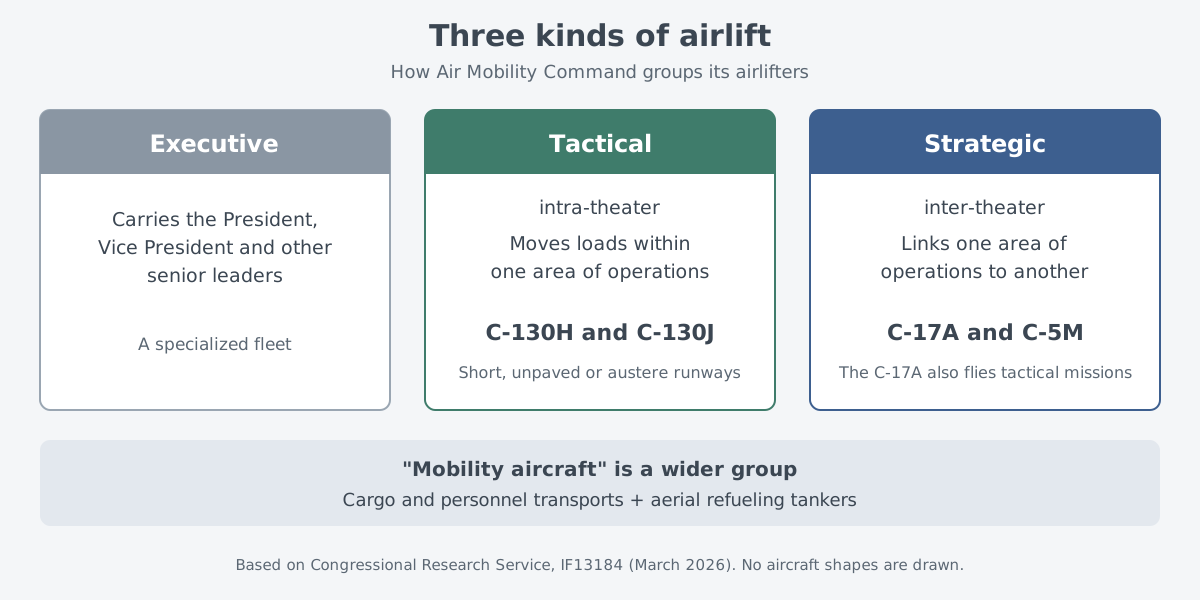
Air Mobility Command (AMC) runs airlift for the U.S. Air Force, and its airlifters fall into three groups. Executive aircraft carry the President and other senior leaders. Tactical airlifters move loads within a theater. Strategic airlifters link one theater to another.
There are four principal airlifters. The C-130H and C-130J mainly fly tactical missions, and the C-17A and C-5M mainly fly strategic ones. The line is not rigid. The C-17A does both kinds of airlift, and it also performs airdrops and carries patients.
Think of a parcel service. Strategic airlift is the long-haul truck between cities, and tactical airlift is the small van that reaches the side streets. In reality, one aircraft type may do both jobs, and the "side street" may be an unpaved runway.
"Mobility aircraft" is a wider term. It covers cargo and personnel transports plus aerial refueling tankers. The more than 250 aircraft in the Afghanistan evacuation were counted in this wider group.
A body built for loading
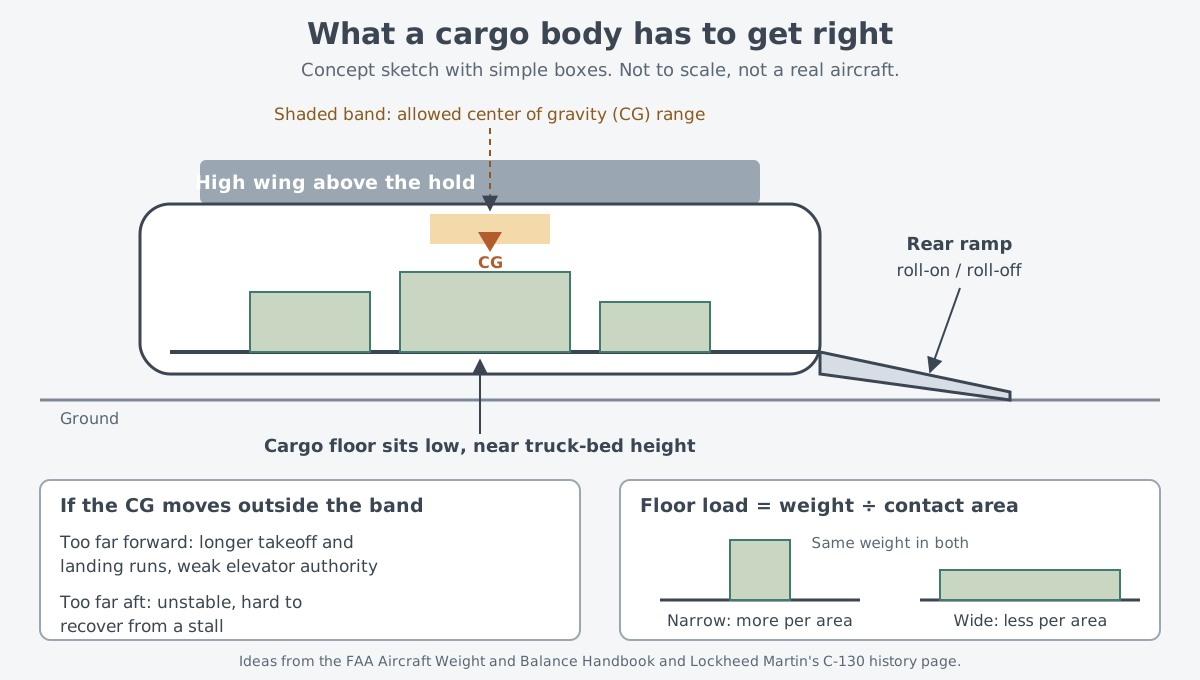
Seen from the side, many airlifters have the wing mounted on top of the body. Lockheed Martin, which builds the C-130, explains that putting the wing up high lets the cargo floor sit about as high off the ground as the bed of a truck. At the tail end, a ramp built into the body lets vehicles drive straight in and out. This is called "roll-on/roll-off" loading.
The cargo hold is large and open. The C-130 has had a hold like this, pressurized, from the start. The space can be quickly rearranged for troops, stretchers or passengers, or for airdrops.
Cargo doors are not limited to one spot. The C-5M, the largest aircraft in the Air Force, can open its nose and rear cargo doors at the same time. Loading through one end while unloading through the other cuts the time spent on the ground. The C-17 also uses a rear ramp and cargo-handling equipment to load and unload quickly.
The floor and wheels are matched to the load too. In World War II, the C-47 was almost the same airplane as the DC-3 airliner. It added a reinforced floor with cargo fittings and a large two-panel cargo door on the left side. According to the manufacturer, Airbus, the A400M has 12 wheels on its main landing gear to spread its weight better.
Center of gravity and floor limits
The more an aircraft carries, the more "where" matters along with "how much." The key is the center of gravity (CG). It is the point where the whole weight of the aircraft is treated as if it were concentrated, and it must stay within set limits for safe flight. Front-to-back balance is the main concern.
A typical airplane keeps its CG slightly ahead of the point where the wing's lift acts. This creates a nose-down force, which a downward push from the horizontal tail balances. It is a bit like a seesaw, where moving a seat changes the balance. Unlike a seesaw, though, the tail's push changes with airspeed, and the airplane has to hold this balance while it flies.
If the CG moves too far aft, it gets too close to the center of lift. The airplane becomes unstable and hard to recover from a stall. If it sits too far forward, the tail must push down harder, which has the same effect as carrying extra weight, so the angle of attack and drag go up. A bigger problem is that the elevator may not have enough authority, and a CG too far forward lengthens both the takeoff and landing runs.
Airlifters feel this more. The Federal Aviation Administration (FAA) weight and balance handbook warns about this. Because large aircraft carry so much cargo, adding, removing or moving it between holds can shift the CG a long way. Putting one heavy vehicle near the front or near the back changes the balance of the whole aircraft.
The floor has limits as well. Each cargo hold has a structural floor loading limit, based on the weight of the load and the area it spreads over. The total weight of a loaded pallet divided by its area must not exceed that limit. The same weight spread over a wider area puts less strain on the floor.
Weight itself has a price. An overloaded aircraft needs a higher takeoff speed and a longer takeoff run, and it climbs at a lower rate and angle. It also needs a longer landing roll and puts excessive loads on its structure, especially the landing gear.
Load and distance are also traded against each other. For maximum range, people or cargo must be left behind; to carry the maximum load, the range set by the fuel on board must shrink.
Short and rough runways
The C-130 grew out of the Korean War. As the United States entered that war, the Air Force realized it had no true military transport for the job, according to Lockheed Martin's history. It needed a plane that could move combat troops a medium distance and set them down on short, rough airfields. In early 1951, the Air Force Tactical Air Command put out a specification for a new medium-sized cargo plane.
Today the C-130 is still a tactical airlifter that can use short, unpaved or austere runways. Larger airlifters claim the same ability. Boeing says the C-17 can land day or night on short strips, paved or unpaved. Airbus says the A400M can land on short, soft ground such as sand, gravel or grass.
Why are short runways hard? A wing's lift depends on its airfoil shape, angle of attack, speed through the air and air density. An overloaded airplane needs a higher takeoff speed, and so a longer takeoff run. Carrying a lot and landing in a short space pull in opposite directions.
What it takes to carry a tank
Tanks were already part of the 1951 requirement. That year the Air Force wanted an aircraft that could move big, bulky equipment such as artillery and tanks a long way. It also had to be able to land in cramped spaces and, if needed, keep flying on one engine.
Figures published by manufacturers today show the scale. According to Boeing, the C-17 carries up to 164,900 lb (74,797 kg). It has room for big equipment, such as main battle tanks, loaded in two rows next to each other.
Airbus gives the A400M a maximum payload of 37 t (81,600 lb), a cargo hold cross section of 4 m × 4 m, and a volume of 340 m³. The hold is designed for outsize loads such as heavy infantry fighting vehicles, CH-47 Chinook helicopters and the heavy cranes used in disaster relief.
For strategic airlifters, distance is part of the job. According to the CRS report, the C-5M can carry oversized cargo more than 4,800 nautical miles (about 8,900 km).
These numbers are maximum or headline values for a type. What one flight can actually carry depends on both the aircraft's own maximum limits and the limits set by that particular trip. The CG, floor load, runway and distance discussed above all feed into it.
From the C-47 to the C-17
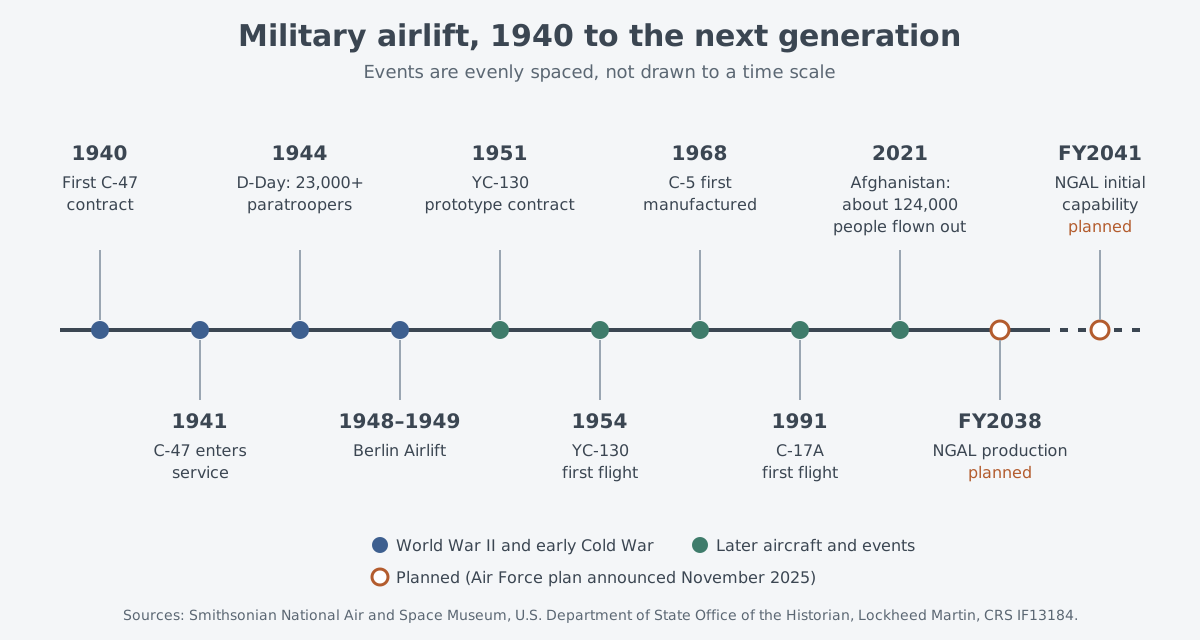
Military airlift began with an airliner. The C-47 was a military version of the classic DC-3. The Army Air Corps signed its first C-47 contract on September 16, 1940, and the type went into service on December 23, 1941. Over 10,000 were eventually built.
A C-47 could take 6,000 lb (about 2.7 metric tons) of cargo, 28 paratroopers with full gear, or 14 stretchers plus medical staff. It was the main Allied military transport of World War II. The Smithsonian National Air and Space Museum notes that by the end of the first full day on D-Day, over 23,000 paratroopers had come down by parachute or glider. Most of them were carried by the C-47.
After the war, an entire city was kept going by air. On June 24, 1948, Soviet forces cut off the rail lines, roads and waterways into the parts of Berlin under Allied control. The United States started Operation Vittles on June 26, and the United Kingdom started Operation Plainfare two days later, carrying food and fuel by air from bases in western Germany.
According to the U.S. State Department's Office of the Historian, at the busiest point one plane landed at Tempelhof Airport every 45 seconds. The blockade was lifted on May 12, 1949, when the Soviets opened the land routes again.
The C-130 came next. Lockheed signed the contract for two YC-130 prototypes on July 2, 1951, and the YC-130 first flew on August 23, 1954, at the company's plant in Burbank, California. The first production C-130A, nearly identical to the prototypes, made its first flight in Marietta, Georgia, on April 7, 1955.
Larger strategic airlifters followed. The C-5 was first manufactured in 1968, and today's C-5M is a modernized version with new engines and other changes. The C-17A first flew in 1991. The Air Force first planned for 120, later raised the requirement to 180, and Congress funded more than the Air Force asked for, bringing the total to 223.
Today's fleet and the next generation
As of 2025, the Air Force operates 222 C-17As: 146 in active-duty units, 50 in the Air National Guard and 26 in the Air Force Reserve. It has 52 C-5Ms, with 36 on active duty and 16 in the Reserve.
The C-130 fleet mixes two versions. Active duty has 102 C-130Js, the Air National Guard has 40 C-130Js and 91 C-130Hs, and the Reserve has 12 C-130Js and 13 C-130Hs. The C-130J is replacing the C-130H, but not on a one-for-one basis.
The next generation of large airlifters is still a plan. In November 2025, the Air Force announced plans to keep the C-5M flying until about 2045 and the C-17A until about 2075. If the C-17A flies until 2075, that will be more than 80 years after its 1991 first flight.
A Next-Generation Airlift (NGAL) program has been proposed to replace both types. The Air Force's timeline comes with conditions. If the FY2027 study of alternatives is sped up and money and buying continue without breaks, production could start in FY2038 and initial operational capability could follow in FY2041. The plan is to replace the C-5M one for one first, then the C-17A.
Congress still has questions to weigh. They include whether to set the size and makeup of the airlift fleet in law, whether to retire more C-130Hs, and whether to buy more or fewer C-130Js. Lawmakers can also ask whether to pay for improvements to the current aircraft, and how to weigh nearer-term upgrades against replacing the fleet later.
Where this meets lasers: weight and space on board
Whatever goes on an aircraft, the same questions follow. How heavy is it, where does it sit, and can the floor and structure take it? When a laser weapon goes on a vehicle, ship or aircraft, the size, weight and power (SWaP) check is part of the same family of problems. That story continues in Weight and platforms: fitting on a vehicle, ship or aircraft.
The Air Force also modifies C-130Js for specialized missions beyond transport. The U.S. Navy's plan to turn a C-130J-30 into an E-130J is covered in Lockheed Martin delivers the first C-130J-30 that the U.S. Navy will convert into the E-130J.
What to read next
- Aerial refueling: sharing fuel in the air: what tankers, the other half of mobility aircraft, do
- Military logistics: performance must be sustainable: the bigger picture that airlift supports
- VTOL and STOVL: flying from short runways: aircraft that tackle the runway problem another way
- Weight and platforms: fitting on a vehicle, ship or aircraft: what platforms must offer a laser weapon