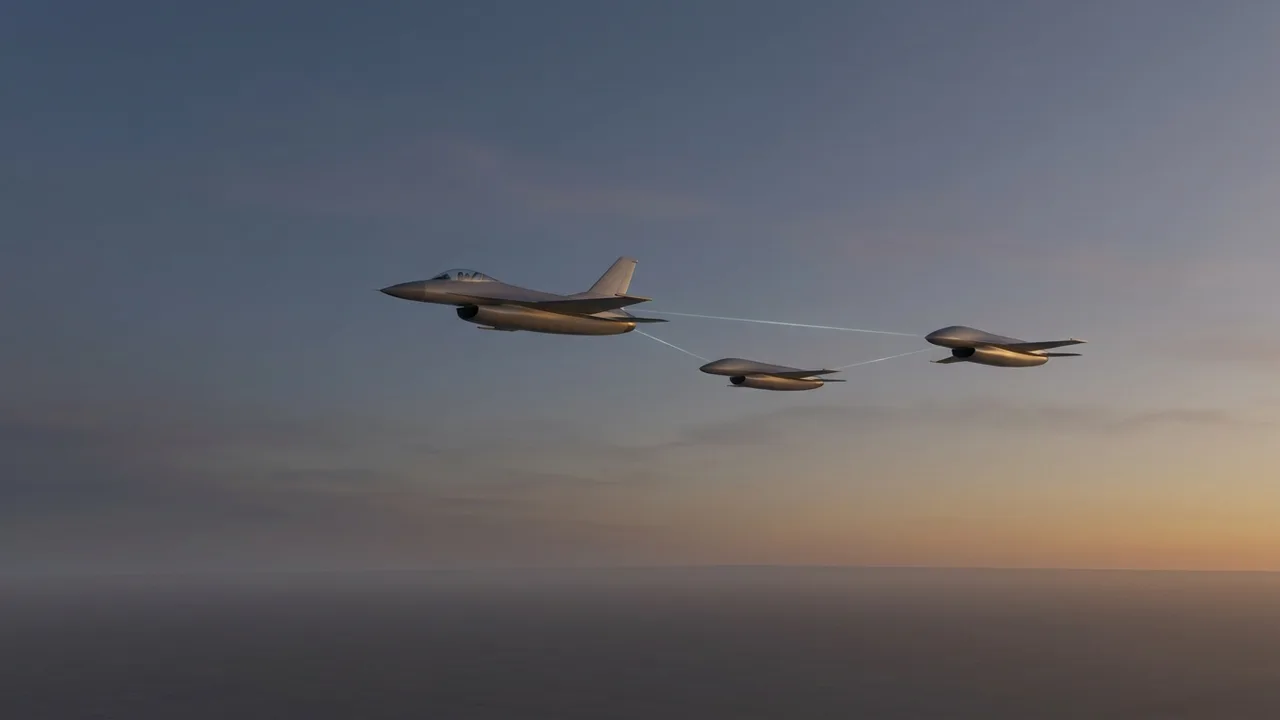
Picture a fighter pilot with a wingman flying alongside, except nobody sits in the wingman's cockpit. The pilot gives directions, and the drone follows them as part of the flight. That is roughly what the U.S. Air Force and Australia are testing right now.
This pairing is called manned-unmanned teaming (MUM-T). The idea is not new. Since the 2010s the U.S. Army has been putting helicopters and drones on the same team. This article follows that path from helicopters to fighters, looks at the names and years of public plans, and points out the questions that remain open.
What manned-unmanned teaming means
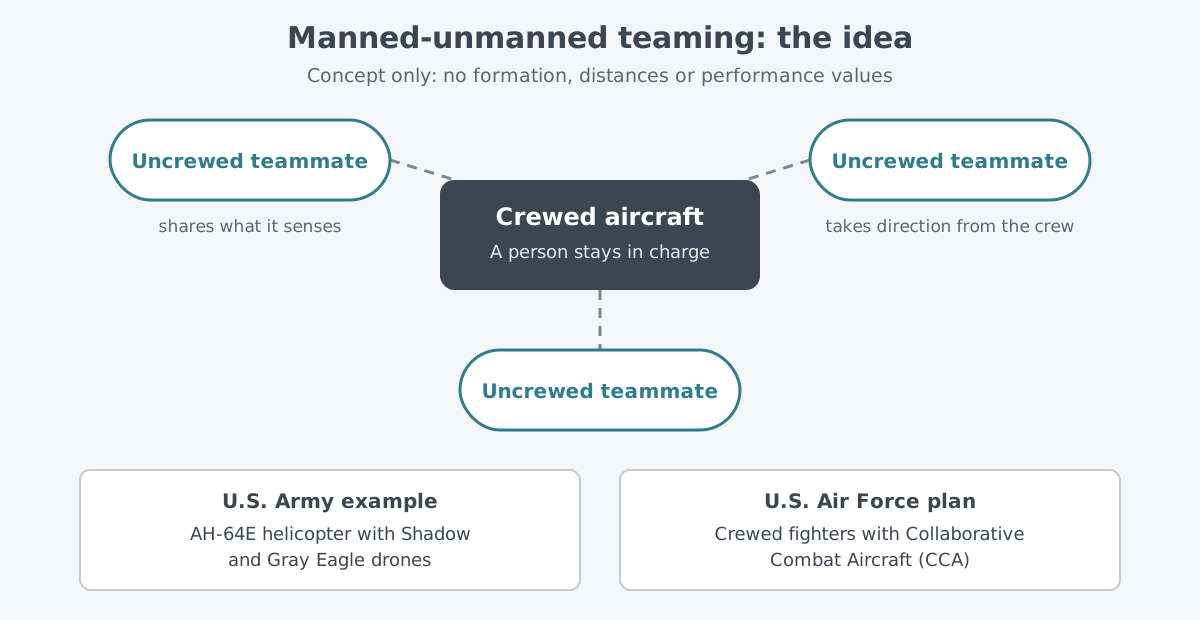
A U.S. Army article describes manned-unmanned teaming as combining soldiers with machines to gain greater lethality and better survivability. The key word is "combining." The drone does not fly off and do its own job. It becomes a teammate that shares information with a crewed aircraft and takes direction from the people on board.
What do the people get out of it? An Apache pilot who took part in a 2020 test singled out distance. Teaming lets the crew keep farther from danger. When an uncrewed teammate moves up front, the person can stay a step back.
Think of a site foreman with a crew of machines: the foreman decides, and the machines do the hands-on work. The real thing is different. An uncrewed teammate is not a colleague who understands speech. It is a machine tied in by data links and software, and people are still deciding how much to hand over to it.
Helicopters and drones paired up first
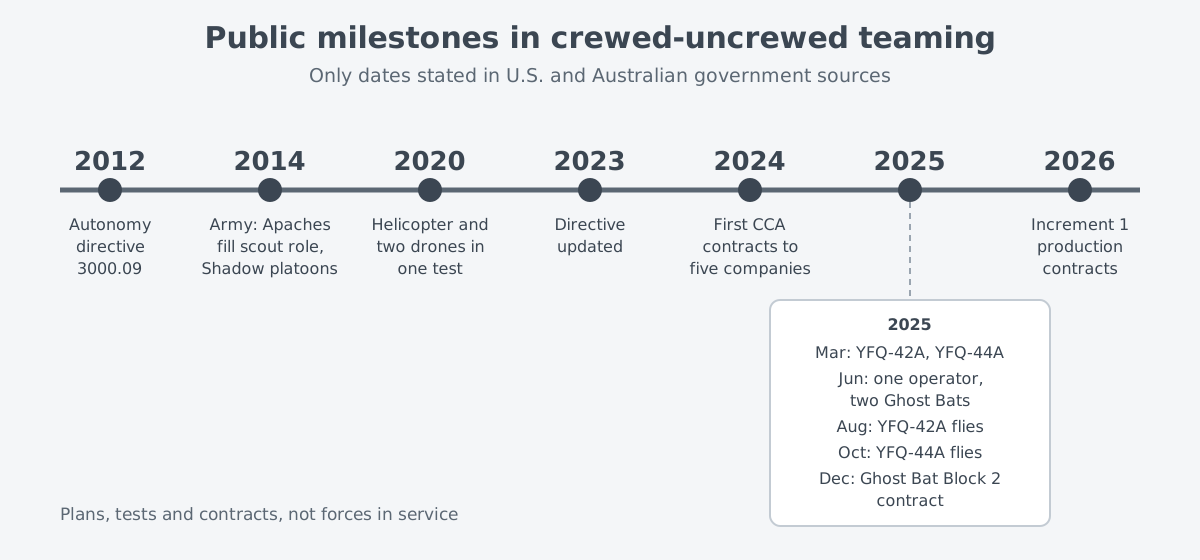
In 2014 the U.S. Army began reorganizing its aviation units under the Aviation Restructure Initiative (ARI). An Army colonel at the Aviation Center's capability development directorate said the requirement for an armed scout helicopter remained, but Apaches (AH-64) would fill it for the time being. He added that budget limits and force cuts left no room to start a new armed scout program.
The plan also turned one Apache battalion in each brigade into a heavy attack reconnaissance squadron and added platoons of Shadow drones. The work of the scout helicopter passed to attack helicopters and drones working together.
A further step came in October 2020 at the Army's Dugway Proving Ground. Three aircraft acted together there and completed a live missile firing. They were an AH-64E Apache helicopter, an RQ-7BV2 Shadow drone and the extended-range version of the MQ-1C Gray Eagle drone. It was a first for the U.S. Army with this trio of aircraft.
The point was not how well any one aircraft performed. An engineer who helped run the test called this level of interoperability, meaning different aircraft working in step, a big step forward for MUM-T. Making the aircraft work together matters as much as building each one well.
Drones beside fighters: collaborative combat aircraft
On the fighter side, the term is collaborative combat aircraft (CCA). This new uncrewed weapon system is under development in the U.S. Air Force, which plans to fly it alongside new and existing crewed fighters. A CCA is a large drone with a jet engine. It could take on air-to-air fights, strikes on ground targets, electronic warfare, targeting, and ISR, short for intelligence, surveillance and reconnaissance.
The plan is for CCA's AI-driven software to cooperate with pilots and take their directions. The Air Force's 2025 report to Congress also presents CCA as an addition to crewed aircraft, not a replacement. The picture is not one where people drop out, but one where machines join them.
Cost is part of the story. By Air Force officials' estimates, a CCA might cost about a third of a crewed fighter's price. The savings might let the service field more of them than crewed fighters. It is an estimate, and actual prices will only show once production is under way.
How many will there be? In 2023 one Air Force official floated an idea of buying 1,000 CCAs one day, pairing two with each of about 500 advanced crewed fighters. The Congressional Research Service (CRS) labels this as "notional plans."
In June 2026 the Secretary of the Air Force spoke of a path to buy more than 150 combat-capable CCAs by the end of the 2020s. In the same announcement, the Air Force said it intends to field about 1,000 combat-capable CCAs. The 150 is a count for the end of the 2020s, while the 1,000 is an overall goal with no deadline stated.
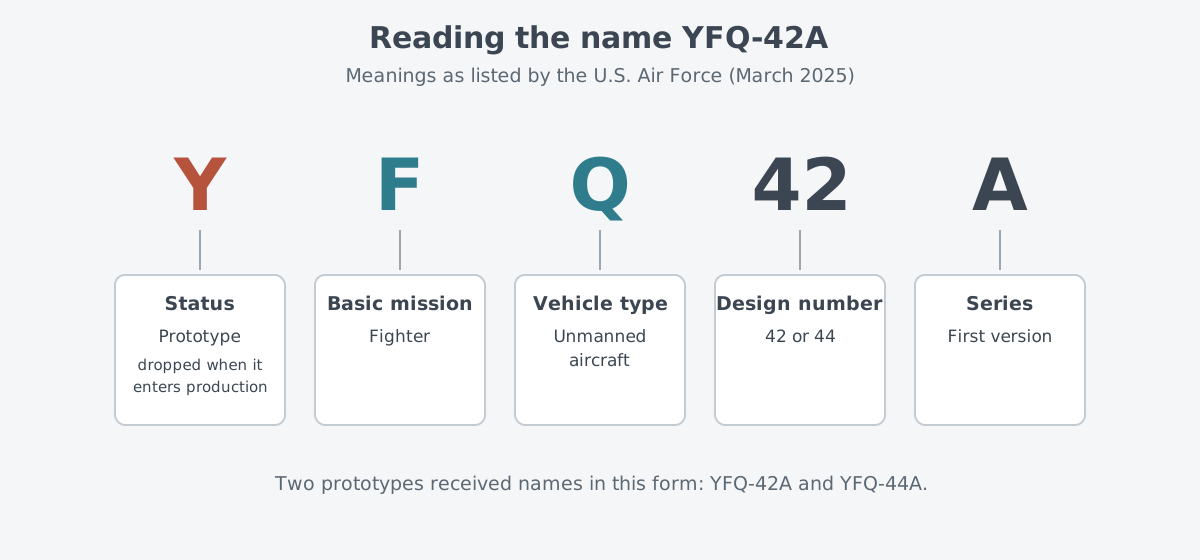
In 2024 the Air Force gave five companies initial contracts to design and build CCAs, and in March 2025 it named two prototypes YFQ-42A (General Atomics) and YFQ-44A (Anduril). Read letter by letter, Y marks a prototype, F a fighter and Q an unmanned aircraft, while the number is the design number and the final A the first version. The Air Force chief of staff at the time said the YFQ-42A and YFQ-44A gave the service a fighter designation for the first time in its history. He added that it may be just symbolic.
The YFQ-42A first flew on August 27, 2025. The YFQ-44A, built to fly semi-autonomously, followed that October. Both are being tested in California for development and assessed for operational use with an experimental operations unit at Nellis Air Force Base, Nevada. In June 2026 the Air Force signed development and production contracts with both companies for Increment 1.
The software part of that announcement stands out. The mission autonomy software is bought apart from the aircraft, through competition within a pool of six companies. In effect, the airframe and its "brain" are bought separately.
Public plans in other countries
Australia is developing the MQ-28A Ghost Bat. The Australian government describes collaborative combat aircraft as uncrewed air vehicles that team with crewed platforms and take on roles usually given to fighters. Ghost Bat was developed with Boeing Defence Australia and is the first military combat aircraft designed, engineered and built in Australia in more than 50 years.
In a demonstration announced in June 2025, one operator aboard an airborne E-7A Wedgetail early warning aircraft took control of two Ghost Bats for a mission. Australia's Minister for Defence Industry said Ghost Bat could turn a single fighter jet into a team. The remark ties in with the demonstration in which one operator handled two aircraft.
That December the Australian government said it would spend about $1.4 billion (the figure given in its release) to turn Ghost Bat into an operational asset. The money includes contracts for six operational Block 2 aircraft and the development of an improved Block 3 prototype. The same release reported that Ghost Bat had hit an aerial target with a live weapon in a test. Contracts and tests are moving ahead, but settling into service with units is the next stage.
Open questions: autonomy and human judgment
How far should an uncrewed teammate decide things on its own? The U.S. Department of Defense has a policy on this question. It is Department of Defense Directive (DODD) 3000.09 on autonomy in weapon systems, first issued in November 2012 and most recently updated in January 2023.
At its core, the directive says every system must let commanders and operators exercise "appropriate levels of human judgment over the use of force." CRS notes that this does not mean a person must steer the weapon by hand. It means people take a broad part in deciding how, when, where and why a weapon gets used. Under the directive, the human-machine interface must also be easy for trained operators to understand.
The same question applies to CCA. CCAs are meant to act with a degree of autonomy while people stay involved in running them. With better AI software, future CCAs may react to changes on the battlefield faster than human operators. That leaves Congress to weigh what risks and benefits come with leaning more on autonomy.
Software is not the only challenge. Storing and moving hundreds of large drones is also on the list of issues. The House Armed Services Committee asked for a briefing on the interfaces CCA operators will use, both between human and machine and between pilot and aircraft. A pilot who flies one aircraft while directing uncrewed teammates first needs displays and controls that make that workload manageable.
What to read next
- ISR drones: why endurance matters: a closer look at the scouting work that uncrewed teammates often do.
- Drone swarms: is every group of drones a swarm?: what it means when many drones move together.
- Weight and platforms: fitting on a vehicle, ship or aircraft: why putting equipment such as a laser weapon on an aircraft is not simple.