On the morning of Friday 25 October 1415, two armies stood facing each other across a field near Azincourt in northern France. One was the army of Henry V of England, which had taken a Norman port and was heading for Calais. The other was a French army gathered to block that road. By the end of the day, the fight had ended in a quick English victory.
This was the Battle of Agincourt. Shakespeare's play made it the most famous fight of the Hundred Years' War, and it is argued about just as much. Did the French really outnumber the English several times over? How much did the mud add to the outcome?
The answer to both questions depends on which record you trust. This article lays three kinds of evidence side by side. They are a French chronicle finished about 30 years after the battle, the English crown's contracts and pay records, and what museums say today.
Why Henry V crossed the sea in 1415
The roots go back almost 80 years, to 1337. That year Philip VI of France attacked the lands Edward III of England held in France, and the two kingdoms went to war over territory. In 1340 Edward went further and claimed the French crown for himself. That long struggle, broken by truces, became the Hundred Years' War.
Henry V, Edward's great-grandson, took up that claim again. He declared war and besieged the Norman port of Harfleur from August to September 1415. The University of Southampton describes the surprise victory that autumn as Henry beating the French and pressing his claim to the French throne.
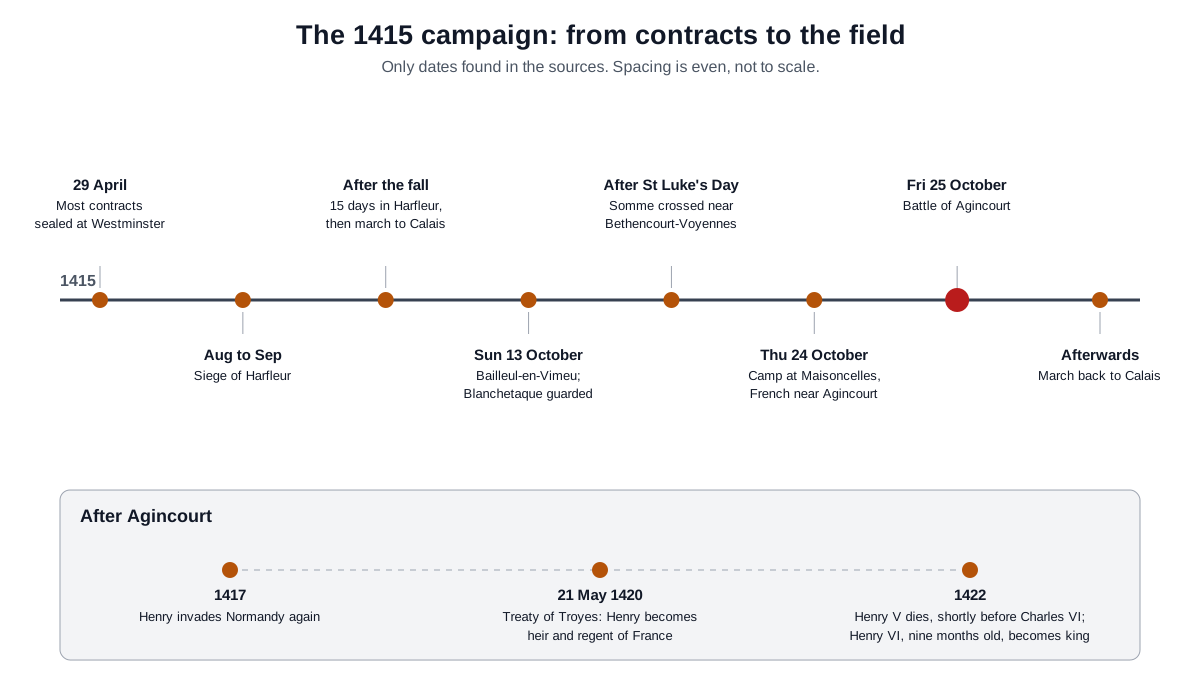
The way armies were raised looks a lot like a modern contract. Men called captains signed agreements with the king to supply a set number and mix of soldiers, for a campaign of no more than 12 months. Historians call this the indenture system. Most contracts for the 1415 campaign were sealed at Westminster on 29 April that year, and many originals still survive in The National Archives in the UK.
Each contract was written out twice on one sheet, then cut apart along a toothed line, so the king and the captain each kept one half. It works a little like a tally stick split in two, where only the true pieces fit back together. The difference is that this fit was used for accounts, not for proving who someone was. After the campaign the two halves were matched to settle pay, and a forged copy would not line up with the cut.
English kings had a reason to pay for soldiers this way. During the 14th century, feudal service alone could no longer supply enough men for long campaigns overseas. French kings paid soldiers as well, but they still leaned on older feudal powers to call up armies.
The French side left paperwork too. Medieval Soldier, a research project of the universities of Southampton and Reading, has gathered 228 musters and 343 pay receipts from 30 June to 25 October 1415. These documents clearly show an army forming at Rouen in September and October, and a separate force kept back to guard Paris against a feared Burgundian attack.
Even the ships have been recounted. Henry's fleet was long thought to be about 1,500 foreign vessels. Craig Lambert at Southampton puts it at about 700 ships, mostly English. By his count, Henry hired about 250 foreign ships and requisitioned about 400 from English merchants.
From Harfleur to Agincourt
The road after Harfleur's fall is told in detail in the chronicle of Enguerrand de Monstrelet. Monstrelet was governor of Cambrai and a supporter of the French crown, and his chronicle was finished by 1447. He did not see the battle himself, but he wrote on the French side within about 30 years of it.
Henry left 500 men-at-arms and 1,000 archers to hold Harfleur. After 15 days in the town, he set out to march to Calais. In the chronicle, the king's escort numbers 2,000 men-at-arms, about 13,000 archers, and many others. That is far from the numbers modern researchers have counted from the records, a gap the numbers section looks at later.
The river Somme stood in the way. Henry aimed for the Blanchetaque ford, where Edward III had crossed in 1346, almost 70 years earlier, before the Battle of Crécy. His scouts reported a large French force guarding it, so he changed course. On Sunday 13 October he stayed at Bailleul-en-Vimeu, then moved along the river looking for a place to cross.
The French marched along the far bank, matching his moves and guarding the fords. The English only got across on the day after St Luke's Day, at a ford between Béthencourt and Voyennes. The French king had ordered the people of Saint-Quentin to block that ford with stakes, but the order was not carried out.
On Thursday 24 October, English scouts saw large French forces coming to camp at Rousiauville and Agincourt. Henry quartered his army in the small village of Maisoncelles in front of them. The French were about three bowshots away. The English soldiers were worn down by cold and hunger.
More French troops were still on the way. The Duke of Brittany had reached Amiens with 6,000 men and could have joined if the battle had waited until Saturday. The Royal Armouries sums up the moment simply: Henry was trying to get back to Calais, and a French army blocked his route.
Professor Anne Curry of the University of Southampton says people tend to forget one thing. The battle came at the end of a failed campaign, while Henry was heading home from a siege.
25 October: a day in the field
On Friday morning the French drew up in three divisions. The vanguard held about 8,000 helmeted knights and esquires, 4,000 archers and 1,500 crossbowmen. A main body stood behind it, and a rearguard of the remaining men-at-arms stood at the back. Two wings were set apart to strike the English flank and archers: one of 1,500 men-at-arms, the other of 800 picked men.
The French held their ground and waited until between nine and ten in the morning. Monstrelet adds that only a few of the wisest among them feared an open battle.
On the English side, the old knight Thomas Erpingham set the line. Archers stood at the front with men-at-arms behind, and two wings mixed both kinds of soldier. The horses and baggage went to the rear.
Each archer drove a stake, pointed at each end, into the ground in front of him. Henry also sent about 200 archers quietly toward the village of Tramecourt, to hide in a field near the French vanguard.
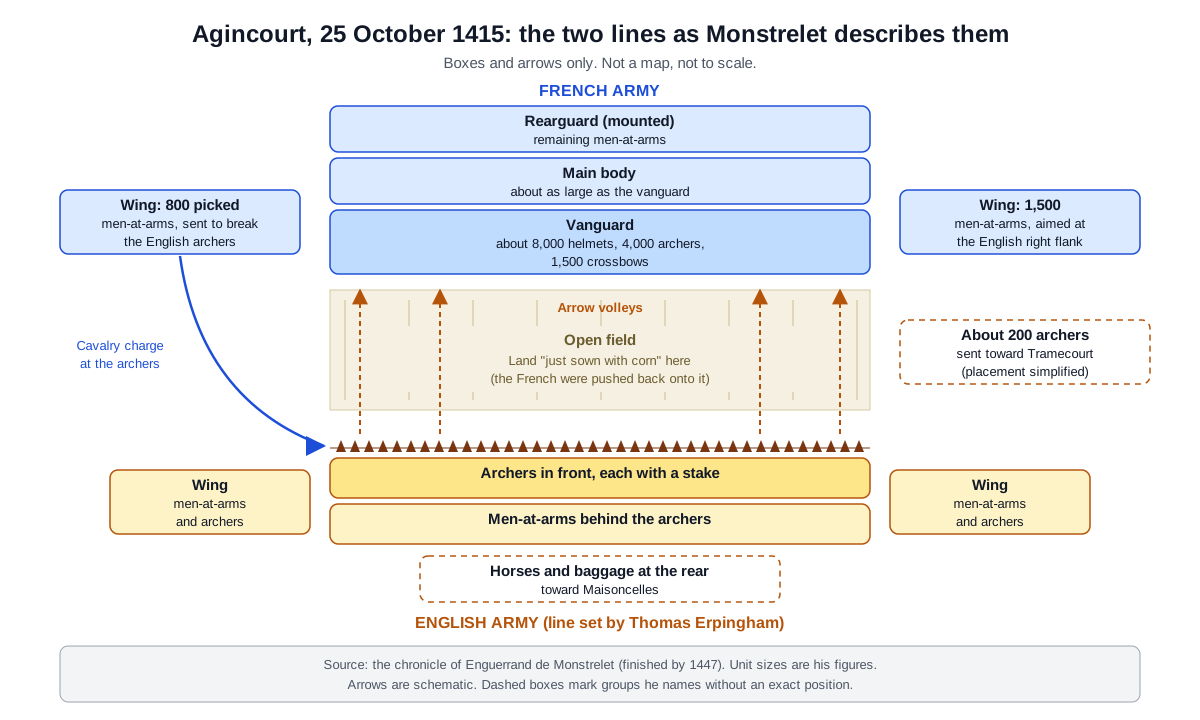
When the French did not move, the English advanced first. They stopped now and then to catch their breath and shouted as they came, and the hidden archers shouted back and began to shoot. In the chronicle, at least 13,000 archers loosed their arrows as hard and as high as they could. The French bent their heads to keep arrows off the visors of their helmets, and many were killed or wounded before the lines even met.
The Royal Armouries reads this as Henry using defensive tactics in an attacking way. Archers behind stakes are normally a defender's weapon, but Henry moved forward and drew the French into charging him. A French cavalry wing did ride out to break the archers, yet the 800 under Clugnet de Brabant had shrunk to 140.
Horses wounded by arrows bolted back into their own vanguard. The line broke in many places, and horses and riders fell together. The whole army was pushed back onto ground that had just been sown with grain, and some men fled in fear.
The English seized the moment. The archers dropped their bows and ran in with hatchets, swords, bill-hooks and mallets. Anthony, Duke of Brabant, newly arrived at the French king's summons, threw himself between the broken vanguard and the main body and was soon killed. The mounted rearguard watched the first two divisions collapse and, apart from a few leaders, began to flee.
When the English had the upper hand and had taken many prisoners, news arrived. A few French men-at-arms and about 600 peasants had attacked the English king's baggage and carried off much of it. According to Monstrelet, Henry feared the French would renew the fight, in which case the prisoners might help them, so a trumpet call ordered every man to kill his prisoners. How to judge this order is still disputed, and the last section returns to it.
In the end the field was left to the English. In Monstrelet's count, the English king lost about 1,600 men of all ranks, including the king's uncle, the Duke of York. Henry asked the name of the nearby castle, was told it was Agincourt, and gave the battle that name. The English then marched back to Calais without further trouble.
Longbows, plate armour and stakes: the weapons of the day
The two armies were built differently from the start. In 1415, says the Royal Armouries, about one English soldier in four was a man-at-arms, knight or noble. In the French army it was more than three in four. England fielded an army of archers, and France an army of men in full armour.
The English and Welsh archers used the longbow. It was usually about 1.8 m long, roughly a man's height, and was most often made of yew. War arrows were stored and handed out in bundles of 24. Its range is thought to have been about 229 m, perhaps more.
The longbow's real strength was speed. A longbow archer could shoot 10–12 arrows a minute, while a crossbowman managed 2–3 bolts. The crossbow, more common on the French side, was slower but more powerful. One weapon shot many, the other shot hard.
So did arrows pierce plate armour? The Royal Armouries answers more cautiously than the legend does.
Good armour protected both men and horses fairly well. Probably only a small share of arrows got through, and then only at thin spots like the sides of a helmet. What made the arrows work was the sheer number of them.
Another common idea is that plate armour made men clumsy. A full harness weighed about 60–70 lb, but the load was spread over the whole body, and the wearer could move with real agility. The rigid plates turned aside glancing blows, and only a direct, forceful strike could break through. Overheating from hard effort, though, was a real danger.
The archers were dressed much more lightly. A heavy padded coat and a helmet were about all they had. In the chronicle, most English archers that day wore jackets with no armour, carried hatchets or swords at the belt, and some went barefoot. Archers kept other weapons for when their arrows ran out and fought alongside the men-at-arms where the fighting was heaviest.
Newer weapons were starting to appear. The records note one English soldier killed by a gun at Agincourt. Henry also took miners from the Forest of Dean with him in 1415.
Thomas Montague, Earl of Salisbury, fought at Agincourt. A picture of the time shows him with a pollaxe, which put an axe blade, a hammer and a spike on one shaft.
The mud argument: how much did the ground matter?
Mud turns up in almost every retelling of Agincourt. In that version, heavy armour and soft ground brought the French down. The records followed here give the mud less weight than that.
In the Royal Armouries summary, mud is an extra condition, not the main cause. The longbowmen's arrows, shielded by stakes in the ground, broke up the French men-at-arms, and the muddy ground left them "further" hampered. Arrows and stakes come first, and the mud sits on top. Monstrelet's chronicle does not use the word mud at all; it only says the broken French army was pushed back onto freshly sown ground.
What comes through more clearly about the ground is how crowded it was. The chronicle shows the same thing. Once the English closed in, only the front rank and men who had shortened their lances could even lift a hand against them. The Royal Armouries also notes that the French fought so tightly packed that they could hardly use their swords.
The deaths and captures of well-known men show what that crush looked like. The Duke of York, who led the English vanguard, died taking the full weight of the French assault. No one knows for sure whether he was cut down or died from heat and suffocation under the press of men on top of him.
The French Duke of Orléans was found under a pile of bodies and taken prisoner. Henry V himself was nearly cut down by French soldiers.
This crowding links straight to the numbers argument. Anne Curry says that, looking at the battlefield, the numbers often claimed simply would not have fit in the space. Her research included a new study of the battlefield's terrain. The idea is that the size of the ground sets a ceiling on the number of people.
The numbers argument: from 150,000 to 12,000
Monstrelet writes that on the night before the battle the French were "full one hundred and fifty thousand strong." The next morning, with the French drawn up, a quick look put them at more than six times the English. Jean de Waurin, another chronicler on the French side, also said the French army was six times as large as the English one.
The version that circulates today is smaller but still lopsided. In it, a worn-out English army of about 6,000–9,000 beats French forces of 15,000–25,000. The claim that the French outnumbered the English five to one is also widespread.
Anne Curry came at the numbers another way. Alongside the chronicles of the time, she worked carefully through the surviving financial and administrative records, which no one had analyzed this way before. From 2004 she built a database of roughly 8,000 men who served Henry in 1415, and published it in a book in 2005.
The gap between the armies came out much smaller than people had believed. A case study submitted to the UK's Research Excellence Framework (REF) gives about 12,000 French and 9,000 English. In a 2016 University of Southampton article, Curry repeated her earlier suggestion of 8,500 English and about 12,000 French. Even one researcher's figures shift a little from one publication to the next.
These figures met resistance. Curry herself says they were controversial because people are deeply attached to the idea of a vastly larger French army. A University of Sheffield student history magazine notes that her conclusions also drew criticism from many experts on the period.
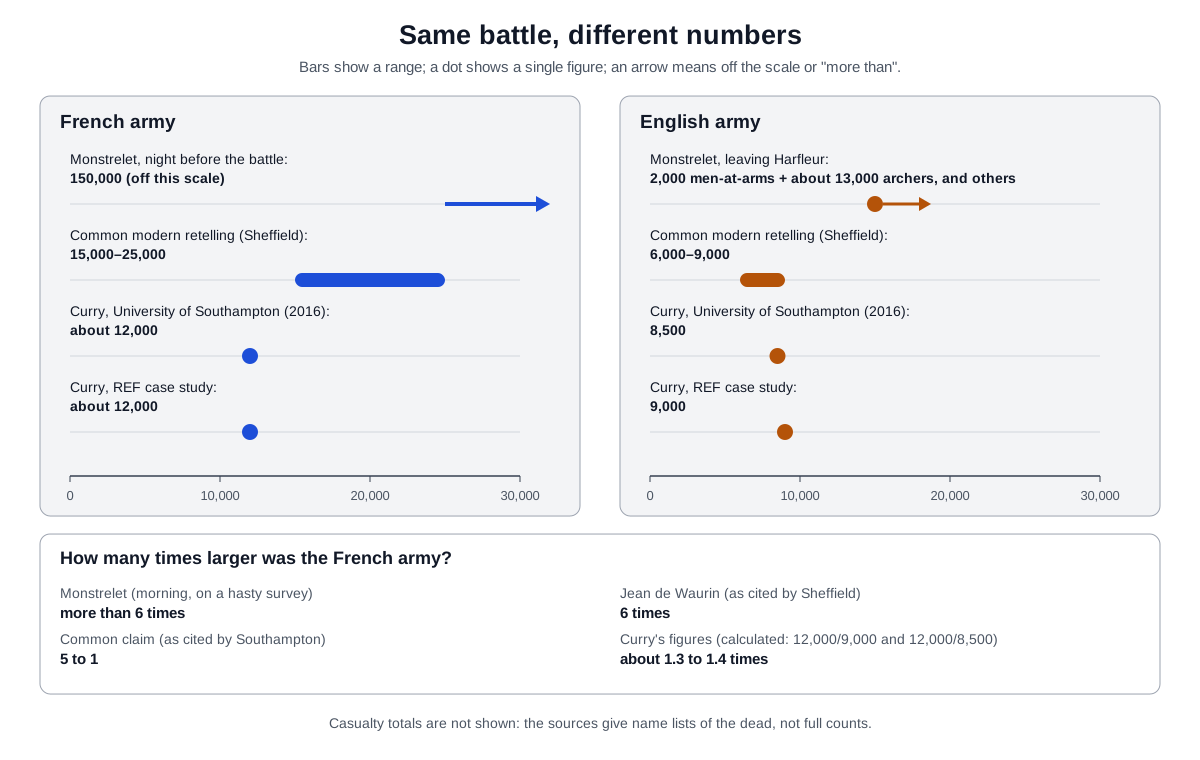
Monstrelet's English numbers are hard to accept as they stand, too. His 2,000 men-at-arms and about 13,000 archers leaving Harfleur add up to more than the whole campaign army that modern researchers count from the records.
The Sheffield article asks how anyone can know Waurin was not a medieval spin doctor. Record-based counts have gaps as well. Not every document survives, so the size and makeup of every company cannot always be worked out.
The dead are even harder to count. French dead are known mainly from name lists in chronicles. The longest, in Monstrelet, has 273 names, and the longest in an English chronicle, versions of the Brut, has 38.
A list kept by the city of Salisbury gives 92 named dead plus 3 unnamed. The names differ a good deal from list to list, so no single list gives a full count.
For English losses, Monstrelet gives about 1,600, and the Royal Armouries says only that French losses were much heavier than English ones. Part of the reason no single number settles this is that each name on those lists is someone who never came home.
Prisoners, ransoms and Shakespeare: what remained
Many French were taken prisoner at Agincourt. The dukes of Orléans and Bourbon were among them. The Duke of Orléans was taken to England and held in various castles, including the Tower of London, for 25 years, until his release in 1440.
Prisoners meant money. The English crown was entitled to a share of prisoners' ransoms, so royal financial records show who was captured and ransomed. The right to a ransom could be bought and sold, and the actual ransom was normally three times what the holder of that right owed the crown.
The order to kill the prisoners is still read in different ways. Monstrelet ties it to the attack on the baggage. He writes that the order led to a sudden, general killing of the French prisoners, and he puts the blame on the men who attacked the baggage. Those men were later punished by John, Duke of Burgundy.
The Royal Armouries notes that even Henry V was criticized in some quarters for the order. Rémy Ambühl at Southampton studied about 100 ransom contracts and found that people from a wide range of ranks, not only knights, were kept for ransom once the fighting ended. He says that if a massacre took place, it did not spare the great while killing only the lower ranks.
Victory did not bring peace right away. In 1417 Henry returned to Normandy with conquest in mind. Charles VI of France eventually had to accept Henry's claim, and the Treaty of Troyes, agreed on 21 May 1420, made Henry heir and regent of France. But Henry died in 1422, shortly before Charles, and his son Henry VI, just nine months old, was left as king of England and of France.
The Musée de l'Armée presented Agincourt in its exhibition "Knights and bombards: Agincourt - Marignano, 1415-1515" as the battle that closed the era of the feudal army. The exhibition's theme was that armies, tactics and military institutions changed sharply over the following 100 years. In that view, the field at Agincourt is the starting point of a century of change.
Much of the Agincourt people picture today comes from Shakespeare's 1599 play Henry V. When newspapers began marking the battle in 1757, they printed Shakespeare's speeches rather than anything written at the time. During both world wars, the play's speeches were used to raise soldiers' spirits.
As the story grew, myths attached to it. One legend says the French vowed to chop off the fingers of English archers, who raised those fingers in defiance and so gave rise to the "V" sign. Curry points out that nothing written at the time mentions it, and calls it almost certainly an urban myth of the 20th century.
The idea that most of Henry's army was Welsh is also wrong: the muster rolls name 500 Welsh archers and a few men-at-arms with them.
Many families also claim an ancestor who fought at Agincourt. The name carried prestige, and that led to a stream of claims without evidence. Curry's database, built from muster rolls and the campaign's financial records, makes it possible to check them. People can still argue about the mud and the numbers more than 600 years later because those names survive on paper.
What to read next
- The Hundred Years' War at a Glance: What Happened Over 116 Years: the wider story before and after Agincourt, laid out on a timeline.
- Crécy and the Longbow: The Real Story Behind Bows Beating Knights: the 1346 battle where Edward III crossed the Blanchetaque ford that Henry hoped to use.
- Joan of Arc and the Siege of Orléans: The Turn of 1429: how the direction of the war reversed after the Treaty of Troyes.
- Turning points in military technology: how battlefields changed as weapons changed, traced through 20th-century technology.
- A history of laser weapons: how long-range weapons came to use light, told through official records.