At about one in the afternoon on April 9, 1865, in the small Virginia village of Appomattox Court House, General Robert E. Lee sat waiting in Wilmer McLean's parlor. Half an hour later General Ulysses S. Grant arrived; that morning he had already covered more than 20 miles on horseback, circling the two armies.
The two shook hands and parted by three o'clock. But did this surrender end the Civil War? The park that the National Park Service (NPS) runs at Appomattox calls it "the beginning of the end." No treaty ever ended the war, and the official end came more than a year later.
The park's home page says two questions remained after the surrender. Could the country become one nation again? And how would freedom for the enslaved become real?
This article starts with the last eight days after Lee's army left Petersburg. It then follows the terms and paroles, a war that ended piece by piece, and Reconstruction, the effort to answer those two questions, up to its halt in 1877.
Eight days from Petersburg
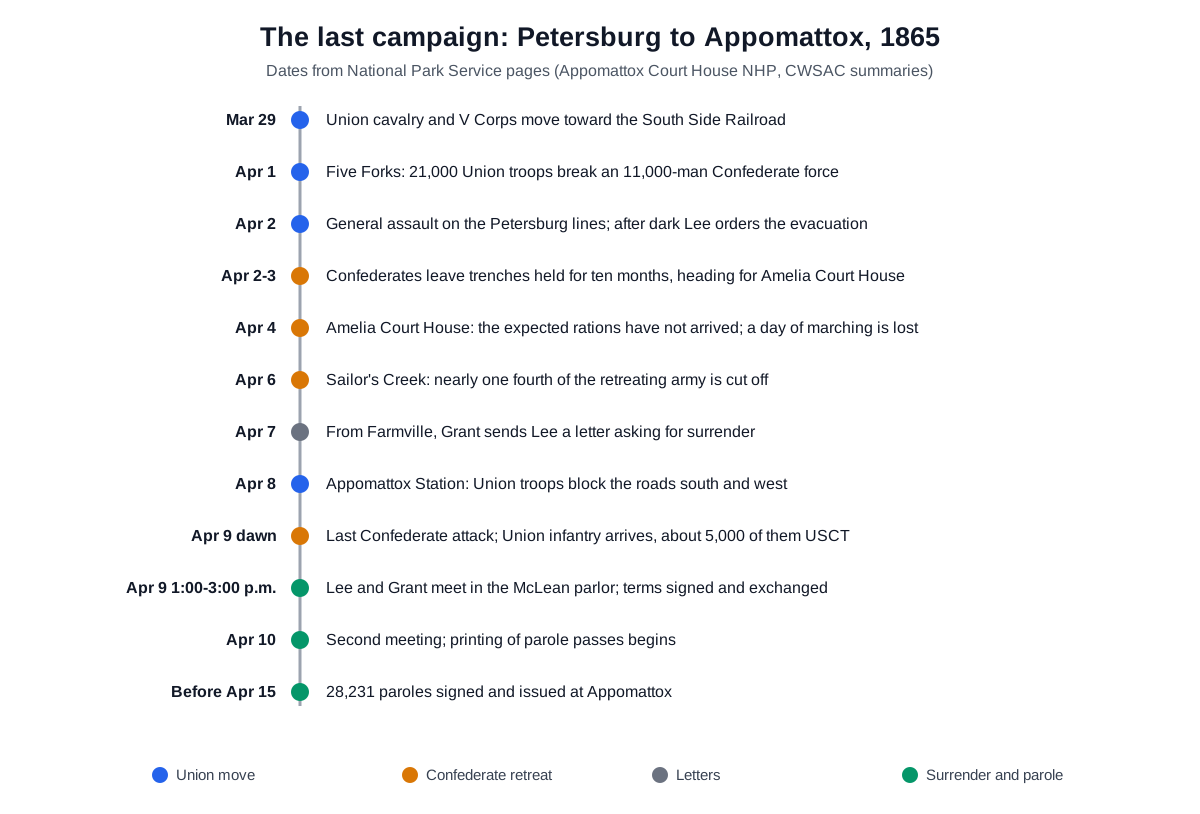
The roots of the last campaign go back to June 1864. After the Union Army of the Potomac got across the James, it kept up steady pressure on the Confederate defenses of Richmond and Petersburg. By the fall, three of the four rail lines running into Petersburg had been cut. Only the South Side Railroad was left.
On March 29, 1865, Sheridan led his cavalry, along with the V Corps, toward that railroad. On April 1, at a road junction called Five Forks, 21,000 Union troops broke a Confederate force of 11,000 led by Pickett. The NPS battle summary (CWSAC) estimates 3,830 casualties. With his last supply line in danger, Lee told President Jefferson Davis the next morning that Petersburg and Richmond had to be abandoned.
On April 2 Union forces assaulted the whole Petersburg line, and that night Lee gave the order to pull out. The Confederates left trenches they had held for ten months. Their first goal was Amelia Court House. There the scattered units would gather and pick up food shipped out from Richmond.
When Lee reached Amelia on April 4, the rations had not arrived. He sent wagons into the countryside, but the farms nearby had almost nothing to spare, and the wagons returned close to empty. The lost day of marching let the pursuing Union troops catch up, and the park page describes the stop at Amelia as the moment the campaign turned.
Food comes up in the record of this campaign as often as cannon do. As logistics, the work of feeding and moving an army, faltered, hungry men dropped out of the march or left their units to look for something to eat. At Sailor's Creek on April 6, Union forces cut off almost a quarter of Lee's retreating army, and most of those men surrendered.
On April 7 Grant sent Lee a letter from Farmville asking him to surrender. Lee hoped to reach Appomattox Station first and pick up rations sent from Lynchburg; if he failed, surrender was the only choice left. On the night of April 8, Union horsemen and troops of the Army of the James got ahead of Lee by shorter roads. They closed the routes to the south and west.
Before dawn on April 9, about 9,000 Confederates lined up in open ground on the village's west side. Their attack, launched before eight in the morning, at first pushed back the Union cavalry. Then nearly 25,000 Union infantry came up after marching hard for more than 30 miles, and about 5,000 of them were United States Colored Troops (USCT).
Between ten and eleven in the morning, white flags of truce went out from the Confederate lines. Lee chose surrender over throwing away the lives of the roughly 33,000 soldiers he still had. In the NPS battle record, this is the war's last fight in Virginia.
Surrender in the McLean parlor
Close to 95,000 soldiers were gathered near the village, so most of the people who lived there had left. The McLean family stayed. Charles Marshall, a lieutenant colonel on Lee's staff, was looking for a building for the meeting when he met Wilmer McLean, who offered his parlor.
The two generals first talked briefly about their service in the U.S.-Mexican War. It was Lee who turned the talk back to business. Grant quickly wrote a draft of the terms, based on what the two had already outlined in letters over the past two days.
The core of the terms was simple: Confederate soldiers would give up their weapons, equipment and flags, while officers could keep their own horses, sidearms and belongings. Officers and men alike would be paroled and go home, not to prison camps. Lee asked whether cavalry and artillery enlisted men could keep their horses and mules too. Grant would not change the terms, but he said he would put out a separate order to let them do so.
Lee could not tell Grant how many men were still with him, so Grant offered food for 25,000 men for three days. Ely S. Parker, a lieutenant colonel serving as Grant's military secretary, wrote the formal copy of the terms, and Marshall wrote Lee's letter of acceptance. The generals each signed one of the two documents and exchanged them.
Another change came the same day near the McLean house. Nine people held in slavery by the family were now free to live on their own.
The house itself is not the original building as it stood. It was sold at auction in 1869 and taken apart for a planned exhibit that never happened. After lying in pieces for years, it was rebuilt, and the NPS first opened it to the public on April 9, 1949.
Parole: home instead of prison camps
Today the word parole calls up prisons. In the 19th century, parole was used almost only for prisoners of war. Because paroled prisoners were not held, it saved the people and supplies needed to house, feed and guard them.
During the Civil War a formal exchange system was set up in 1862. It ended in 1863. When the Confederacy refused to treat Black soldiers of the USCT as soldiers, the Union stopped paroling and exchanging prisoners, and it did not restart them before the war ended. As a result, tens of thousands of prisoners died in brutal conditions in camps in both the South and the North.
The Appomattox terms revived parole. The formal terms said those who surrendered would not be disturbed by U.S. authority as long as they kept their parole and obeyed the laws where they lived. That line protected every soldier who surrendered with Lee, and Lee himself, from later prosecution unless he took up arms again. It became the model for the other Confederate surrenders over the following months.
The park links this generosity to Lincoln. Lincoln directed his generals to go easy, following the principle from his second inaugural address: "malice toward none, with charity for all." The McLean house page adds that the terms were meant to "pacify the white southern population."
When the generals met again on April 10, Lee asked for written proof that his men were paroled. Many would be going home through parts of the South that had not surrendered yet. Printing presses ran day and night and turned out more than 30,000 passes, and 28,231 were signed and issued before April 15.
Thirty-nine Black men also received paroles. All were enslaved people or free Black men forced into service, working as laborers, cooks, teamsters and in other camp jobs. A parole pass let its holder draw federal rations and ride federally run railroads and steamships for free. How many men actually used these benefits is hard to know.
Black soldiers on the Union side have their own part in the story. More than 180,000 Black soldiers served in the Union Army in the second half of the war, and more than 5,000 of them were at the April 9 battle. They marched 30 miles in less than 20 hours to block Lee's escape route. After the surrender their 25th Corps was sent to Texas, where cholera, scurvy and dysentery killed hundreds of men who had been at Appomattox.
An end without a treaty
The Civil War never ended with a signed treaty. Appomattox was the military surrender of one surrounded army, and the Confederate government never surrendered. Treaties are made between nations, and the United States would not grant the Confederacy legal standing as one.
So the war ended piece by piece, through four major surrenders and many smaller ones. On April 14 Lincoln was shot at Ford's Theater in Washington and died the next morning.
On April 26 in North Carolina, Johnston surrendered 30,000 troops of the Army of Tennessee to Sherman. Nearly 50,000 more troops he commanded across Georgia, Florida and the Carolinas were included. A first agreement reached on April 18 was judged too generous in Washington, and the two sides signed again on terms that followed Appomattox.
On May 4 in Alabama, Taylor surrendered 40,000 troops. On May 5 Davis and his cabinet broke up in Georgia, and from then on the Confederacy had no working government. Davis was captured on May 10, held at Fort Monroe for nearly two years and released without a trial. The park FAQ says many scholars think the government worried that a treason trial would become a case about whether secession was constitutional.
On June 2 Kirby Smith formally surrendered the region west of the Mississippi, but his troops had already scattered, and only about 17,000 of nearly 60,000 received paroles. On June 19 Union troops reached Galveston, Texas, and enforced the freedom proclaimed more than two years earlier, freeing more than 250,000 people. That day is remembered today as Juneteenth.
At sea, the Confederate warship Shenandoah, which had been raiding whaling ships in the North Pacific, surrendered in Liverpool, England, on November 6. Then President Andrew Johnson, on August 20, 1866, issued a proclamation declaring peace and order across the whole United States. That document is treated as the formal close of the war.
Lincoln's death and Presidential Reconstruction
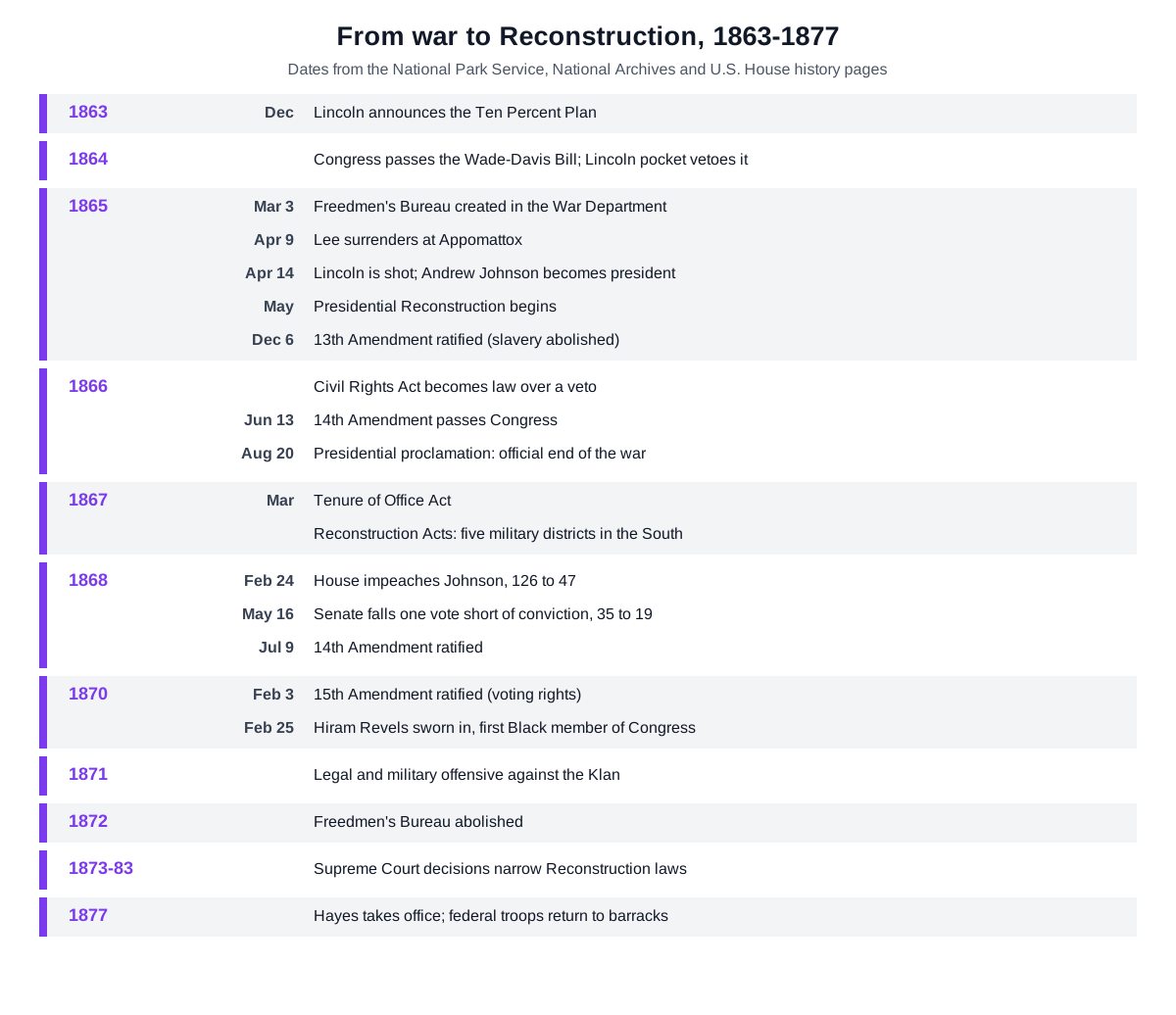
The debate over what would follow the war began during the war itself. In December 1863 Lincoln announced the first full Reconstruction program, the Ten Percent Plan. Southerners other than Confederate leaders would be pardoned if they took an oath to be loyal to the Union and to accept emancipation. Once 10% of a state's voters took the oath, they could form a new state government.
Eric Foner of Columbia University wrote the NPS essay on this period. In his reading, Lincoln meant the plan less as a design for the South after the war than as a way to weaken the Confederacy. In 1864 Congress passed the Wade-Davis Bill, which would have held off new governments in the South until more than half of the voters had sworn loyalty. Lincoln killed it with a pocket veto.
In April 1865, in what became his final speech, Lincoln said some Black men in the South should be able to vote: the "very intelligent" and Union army veterans.
After Lincoln's death Andrew Johnson became president. He was a former slaveholder from Tennessee, but as a senator he sided with the Union throughout the war. The policy he began in May 1865 is called Presidential Reconstruction (1865–67).
Johnson pardoned Southern whites other than Confederate leaders and wealthy planters, and most of those later received individual pardons. As long as they abolished slavery, repudiated secession and canceled the Confederate debt, new state governments elected by whites alone could run their own affairs. Across the South, former Confederates won seats in state legislatures and in Congress.
These state governments passed laws known as the Black Codes. They forced Black workers to sign yearly labor contracts and let unemployed Black people be labeled vagrants and hired out to white landowners. The laws aimed to restore plantation discipline over freed people, and African Americans strongly resisted them.
Congressional Reconstruction and military districts
When Congress met in December 1865, it refused to seat the members elected from the Southern states. It formed a Joint Committee on Reconstruction, made up of six Senators and nine Representatives, to look into conditions in the South. In early 1866 Congress sent Johnson a bill extending the Freedmen's Bureau and a civil rights bill.
The civil rights bill made everyone born in the United States a citizen with equality before the law. Johnson vetoed both bills, but Congress overrode him, making the Civil Rights Act the first major U.S. law ever enacted over a presidential veto. Next, Congress approved the 14th Amendment. It wrote birthright citizenship and "the equal protection of the laws" into the Constitution.
In the fall 1866 elections, Northern voters overwhelmingly rejected Johnson's policies. Yet all the Southern states but Tennessee turned down the 14th Amendment, and Congress chose to begin Reconstruction again.
Under the Reconstruction Acts of 1867, the South was split into five military districts, each occupied by federal troops. Before Southern states could send members back to Congress, they had to ratify the 14th Amendment, adopt new state constitutions and guarantee Black men the vote. The Radical or Congressional Reconstruction that began this way lasted until 1877.
Federal troops stayed in the South after the war was over. The U.S. House history office writes that the armed forces were central to protecting the rights of Black Americans as citizens and voters and to making fair elections possible.
The fight between president and Congress led to impeachment. In March 1867 Congress approved the Tenure of Office Act. It stopped the president from dismissing Cabinet members without the Senate's consent. Johnson twice dismissed Edwin Stanton, the Secretary of War, and on February 24, 1868, the House impeached him by a vote of 126 to 47.
Eight of the 11 articles of impeachment dealt with the Tenure of Office Act. When the Senate voted on May 16, 1868, the count was 35 to 19, a single vote below the two-thirds majority required for conviction. The Supreme Court ruled the act unconstitutional in 1926.
Three amendments and the Freedmen's Bureau
Help for freed people began during the war. On March 3, 1865, Congress created the Freedmen's Bureau inside the War Department. Its full name was the "Bureau of Refugees, Freedmen, and Abandoned Lands," and in May of that year Major General Oliver Otis Howard became its commissioner.
The bureau lasted until 1872, but it did most of its work between June 1865 and December 1868. It handed out rations and clothing, ran hospitals and refugee camps, and supervised labor contracts between planters and freed people. It helped charities set up schools, helped make marriages from the time of slavery legal, and helped Black soldiers and sailors collect back pay and pensions.
Land was a different story. For freed people, economic freedom meant owning land. But in the summer of 1865 Johnson ordered land held by the federal government handed back to the people who had owned it before. The hope of "40 acres and a mule" never came true, and most freed people stayed landless and poor.
The Constitution changed three times. Congress passed the 13th Amendment on January 31, 1865; ratification followed on December 6, 1865, and slavery was abolished. A constitutional amendment was needed because the Emancipation Proclamation applied only to areas in rebellion and did not end slavery across the nation. Even so, the 13th Amendment left an exception for forced labor as "punishment for crime."
The 14th Amendment passed Congress on June 13, 1866, and was ratified on July 9, 1868. It made every person "born or naturalized in the United States" a citizen and barred any state from denying anyone "the equal protection of the laws." The National Archives notes that, during Reconstruction, the amendment did not actually shield the rights of Black citizens. Even so, the arguments and dissents of that time laid the groundwork for change in the next century.
The 15th Amendment passed Congress on February 26, 1869, and was ratified on February 3, 1870. It barred any denial or narrowing of voting rights "on account of race, color, or previous condition of servitude," giving Black men the vote.
The changed Constitution soon showed in the Capitol. On the afternoon of February 25, 1870, Hiram Revels of Mississippi took the oath in the Senate, becoming the first Black American to serve in Congress. On December 12 Joseph Rainey of South Carolina became the first Black American seated in the House. Reconstruction governments in the South created public school systems paid for by the states, a first for the region.
At the same time, railroad aid programs bred corruption and higher taxes, turning more and more white voters away.
The end of Reconstruction in 1877
Opponents of Reconstruction turned more and more to violence. Terrorist groups such as the Ku Klux Klan (KKK) targeted local Republican leaders and Black people who asserted their rights. Congress passed Enforcement Acts that allowed national action against political violence, and in 1871 the Grant administration's legal and military offensive broke the Klan. The 1872 election that returned Grant to office was the calmest of the whole period.
After that, Reconstruction faded. By 1876 Republicans still controlled just three Southern states: South Carolina, Florida and Louisiana. That year's presidential race between Hayes and Tilden hinged on disputed returns from exactly those states. Congress set up a special commission, whose slim Republican majority gave all the disputed electoral votes to Hayes.
Hayes won the presidency by one electoral vote.
Foner's essay calls the deal that followed the "Bargain of 1877." Hayes agreed to accept Democratic rule in the last Southern states still in dispute, and Democrats agreed to let Congress certify his win. Hayes took office, and the federal troops in the South went back to their barracks. With that, Reconstruction came to an end, if Reconstruction means the years when Washington accepted the duty of guarding the rights of people who had been enslaved.
Reconstruction also narrowed in the courts, as a string of Supreme Court rulings between 1873 and 1883 steadily wore away its legal gains. The first was the Slaughterhouse Cases of 1873, and in 1876 United States v. Cruikshank threw out the convictions of men who had carried out the 1873 massacre at Colfax, Louisiana. The Civil Rights Cases of 1883 struck down the parts of the Civil Rights Act of 1875 that barred private businesses from discriminating.
In the early 1890s, former Confederate states wrote literacy tests, "grandfather clauses" and other devices into their laws to keep Black citizens from voting, and in 1896 Plessy v. Ferguson made "separate but equal" facilities legal. After the last Black member elected in the 19th century left Congress in 1901, no Black lawmaker was elected to Congress until 1928. The most direct attack on Black disenfranchisement came with the 1965 Voting Rights Act.
Numbers and dates that differ by source
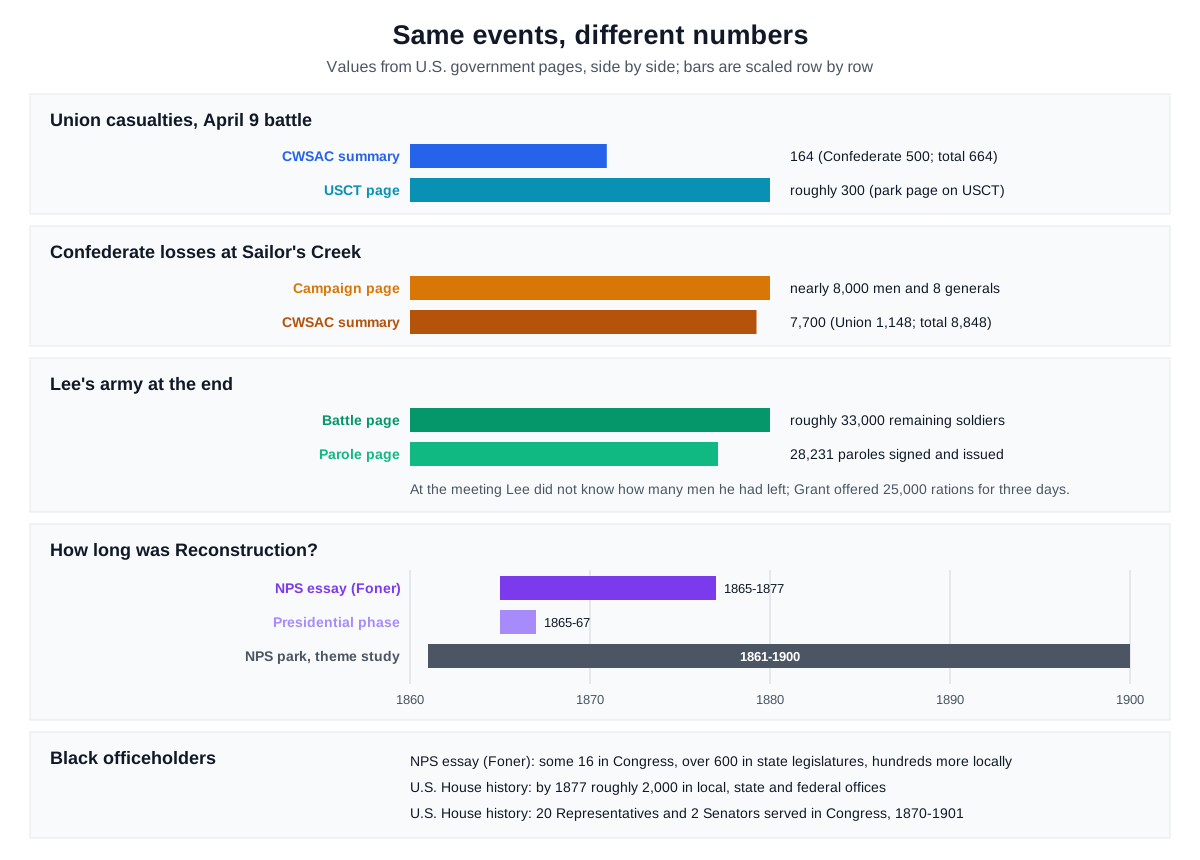
Even within the same agencies, the numbers for Appomattox and Reconstruction differ from page to page. For Union casualties in the April 9 battle, the CWSAC summary gives 164 (Confederate 500, total 664), while the park's USCT page gives "roughly 300." The park's battle page only says the battle produced "fewer than 1,000 casualties."
For Confederate losses at Sailor's Creek, the campaign page says "nearly 8,000 men and 8 generals," while CWSAC gives 7,700 (Union 1,148, total 8,848). For Lee's army at the end, the battle page gives about 33,000, and the parole page counts 28,231 passes issued. Lee himself could not give Grant a count of his remaining men.
For Black Union soldiers, the park's USCT page says "more than 180,000," and the NPS "Civil War Facts" page gives 178,975. For Black officeholders during Reconstruction, Foner's essay gives some 16 in Congress, more than 600 state legislators and hundreds of local officials. The House history office counts roughly 2,000 Black men across the South who had held local, state or federal posts by 1877. From 1870 to 1901, 20 Black Representatives and 2 Black Senators served in Congress.
Dates and periods vary as well. On the same National Archives page, the 14th Amendment's ratification date is July 9, 1868. July 28 is the day the Secretary of State certified that the needed 28 of the 37 states had ratified it.
Foner's essay dates Reconstruction 1865–1877, but the Reconstruction Era National Historical Park and a 2017 NPS theme study use a broader 1861–1900. The difference is less about one source being wrong than about what was counted and where each draws the start and end of Reconstruction.
How Reconstruction has been judged
Foner's essay calls Reconstruction possibly the most disputed period in the nation's history. Historians once described it as an ugly chapter in which vengeful Radical Republicans forced "black supremacy" on the beaten South. Recent work treats it more kindly, as a worthy experiment in democracy shared across races.
The essay also traces where the older picture came from. As the mood in the North shifted in the 1870s, Reconstruction came to symbolize bad government and a wrong-headed effort to raise up the poor through federal power. The same essay says "black supremacy" never existed, but that Black Americans gaining political power was one of the era's most far-reaching changes, a sharp departure from American tradition.
Even single words carry a point of view. White supremacists of the time called the Democratic recapture of Southern state governments in the 1870s "redemption." The House history office puts the word in quotation marks as their term. It explains that the process relied largely on violence and other means of stopping Black citizens from voting.
On what Reconstruction left behind, the agencies point in a similar direction. Foner writes that the Reconstruction amendments, though flagrantly violated, stayed in the Constitution as "sleeping giants" for later generations to awaken. He adds that the civil rights movement of the 1960s is sometimes called the "second Reconstruction." The National Archives likewise sees the 15th Amendment as one step in a struggle for equality that lasted more than a century.
Explanations of the generous terms at Appomattox also differ. The parole page ties them to Lincoln's wish for healing, while the McLean house page says they were meant to calm white Southerners. As the 2017 theme study's news release put it, this is a "complex and contested period," and it still does not fit into a single line.
What to read next
- The American Civil War at a Glance: 1861 to 1865. A one-timeline view of the whole war, from the first shots at Fort Sumter to the spring of 1865 where this article begins.
- Sherman's March: From Atlanta to the Sea. How the Union armies in the Carolinas that worried Lee got there.
- Railroads and the Telegraph: What Made the Civil War Industrial. Why the South Side Railroad mattered so much as a last supply line.
- Military logistics: performance must be sustainable: like the empty wagons at Amelia, why feeding and moving an army sits at the base of any fight, in today's terms.
- Turning points in military technology: the big shifts in weapons technology that followed in the 20th century.
- A history of laser weapons: from chemical to electric lasers: how laser weapons, the core topic of this site, have developed.