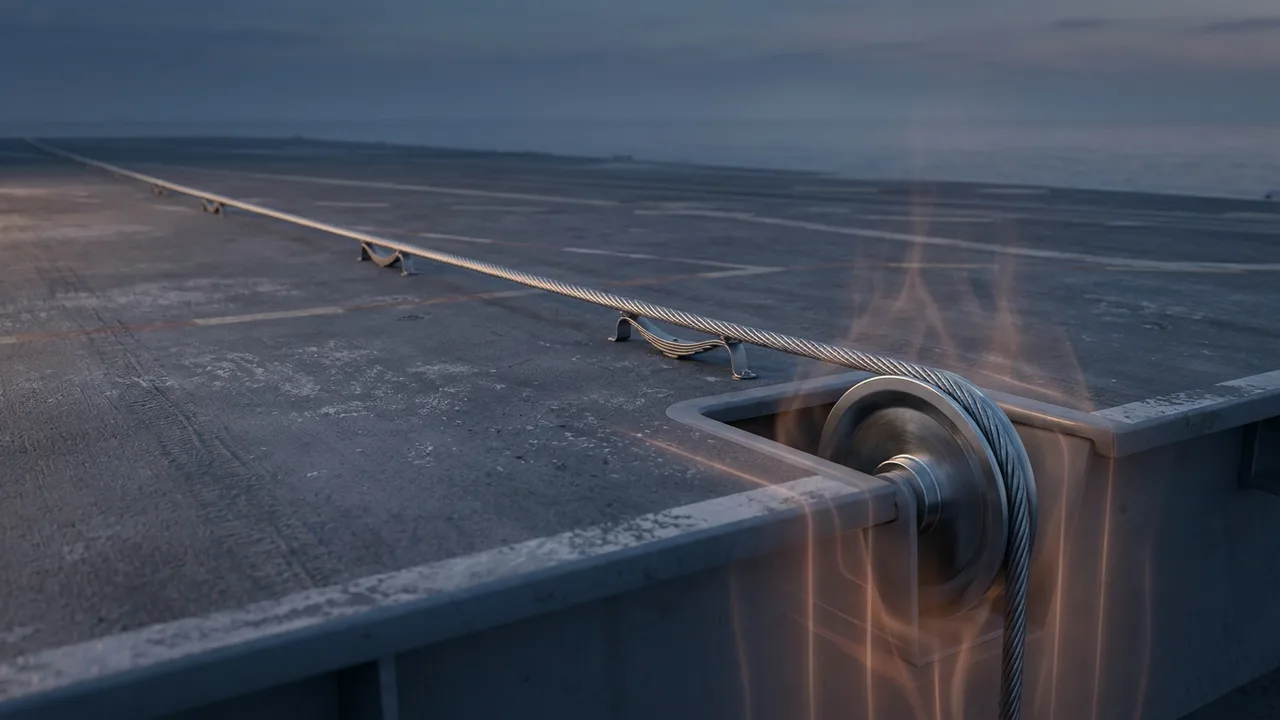
The moment a fighter touches down on a carrier deck, a hook lowered under its tail catches a steel wire stretched across the deck. That wire holds the jet from behind and brings it to a stop. On an ordinary runway at a naval air station, aircraft can land without such a device, but aircraft landing on a carrier need this arresting gear.
What does it take to stop a fast jet with one wire? Thinking in terms of force makes it look complicated. Thinking in terms of energy makes the picture simpler: the job is to move the energy of the moving jet somewhere else.
This article follows the parts that run from the hook to an engine below deck and the path by which that energy ends up as heat. It then turns to the problems facing the new arresting gear on the latest U.S. carriers.
Stopping means getting rid of energy
A moving object has kinetic energy. Physics textbooks define it as half the mass times the square of the speed, and its unit is the joule (J).
K = ½ m v²
The square on the speed is the key point. If the same jet moves twice as fast, its kinetic energy is not two times but four times larger. A heavier jet carries more energy in the same way.
Stopping the jet means bringing this kinetic energy down to zero. The work-energy theorem describes how. The net work done on an object is equal to how much its kinetic energy changes. When the object slows down, the kinetic energy drops, and the net work is negative by that amount.
What kind of force does negative work? A force that acts against the direction of motion. The pull of the arresting gear, dragging the jet backward, is exactly that kind of force.
For a constant force, work is the force times the distance moved. So if the stopping distance doubles while the kinetic energy stays the same, the force needed is cut in half. It also means that a shorter stop needs a larger force.
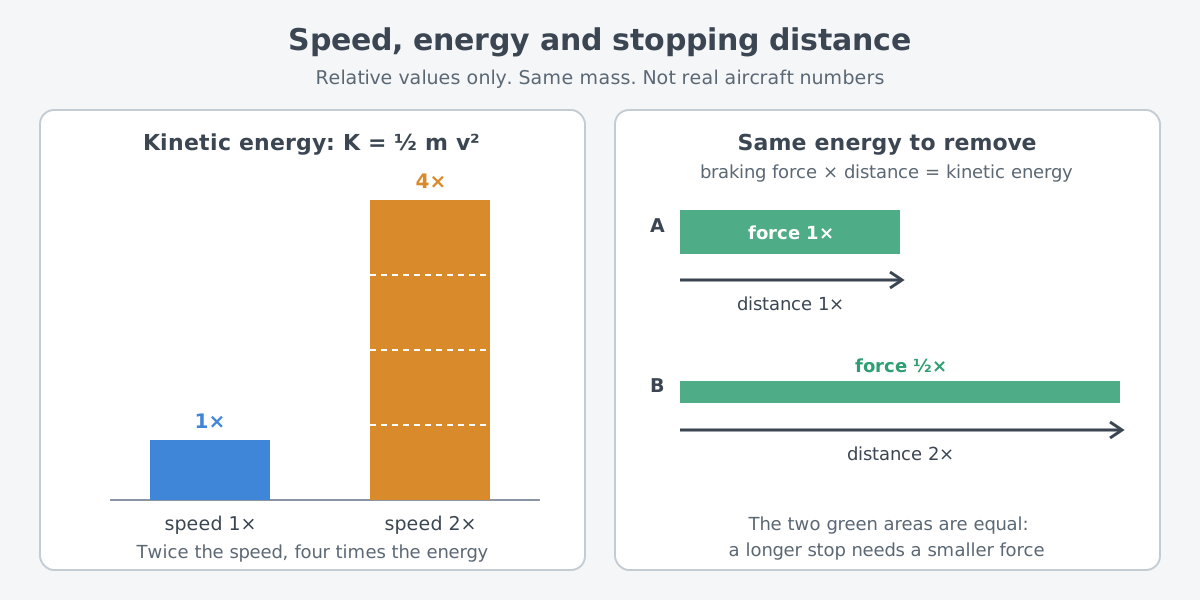
It is a bit like catching a ball: pulling your hands back as you catch it hurts less. The difference is that a machine, not a hand, does the catching, and where that machine sends the energy is the next part of the story.
A hook, a wire and an engine below deck
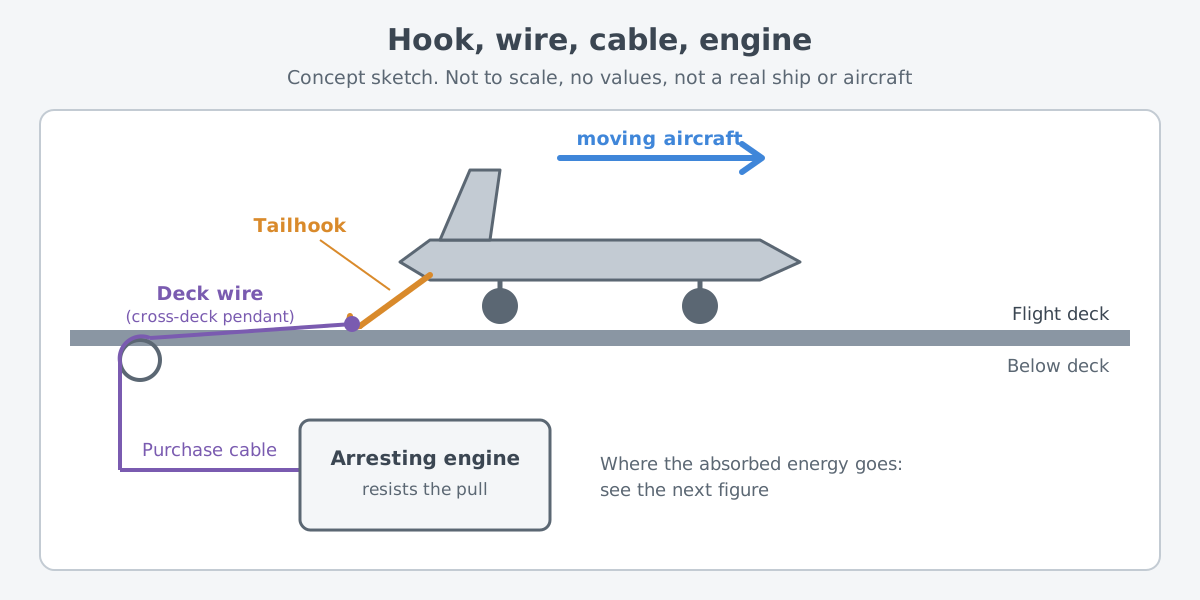
A 2014 public affairs story from the U.S. Navy carrier USS George Washington (CVN 73) describes a landing this way. As the fighter sets down, its tailhook catches the number three wire. The wire pulls back against the jet's thrust until the jet comes to rest.
The gear has several parts. The wire across the deck is called the cross-deck pendant (CDP). It is joined to a purchase cable, and the purchase cable runs through an arresting engine below deck. What stops the jet is the tension this engine produces.
The engines are set to a specific resistance for each aircraft type. By the formula above, a change in weight or speed changes the kinetic energy that has to be removed. When the story ran, about 55 aviation boatswain's mates (equipment) on George Washington looked after five arresting gear engines and related equipment.
The idea of catching a cross wire with a hook goes back a long way. On January 18, 1911, Eugene Ely landed an airplane on the armored cruiser USS Pennsylvania, anchored in San Francisco Bay. It was the first time a pilot landed on a warship and then took off from it again.
The arresting gear that day was simple. According to the Smithsonian National Air and Space Museum, ropes and sandbags were laid across a 120-foot platform, and hooks were fitted to the airplane's landing gear. The landing was safe, and the arresting equipment worked as planned.
Where the energy goes: heat
So where does the engine send the energy it absorbs? A U.S. Navy training manual walks through the process using the E-28, an emergency arresting gear for runways on land. It describes land equipment, but the basic chain is the same as on a ship: a hook catches a wire, and an engine absorbs the jet's kinetic energy.
When the hook catches the wire, tape wound in the engine pays out. The drum holding the tape turns, through a shaft, a bladed rotor inside a housing full of fluid. The fluid resists and slows the drum, the tape pays out more slowly, and that slower payout is what brakes the aircraft.
The churning, turbulent fluid is where the jet's kinetic energy becomes heat. The whole arrestment happens automatically.
After the arrestment, while the tape is wound back in, the warm fluid is sent to a cooling tank. The tank's large outer surface works as a heat exchanger and gives off the extra heat to the air around it. In the end, the energy of a fast-moving jet leaves as heat in the surrounding air.
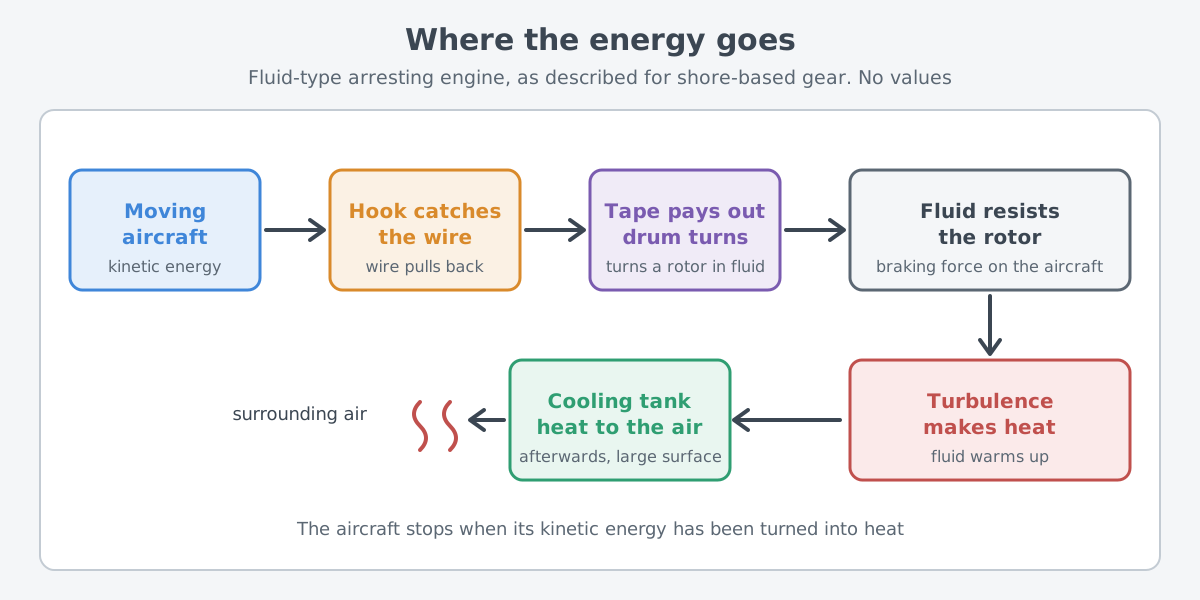
Sweep a flat hand through water, and it feels heavy. An engine that spins blades in fluid relies on the same kind of resistance. A real engine is a machine that makes this resistance large enough to stop an aircraft, and it comes with equipment to cool the warmed fluid.
Energy that ends up as heat, and heat that has to be sent away, is a problem that comes back in laser equipment. Laser thermal management is covered in Cooling and thermal management: where the heat that did not become light goes.
Runways have them too
At an ordinary naval air station, aircraft can land without arresting gear, unlike on a carrier. Emergencies are different. A blown tire, a warning that the landing gear is not locked, or a sick pilot are examples. In such cases the aircraft has to be caught and stopped in the shortest possible distance.
The E-28 sits on the runway for those moments. Its purpose is to catch an aircraft safely after an aborted takeoff or during an emergency landing, and its arresting engines sit just beyond the runway edges.
There is separate equipment for aircraft without a tailhook. An MA-1A overrun barrier stops aircraft that have no hook. It only works, though, if the aircraft has a nose wheel.
The new AAG and its open problems
The newest U.S. carriers, the Gerald R. Ford (CVN-78) class, carry a new system for arrested landings, the Advanced Arresting Gear (AAG). The public government documents used here deal less with what is inside it than with cost, reliability and schedule.
In a 2019 report, the Congressional Research Service (CRS) named AAG as a cost-growth risk for the first ship. It was one of the new systems whose late development could hold up the ship's completion. In July 2016, the Department of Defense Inspector General published a report that criticized the Navy's management of AAG development.
The assessment after the gear went to sea appears in a January 2025 report by the Director, Operational Test and Evaluation (DOT&E). That report, quoted in the December 2025 edition of the CRS report, named five systems new to the class, AAG among them, as the biggest challenges for flight operations. The Navy reported 8,725 arrested landings with AAG by the ship and its air wing over a 262-day deployment of the Ford.
The numbers were not the whole story. DOT&E said it had not received enough data to update its reliability statistics. Getting replacement parts was hard, and reliance on technical support from off the ship was still a problem. The reliability and maintainability of the electromagnetic catapult (EMALS) and AAG continued to hurt sortie generation and flight operations.
The number of engines is another issue. A fourth AAG engine was part of the Ford-class design but was not installed, to save money. A fourth engine, in DOT&E's judgment, would improve AAG reliability and availability. The Navy is using initial operational test and evaluation (IOT&E) to help decide whether to retrofit it on Ford-class carriers.
AAG also affected the schedule of the second ship, John F. Kennedy (CVN 79). A July 2025 press report quoted by CRS says the Navy's FY2026 shipbuilding budget book moved the delivery date. The new date is March 2027 instead of July 2025, and the reasons given are finishing AAG certification and work on advanced weapons elevators.
From the ropes and sandbags of 1911 to today's AAG, the starting point is the same: catch a wire with a hook and absorb the jet's kinetic energy. In the published assessments, the open problems are reliability, maintenance and parts, and schedule.
What to read next
- Carrier catapults and EMALS: taking off from a short deck. After the gear that removes energy on landing, the next step is the gear that adds energy for takeoff.
- Aircraft carriers: turning a ship into an airport. The flight deck, the hangar and the division of work on deck, seen as one ship.
- Cooling and thermal management: where the heat that did not become light goes. The question of where heat goes comes back in laser equipment.