The generals who went to war in the summer of 1914 expected quick victories. By that winter, soldiers on the Western Front were spending their first winter in ditches half full of rainwater. A trench line ran from the English Channel to the Swiss border, and it stayed in nearly the same place until spring 1918.
Millions of men went on the attack, so why did the line not move? The first answer that comes to mind is the machine gun. That answer is not wrong, but it is only one piece of the story.
This article goes step by step. It covers how the trench line formed, how its layers were laid out, why attacks stalled, what was tried over four years, and how the front moved in 1918. The sources are public material from the National Army Museum in London, the Canadian War Museum, the Australian War Memorial and the US National WWI Museum and Memorial.
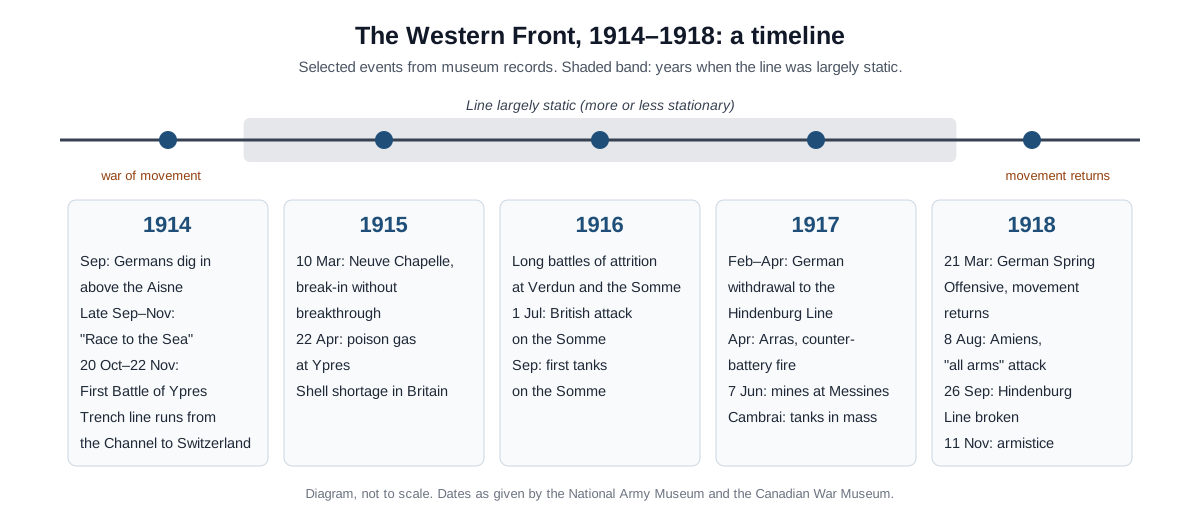
Autumn 1914: a war of movement goes underground
Weapons technology had advanced a great deal in the 50 years before the First World War. There had been several modern wars in that time, yet few people foresaw how firepower would rule the battlefield. When armies advanced across open ground early in the war, they took heavy losses from machine guns, quick-firing guns and the rifle fire of whole lines of infantry.
In September the British Expeditionary Force (BEF) pushed into the space separating two German armies, the First and Second. It helped force them to fall back as far as the River Aisne. North of the river, the Germans entrenched on the heights of the Chemin des Dames ridge. In mid-September they held off several attempts to dislodge them, and both sides then tried to get around each other's flank to the north.
That stretch of fighting, which lasted from the last days of September until late November, is often called the "Race to the Sea." It ended at Ypres in Belgium. There, from 20 October to 22 November, a major German push toward the Channel ports was stopped.
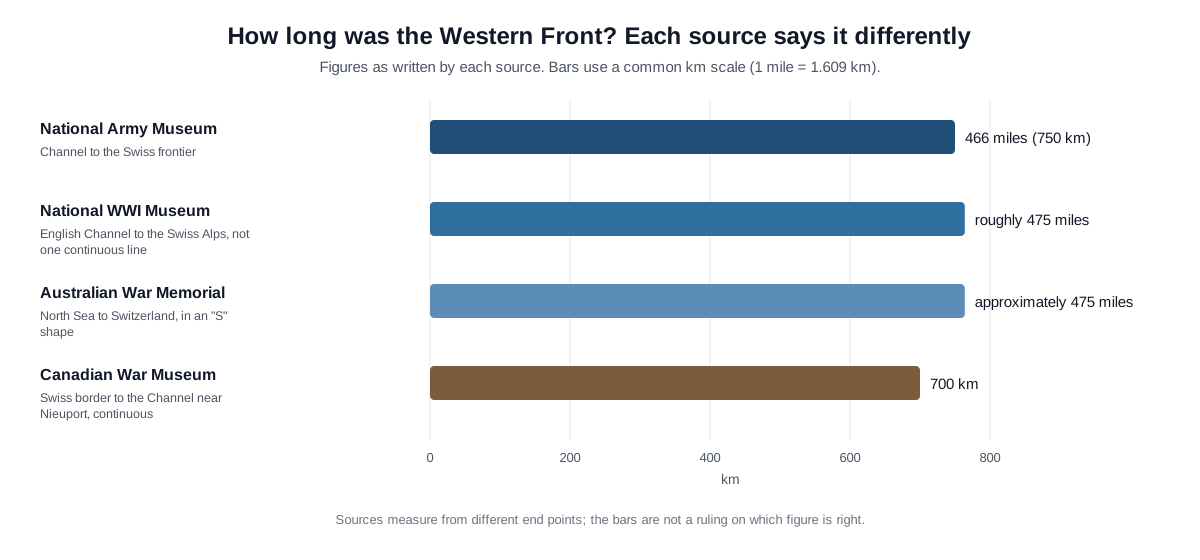
The National Army Museum (NAM) treats the Allied win at Ypres as the point where fighting in the open ended. Both armies entrenched, and before long a 466-mile (750 km) line of trenches stretched from the Channel coast to the border of Switzerland. The BEF alone had more than 90,000 casualties by December, and little was left of the force that first crossed over.
Across the whole war the numbers were far larger. By the end of 1914, after only five months of fighting, more than four million men had been killed or wounded. Flanking moves, surprise attacks and coastal landings had all failed, so digging in was the only option left. Positions that began as little more than ditches with soldiers in them gradually became trenches.
Trench warfare did not begin in 1914. There had been some of it in the American Civil War and in the Russo-Japanese War. Even so, the Australian War Memorial notes that fixed trench warfare became the standard way of fighting only in the First World War.
How a trench system was laid out: layers, not a single line
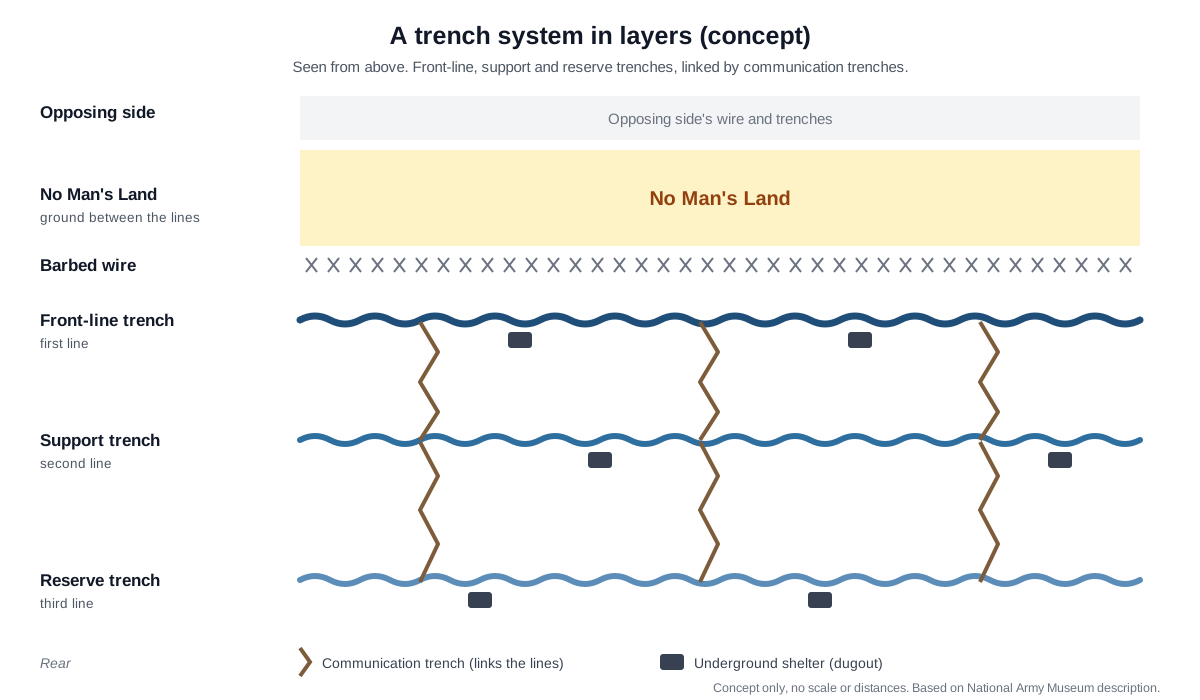
On a map the front is drawn as one line, but the real thing had several layers. Behind the front-line trench ran a second line, the support trench, and a third, the reserve trench. Communication trenches linked these lines front to back, and thick belts of barbed wire lay in front.
Fortifications and underground shelters were added to this. The first trenches were dug in a hurry, were simple, and gave little shelter from the weather, but they soon grew stronger. They were built with sandbags, wooden planks, woven sticks, barbed wire, and sometimes just mud.
The ground between the two trench lines was called No Man's Land. The term was old, but it took on a terrible new meaning in a war of constant shelling and rapid machine-gun fire.
The two sides also thought about trenches differently. The Germans had taken large parts of northern France and Belgium, built defenses to hold that ground, and hoped to bargain with it when peace came. So German trenches were solid from the start. The British and French saw trenches as temporary, needed only until the next "Big Push."
Why it was so hard to break: breaking in versus breaking through
Commanders faced one main problem. They had to get soldiers across the gap swept by fire, alive, between the trenches and through the enemy's defenses. That gap was guarded by the firepower of rifles, machine guns and artillery.
The rifle was the most widely used weapon of the war, and artillery was the most destructive. The Canadian War Museum states that artillery caused the majority of casualties. Trenches gave some protection from shrapnel bursting overhead but not from high-explosive shells, and only the larger siege guns could destroy deep shelters.
Machine guns had existed for half a century before the war and were in wide use by 1914. Even so, most armies had doubts about their role before the war. At first only the German army saw their power in defense, firing from prepared positions whose arcs of fire overlapped, and other armies soon learned the same lesson.
The figures vary between sources. For the British Vickers machine gun, NAM gives over 600 rounds per minute and a range of 4,500 yards. The Canadian War Museum gives 450–500 rounds per minute and a maximum range of 4,500 m. It adds that the gun was reliable but heavy and hard to move forward during a battle.
Firepower alone does not explain it. The Canadian War Museum sees the defense as strong because of wire, trenches several lines deep, a constant flow of fresh troops, and the machine guns and artillery behind them. Most attacks were broken before they reached the defender's lines, and attacks that took the first positions could rarely be reinforced, so counterattacks usually threw them back.
The attack at Neuve Chapelle on 10 March 1915 shows the pattern. It was the first major British offensive of the war, and the troops quickly took the German front-line trenches. But further orders and reinforcements were slow to arrive, and a German counterattack blocked the way before the early gains could be built on. Three days of fighting won a small patch of ground, while British casualties passed 7,000 and Indian casualties 4,000.
The lesson of the battle can be put simply. Entering the German positions could be done, but it was hard to turn a local success into a major breakthrough. Getting into one enemy trench line (breaking in) and getting through all the layers behind it to open ground (breaking through) were different tasks.
Other battles in 1915 went the same way. In most of them the British and French had about a three-to-one advantage in men and artillery. Yet the German defenders gave ground without breaking and often retook part of what they had lost. After Neuve Chapelle, Sir John French, who commanded the British forces, put the failure down to a shortage of shells, and this grew into the "Shell Crisis" of 1915.
Days in the trenches
Trench life was long stretches of boredom broken by short bursts of terror. Attacks most often came at dawn, so every morning soldiers rose for "stand-to" and manned the front line. In daylight all work was done below ground, out of sight of snipers.
Night was the busiest and most dangerous time. Under cover of darkness, work parties went out into No Man's Land to repair wire or dig new trenches. Even on days with no battle, snipers and shells kept killing men, a steady loss known as "wastage."
In Canadian records, wastage in an 800-strong infantry unit could reach 10% a month, or 80 soldiers killed or put out of action. This steady toll meant that reinforcements were always needed.
The surroundings were an enemy too. Wooden "duckboards" and sandbags were meant to keep the water out, but front-line soldiers lived in mud. Trenches were often flooded and crawling with lice and rats.
Trench fever, trench nephritis and trench foot became common medical problems and cost a great deal of manpower. Trench foot was a frostbite-like infection that came from cold, constant damp. Doctors only showed in 1918 that lice were the cause of trench fever.
Attempts to break the deadlock
For four years both sides looked for ways over this wall. Gas was one of them. In October 1914, while taking Neuve Chapelle, the German army first used shells filled with an irritant chemical that caused violent sneezing against French troops. On 22 April 1915, at the Ypres Salient, they used poison gas in the hope of breaking the stalemate.
There were not enough reserves to exploit the gap the gas cloud opened, and the Germans did not break through. Afterward every side developed more lethal gases, such as chlorine, phosgene and mustard gas. British and Commonwealth forces alone suffered over 180,000 gas casualties.
With the surface blocked, armies also went underground. Tunnels were dug under No Man's Land to place explosives beneath enemy positions. In the British Army much of this work fell to special engineer units made up of miners from Wales and Durham. On 7 June 1917, huge explosions at Messines Ridge killed around 10,000 Germans and threw that part of their line into disorder.
The British Army developed the tank as a mechanical answer to the trench deadlock. When tanks first appeared on the Somme in September 1916, they broke down often and were too few. At Cambrai in 1917 they were used in large numbers and made their first significant breakthrough, but they stayed vulnerable to enemy fire and mechanically unreliable. What a modern tank fights with is covered in the main battle tank article.
The way artillery was used also changed. Early in the war the British shelled first and then sent the infantry over, but this became less effective as the war went on. Before the Battle of the Somme, German troops waited out the shelling in concrete dugouts and came out when the guns stopped.
The British developed the creeping barrage. In this method, infantry crossed No Man's Land behind a line of shellfire that moved forward ahead of them. Locating and silencing enemy guns with new tools such as aircraft, sound ranging and flash spotting also grew in importance.
At Arras in April 1917, specialist artillery units targeted German guns with counter-battery fire. The attack advanced up to 8 km in the first two days, but fresh troops, guns and supplies fell behind the advance. When the battle ended on 16 May, the front had returned to trench stalemate, with over 150,000 British and Canadian and over 100,000 German casualties. Modern equipment that finds where incoming shells were fired from is covered in the counter-battery radar article.
The infantry changed as well. In 1914 a typical soldier had just a rifle with a bayonet. Later the infantry also used hand grenades, grenades fired from rifles, mortars and different kinds of machine gun. Groups of eight to 30 men learned to combine these weapons.
Between major offensives came smaller trench raids. Many officers believed raids sharpened infantry tactics and kept the troops alert. The rank and file often saw them differently: as frightening, futile operations that often cost a unit its best men.
The defense did not stand still either. In 1916 Germany judged that no general breakthrough was possible in the west and chose a limited advance around Verdun. It turned into a battle of attrition that wore down both sides. Between February and April 1917, the Germans withdrew to the Hindenburg Line, which was much shorter and protected by pillboxes and deep belts of wire.
1918: the front moves again
When Russia left the war in 1917, large numbers of German troops were freed. On 21 March 1918, Germany opened its Spring Offensive with Operation Michael. About 10,000 German guns fired more than a million shells within five hours. Then heavily armed "storm troopers" slipped through weak points in the line.
The storm troopers went around strongpoints that still held out and broke through the British trenches. NAM sees this offensive as the moment movement came back to the Western Front after years of deadlock. The Germans advanced as much as 64 km, but by about 5 April they had run out of steam and were held east of Amiens.
They stopped because the troops were exhausted and transport was short. Moving men, supplies and guns across the shattered ground was hard, and local wins could not be turned into strategic victory. The British lost 178,000 men in this fighting, the French 77,000 and the Germans 240,000.
On 8 August the Allies struck hard at Amiens. Thirteen divisions of the British Fourth Army had the support of more than 2,000 guns, 450 tanks and 1,900 aircraft. It was an "all arms" attack that tied infantry, artillery, tanks and aircraft together, and on this occasion the German line gave way.
Amiens began the "Hundred Days." British troops broke the Hindenburg Line on 26 September. At 5 a.m. on 11 November 1918 an armistice was signed in a railway carriage at Compiègne, France. The guns fell silent at 11 a.m. that day.
How to read "it did not move for four years"
The question in the title comes with a condition. The Canadian War Museum's wording is that the trench lines stayed "more or less stationary" for four years. Some attacks, like Arras in 1917, gained several kilometers, and in spring 1918 the Germans pushed as far as 64 km.
So the line did move. A closer reading of the record is that, again and again, armies broke in, failed to turn that into a breakthrough, and were pushed back.
Even the length of the front is written differently from source to source. The end points differ, too: the Channel, the North Sea, or near Nieuport. One source says the line was not continuous, while another says it ran without a break.
There is no single cause either, though many records agree that machine-gun and artillery fire drove soldiers underground. But no tank, gas or new tactic could, on its own, give either side a decisive victory. As the years passed, trench systems became more elaborate and harder to crack. The German army, on the defensive for most of 1915–1918, became especially skilled at this kind of war.
Supply and production carried equal weight. In 1914–1915 the fighting used shells faster than factories could make them, so both sides ran short, and every fighting nation reorganized its economy for war. The Canadian War Museum names superiority in the quantity, and often the quality, of materiel as a major factor in the Allied victory of 1918.
Short of labor, raw materials and coal, the Central Powers saw their railways fail and their fronts go short of food and equipment. The principles of supply continue in the military logistics article.
The last factor is learning: both sides drew lessons from the failures of 1915. At Arras in 1917 the British applied lessons from the Somme, developing methods such as infantry-tank cooperation and close air support. The "all arms" attack at Amiens in 1918 is where that learning came together. Four years of deadlock were less the story of one weapon than of firepower, reinforcement, supply and learning working on each other.
What to read next
- The Battle of Verdun: Three Hundred Days of Attrition: the attrition of 1916, followed through one battle.
- The Battle of the Somme: Questions Left by the First Day: the record of the first day, when infantry crossed No Man's Land after the bombardment.
- The First Tanks and Cambrai: Machines Built to Cross Trenches: a closer look at the early tanks mentioned briefly here.
- Poison Gas in World War I and the Ban on Chemical Weapons: how gas was used and the ban that followed.
- A history of laser weapons: the path from a new weapon's debut to its place in an army, traced through weapons that use light.