On February 21, 1916, German shells began to fall on the French trenches and forts in front of Verdun, a fortress city on the Meuse River. The fighting did not stop until December. It was the longest battle of World War I.
For ten months, soldiers of the two nations fought over hills, forts and villages, and a village such as Fleury changed hands several times. German and French soldiers alike called the place the "blood mill" (Blutmühle) and the "hell of Verdun." French and German losses ended up almost the same.
Why did Germany pick a city ringed with forts, and what was it trying to achieve? Researchers still argue over the second question. This article follows the background of the attack and the ten months of fighting. It also looks at the part played by guns and by one supply road, at casualty numbers that differ by source, and at how the two nations remember the battle.
Why Verdun
After the Battle of the Marne in the fall of 1914, the Western Front turned into a war of positions, with both sides dug into trenches. Erich von Falkenhayn, the chief of the German General Staff, wanted to end that deadlock. He believed that Germany, worn down by attrition on two fronts, west and east,, could not win on military strength alone.
Falkenhayn saw Britain, not France, as Germany's main enemy. Even so, he chose to strike France first. He judged that France's army had been weakened by its huge losses in the first two years of the war, and by then French losses had reached 700,000.
Imperial War Museums (IWM) sums up the goal this way. Germany would crush the French army before the Allies grew stronger through the full deployment of British forces. To do it, Falkenhayn planned to wreck French units with artillery while using his infantry sparingly to keep German losses down.
On November 30, 1915, Falkenhayn told his top generals that Germany would put its main effort into the Western Front in 1916. His first idea was to attack in front of Belfort. In mid-December, Schmidt von Knobelsdorf, who served as chief of staff to the German Fifth Army facing Verdun, talked him into choosing Verdun instead.
There were reasons to pick a fortress city. Supplies could reach Verdun only by one road from Bar-le-Duc or by a small meter-gauge railway that could not carry a large battle. In addition, General Joffre, the French commander in chief, had decided in August 1915 to disarm the Verdun forts, and the Germans probably knew it. In the words of the Verdun Memorial (Mémorial de Verdun), the forts were "like empty shells sitting on the hilltops."
The German Historical Museum (Deutsches Historisches Museum, DHM) adds another reason. Falkenhayn chose to attack Verdun despite its fortifications partly because of what the city meant to France's sense of itself. The offensive was meant either to open a breakthrough or to break the French will to fight.
So what was the real aim? The phrase "bleed the French army dry" comes from Falkenhayn himself. But it appears in memoirs he wrote after the war, and specialists still debate whether that was truly his aim in 1916.
The Verdun Memorial sorts the researchers' views into three groups. In the first, the aim was to use massed German guns to cause the French the greatest possible losses. In the second, a symbolic defeat was meant to force the French army to give up Verdun town and the forts on the Meuse's right bank. In the third, it was to regain control of the Western Front.
Whether Falkenhayn ordered the capture of the town cannot be said for sure. But for the men who organized the offensive, Crown Prince Wilhelm of the Fifth Army and his chief of staff Knobelsdorf, taking the town was clearly the goal. Once the attack began, the Crown Prince's staff drifted from Falkenhayn's concept and fixed on seizing ground. By the end of February, German losses were already similar to French ones.
February 21: the bombardment and Fort Douaumont
Germany gathered ten infantry divisions, some 150,000 men. Counting trench mortars, almost 1,200 guns were aimed at Verdun by the Memorial's count, while IWM gives more than 1,200. They included 42 cm heavy mortars that could throw a shell of almost a ton more than 14 km. Fourteen railway lines served the Verdun front, so men and equipment could be massed quickly.
The French positions were not finished. The German Fifth Army had planned to attack on February 12, but bad weather forced a delay. On the night before the attack, about 25,000 French infantry and 140 guns held unfinished positions on the right bank.
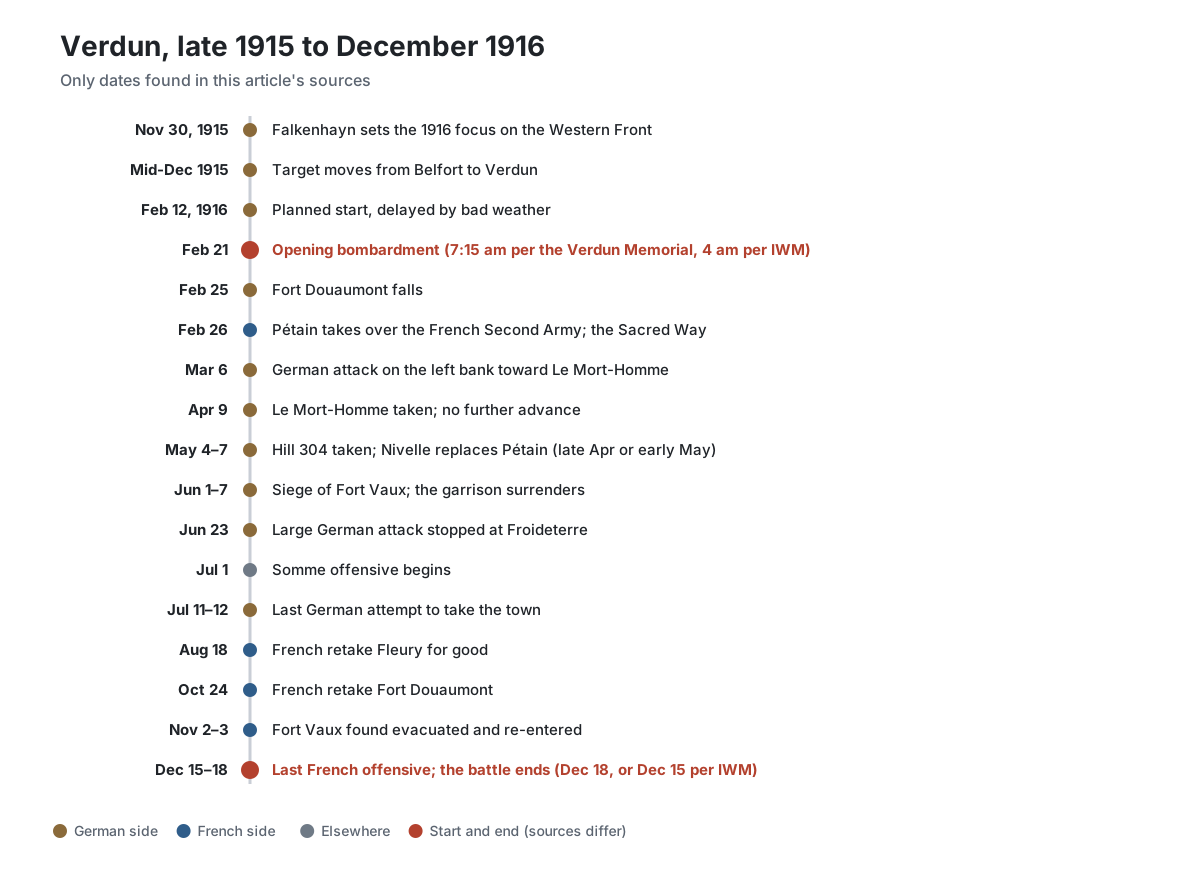
The bombardment began on February 21. Sources disagree on when. The Memorial says it started at 7:15 a.m. and stopped at 4 p.m., with about 350,000 shells fired that day, while IWM's Verdun page gives 4 a.m. The Germans called this kind of fire "Trommelfeuer."
When the shelling ended and German infantry moved forward, the French still held the Caures and Herbebois woods that evening. On February 24 the villages of Samogneux, Beaumont and Ornes fell, and the French lost both their first and second lines of defense. In six days, French losses reached 21,000, which was half the men committed, and in places the Germans advanced more than 8 km.
On February 25, Fort Douaumont fell. It was the largest and highest of the 19 forts protecting Verdun and the key to its northeastern defenses. Its small garrison of 50 men believed the enemy was much farther away and did not defend it, and the German 24th Infantry Regiment took the fort.
The news was celebrated in Germany as a great success. The DHM, however, judges that the capture had little military weight. On the French side, the General Staff soon became fixed on retaking the fort.
Pétain and the Sacred Way
On February 26, General Pétain took command of the French Second Army, responsible for defending Verdun. He set up a rotation that sent each available reserve division, plus any that Joffre released, to the front in turn, a system called the "noria." Instead of packing troops into the front-line trenches, he built defense in depth from mutually supporting strongpoints.
The rotation had a cost and a benefit. Much of the French army went through Verdun, but no unit stayed at the front for long. About three in four French soldiers served at Verdun at some point.
Both rotation and supply depended on one road. The Bar-le-Duc road soon earned the name Sacred Way (Voie Sacrée), and it stayed open despite constant German shelling. IWM credits the French ability to keep fighting to the ammunition and supplies that came in along it.
The numbers on that road show the scale. Some 3,500 trucks, 2,000 cars and 800 ambulances shuttled back and forth, with one truck going by every 14 seconds. During the heaviest fighting in June and July, the gap shrank to five seconds. In a single week the road carried 90,000 men and 50,000 tonnes of equipment.
The solid rubber tires of the vehicles wore the road down badly. As much as guns and soldiers, logistics, moving people and materiel in time, held this battle up.
Spring and summer on both banks of the Meuse
On March 6, Germany widened its attack to the left bank of the river. To silence French guns that were hitting German movements from the side across the river, it needed the high ground on the left bank. The target was the hill of Le Mort-Homme, which the Germans took on April 9 without being able to advance further. Rain fell through March and April and turned the battlefield into a quagmire.
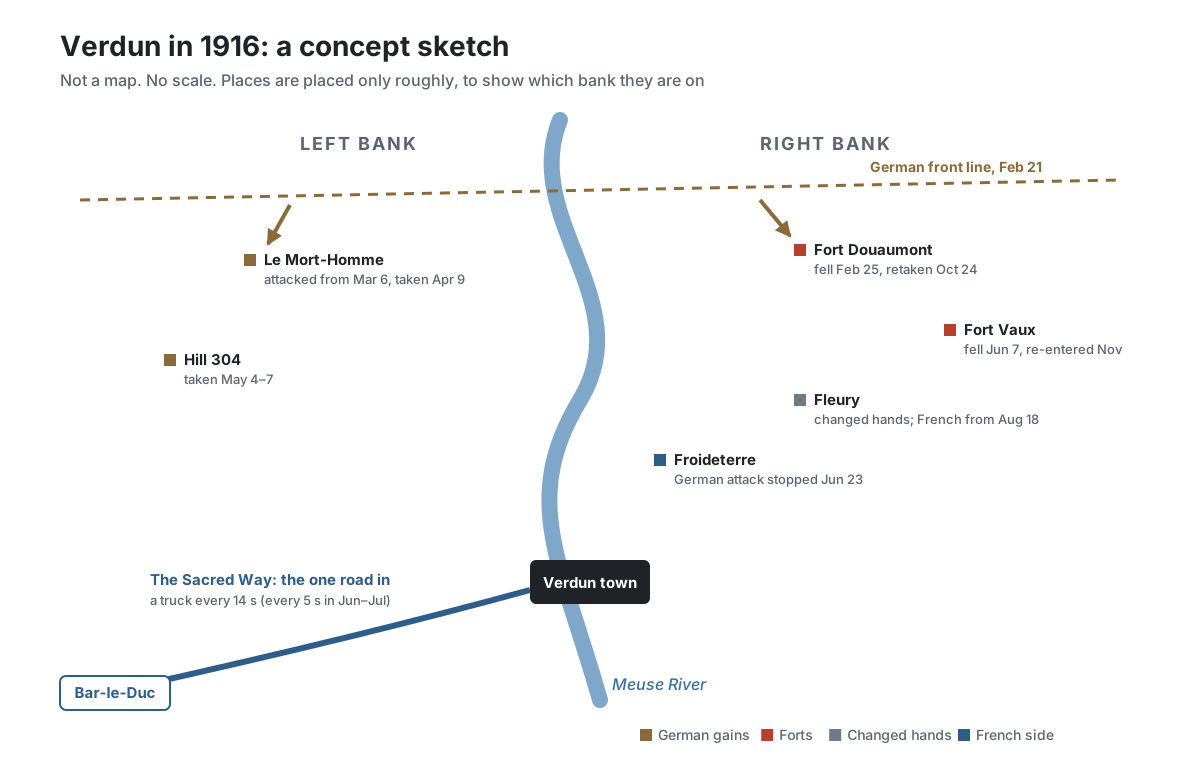
On May 3, 500 heavy German guns pounded Hill 304, and the Germans took it between May 4 and 7. Around this time the French command changed. Pétain moved up to lead the Group of Armies of the Center and Robert Nivelle replaced him, which the Memorial dates to early May and IWM to late April.
Inside Fort Douaumont, an ammunition depot exploded on May 8, and 679 German soldiers died. On May 22 the French tried for the first time to win the fort back. It stayed in German hands until October.
On June 1, 40,000 German troops equipped with ten large flamethrowers attacked toward Fort Vaux. After a six-day siege, the garrison surrendered on the morning of June 7. It was Germany's last success at Verdun.
On June 20, Germany opened another preparatory bombardment with some 2,000 guns and fired almost 100,000 gas shells. On June 23, 50,000 men attacked and took the Thiaumont position and nearly the whole village of Fleury, but they were stopped in front of the Froideterre position. Phosgene gas was used around this time, but the advance could not continue.
On July 11–12, Germany made a last attempt on the town, firing 330,000 shells before sending in 40,000 men. This attack also failed to reach it, and afterward Germany went over to the defensive with only local attacks. Fleury changed hands several times before it was back in French hands for good on August 18.
The Somme and the autumn counterattacks
On June 24, British and French guns opened fire on the Somme, and the offensive followed on July 1. It was meant in part to ease the pressure on Verdun, but it failed to break the German front and became another battle of attrition. Even so, Germany had to scale back its Verdun offensive to reinforce the Somme. Russia's offensive that same summer also pushed Germany to thin out its forces at Verdun.
The effect ran the other way too. The pressure on Verdun throughout 1916 made action on the Somme more urgent. And because the German attack at Verdun sharply cut the number of French troops available, Britain took the main role on the Somme.
In the fall, France struck back. Having gathered 650 guns, the French sent four divisions forward behind a creeping barrage on October 24 and retook Fort Douaumont with relative ease. The same day's attack on Fort Vaux did not succeed. On November 2 an intercepted German radio message told the French that the fort had been abandoned, and they entered it the following night.
The last offensive began on December 15. The French brought up 886 guns and, in temperatures of −20°C, four divisions cleared the ground around Fort Douaumont and retook the villages of Louvemont and Bezonvaux. The offensive ended on December 18 with the capture of Chambrettes Farm. IWM's Verdun page, however, says the battle closed down on December 15, as winter and the results on the Somme made further fighting impossible.
A battle dominated by artillery
Line up the numbers from Verdun and one weapon keeps showing up. There were about 350,000 shells on the first day and 500 heavy guns on Hill 304 on May 3. Then came some 2,000 guns for the June bombardment and 330,000 shells on July 11–12. France, for its part, gathered 650 guns for the autumn counterattack and 886 for the December offensive.
The French greatly increased their artillery at Verdun, so the Germans suffered just as much from constant shelling. By the end of 1916, 26 million high-explosive shells and 100,000 poison gas shells had fallen on a very small area.
The DHM calls battles like Verdun "Materialschlacht," battles of materiel. With them, a new phase of industrialized war began. What became decisive was which country could mobilize more soldiers and produce more weapons and ammunition.
Guns were not the only weapons. Flamethrowers were used in the attack on Fort Vaux and gas shells in the June attacks. In the fall, Nivelle had the advantage in artillery. He used new tactics built on specialist infantry sections with light machine guns, rifle grenades, mortars and light field guns.
Numbers that differ by source
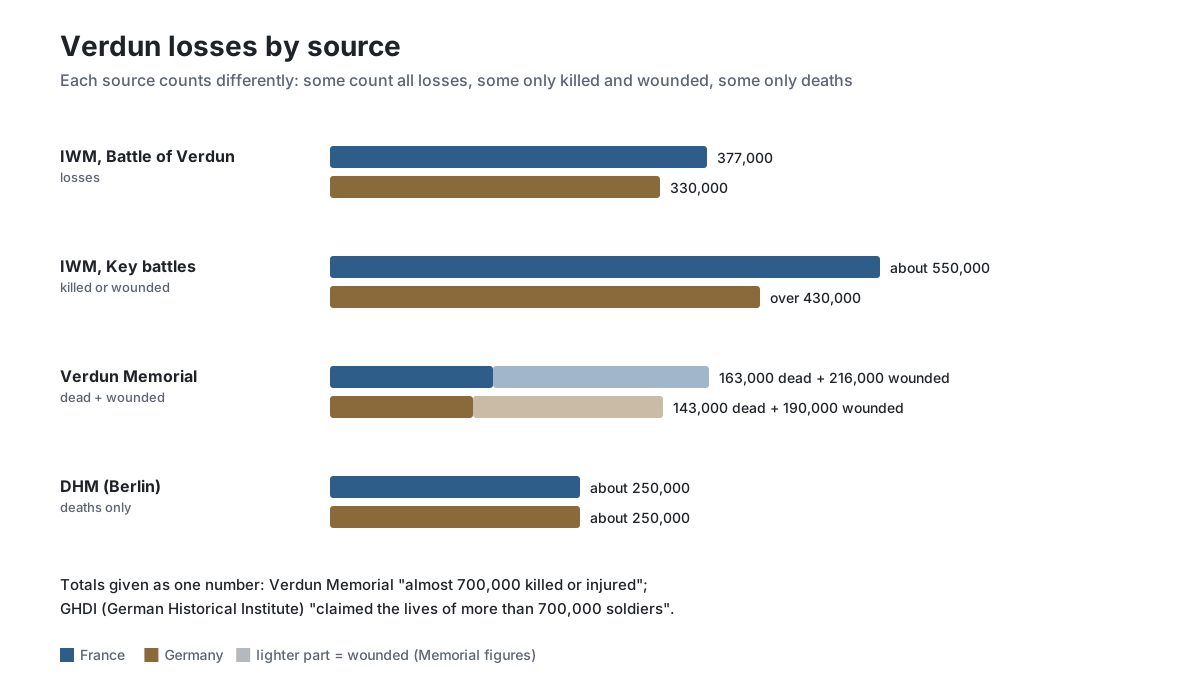
Casualty figures for Verdun vary widely, starting with what each source counts. Even within IWM, the Verdun page says France lost 377,000 men and Germany 330,000. The key battles page counts only killed and wounded and gives over 430,000 for Germany and about 550,000 for France. Whichever number you take, each one is a person who never came home or came home wounded.
The Verdun Memorial splits its figures into 163,000 French dead and 216,000 wounded, and 143,000 German dead and 190,000 wounded, which adds up to nearly 700,000 dead or wounded. Its opening summary, though, breaks the same 700,000 into 306,000 killed or missing and roughly 400,000 wounded.
The DHM counts only deaths: about 250,000 each for Germany and France. GHDI, a collection from the German Historical Institute Washington, says in its page on the 1984 ceremony that the battle "claimed the lives of more than 700,000 soldiers." The same "700,000" stands for everyone killed or wounded in one source and for the dead alone in another.
Dates differ a little too. The first bombardment begins at 7:15 a.m. or at 4 a.m., and the battle ends on December 18 or on December 15. From February 21 to December 18 is 301 days, and to December 15 is 298 days, so the "three hundred days" in the title is a round figure. IWM calls Verdun "the longest battle in modern history" on its Verdun page and "the longest battle of the First World War" on its key battles page.
How France and Germany remember it
Views of the outcome differ as well. IWM's key battles page says France secured a defensive victory before the year was out. The Verdun Memorial goes further and argues that Germany had to change its whole strategy after failing at Verdun and losing heavily on the Somme and the Meuse heights. Forced onto the defensive for a time, Germany turned to unrestricted submarine warfare, which brought the United States into the war and tipped the balance toward the Allies.
The German museum tells it differently. The DHM writes that by December 1916 neither side had won, and that in December the French also ended their attacks without success. It concludes that "Verdun" became a byword for the senselessness of war.
Both sides carried something away. IWM says Falkenhayn's plan to destroy the French army had failed. The heavy losses at Verdun and on the Somme together created a manpower crisis in the German army. In France, the trauma shaped political and military decisions during and after the war and left a lasting mark on the national consciousness.
The battlefield holds villages that no longer exist. Nine villages were wiped out and never rebuilt: Fleury, Bezonvaux, Haumont, Beaumont, Cumières, Vaux, Ornes, Louvemont and Douaumont. They were declared to have "died for France." At Douaumont, an ossuary keeps 130,000 soldiers' remains, and more than 16,000 graves stand in the cemetery before it.
In 1984, on September 22, seventy years after the war began, France's President François Mitterrand and Germany's Chancellor Helmut Kohl attended a memorial service for the fallen at Verdun. As the two national anthems played, they joined hands. Verdun is now a name that stands for the horror of war in both France and Germany.
What to read next
- The Schlieffen Plan and the Marne: Where the Quick-Victory Plan Stopped: where the deadlock in front of Verdun began.
- Trench Warfare: Why the Western Front Barely Moved for Four Years: the trenches and forts of Verdun seen across the whole Western Front.
- The Battle of the Somme: Questions Left by the First Day: the same year's battle, launched in part to ease the pressure on Verdun.
- Military logistics: performance must be sustainable: the supply problems behind a battle, like the Sacred Way, in today's terms.
- Turning points in military technology: the technologies that changed war after the age of materiel battles.
- A history of laser weapons: from chemical to electric lasers: long after the age of gunpowder and shells, how a new kind of weapon grew up.