Early on 27 May 1905, a report reached the Japanese Combined Fleet as it lay at anchor in Chinhae Bay, near the southern end of the Korean Peninsula. The Shinano Maru, a converted cruiser, had sighted the enemy fleet. The Japanese ships put to sea at once, and that day and the next they fought a Russian fleet off Tsushima. The Russian ships had left the Baltic the previous autumn and sailed around Africa to get there.
This was the greatest naval battle of the Russo-Japanese War. The two countries at war were Russia and Japan, but the land they fought to control was Manchuria and Korea. Fighting started in February 1904, and a treaty signed at Portsmouth in the United States brought it to an end in September 1905. Two months later, Korea was forced to accept the Eulsa Treaty.
This article follows why the war started and how it unfolded on land and at sea over about a year and a half. It also looks at the part railways, rapid-fire guns, mines and torpedoes played, and at how Korea, Japan and Russia each remember the same war.
Why Manchuria and Korea?
The story starts ten years earlier with the Sino-Japanese War. Under the Treaty of Shimonoseki of 17 April 1895, Japan gained a great deal from China. That included a position on the Liaotung (Liaodong) Peninsula, which controlled the way to Beijing and to Manchuria.
Six days later, on 23 April, Russia, Germany and France stepped in, declaring that a Japanese foothold there would unsettle Asia even more. This was the Triple Intervention, and Japan was left with no option except to hand the peninsula back.
Russia then moved into the same area.
In 1898 it leased Port Arthur (Lüshun) and Dalian for 25 years. Port Arthur was a warm-water port that mattered both for war and for trade. The Boxer Uprising spread into Manchuria in 1900. Russia occupied Manchuria with troops on the grounds of protecting the Chinese Eastern Railway, and it refused to leave after the uprising was put down.
Meanwhile Russia completed the Trans-Siberian line linking Moscow with Vladivostok around the turn of the century. Branches across Manchuria and south to Port Arthur were running by 1903. Japanese leaders were split on how to respond, but in January 1902 Japan signed an alliance with Britain. If another power joined Russia, Britain would back Japan, so the alliance kept other nations from siding with Russia.
From August 1903 the two countries held several rounds of talks on Manchuria and Korea. Japan's position was that Korea should become its protectorate, while Russia would hold the upper hand in Manchuria as long as other countries had equal opportunity there. Russia held on to sole control of Manchuria, a neutral zone in Korea north of the 39th parallel, and a ban on using Korean territory for military purposes. In February 1904, before Russia's reply to Japan's last proposal was even known, an emergency Japanese cabinet meeting decided on war.
From February 1904 to September 1905 on one timeline
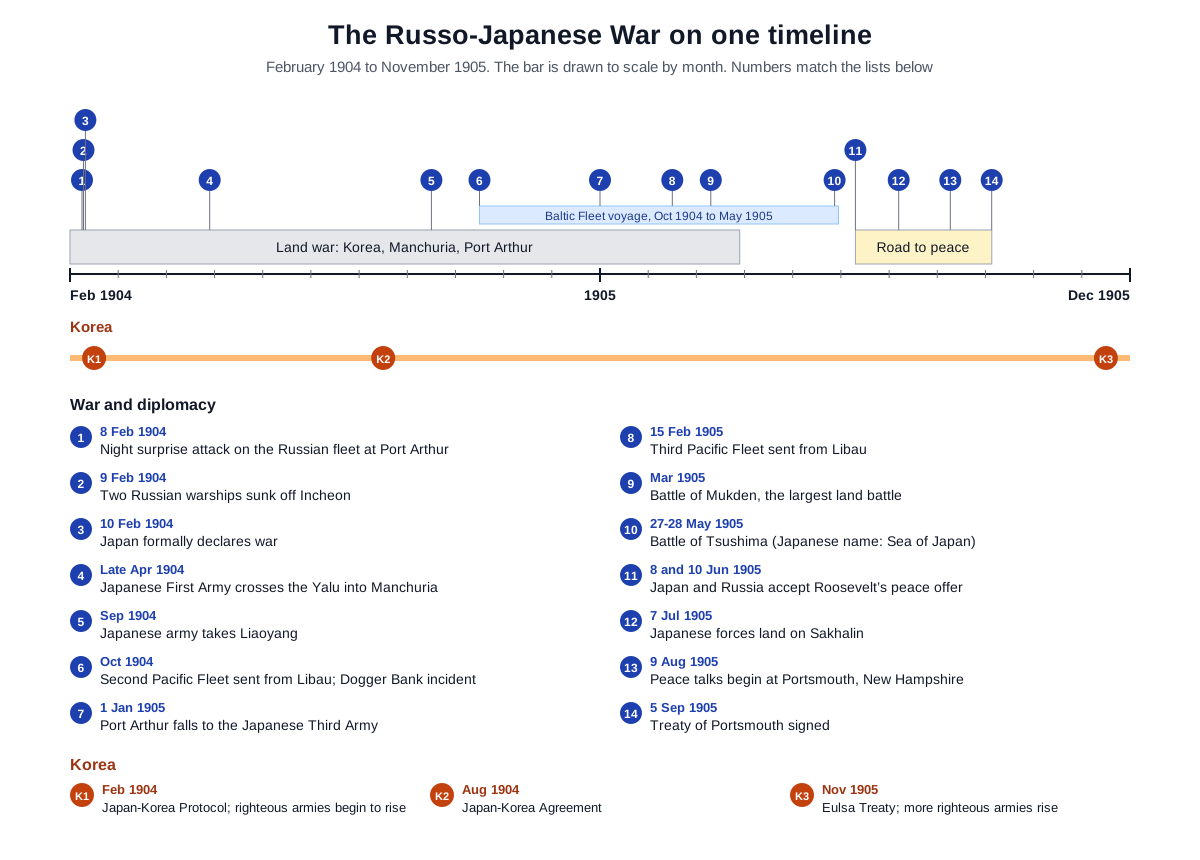
The war began on the night of 8 February 1904 with a Japanese surprise attack on the Russian fleet at Port Arthur. The formal declaration of war had not yet reached Russia. The next day, 9 February, Japan sank two Russian warships off Incheon, and only on 10 February did it declare war. From the very start, the Russian Far Eastern Fleet was bottled up inside Port Arthur.
The next year and a half falls into three broad parts. From February 1904 to March 1905, a land war ran through Korea into Manchuria. From October 1904 to May 1905, a Russian fleet sent from Europe sailed halfway around the world. From June to September 1905, the United States helped broker peace.
Japan won a string of major victories, but at a high price. Both sides suffered heavy casualties.
Port Arthur and Mukden: the great land battles
In late April 1904, the Japanese First Army marched north through Korea and crossed the Yalu River into Manchuria. In June, Japan set up a Manchurian Army headquarters, and its forces grew to 15 divisions. In September the Japanese took Liaoyang.
The Japanese fought their way down the Liaotung Peninsula, hauled guns onto the mountaintops around Port Arthur, and used them to sink the Russian fleet trapped in the harbor. They were the largest guns used in modern warfare up to that time. The Japanese Third Army under General Nogi Maresuke took Port Arthur on 1 January 1905.
The greatest land battle came at Mukden in March 1905. About a quarter-million Japanese troops faced roughly 320,000 Russian troops. The U.S. State Department's Office of the Historian puts the losses at 60,000 Russian soldiers and 41,000 Japanese soldiers. With this victory, Japan in effect brought the land war to a close.
The two sets of figures come from different sources and count different things. The first is the number of troops facing each other; the second is the number of soldiers lost in the battle. The numbers chart further down returns to this.
A fleet that sailed halfway around the world, and Tsushima
To turn around a war that was going badly, the Russian tsar decided to send naval forces from Europe to the Far East. Vice Admiral Rozhestvensky's Second Pacific Fleet left the Baltic naval port of Libau in October 1904, and the Third Pacific Fleet followed on 15 February 1905. Together they are usually called the Baltic Fleet. The fleet numbered 45 warships.
In the same month the Second Pacific Fleet set out, the "Dogger Bank" or "Hull Incident" briefly raised fears of war with Britain. The fleet's route from the Baltic took it around Africa and past India, a very long voyage. The long voyage around the southern tip of Africa had badly worn down the fleet's strength and fighting spirit.
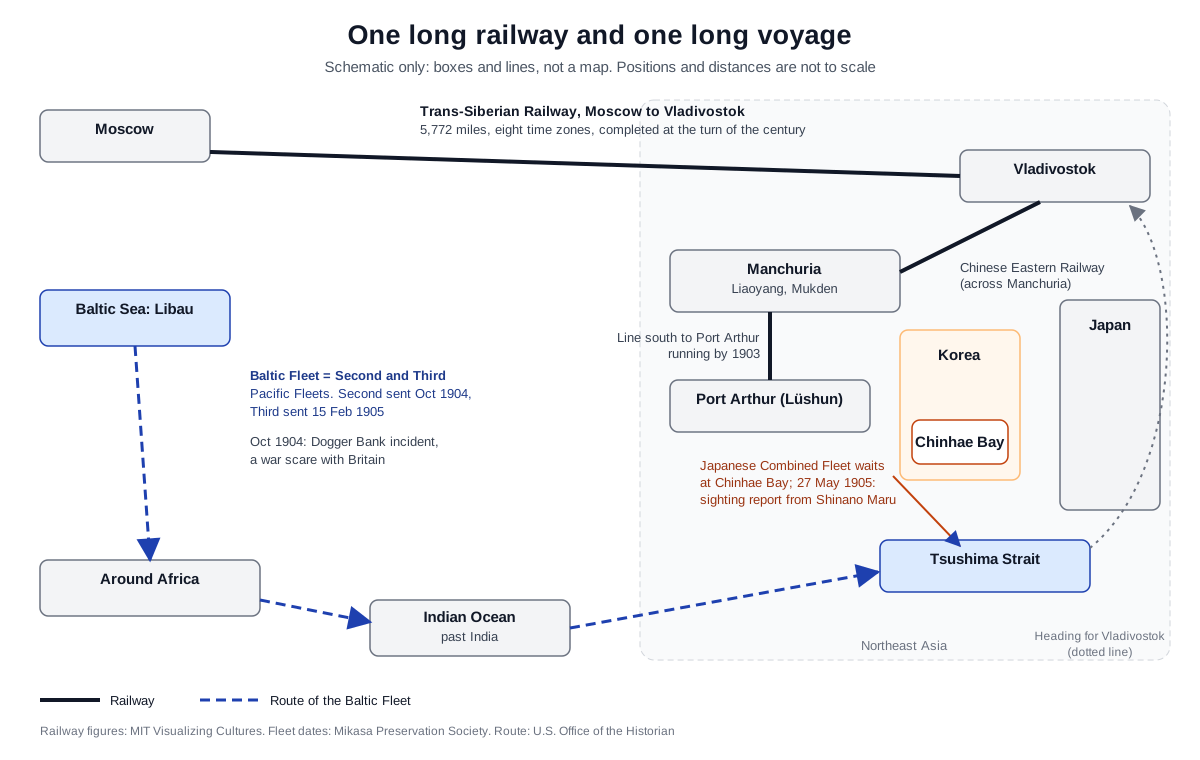
Admiral Tōgō Heihachirō, commander of the Japanese Combined Fleet, expected the Baltic Fleet to pass through the Tsushima Strait on its way to Vladivostok. He assembled his ships in Chinhae Bay, in the far south of Korea, and waited. When the sighting report from the Shinano Maru came in early on 27 May, the fleet sailed at once.
Its flagship was the battleship Mikasa. After the Triple Intervention, Japan pushed a "6-6 Fleet" plan to build six battleships and six armored cruisers. Mikasa, the sixth battleship ordered from Britain, was commissioned at the Vickers yard in March 1902.
Sources describe the outcome in different words. The Office of the Historian says the Russian fleet was half destroyed on arrival, while John W. Dower, the historian who wrote the essays for MIT Visualizing Cultures, and the Mikasa Preservation Society say it was annihilated.
The society says the fighting lasted two days, 27 and 28 May, and ended with the Russians forced to surrender. The Encyclopedia of Korean Culture, from the Academy of Korean Studies, describes a battle that went on for 24 hours and ended with Admiral Rozhestvensky taken prisoner.
The battle has more than one name, too. In Korea it is also called the Battle of Daemado (Tsushima), and its official name in the Japanese navy is the Battle of the Sea of Japan. In English it is usually called the Battle of Tsushima.
Railways, rapid-fire guns, mines and torpedoes
One of the biggest walls Russia ran into was distance. Every soldier and every load of supplies faced an enormous journey to the front, and the Trans-Siberian Railway and the lines connected to it carried that load.
The Trans-Siberian ran 5,772 miles and crossed eight time zones. Yet early in the war it moved only six railcars of military traffic a day. Most of the 1.2 million Russian troops sent to Manchuria went there in 1905.
Supply, movement and maintenance for armed forces together go by the name logistics. Russia's side of this war shows how much its logistics hung on a single railway. Its 24,000 railway guards were spread thin along the Chinese Eastern Railway across a vast area.
Weapons were changing fast at the time. In 2004, Japan's National Institute for Defense Studies (NIDS) held an international war history forum on the Russo-Japanese War. There, Yokoyama Hisayuki explained that the war broke out during more than half a century of innovation. It included rapid-fire, long-range and automatic artillery, smokeless gunpowder, better communications and a growing railway network.
Yokoyama says this wave of firearms innovation in the war is now called a "Revolution in Military Affairs" (RMA). In his view, Japanese weapons were of lower quality than Russian ones early in the war.
At sea, this war saw the first large-scale use of mines and torpedoes. At the same forum, the researcher Berthold Sander-Nagashima argued that this was one reason the German navy followed the war so closely. France and other advanced countries competed to send military observers. What drew them was that two modern states' standing armies, equipped with newly developed weapons, were fighting each other.
Journalists, photographers, artists and officers came from many countries to see the war, and a large number went along with the Japanese army in an official capacity. Warships from Britain, the United States, France and Germany also collected off the Chinese coast to look on. Cameras were still too slow to capture action as it happened. The war also happened to coincide with the rise of the picture postcard as a worldwide phenomenon.
War also took money. Japan borrowed heavily from lenders in London and New York. Japan expected to spend about 450 million yen a year on the war but actually spent 1.9 billion yen over two years. Britain and the United States lent Japan $410 million in four loans between April 1904 and May 1905, and about 40% of it went to war costs.
The Portsmouth peace and what Korea went through
After the Battle of Mukden, Japan had run out of strength to carry the war much further. Russia, too, could hardly go on after revolution broke out at home in 1905. On 8 and 10 June the two countries accepted U.S. President Theodore Roosevelt's offer of peace talks, and on 12 June the United States announced it would mediate. While the place and the delegates were still being settled, Japan landed troops on Sakhalin on 7 July.
The talks were held in Portsmouth, New Hampshire. Komura and Takahira for Japan and Witte and Rosen for Russia met for about four weeks, from 9 August to 5 September. They agreed easily on Japan's "paramount" interests in Korea, the lease of the Liaotung Peninsula, and the handover of the railway between Changchun and Port Arthur. The sticking points were Sakhalin and an indemnity.
Japan demanded 1.2 billion yen in return for handing northern Sakhalin, above 50 degrees north, back to Russia. The Russian army had not been fully broken and its supply lines still worked fairly well, which is why Witte refused to admit defeat. When the talks came close to collapse, Japan dropped the money demand and settled for southern Sakhalin. The Treaty of Portsmouth was signed on 5 September 1905.
Under the treaty, Japan won control over Korea and most of South Manchuria, Port Arthur and its railway among them, plus the southern half of Sakhalin. Russia was not made to cover what the war had cost Japan. Neither country was in good enough financial shape to keep fighting easily, so both had to compromise.
Many in Japan believed their country had won, and they saw a peace with no indemnity as an insult. When the terms became public, there were brief protests and riots in Tokyo, and many Russians resented losing half of Sakhalin.
Roosevelt received the Nobel Peace Prize for 1906. The Nobel citation credits his role in ending the bloody war between Japan and Russia, two great powers of the day. The Office of the Historian adds, however, that it is not clear how far his mediation and pressure shaped the final deal.
For Korea, this was not someone else's war. Right after the war began, in February 1904, Korea was forced to sign the Japan-Korea Protocol, and in August the Japan-Korea Agreement. Righteous armies (uibyeong) rose up against this in many places, and after the Eulsa Treaty of November 1905, leaders such as Won Yong-pal, Min Jong-sik and Choe Ik-hyeon launched uprisings. From this point, Japan's aggression against Korea moved to the direct seizure of national sovereignty.
Some Koreans also hoped to use the war as a chance for reform. At the 2004 NIDS forum, the presenter Lee Sung-Hwan described two proposals that emerged after the war began. One called for a constitution that would limit the absolute monarchy; the other, to protect Korea's independence through an alliance of Japan, China and Korea. Both failed.
Lee sees a shared fear of Russia and an optimistic view of Japan behind these movements. He calls the war the last chance for Koreans to build a modern nation state.
Many ways of seeing the same war
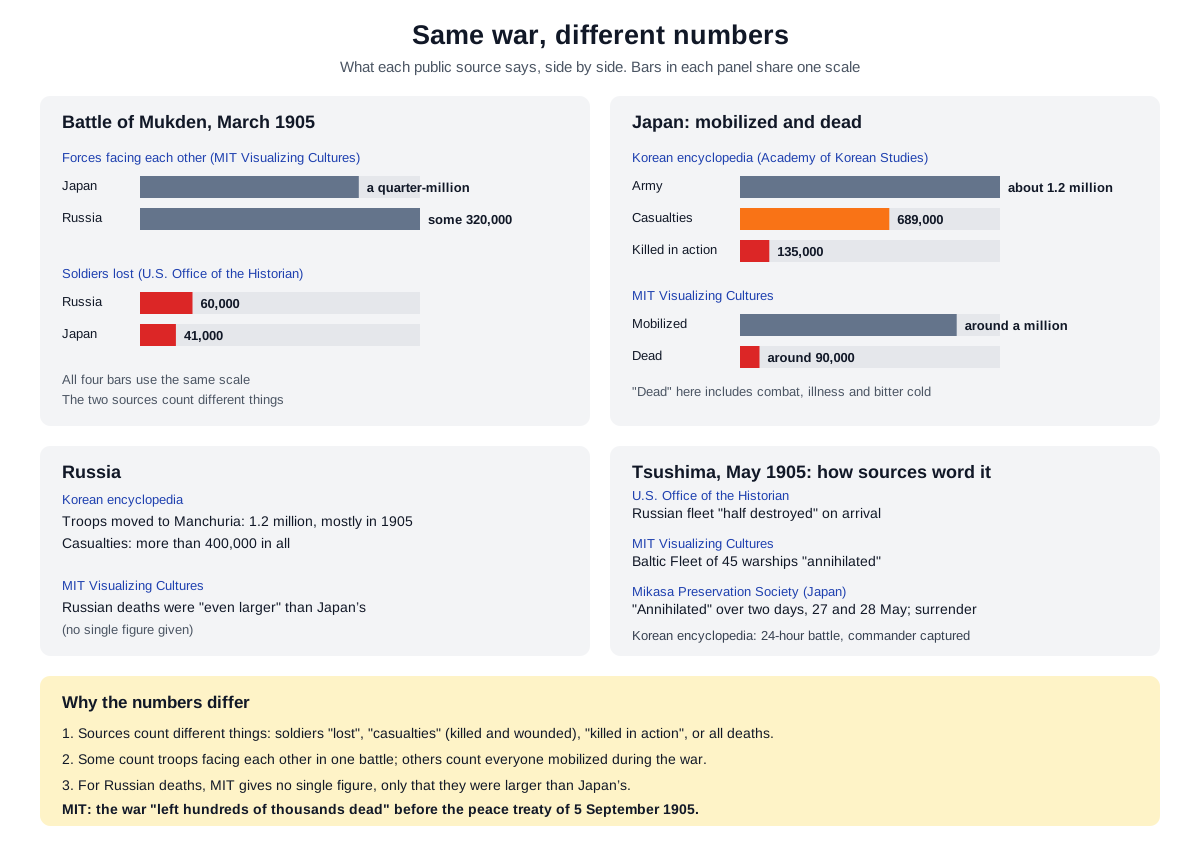
The numbers are the first thing that differ. The Korean encyclopedia puts Japan's wartime army at about 1.2 million, with 689,000 casualties, 135,000 of them killed in action. Dower writes that Japan mobilized around a million people and that around 90,000 died in combat or from illness and bitter cold.
For Russia, the encyclopedia gives more than 400,000 casualties, while Dower says only that Russian deaths were even larger than Japan's. "Casualties" counts both the killed and the wounded, and "deaths" includes those who died of disease, so figures for the same war can differ widely.
Nor is there one answer to why the war started. A long-standing view blames the adventurism of Russia's Bezobrazov clique, Japan's push north, or Russia's push south.
The author of the Korean encyclopedia entry would add two more causes. One is German diplomacy, which tried to turn Russia's attention toward Asia. The other is the tsar's wish to distract from a crisis at home that threatened revolution.
The historian Ito Yukio concludes that the war could have been avoided. Former prime minister Itō Hirobumi and the Meiji Emperor, he finds, opposed it, judging it would ruin both powers.
Views of what kind of war it was also differ. The Korean encyclopedia defines it as an imperialist war for control of Manchuria and Korea.
The historian Dmitrii Pavlov counts around 800 Russian works on the war. Under the tsars, the official history set out to find the causes of defeat. Soviet historians saw it as an imperialist and colonial war on both sides.
Some Soviet scholars argued that Japan fought, on behalf of Britain and the United States, a war those two powers wanted against Russia. American opinion mostly favored Japan, both during the fighting and at the peace talks.
A Japanese memorial foundation remembers it differently again. The society that preserves the Mikasa explains that the victory let Japan secure its independence and raise its international standing, and that it gave hope to independence movements in Asia. Until World War II ended, Japan marked the anniversary of Mukden, 10 March, as Army Day and the anniversary of Tsushima, 27 May, as Navy Day.
Some historians see the war as a step on the road to World War I. The historian Keith Neilson calls it perhaps the single most important international event on the path to that war. In his view, Japan became a regional great power, and a weakened Russia was now ready to reach the 1907 Anglo-Russian Convention with Britain.
The Korean encyclopedia likewise says that Russia, blocked in East Asia, turned toward Central Asia and the Balkans, speeding up the power alignments that led to World War I.
The Office of the Historian sees the Treaty of Portsmouth as the close of a period of U.S.-Japanese cooperation that had lasted since the Meiji Restoration of 1868. After it, rivalry between the two countries in the Pacific grew.
By the time the peace treaty was signed on 5 September 1905, the war had killed hundreds of thousands of people. Behind every number in the chart were those people, and Korea, which was not a party to the fighting, also bore the results of the war.
What to read next
- The Crimean War: the war Russia fought around the Black Sea fifty years earlier.
- Why did World War I begin?: where the power shifts after the Russo-Japanese War led.
- Heavyweight torpedoes: how they differ from lightweight ones: what the torpedo, first used on a large scale in this war, looks like today.
- Military logistics: performance must be sustainable: the job the Trans-Siberian Railway did, explained in today's terms.
- Turning points in military technology: the big technology shifts that came after rapid-fire guns and smokeless powder.
- A history of laser weapons: from chemical to electric lasers: a weapon that appeared more than a century after this war.