On 17 May 1900, the siege of Mafeking, a town in South Africa, came to an end. It had lasted 217 days, longer than any other siege of the war. When the news arrived, crowds across Britain celebrated wildly.
The war did not stop there. For almost two more years, British mounted troops fought Boer irregulars in a guerrilla war, and Britain burned farms and held civilians in camps, where tens of thousands died. This article follows why the war began and how a new, cleaner-burning powder and the magazine rifle changed the look of a battlefield. It also asks what the guerrilla war left behind for civilians.
Gold and two republics
In the late nineteenth century, South Africa held two British territories and two Boer states. On the British side were the Cape Colony and Natal. On the Boer side were the Orange Free State and the South African Republic, also called the Transvaal. The Boers were Afrikaans-speaking farmers.
The National Army Museum (NAM) in London traces the war's roots to a British wish to join all four territories into one confederation. The Boers wanted to stay independent. The Transvaal Boers had already fought Britain for that independence in 1880–81, and won. At Majuba Hill in February 1881, the British side had 285 killed or wounded, while the Boers lost two dead and four wounded.
Gold, found in the South African Republic in 1886, raised the stakes. South Africa became the world's largest gold producer. English speakers poured into the mines, and the Boers called them Uitlanders, or "outlanders." The Boers saw these newcomers as endangering the way they lived, and the Transvaal government let foreigners vote only after 14 years or more in the country.
On 29 December 1895, a force led by Jameson rode into the Transvaal. The aim was to spark an Uitlander uprising. The raid failed completely, and Jameson surrendered at Doornkop, near Krugersdorp, on 2 January 1896. Because it ran across the new year, some sources call it the raid of 1896, and its failure humiliated Britain and the backers of confederation.
In 1897, Colonial Secretary Joseph Chamberlain sent Alfred Milner to South Africa as High Commissioner. Paul Kruger, president of the Transvaal, offered to widen the Uitlander vote if Britain would keep out of the republic's internal affairs. Chamberlain turned the offer down, and the NAM writes that he was sure the Boers could be beaten quickly.
On 9 October 1899, the South African Republic sent an ultimatum. It demanded that Britain pull its troops back from the borders and also withdraw every reinforcement sent since 1 June 1899. When Britain refused, on 12 October the two republics sent forces into the Cape Colony and Natal. The Australian War Memorial (AWM) explains that the Boers struck first to head off what they saw as a coming British conquest.
Three phases, 1899 to 1902
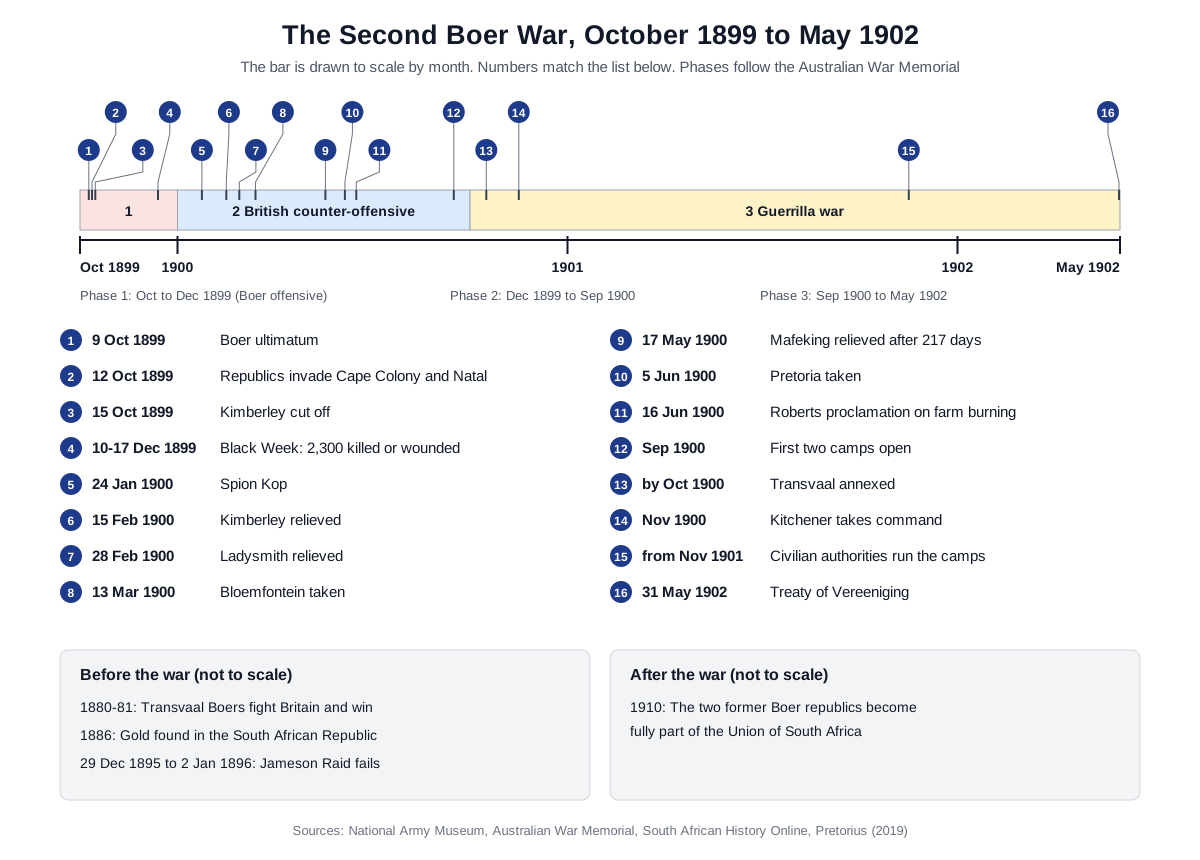
The war is usually split into three phases. From October to December 1899, British armies, mostly infantry, were beaten or besieged by fast-moving Boer horsemen. From December 1899 to September 1900, a British counter-offensive captured most of South Africa's major towns. The last and longest phase ran from September 1900 to May 1902 and was mostly guerrilla fighting that pitted British mounted units against Boer irregulars.
After the early defeats, Britain sent far more troops. Units came from across the Empire, Canada and Australia above all, and in the end more than 400,000 soldiers took part. Bloemfontein, capital of the Orange Free State, fell on 13 March 1900, and Pretoria, the Transvaal capital, on 5 June.
A different enemy waited in Bloemfontein. In early 1900, British troops resting in the town drank water fouled by corpses and human waste, and 1,000 men died. Most of them died of typhoid.
British forces had swept through the Orange Free State by late May 1900, and the Transvaal was annexed by October. On a map, the war looked over. In practice, though, British control reached only as far as the ground their columns stood on, and many Boers kept fighting.
Black Week and three sieges
Early in the war, the Boers surrounded three towns: Kimberley, Mafeking and Ladysmith. In December 1899, British forces marched to rescue them and lost in quick succession at Stormberg, Magersfontein and Colenso. These days, 10 to 17 December, became known as Black Week, and the AWM counts 2,300 men killed or wounded in the three battles.
The British public, used to news of victories from all over the Empire, was badly shaken. The NAM argues that tactics which had mostly worked against poorly armed opponents proved disastrous against the Boers. British troops made frontal attacks on hidden Boer positions, those attacks failed, and several defeats followed that December.
Kimberley's garrison numbered 4,800, including 600 regulars. Cut off on 15 October 1899, the town held out for four months. On 15 February 1900, an Australian Horse patrol, part of the cavalry division under Lieutenant-General John French, rode in and ended the siege.
At Ladysmith, about 13,500 troops and 7,500 civilians were trapped. Most of the troops were British regulars, and 2,500 of the civilians were Indians. Food ran so short that horseflesh went into the rations. The relief force lost again on 24 January 1900 at Spion Kop, then broke through on 28 February after its infantry and artillery worked closely together.
During Mafeking's 217 days, armed black residents took on a growing military role. When the siege lifted on 17 May, the two sides together had suffered 463 battle casualties.
A battlefield without smoke: smokeless powder and magazine rifles
What does a gun leave behind when it fires? Until the mid-1800s, black powder was the only propellant for cannons and rifles. It broke apart as it burned inside the barrel, and it left far more smoke and residue than the smokeless powders that came later.
That changed in the 1880s. Yoel Bergman, in the British Journal for Military History, explains that by the 1880s, smokeless propellants for military use far outperformed black powder, first in France in late 1884. Smokeless powder did not crumble in the gun the way black powder did, so each shot gave nearly the same result. It burned clean with almost no residue, made much less smoke so it did not give away the shooter's position, and opened the way to semi-automatic and automatic fire.
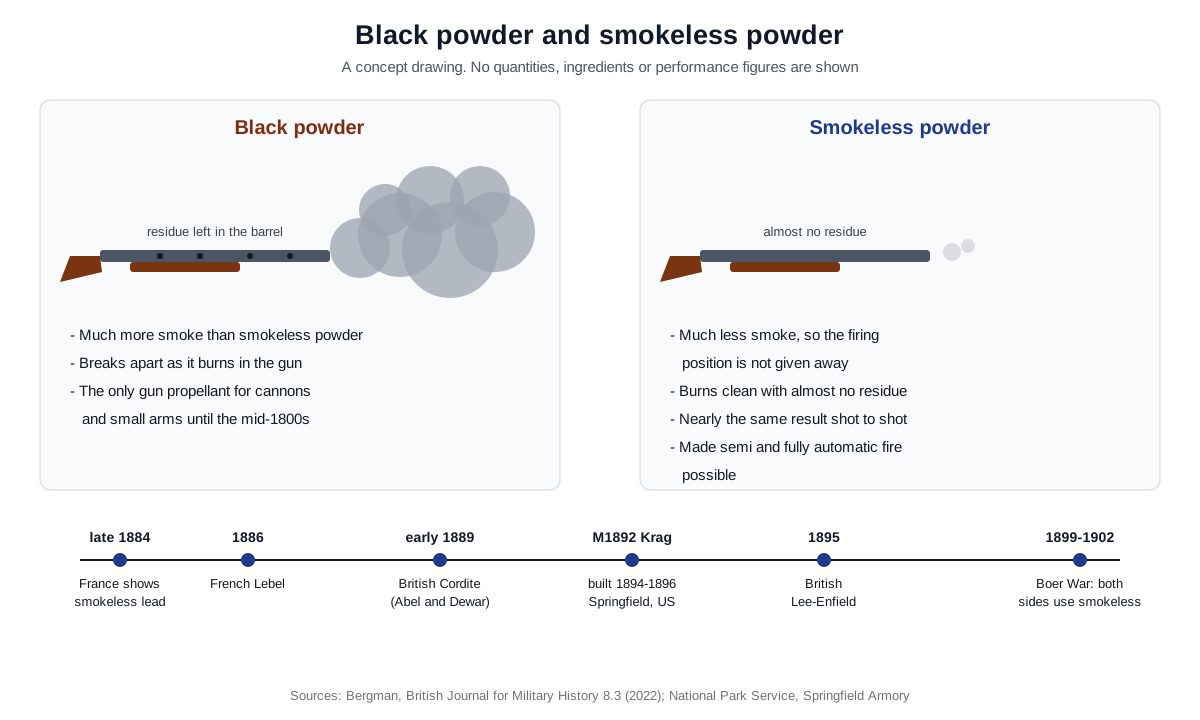
Military rifles were the first to drop black powder. The French Lebel of 1886, the British Lee-Enfield of 1895 and the Russian Mosin were among the first rifles to use smokeless powder. Britain's first smokeless military propellant, Cordite, was developed in early 1889 by Frederick Abel, a War Office chemist, together with James Dewar of the University of Cambridge.
The United States took the same path at about the same time. The National Park Service (NPS) site at Springfield Armory describes the M1892, made there from 1894 to 1896. It was the armory's first bolt-action Krag-Jorgensen magazine rifle and the first to fire small-caliber smokeless cartridges. That was only a few years before the Boer War broke out.
Armed with modern rifles and smokeless powder, Boer marksmen sniped at British infantry from long range and pulled back before any set-piece clash. They moved fast on horseback, used the ground well and were at home on the high veldt. The Boer force numbered 88,000 men, with relatively few guns. Its collection holds a Mauser M1896 rifle used by the Boer commander Louis Botha around 1900.
The new powder was not one side's secret. British forces used Cordite too, and during the Boer War it turned out to wear away gun barrels too fast, which led to later adjustments. Smokeless powder alone also cannot explain Black Week. The NAM sets the frontal attacks on hidden positions next to Boer mobility, fieldcraft and experience of life on the veldt.
Guerrilla war, scorched earth and the camps
Even after losing both capitals, many Boers kept fighting. Eighteen months of harsh guerrilla war followed the annexations. Jan Smuts, one of the Boer commanders, led a raid that took him deep into the Cape Colony during this period.
To hold the countryside, the British built small forts called blockhouses out of stone and corrugated iron. Each had a permanent garrison, and the forts were linked by telephone lines and barbed-wire fences. To cut the guerrillas off from food, news and help, the British burned thousands of farms and wiped out crops, partly to punish local people who had helped the fighters.
The South African military historian Fransjohan Pretorius dates the start of this policy to a proclamation by Lord Roberts on 16 June 1900. It said that each time a railway line was attacked, the nearest farmhouse would be burned. After Lord Kitchener took over command in November 1900, the policy grew much harsher, and almost every Boer farmhouse, about 30,000 in all, was destroyed, along with thousands of livestock.
Britain confined black Africans and Boer families in a chain of concentration camps. The first two opened in September 1900, at Bloemfontein and Pretoria. The NAM sets out the British reasoning. The camps were meant to take away a source of support for the guerrillas, and families in the camps were expected to push the men in the field to surrender.
Pretorius argues that families were taken away whether they wished it or not, and that the purpose was to end the resistance of the Boers still fighting. He also writes that the aim in South Africa was not systematic murder. Researchers at the University of Warwick call the camps the most controversial part of the war. They also note that the subject became a key reference point for the rise of twentieth-century Afrikaner nationalism.
Camp housing was poor. Water and food ran short, medical and sanitary care hardly existed, and disease spread widely. From July 1901 to February 1902, the death rate in the white camps averaged 247 per 1,000 people per year.
There were 66 camps for black Africans, spread across the Transvaal and the Free State. The people held there got no rations and had to grow their own crops.
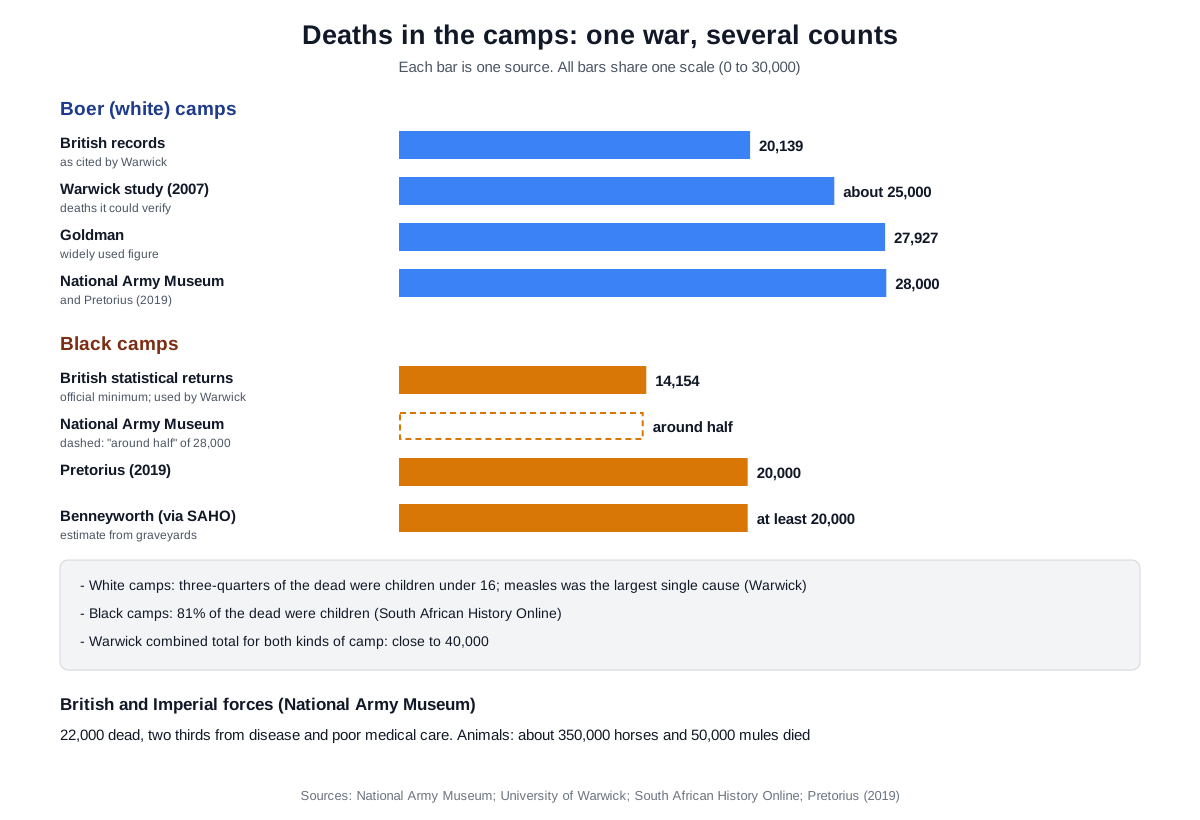
How many died depends on the source. The NAM gives 28,000 Boers, mostly women and children, and says roughly half as many black Africans died in camps of their own. Pretorius treats 28,000 white deaths and 20,000 black deaths as well established.
A Warwick study by Iain Smith and Elizabeth van Heyningen, completed in 2007, verified about 25,000 deaths in the white camps. That is more than the British record of 20,139 and fewer than the widely used figure of 27,927 compiled by Goldman. For the black camps it used the 14,154 deaths in British statistical returns. The researchers accept that this may be too low but judge the proposed 20,000 to be poorly supported, so their total for both kinds of camp comes close to 40,000.
South African History Online (SAHO) gives an official minimum of 14,154 deaths in the black camps and adds that G. Benneyworth, after examining actual graveyards, estimates at least 20,000. Of those who died in the black camps, 81% were children. In the white camps too, three-quarters of the dead were children under 16, and measles epidemics were the largest single cause of death.
The deaths drew sharp criticism in Britain and abroad. Emily Hobhouse did much to make the camps known and organized relief work. A government Ladies Commission report followed, and from November 1901 Milner's civilian authorities took the camps over from the army, after which conditions slowly improved.
The NAM also calls the policy militarily flawed. With Britain caring for their families, the Boers who fought on could put all their effort into fighting. Kitchener later reversed course and had his men leave Boer families in the care of the Boers themselves, which slowed Boer units down and led many to give up. Boer prisoners were sent to camps not only in South Africa but also in India, Ceylon (now Sri Lanka), Bermuda and St Helena.
Railways, telegraph, balloons and searchlights
South Africa is vast. Because of the distances, the British Army relied heavily on the electric telegraph and the field telephone, and it flew hydrogen balloons to watch the enemy and direct artillery fire. Some of these tools had appeared in earlier campaigns, but the NAM notes that the scale of their use in South Africa was exceptional.
Railways mattered a great deal in this war, and the Boers attacked them often. The British answered with armored trains that patrolled the main lines. Winston Churchill, who was working as a war correspondent at the time, was on board one of these trains when Boer commandos ambushed it.
At night, searchlights run by mobile generators lit the railway so crews could repair the track. Steam traction engines hauled heavy loads by road and across open country, sparing the draught animals.
The animals paid a heavy price. Horses and mules were too often worked before they had adjusted to the climate, poorly fed and poorly cared for. Over the course of the war, about 350,000 horses died, along with 50,000 mules.
The Treaty of Vereeniging and what remained
On 31 May 1902, the two sides signed the Treaty of Vereeniging. Smuts was one of the Boer negotiators. The Boers accepted British sovereignty along with limited self-government. In 1910 the two former republics were folded fully into the new Union of South Africa.
Here are a few of the treaty's terms. Burghers still fighting in the field were to give up their weapons at once, and Dutch was to be taught in public schools where parents wanted it. Whether to give the vote to "Natives," meaning black Africans, was put off until after self-government arrived.
The British government spent £210 million on the war, which the NAM reckons at over £25 billion today. British and Imperial casualties topped 120,000, of whom 22,000 died. Disease and poor medical care caused two thirds of those deaths.
Britain's own soldiers were not the only ones involved. From 15,000 to 30,000 black Africans served British forces as armed scouts and sentries, and another 100,000 worked as laborers, transport drivers, blacksmiths and builders. At the start, both sides had quietly agreed not to arm the black population, but that agreement proved hard to keep. The Indian Ambulance Corps was made up of 800 indentured sugar-estate workers and 300 free Indians.
About 16,000 Australians are generally thought to have served. In Australian units, 282 men died in action or of wounds, 286 died of disease, and 38 died in accidents or of unknown causes. A small number of Australians fought for the Boers. Australians at home backed the war at first but grew disillusioned as it dragged on and as the suffering of Boer civilians became known.
For Britain, this was the first war in which people from every class took up arms. Many joined new units such as the Imperial Yeomanry, and reforms to tactics, equipment and administration followed in the years after the war.
Even the war's name varies. The NAM calls it the Boer War, while South African writing also uses the South African War, otherwise known as the Anglo-Boer War. A 2007 text by Giliomee and Mbenga, quoted on SAHO, ranks it as the worst and most destructive modern war South Africa has known. It also sees the end of the war as the close of a long process in which Britain conquered the societies of South Africa, black and white alike.
What to read next
- The Rifled Musket and the Minié Ball in the Civil War. The story of rifles in the black powder age, before the magazine rifle.
- The Crimean War: The War of the Telegraph, the Camera and Nightingale. Half a century earlier, the telegraph and disease were already reshaping war.
- Why World War I Began: From Sarajevo to Mobilization. The next great war, in which a British Army reformed in tactics, equipment and administration after the Boer War fought again.
- Military logistics: performance must be sustainable. Why railways, horses and mules mattered so much, explained in today's terms.
- Turning points in military technology. Other moments when a new technology, like smokeless powder, changed the battlefield.
- A history of laser weapons: from chemical to electric lasers. After the searchlights that lit railways at night, the story of light as military equipment runs on to lasers.