On 3 July 1187, on dry hills west of the Sea of Galilee, the army of the Kingdom of Jerusalem settled down for a night without water. Fires burned around the camp, and smoke and arrows kept coming until morning. The next day the army collapsed. In less than three months, Jerusalem was also in the hands of Saladin (Salah al-Din).
When the news reached Western Europe, efforts began to bring the German emperor and the kings of France and England into a great expedition. This was the Third Crusade (1189–1192). King Richard I of England, together with the French king, retook Acre and held off Saladin's army at Arsuf, yet he never entered Jerusalem.
Why was the defeat at Hattin so complete, and what did the later expedition gain and fail to gain? This article follows events from Hattin to the truce of 1192. It also sets side by side how crusader chronicles and Muslim accounts recorded the same events.
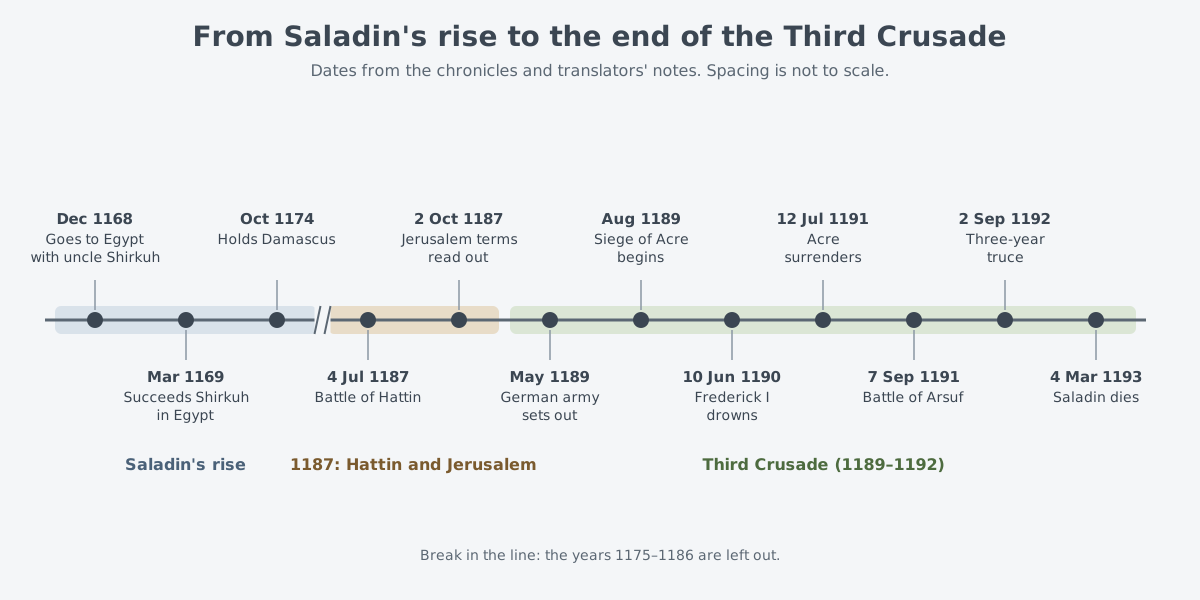
Saladin's road from Egypt to Syria
Saladin was the son of Ayub, governor of the town of Tikrit on the Tigris. In December 1168 he went with his uncle Shirkuh, a lieutenant of the Syrian ruler Nur al-Din, on the campaign to conquer Egypt. Archer, who collected the sources of this period in 1912, wrote that Saladin went "unwillingly."
Shirkuh died on 23 March 1169, and his nephew took his place. As Saladin's power grew, Nur al-Din became suspicious of him. Nur al-Din was getting ready to move against Saladin when he died on 15 May 1174. By the end of October that year, Saladin held Damascus.
By 1187, Saladin's rule stretched from the Mediterranean coast and the Nile all the way east to the Euphrates and the Tigris. The crusader states founded after the First Crusade took Jerusalem in 1099 now faced a power in which one man held both Egypt and Syria.
Hattin: an army far from water
In the summer of 1187, King Guy de Lusignan of Jerusalem gathered his army near the springs of Saffuriyah. A chronicle of these years is the De Expugnatione Terrae Sanctae per Saladinum. It counts 1,200 knights, countless Turcopoles (light horsemen raised locally) and at least 18,000 foot soldiers. Even the money that England's King Henry II had left in trust was opened up, and anyone who could carry a lance or a bow was paid to join.
On 2 July, Saladin's army surrounded the town of Tiberias. Tiberias was the town of Raymond III, count of Tripoli, and his wife was inside. Even so, Raymond argued against leaving the water and food. He said that in this heat the army could not last half a day without plenty of water.
The king took other advice. On Friday, 3 July, the army marched out by troops and left its supplies behind. Worn down by attacks and thirst, it camped at a dry spot, and the Muslim army set fire to the brush around it. Saladin had brushwood and dry grass gathered for the fires, and he had camel caravans bring water up from the Sea of Tiberias.
The fighting ended on Saturday, 4 July 1187, at the "Horns of Hattin," 4 miles from Tiberias. Raymond's division charged, was surrounded, and only 10 or 12 of its knights got away. The king was taken prisoner, along with the head of the Templars, Reynald of Châtillon and many other nobles. The relic of the True Cross, which the king had asked the Patriarch of Jerusalem to bring to the camp, was lost as well.
Reynald was killed afterward, but the records disagree on when and how. The De Expugnatione places it on the next day. The account of Ernoul, a local Frank, and the 14th-century Muslim scholar al-Umari both say Saladin killed him with his own hand that same day. Captured Templars and Hospitallers were also killed, while the countess and the people in the citadel of Tiberias were promised their lives and allowed to leave.
Jerusalem surrenders and the West answers
After Hattin, the remaining soldiers fled to the fortified coastal cities, above all Tyre. In July and August, Saladin took the remaining towns and castles one by one, but his first attack on Tyre failed and he passed it by. Meanwhile Conrad of Montferrat, who had come by ship from Constantinople, reached Tyre in time to stop the city from giving up.
Jerusalem was besieged on 20 September. Saladin set the ransom at 10 besants for each male aged ten or over, 5 besants for each female, and 1 besant for each boy aged seven or under. On Friday, 2 October, these terms were read out in the streets, and people had 40 days to find the money. Those who could not pay were to become booty.
The Metropolitan Museum of Art's essay adds a story told by Saladin's personal secretary. In it, Saladin allowed the Patriarch of Jerusalem to leave the city with the church's treasure. One record stresses the harsh terms, while the other stresses generosity.
On 29 October 1187, even before the news of Jerusalem reached him, Pope Gregory VIII called for a new crusade. In January 1188, Philip II of France and Henry II of England met at Gisors and agreed to go together. Before the year was out, they were at war again. When Henry II died in July 1189 and his son Richard became king, the prospects for the expedition greatly improved.
Emperor Frederick I (Barbarossa) moved first. In May 1189 his German army set out overland, crossing the Balkans and then Asia Minor, and on 17 May 1190 it won a pitched battle near Konya. Then, on 10 June 1190, the emperor tried to swim a fast-flowing river, the Calycadmus, was caught in a whirlpool and drowned. The German army split up afterward.
Acre: a siege of nearly two years
King Guy had been released in May 1188. With the forces he could gather, he camped before the coastal city of Acre at the end of August 1189. With a good harbor and strong walls, Acre was close to impossible to take as long as its defenders controlled the sea. Saladin also moved his field army near the city, so the besiegers had to face the garrison inside and an army outside at the same time.
The besiegers were themselves under siege. In April 1191 the French fleet and army arrived, and Richard reached Acre after taking Cyprus on the way. The French king's assault had to pull back because of attacks from the army outside, and his carefully built siege engines were burned one after another by "Greek fire."
Richard's side tried other methods too. The Itinerarium Peregrinorum says his miners dug under a tower and cut away part of its foundation. They filled the gap with timber and set it on fire, and stone missiles then brought the tower down. He offered two gold pieces to anyone who pulled a stone out of the wall, and later raised the reward to four.
In the end, the Muslim side offered to surrender. It would return 2,000 noble Christian captives and 500 of lower rank, and the garrison would leave with only the clothes they wore. It would also pay 200,000 Saracen talents to both kings and give leading men as hostages. The hostages were handed over on 12 July 1191, and the True Cross and the captives were due later that month.
Philip II gave illness as his reason and sailed away on 1 August 1191. Most of his army stayed behind with Richard. Command of the expedition now rested on Richard alone, and on 20 August, saying the agreement had not been kept, he had the Muslim prisoners at Acre executed. Because the numbers and reasons differ between records, that event is treated on its own further below.
Arsuf: a fighting march along the coast
Two days after the executions, the crusaders set out from Acre and headed south, keeping to the shore. Saladin's army followed. A fleet loaded with food sailed alongside, and the packhorses and wagons moved on the seaward side of the troops to keep them safe from attack.
At Hattin, too, whether to leave the water and food had been the point of dispute. Today the work of supplying a fighting army with food and water is called logistics. How modern armies divide up that work is covered in Military logistics: performance must be sustainable.
After the army left Caesarea on 1 September, Saladin's forces pressed in on the column every day. Richard formed twelve squadrons into five divisions, with the Templars at the front and the Hospitallers at the rear. Bowmen and crossbowmen closed the rear, and the army moved at a slow pace so it would not break apart.
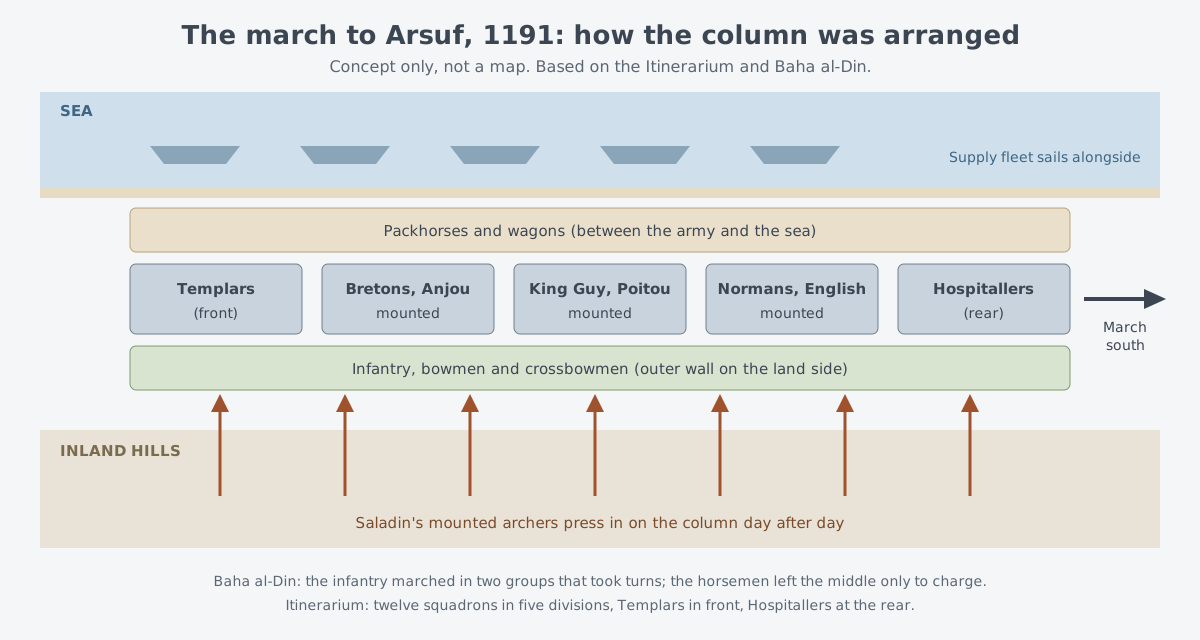
A Muslim account described the column as well. Baha al-Din (spelled Bohadin in older translations), who was with the center of Saladin's army during the battle, said he saw it himself and heard more from prisoners and merchants. In his account, the infantry was split into two groups: one marched along the shore and took turns with the other when it grew tired. The horsemen rode between them and left that middle place only to charge.
On 7 September 1191, a major battle broke out near Arsuf. The Hospitallers at the rear could not strike back and had to endure arrows and clubs, so their Master asked Richard for leave to charge. Richard told him to hold on. The plan was for six trumpets in three parts of the army to sound together for one combined charge.
Then two knights who could not wait, the Marshal of the Hospitallers and Richard's companion Baldwin de Carro, rode out first, and as other squadrons followed, the plan came apart. Even so, the crusaders held their ground under pressure, and when the fighting ended, Richard's army held the field. The army went on past Arsuf to Jaffa and fortified the city.
Bows, crossbows and mail: the weapons of two armies
The two armies relied on different weapons. The weapon that crusader accounts mention again and again on Saladin's side is the bow carried by horsemen. The Itinerarium says the Turks took special pride in the bow, and that at Arsuf arrows covered the ground so thickly that one sweep of the hand could gather twenty.
The crusaders relied on the charge of knights with lances. But knights alone could not stand up to the arrows. Even on the last day at Hattin, the infantry was placed facing the enemy's arrows, while the knights' lances protected the infantry from enemy charges. Each side of the formation protected the other.
At Hattin this arrangement broke down. The thirsty infantry climbed to a hilltop and would not come back, saying they were dying of thirst and would not fight. With the foot soldiers gone, the king had nothing to stand between him and the Turkish arrows.
At Arsuf the arrangement held. To Baha al-Din, the crusader infantry in thick felt jerkins and mail coats stood like a wall. He saw men keep their place in the ranks with ten arrows in their backs. The crossbowmen and bowmen at the rear kept shooting to beat back the attacks, though as the pressure grew, many crossbowmen gave way and fell back inside the main column.
In sieges, both sides used machines. At Jerusalem in 1187, Saladin's army set up siege engines and ballistas, hurled stones and threw Greek fire. At Acre in 1191 it was the other way around: the defenders used Greek fire to burn the crusaders' siege engines. Later examples of new weapons changing the shape of fighting are collected in Turning points in military technology.
One event, different records
Records of the Third Crusade survive from both sides. That makes it easy to see where the same event was written down differently. The numbers are a good place to start.
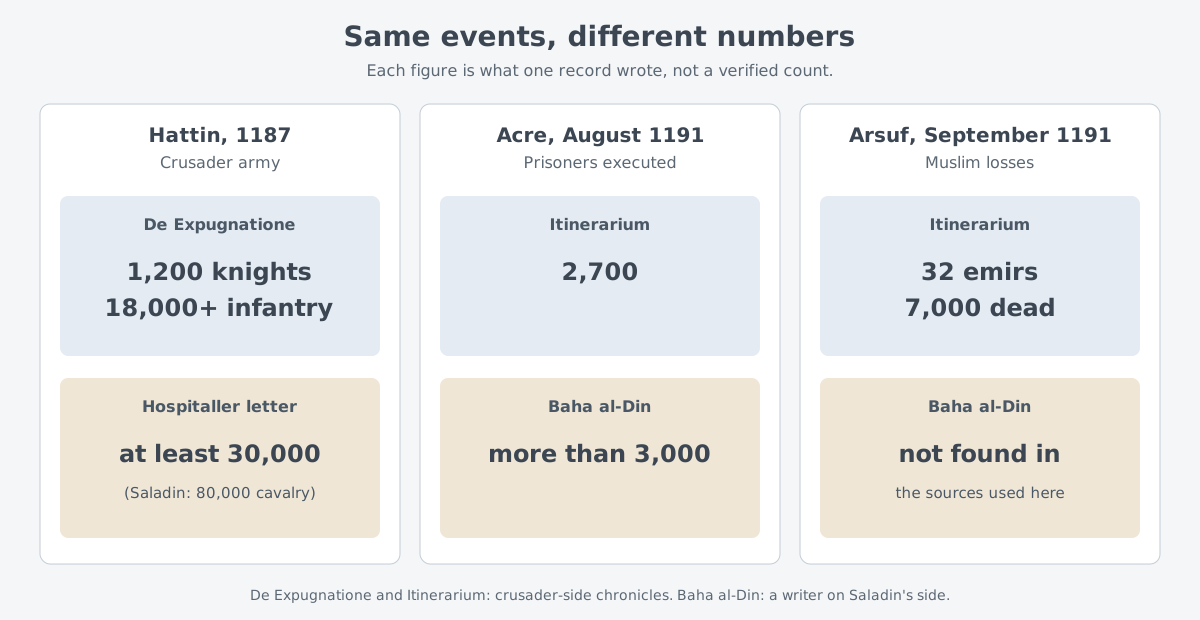
For the crusader army at Hattin, the De Expugnatione gives 1,200 knights and 18,000 or more infantry. A Hospitaller letter, probably written within two months of the battle, gives "at least 30,000 men" and says Saladin came with 80,000 cavalry. Figures like these tell us what a record said, not what anyone actually counted.
The heaviest difference concerns the execution of the prisoners at Acre. When the deadline passed without the True Cross and the captives, Richard decided to kill the prisoners. The Itinerarium says that a few nobles were set apart in hope of ransom or exchange, and that 2,700 were led out of the city and killed. According to a note in the translation, the decision was made on 16 August and the killing took place on 20 August.
Baha al-Din's record reads differently. He wrote that the prisoners numbered more than 3,000 and were bound with ropes. In his account, Saladin refused the crusaders' demand, reasoning that paying first while his own men were still held would leave him open to betrayal. He also wrote that Richard had promised the prisoners their lives when the city surrendered.
The reasons given differ as well: the Itinerarium presents the killing as revenge for Christians killed earlier. The chronicler Roger of Howden wrote that Saladin had killed all his Christian prisoners two days before. Baha al-Din reports a revenge explanation and also the view that Richard, heading for Ascalon, did not want to leave so many prisoners behind. He ended by writing that God alone knows the real reason.
For the losses at Arsuf, only one side's figures appear in these sources. The Itinerarium says men who went back to the field counted the bodies of 32 emirs (commanders) and reported 7,000 dead on the Turkish side. Archer added that Baha al-Din's picture of the battle may not match this account on some small points.
The truce and what it left
In the winter after Arsuf, Richard's army rebuilt the walls of Ascalon, which Saladin had pulled down. From the spring of 1192, Richard received troubling news about his brother John and about Philip II, and in the summer he fell ill. Through all of 1192, Saladin kept control of Jerusalem.
The truce was arranged with Saladin's brother Saif ad-Din acting as go-between. Ascalon would be torn down and stay unbuilt for three years, and Jaffa would go back to the Christians. Both sides would travel freely, visit the Holy Sepulcher without paying tribute, and trade freely. Baha al-Din wrote that the peace ran for three years counted from the written agreement of Wednesday, 2 September 1192, and that Ramleh and Lydda were left to the Franks.
Both sides were worn out, and Baha al-Din wrote that the sultan chose peace because his soldiers had been through great hardship and his funds had run out. Richard left the Holy Land in October 1192. On the way home, the Duke of Austria's men found him near Vienna, and he was held in the castle of Dürnstein (Tyernstein) on the Danube. Saladin died on 4 March 1193.
Views differ on what the expedition achieved. Brundage, who translated the sources, judges the gains modest: it rebuilt a small Latin kingdom on the coast of Palestine but left its main task, regaining Jerusalem, undone. The Metropolitan Museum of Art's essay notes that the crusaders gained Cyprus and Acre, and that Saladin guaranteed European pilgrims access to Jerusalem and welcomed Jews back to the city.
In 1912, Archer named Philip's departure, the quarrel over the crown and the national rivalries that had already damaged the two earlier crusades as causes of failure. That is one scholar's reading from more than a century ago. What comes up again and again in the records followed here is water, supply and the arrangement that tied knights and foot soldiers together. At Hattin that arrangement fell apart in thirst, and at Arsuf it held as the army marched beside its fleet.
What to read next
- The First Crusade: Why European Armies Marched to Jerusalem: looks back at how the crusader states that Saladin faced came to exist.
- The Fourth Crusade: The Expedition That Took Constantinople Instead: follows where the crusades went after the Third Crusade.
- Military logistics: performance must be sustainable: puts the supply problems seen in Hattin's water and the fleet at Arsuf into today's terms.