A granary inside a frontier fort, a daily wage of two obols, a camp laid out the same way every time. Picture a Roman legion and you probably see soldiers marching behind their shields. Read the records, though, and the details of daily upkeep come first.
How could Rome keep armies on so much land for so long? This article starts with how the Republican legion was put together, then looks at the recruiting of Marius and the rewards Augustus set down. It ends with the frontier walls and roads that held the army up. The evidence comes from writers of the time and from UNESCO World Heritage records.
An army of citizens
The Greek historian Polybius wanted to explain how Rome brought almost all of the known world under its rule within fifty-three years. He looked for the answer in Roman institutions, and the army sits at the center of his account.
The army he describes belonged to citizens. A cavalryman served ten years in all, and a foot soldier served sixteen years before turning forty-six. In a crisis, foot soldiers could be asked for twenty years.
Men rated below 400 drachmae in the census were all sent to naval service.
The general did not control the money and supplies alone. The legions always needed supplies, and without the Senate's consent there was no grain, no clothing and no pay. An army in the field stayed tied to politics and supply back in Rome.
Three lines by age: the maniple
In Polybius's account, one legion had 4,200 foot soldiers, raised to 5,000 in times of great danger, plus 300 cavalry. These figures were the standard in the Republic Polybius saw, and they were raised in an emergency. The size of legions under the emperors could not be confirmed from the sources used here, so it is not given.
The foot soldiers were sorted by age and wealth into four classes. The youngest and poorest became the lightly armed velites. Next came the hastati, then the principes, men in the prime of life, and finally the oldest men, the triarii.
There were 600 triarii and 1,200 each of principes and hastati, with the rest serving as velites. Even when a legion grew larger, the number of triarii stayed fixed.
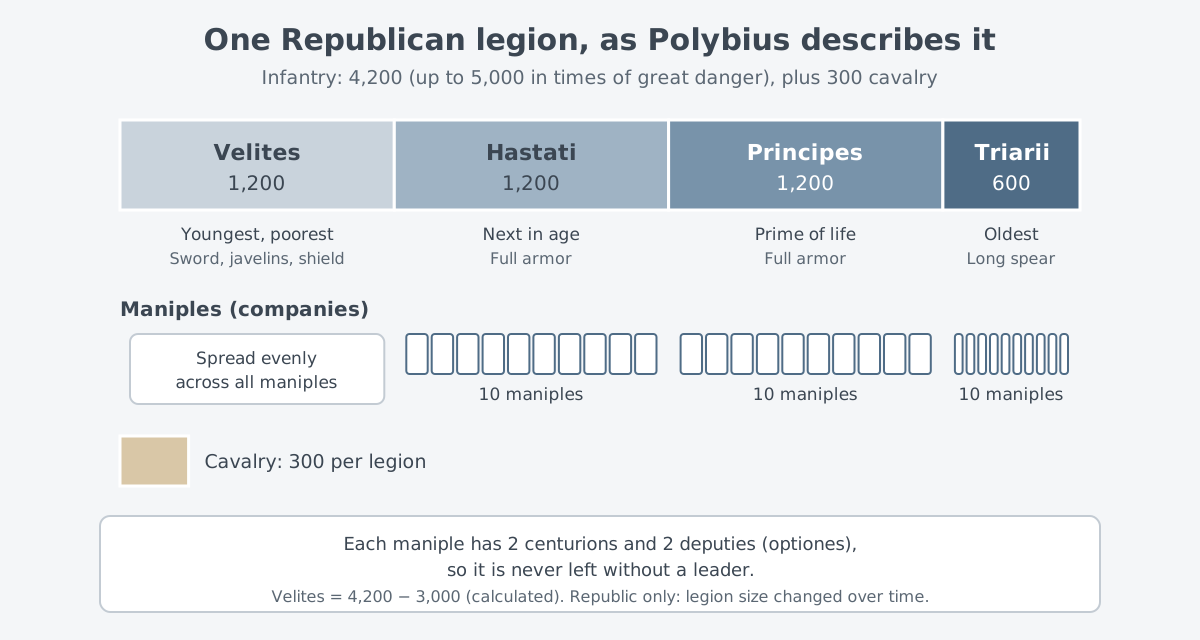
Equipment differed by class as well. The velites carried a sword, javelins and a round shield. The hastati wore a full set of armor, and the principes and triarii were armed the same way. The triarii, however, carried long spears instead of the throwing spear called the pilum.
Each of the three classes other than the velites was split into ten companies. These companies were called maniples (manipulus). From each class, ten centurions were chosen by merit, and then a second ten, so every maniple had two centurions and two deputies. The record even gives the reason for two leaders: whatever happened to one of them, the maniple would never be left without a commander.
The same camp everywhere, and steady supplies
The Roman army laid out every camp to a single plan, wherever and whenever it stopped. Greek armies fitted each camp to the shape of the land. Romans instead accepted the hard work of digging ditches and building defenses, so that every camp was the same and familiar to all.
What did a standard camp give them? Since everyone always took the same place, each soldier knew exactly which street his tent was on and where along that street it stood. Polybius said that making camp was a bit like an army coming home to its own city.
Daily upkeep was set down in numbers. Pay for a foot soldier was two obols per day. A centurion got double that, and a cavalryman one drachma. Each month a foot soldier drew roughly two-thirds of an Attic medimnus of grain.
For Roman soldiers, the quaestor, a finance official, took the cost of grain, clothing and any extra weapons out of their pay. In today's terms, logistics was written into the system.
Recruiting and rewards: Marius and Augustus
The historian Sallust tells how the general Marius raised troops during the war against Jugurtha. Marius did not enroll men by property class, as earlier Romans had. He let anyone volunteer, and most of the men who came had no property at all.
A note in the translation explains that these classes were the old property-based ranks, and that the propertyless men below the lowest class had been exempt from military service. People at the time disagreed about why Marius did this. Sallust records that some said he lacked good men, while others said he wanted to win popularity.
Augustus left an account of the army in his Res Gestae. He wrote that about 500,000 Roman citizens had bound themselves to him by military oath. Of these, more than 300,000 finished their service and were given homes in colonies or returned to their own towns, and all of them received land or money.
A military treasury was also set up on his advice. It existed to pay rewards to soldiers who had served twenty years or more, and Augustus says he put in 170 million sesterces from his own fortune. These figures come from Augustus's own account, which is worth keeping in mind.
Legions and auxiliaries on the frontier
Under the emperors, the legions were based along the edges of the empire. In his Annals, Tacitus lists where they stood in what he calls the ninth year of Tiberius. The main strength was eight legions on the Rhine. Spain had three, Africa and Egypt two each, and the lands from Syria to the Euphrates four.
Pannonia and Moesia on the Danube had two each, with two more in Dalmatia, behind those four legions. Together that makes 25 legions.
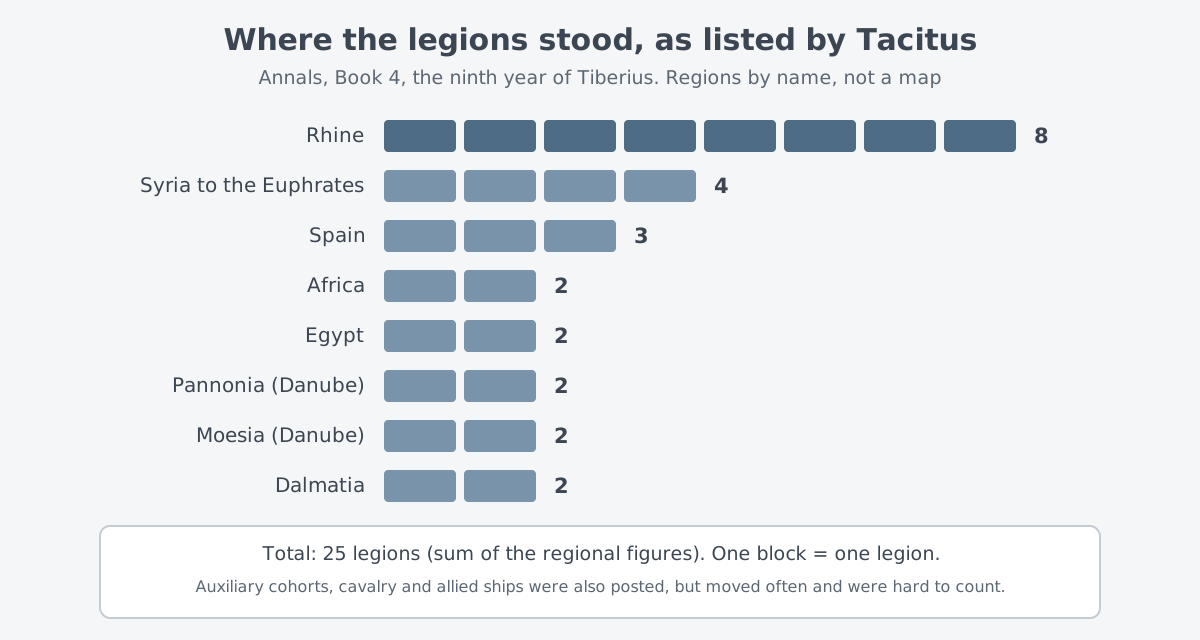
The legions were not alone. The provinces also held allied warships, cavalry units and auxiliary cohorts, nearly as strong as the legions themselves. They moved from post to post so often that even Tacitus found them hard to count.
The ruins still show this today. UNESCO describes a network of Roman frontiers that ran from the Atlantic coast in the west to the Black Sea in the east. It also reached from central Scotland in the north to the northern edge of the Sahara in the south. Most of it was built in the 2nd century AD, when the empire was at its largest.
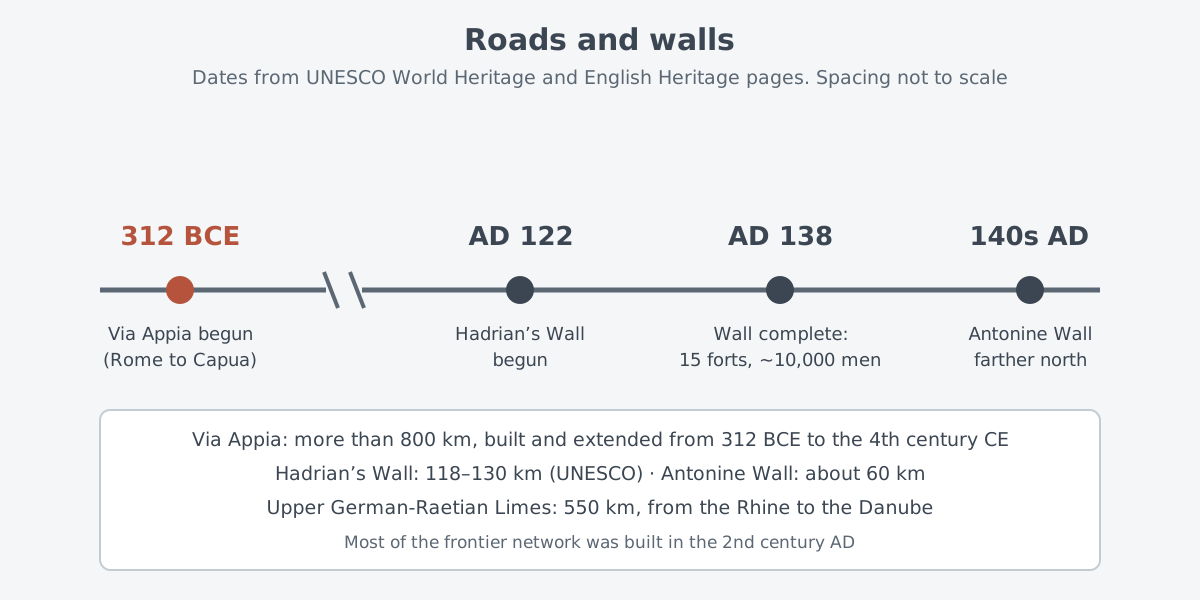
In northern Britain, Hadrian's Wall was begun on the emperor's orders in AD 122. Its length is given two ways even on the same UNESCO page: 130 km from the mouth of the Tyne to the Solway Firth, and 118 km. In the 140s, the Antonine Wall, about 60 km long, went up farther north.
According to English Heritage's history of Housesteads fort, the Wall was complete by Hadrian's death in AD 138, with 15 forts and a garrison of nearly 10,000 along its length. Housesteads itself was held not by legionaries but by auxiliaries, foot soldiers and cavalry raised from conquered peoples. The fort was built from the start for an infantry unit of 800, and its granary was one of the first buildings put up under Hadrian. Heavily armed legionary infantry from across the empire and auxiliaries from conquered peoples held the frontier together.
The frontier was more than a battle line. The Upper German-Raetian Limes, 550 km long from Rheinbrohl on the Rhine to Eining on the Danube, was a military barrier and also an economic and cultural boundary.
Roads: the Via Appia
An army on the frontier needs roads for people and supplies. The UNESCO World Heritage property "Via Appia. Regina Viarum," the queen of roads, shows where this began. The Via Appia was built from 312 BCE under the authority of the censor Appius Claudius Caecus, and it linked Rome to Capua by the most direct route.
From the start, the road was planned as a strategic route for military conquest. As Roman territory grew, it was extended toward Beneventum, Tarentum and Brundisium. Built and expanded from 312 BCE to the 4th century CE, the road is more than 800 km long. It counts as the oldest and most important of the great Roman roads.
Once the conquered lands were settled, the Via Appia quickly became a key route for trade and regional growth, open to everyone without tolls. The cities along it grew, new settlements appeared, and farming and trade picked up.
The forts and marching camps around Hadrian's Wall were likewise tied together by a wide road network.
What the legion left behind
The records in this article say more about institutions than about any single weapon. They show legions with a set standard size, two leaders per maniple and the same camp everywhere. They also show rules for pay and grain, land and money for men who finished their service, and roads joining the frontier to the capital.
The records also show the limits. A Republican general could not carry out his plans if the Senate cut off supplies, and people disagreed even then about Marius's recruiting. The sources in this article were written by ancient historians and by the emperor himself, so when reading their numbers it helps to keep in mind who wrote them.
How long supply and maintenance can keep an army going is still a question for modern weapons.
What to read next
- Military logistics: performance must be sustainable: how the questions of granaries and roads carry over into modern armies.
- Turning points in military technology: moments in the modern era when weapons and organization changed sharply.
- A history of laser weapons: from chemical to electric lasers: how one kind of weapon changed over a long stretch of time, in a very different age.