Sending something high and fast on a rocket is only half the job. The other half is bringing it back down in one piece. On the way back, the biggest enemies are the air and the heat it creates.
A heat shield is what protects a returning object from that heat. This article follows where reentry heat comes from, why a blunt shape takes in less of it, and what the three main ways of handling it are. It draws on a reentry history published by the National Aeronautics and Space Administration (NASA) and on NASA's recent investigation findings.
The story starts with long-range ballistic missiles and ends with crew capsules. Research meant to protect missile warheads became the base for the technology that protects astronauts.
Where the heat comes from
The A-4, the Redstone and other early missiles had low peak altitudes. Because of that, they never flew fast enough for heating to become a serious problem. Longer ranges changed this. Missiles climbed higher and came back faster, and heating turned into a big worry.
A fast-moving object carries a lot of kinetic energy. As it comes back into the atmosphere, almost all of that kinetic energy turns into heat as the air heats up. So where does all that heat go?
A shock wave forms in front of the object, where the air is suddenly squeezed. Along the surface is a thin layer of air flowing against it, called the boundary layer. Heat made outside the boundary layer by the squeezing at the shock wave never touches the body and spreads into the surrounding air.
The trouble is the heat inside the boundary layer. It touches the structure directly, and it got hot enough to melt the body. Heat shield research came down to one question: how to keep that heat away from the body.
Pointed runs hotter: the blunt body
A fast object, it seems, ought to be sleek. Engineers at Convair, which was developing a ballistic missile, ran their computer with that same belief that more streamlined meant better, and the result was a slender, pointed reentry vehicle. Then wind tunnel tests and rocket-launched model tests gave a surprise. Such a warhead would soak up enough heat to vaporize during reentry.
The answer turned out to be the opposite: in 1951, H. Julian Allen of the National Advisory Committee for Aeronautics (NACA) came up with the blunt-body theory. A blunt nose creates a stronger shock wave in front of it, and that shock wave stands off from the body. Much of the reentry heat is dumped into the airflow, which leaves less heat to warm the body.
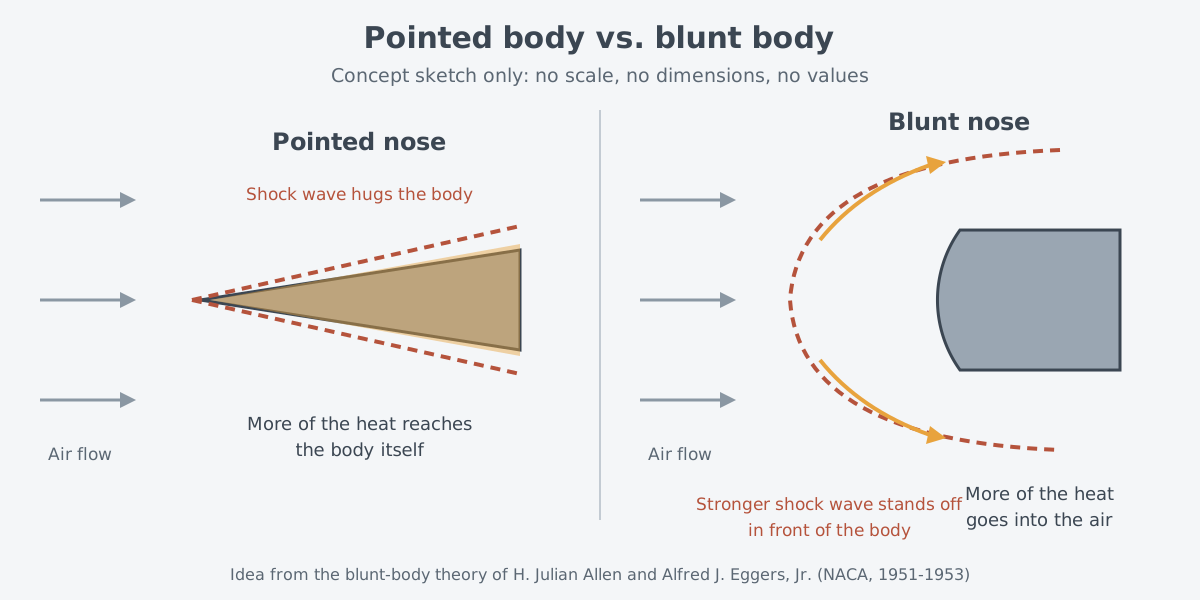
Allen worked out the theory with his colleague Alfred J. Eggers, Jr. By June 1952, the two had a theoretical solution to the heating problem of ballistic reentry vehicles. They also concluded that the rounded nose should be given the largest radius it could have.
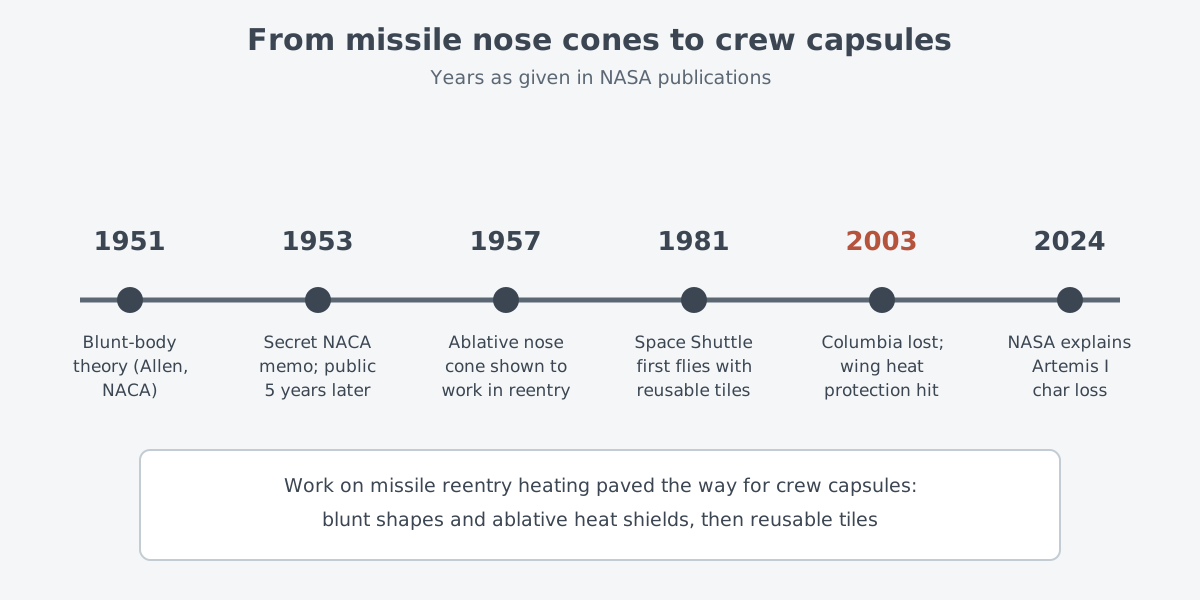
The result came out on April 28, 1953, as a secret NACA research memo that only cleared readers could see. It took 5 years before the idea reached the wider community. NASA's history counts this work as the basis for every successful reentry vehicle since.
The advantage of a blunt body also shows up in where it slows down. A reentry vehicle without lift is described by its ballistic coefficient, which depends on its mass, size and drag coefficient. A long, slender, pointed body has a high ballistic coefficient. It punches through the upper atmosphere, does most of its slowing in the thick lower air, and gets very hot for a short time.
A blunt body has a low ballistic coefficient and does most of its slowing in the thin upper air. It takes longer to slow down and makes less heat, but it takes that heat for a longer time. The total heat load is about the same for both. Even so, heat that arrives at a lower temperature over a longer time was easier for the materials of the day to absorb.
Soaking up heat: the heat sink
Changing the shape did not end the problem. Even a blunt body saw peak temperatures above 5,000 °F. The metal alloys most used in aviation in the 1950s could stand 1,200 °F at most.
Luckily, medium-range ballistic missiles spent only a very short time in reentry. That let a large heat sink absorb the total heat load. A heat sink takes in almost all of the incoming heat and keeps it in a big block of material, usually metal. Adding mass lets it store more, but in general it suits only short bursts of heat.
Picture a big tub full of cold water. Pour in hot water for a moment and the tub handles it, but keep pouring and the whole tub warms up. A real heat sink is a solid mass, not water, and warming up is not the only problem. Once it loses strength at high temperature, the forces from the air and from slowing down can break it apart.
Experience soon showed the limits. This was only one of several ways a heat-sink warhead could fail. Heat that lasted longer and hit harder called for another approach.
Wearing away to protect: ablation
The other path opened first on the U.S. Army side. The Air Force and the companies working for it focused on heat sinks, and meanwhile the Army took the lead on ablators.
In ablation, a material called the ablator gives itself up so that the structure underneath survives. As the ablator heats up, part of it breaks down into gas. That gas carries heat from the surface into the boundary layer, and the byproducts that come with it block more of the heat arriving from the air. Near the surface the material breaks down more completely and leaves a char, much like charcoal.
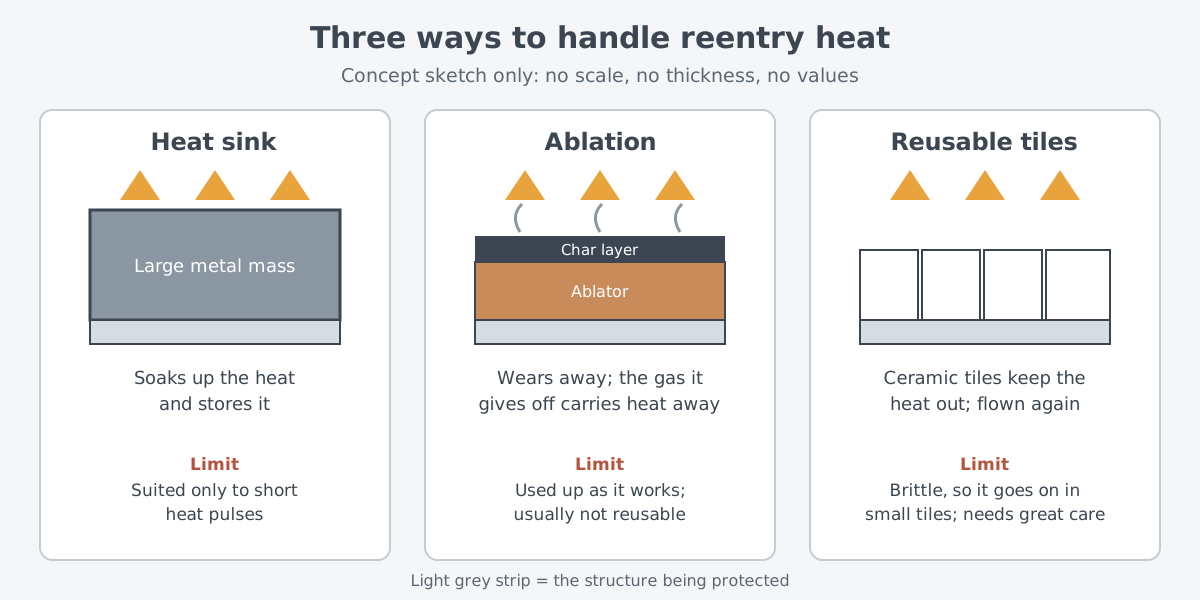
The strength of ablation is how simple it is. The gas that has picked up the heat leaves on its own, so no pumps or machinery are needed, which saves weight and complexity. The cost is just as clear. An ablator is used up as it works, so it can only work for a limited time and usually cannot be reused.
A Jupiter-C rocket lifted off from Cape Canaveral on August 8, 1957, with a scaled-down reentry vehicle on board. The flight showed that an ablative nose cone could survive reentry. NACA researchers also confirmed through testing that ablative coatings did better than heat sinks. After that, as warheads got higher ballistic coefficients and faster reentry speeds, every U.S. warhead used an ablative heat shield.
The same technology then went to astronauts. A Mercury capsule could not be built just by reworking a warhead shell for people. Still, ballistic reentry technology paved the way for crewed spaceflight. Mercury astronauts rode a blunt capsule, protected by an ablative heat shield, down to a water landing.
Apollo used the same approach with much better heat shields. Avcoat, the ablator on the Apollo heat shield, was developed largely from research into materials for long-range missile warheads.
A heat shield used again: Space Shuttle tiles
As Apollo was nearing its end, NASA chose a different path: the Space Shuttle, a reusable vehicle with wings. It still had a blunt-body shape, but for heat protection it relied on new ceramic tiles along with reinforced carbon-carbon (RCC). The Space Shuttle first flew in 1981.
The tiles grew out of a ceramic reusable surface insulation (RSI) that Lockheed had developed. The material was very brittle and expanded very little with heat. So it could not cover the whole vehicle in one piece and had to go on as small tiles.
The tiles resisted heat well but broke easily, so handling them took great care. The wing leading edges and the nose cap used RCC instead of tiles.
A reusable heat shield also came at a heavy price. In 2003, the loss of Columbia killed its crew of seven. The Columbia Accident Investigation Board (CAIB) traced the technical cause back to launch. Foam insulation from the External Tank hit the left wing's leading edge and damaged its heat protection.
A recent case: the Artemis I heat shield
Heat shields are still not a solved problem. Like Apollo, NASA's new crew capsule Orion covers the outside of its heat shield with the ablator Avcoat. Once Artemis I, an uncrewed test flight, was over, engineers found places where the char had come off the heat shield in ways no one expected.
On December 5, 2024, NASA announced the cause. As Orion returned from the Moon, gases formed inside the Avcoat could not escape as expected. Pressure built up, cracks formed, and in several places some of the charred material broke off. The reason was that the Avcoat lacked permeability, the ability to let gas pass through.
Why did it happen on this flight? On Artemis I, Orion made a skip entry. The capsule dipped into the upper atmosphere and slowed down from drag, then used its own lift to skip back out before coming in again. Between the two dips the heating rate dropped, and heat energy built up inside the Avcoat.
The investigation also explained why ground tests had missed this. Tests before the flight heated the material far faster than the real flight did. Under those conditions a permeable char formed and let the gas pressure out. The milder heating of the real reentry slowed the char from forming while gas kept being produced.
NASA also released flight data showing that a crew on board would have been safe. For Artemis II, it decided to keep the heat shield already attached and change the path Orion takes as it enters the atmosphere.
On that return, Orion has to shed speed from nearly 25,000 mph down to about 325 mph before the parachutes come out. Meanwhile, the heat shield has to withstand temperatures of nearly 5,000 °F. Heat shields for later flights are being made to have even and consistent permeability.
Where this meets lasers: testing materials with heat
The Artemis I investigation took eight thermal test campaigns and 121 separate tests. One of the test sites was the Laser Hardened Materials Evaluation Laboratory at Wright-Patterson Air Force Base in Ohio. There, engineers tested radiative heating conditions and took real-time radiography. The arc jet facility at Ames Research Center handled convective heating with several test gases.
Reentry heat shields and laser weapons look at the same question from opposite sides. What happens to a material when strong heat hits it: how does it warm up, break down and wear away? A heat shield is built to survive that heat, while the laser side deals with putting heat into a material in the first place.
How a laser processes material through absorption, heating and melting is covered in How a laser processes material. How a laser system handles the heat it makes itself, its thermal management, continues in Cooling and thermal management.
What to read next
- Ballistic missiles: why they climb high and come down: the flight phases a reentry vehicle passes through.
- Hypersonic glide vehicles: a different flight path: a vehicle that glides inside the atmosphere, unlike a ballistic reentry vehicle.
- How a laser processes material: absorption, heating and melting: what happens to a heated material, seen from the laser side.