Pull the trigger and the bullet flies forward while the gun kicks back into the shooter's shoulder. One more job is left in that short moment. The empty case has to come out of the chamber, and the next round has to go in.
For a long time, a hand did that job. Then gun designers began to borrow forces that a shot already creates. One is the backward push of recoil, and the other is the gas made by burning powder. This article follows how those two paths split, from Maxim's machine gun to today's M-4 carbine.
When the bullet goes forward, the gun goes back
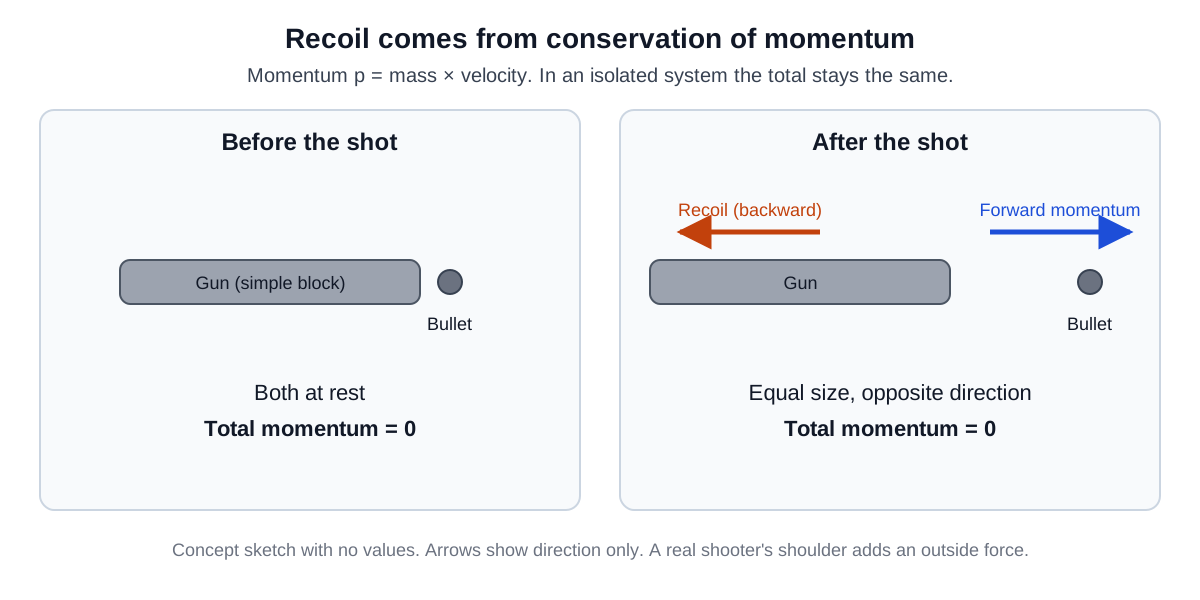
Start with why a gun moves backward at all. An object's mass multiplied by its velocity is called its momentum.
p = m × v
Here p is momentum, m is mass and v is velocity. A system with no net outside force on it is called an isolated system. In an isolated system, total momentum stays the same, no matter how many objects are inside it.
Before the shot, the gun and the bullet are both at rest, so their momenta add up to zero. After the shot, the sum still has to be zero. So the gun gains as much momentum backward as the bullet gains forward.
The same event can also be described with forces. The gun pushes on the bullet to speed it up, and it gets an equal and opposite push in return. That push is the gun's recoil, or kick. It is the same principle that moves a rocket: Newton's third law.
It is a bit like throwing a heavy ball forward from a small boat, which makes the boat drift backward. A real gun is different in one way. The shooter holds it against the shoulder, so the gun is not an isolated system on its own, and the shoulder adds an outside force.
When a hand loaded the next round
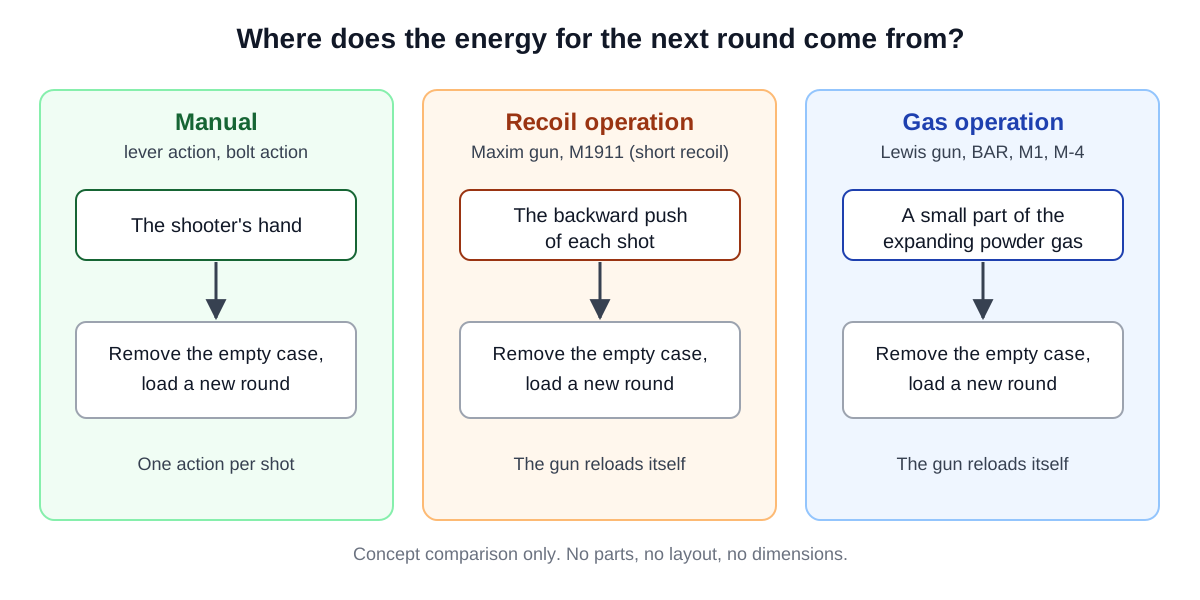
Every shot leaves an empty case behind. For a long time, the force to pull it out and load a new round came from the shooter's hand.
A document from the American Society of Mechanical Engineers (ASME), which named a collection of Browning firearms a mechanical engineering heritage collection, gives one example. Lever-action rifles, starting with the Model 1886, used a lever behind the trigger to remove the spent case and load a new round into the chamber.
In the early 1900s, the U.S. Army's main rifle was the M1903. During the Spanish-American War of 1898, Springfield Armory started work on a new main rifle for the Army, and the new rifle was based on the German Mauser action. Production began in 1903, and by 1936 the armory alone had made more than one million of them.
A gun like a lever action needs the shooter to work it once for every shot. Could a gun get the force to load the next round by itself? The answer lay in the two forces just mentioned: recoil and gas.
Letting recoil do the work
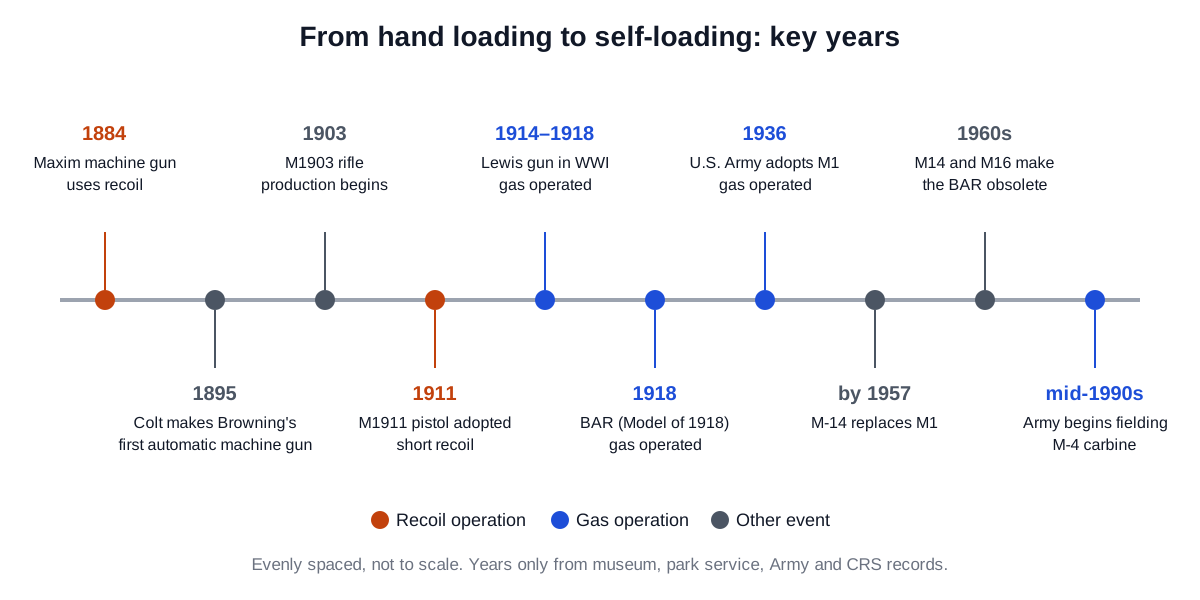
The first path is recoil. In 1884, Hiram Maxim built a machine gun that put recoil to work. The kick of each shot threw out the used case and pulled in the next round. The gun could keep firing through a single barrel, with no crank to turn.
This approach is simply called recoil operation. The Australian War Memorial holds an MG 08/15 from the Maxim family, marked Erfurt 1917, and its collection record says it works by short recoil.
Recoil operation did not stay with machine guns. The Automatic 5 shotgun by American gun designer John M. Browning used the recoil of the shot leaving the barrel to reload. The ASME document says the same principle is used in shotguns, rifles and pistols.
For pistols, one example is the M1911. The U.S. Army adopted it in March 1911. An article by the U.S. Army Military History Institute calls the M1911's short recoil design the basis for almost all modern self-loading handguns.
Borrowing a little of the powder gas
The second path is gas. When the powder in a cartridge burns, it makes expanding gas. Gas operation borrows a small part of that gas to remove the empty case and move a new round into the chamber.
The ASME document calls the development of gas-operated automatic firearms a major breakthrough in 19th-century firearms. Browning's career lasted almost 60 years. His name is tied to 128 patents and more than 100 kinds of weapons. The Colt company made Browning's first automatic machine gun in 1895.
In the First World War, gas-operated machine guns were used on the ground and in the air. The Lewis light machine gun, designed by U.S. Army Colonel Isaac N. Lewis, was an automatic weapon that ran on gas and was cooled by air. British and Australian forces used it widely in that war, both on the ground and on aircraft.
The Browning Automatic Rifle (BAR) was gas operated too. Named the Model of 1918, it was cooled by air, fed from a magazine and carried in the hands. It reached service only as the First World War was ending.
In the end, recoil and gas are two answers to the same question. Both turn part of the energy of one shot into the work of loading the next. Recoil operation uses the backward push, and gas operation uses part of the expanding powder gas.
From the Garand to the M-4
For rifles, one example is the M1. A semi-automatic rifle is a gun fired from the shoulder that weighs less than a machine gun. It can also fire faster than a traditional bolt-action rifle.
John Garand, an engineer at Springfield Armory, had patented the semi-automatic rifle that became the M1 by 1932. The rifle worked by using expanding gases, much like a steam engine. In 1936 the Army formally adopted the M1, and the Marine Corps and Navy followed by 1940.
By 1957 the M1 was replaced by the M-14, a rifle that Garand had worked on at Springfield. The BAR saw heavy use in the Second World War and in Korea, but once the M14 and M16 rifles came along in the 1960s, it became obsolete.
The next generation was the M-4 carbine. The Army started putting the M-4 into service in the mid-1990s. It is a lighter, shorter form of the M-16 rifle from the Vietnam War years. A 2008 report by the Congressional Research Service (CRS) described the M-4 as the main personal weapon of Army infantry units.
Different paths within gas operation
Using gas does not mean there is only one path. The same CRS report says the M-4 uses direct gas impingement. In this system, carbon from each fired cartridge is blown back into the receiver, the main body of the gun, and that carbon can lead to malfunctions.
The other path is a piston. According to the 2008 report, U.S. Special Operations Command (USSOCOM) had started to swap its M-4s with a rifle called the SCAR. The SCAR uses a short-stroke piston system that keeps carbon from blowing back, which the report says theoretically improves reliability.
The Army looked at the same issue. Versions of the report revised through 2010 list the M4 Carbine Improvement Program, which planned to evaluate several changes. One of them was swapping the direct gas design for a piston-driven one.
The energy source is the same, but the path that energy takes can change what is left inside the gun and how likely it is to malfunction. A question that began in the 1880s was still being argued over in congressional reports in the 2000s.
What to read next
- Exterior Ballistics: How a Shell Flies Through Air: how a projectile travels through the air after it leaves the muzzle.
- The Machine Gun: From the Maxim to Today: a longer look at the Maxim, Lewis and Browning machine guns mentioned here.
- Electromagnetic railguns: launching with electricity: another way to push a projectile, using electricity instead of powder gas.
- Lasers, interceptor missiles and guns: how they share the work: how weapons that fire projectiles and weapons that fire light split the work of defense.