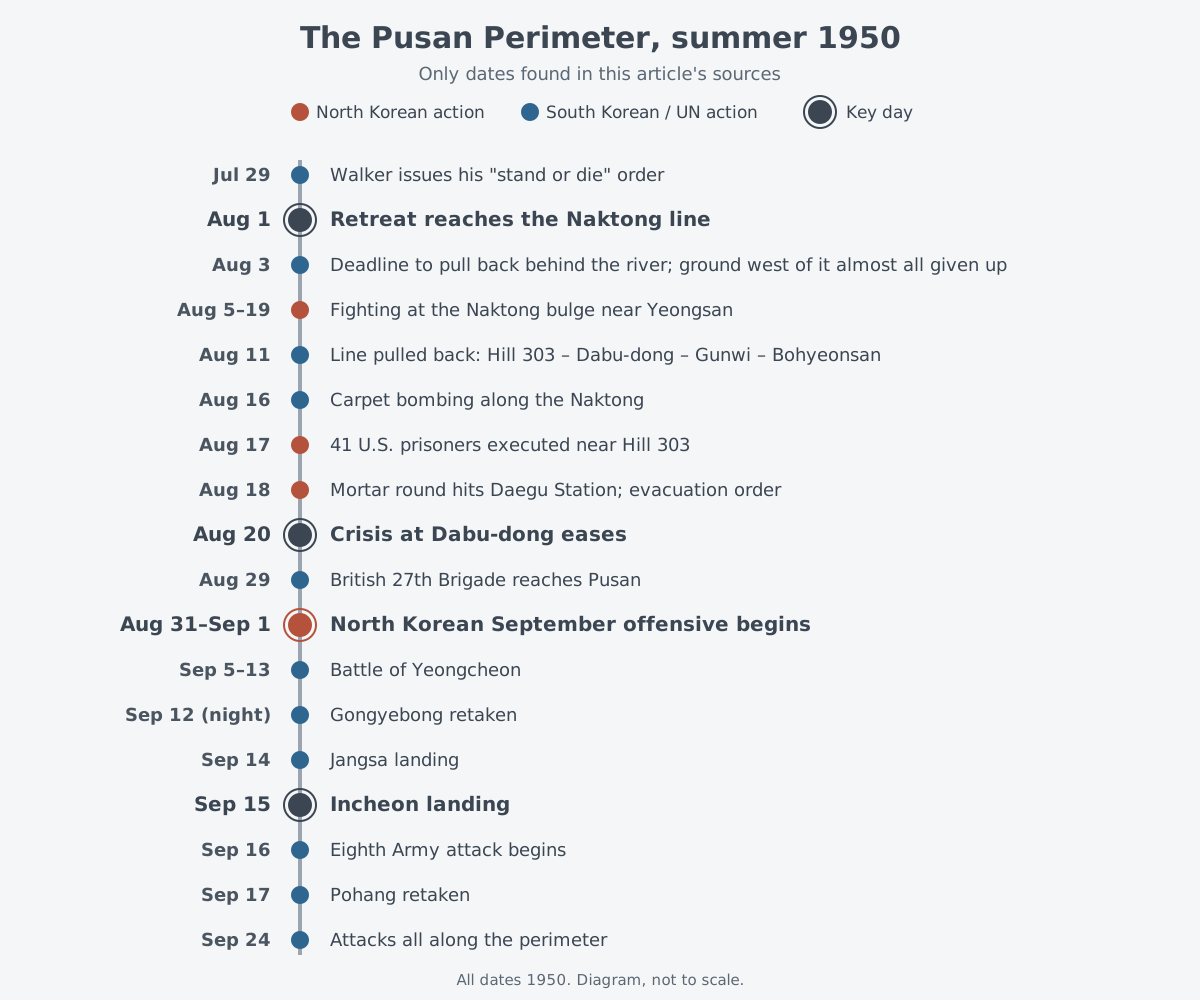
On August 18, 1950, a single mortar round landed on Daegu Station. North Korean troops who had slipped as far as Gasan, just north of the city, had fired it. In the shock that followed, the government moved to Pusan and an evacuation order went out across the Daegu area.
The war was not yet two months old. South Korean and UN forces had been pushed into the southeastern corner of the peninsula, and all they had left was one line drawn along the Naktong River. What did that line look like, where was it most in danger, and what kept it from breaking?
This article follows the Naktong through August and September. It draws on operation orders restored by the National Archives of Korea and the Encyclopedia of Korean Culture from the Academy of Korean Studies. It also uses U.S. Army and U.S. Navy history material and a 1950 record from the British Parliament.
A summer of retreat to the Naktong
The Korean War began on June 25, 1950, when North Korea invaded the South. The South Korean army could not recover from the shock of the surprise attack. UN support arrived, but it was too weak to stop the advance south, and by August 1 the line had fallen back to the Naktong.
Even the withdrawal ran on written orders. Army Headquarters Operation Order No. 91, dated July 31, went to the I and II Corps. It told them to hold off the enemy while crossing to the south side of the Naktong during the nights of July 31 and August 1. Order No. 94, dated August 2, then set August 3 as the deadline for pulling back to the Naktong line. By the account given in the British House of Lords in November 1950, nearly all ground west of the river had been given up by around August 3.
On August 1 the North Korean army stood on a line running through Jinju, Gimcheon, Jeomchon, Andong and Yeongdeok. Earlier, on July 20, Kim Il Sung had come south to Suanbo and pressed his commanders to take Pusan "by August 15 without fail."
The allied side issued a short order at about the same time. On July 29, Lieutenant General Walton Walker, commander of the U.S. Eighth Army, gave what is usually called his "stand or die" order. It included the lines that there would be no more retreating and that there was no line behind them to fall back to.
The shape and size of the line
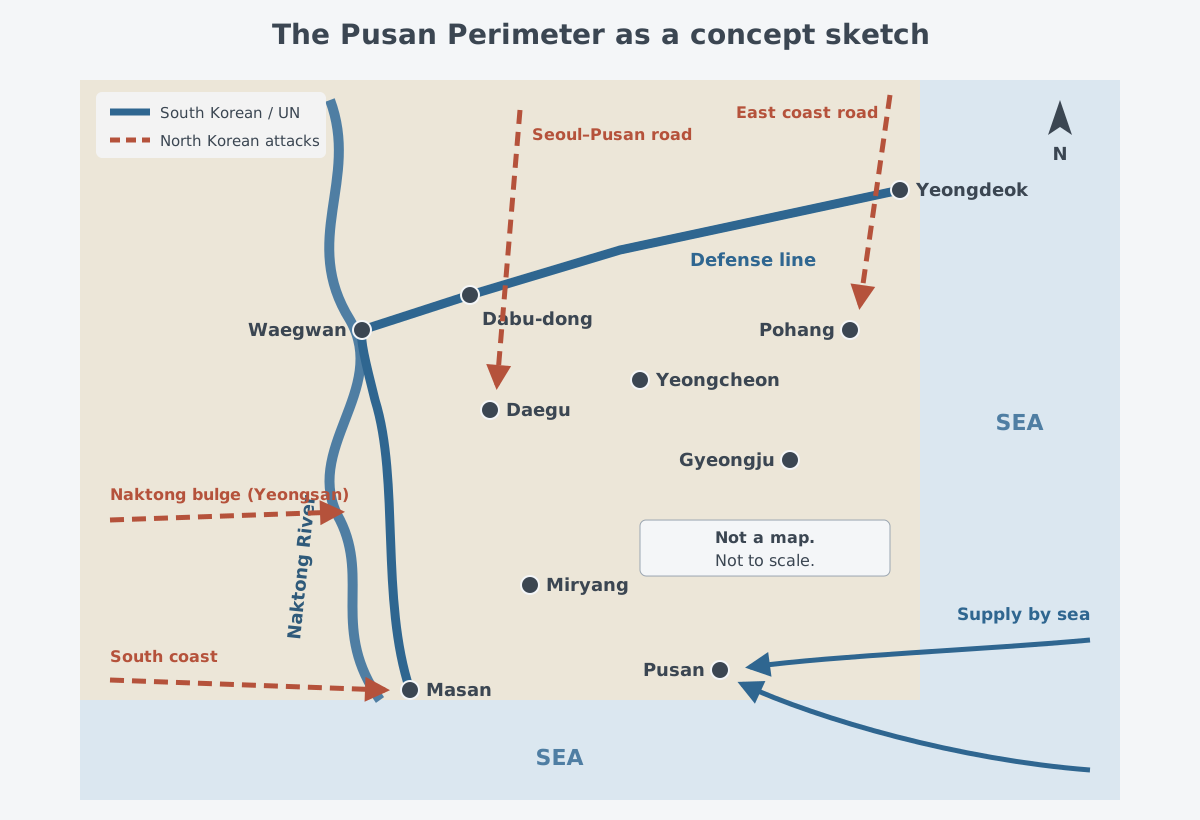
The line followed the Naktong from Masan in the south, through Waegwan, to Yeongdeok on the east coast. The Naktong is the longest river in South Korea, and it made up most of the perimeter. At a 2013 Naktong River battle ceremony, Lieutenant General Bernard Champoux, then commander of the Eighth Army, said that UN forces in 1950 "were surrounded on three sides with their back to the sea."
Its size is given in different terms depending on the source. The National Archives of Korea describes a line of 240 km linking Masan, Waegwan and Yeongdeok. In the 2013 ceremony speech it was ground 50 miles wide and 80 miles long. The Encyclopedia of Korean Culture entry on the Naktong battles calls it a pocket of only about 10% of the country. One figure is the length of a line, one is the size of a box and one is a share of territory, so they are not even measuring the same thing.
In English the line is called the "Pusan Perimeter." An Eighth Army public affairs article explains that reporters gave the defensive line behind the Naktong that name, and that the river was the final natural obstacle standing before Daegu and Pusan. In Korean the names "Naktong River defense line" and "Pusan bridgehead" are both used.
The August offensive: four lines of attack
North Korea did not aim at one place only. The Encyclopedia of Korean Culture entry on Dabu-dong sets out a plan with four lines of attack. One ran down the Seoul–Pusan road toward Daegu, and one down the east coast road toward Pohang and Gyeongju. A third went into the Naktong bulge west of Changnyeong to cut UN supply routes, and a fourth along the south coast toward Masan and Pusan. Striking on all four lines at once was meant to break the perimeter and take Pusan.
The heaviest weight fell north of Daegu. In early August the North Korean army placed five divisions there, half of the units it had available. Facing them were only three divisions, the South Korean 1st and 6th and the U.S. 1st Cavalry, and neighboring divisions could not even link up with each other.
Fighting also broke out at the Naktong bulge in the south. On August 5 the North Korean 4th Division crossed the river near Hyeonpung and Namji and pushed into Yeongsan, with Miryang as its goal. The Eighth Army sent the 9th Regiment of the U.S. 2nd Division, the 27th Regiment of the U.S. 25th Division and the 1st Marine Brigade. Fighting together, they had driven the North Koreans back west of the river by August 19. The North Korean 4th Division did not appear on the Naktong front again until the counterattack began.
The November 1950 House of Lords account sums up this period briefly. Even with reinforcements from the United States, UN ground forces were heavily outnumbered, and all through August they were under constant attack across the Naktong and around Pohang in the north.
Dabu-dong: the road to Daegu
Dabu-dong lies in the Gasan-myeon area of Chilgok County in North Gyeongsang Province, on the road that comes down from the north into Daegu. On August 11, Army Headquarters shortened the line to run from Hill 303 (Jagosan, north of Waegwan) through Dabu-dong and Gunwi to Bohyeonsan. The South Korean 1st and 6th Divisions now defended Daegu along the Dabu-dong–Gunwi line. Operation Order No. 119 was the order for the 1st Division to move to the new line between August 12 and 13.
On August 16, the U.S. Far East Air Forces carried out what was called carpet bombing along the Naktong. Eighth Army headquarters had asked for it, judging the front before Daegu to be in danger and hoping to suppress the main North Korean force across the river. The encyclopedia entry says that its results were never clearly confirmed, but it was judged to have shaken the North Korean commanders badly.
Even so, the crisis at Daegu peaked two days later. The mortar round hit Daegu Station on August 18. That day, Army Headquarters Operation Order No. 139 recorded the judgment that the main enemy force was trying to come down through the 1st Division's front toward Gunwi, Dabu-dong and Chilgok. A U.S. Army article from this period also tells of an American artillery observer who had already been through the fighting at the "Bowling Alley" near Daegu.
The South Korean 1st Division held off attacks by three North Korean divisions on the Yuhaksan–Dabu-dong–Gasan line to the end. Eighth Army reserves sent in at the right moment also counted for a great deal. On August 20 the North Koreans moved their 15th Division, which had been attacking the Yuhaksan front, toward Yeongcheon. The encyclopedia entry treats that as the point where the August crisis at Dabu-dong eased.
Sources set the length of the battle differently. The National Archives of Korea dates the battle of Dabu-dong from August 3 to September 22, 1950, grouping the fighting that went on into September under one name.
What came by sea and air
Most of the soldiers and ammunition inside the perimeter came across the sea. Material from the U.S. Naval History and Heritage Command (NHHC) holds that without American command of the sea, UN forces would almost certainly have been pushed into it. In that view, the steady flow of supplies and reinforcements by sea, the 1st Provisional Marine Brigade above all, is what let the perimeter hold "just barely."
The sea helped from the air as well. Aircraft from American and British carriers struck North Korean supply lines, and Marine aircraft flying from U.S. Navy escort carriers gave close air support. How a single ship can serve as an airfield is covered in Aircraft carriers: what it takes for one ship to become an airport.
Not everything went smoothly. On September 1 the carrier task force TF-77 answered a call to support the perimeter. Its first strikes soon ran into the same control problems that had dogged close air support in Korea before. The next day naval air controllers went ashore and worked the problems out with the U.S. Army 2nd Infantry Division.
On the ground, tanks and bridges mattered. In the September fighting on the Naktong, tanks were very important to the understrength American units. At Waegwan, in August 1950, UN forces blew up one truss span and part of a pier of the upbound track of the Waegwan railway bridge for operational reasons. The bridge was reopened on a temporary basis in October and became a registered cultural heritage site in October 2008.
The September offensive and the most dangerous fifteen days
Between the night of August 31 and September 1, the North Korean army opened its largest offensive yet. It had suffered heavy losses and its supply lines were damaged, but it broke through in several places, and counterattacking U.S. Marines closed the gaps. American commanders soon judged the situation "critical."
The U.S. Army in Korea counts September 1 to 15 as the bloodiest fifteen days of the whole war. During that time the North Koreans split one American division in two and nearly cut communications between its headquarters and frontline units. Losses and a shortage of men often left understrength companies holding thousands of feet of rough hill country, so the line was neither dense nor secure.
Korean War historian Allan R. Millett, speaking in a 2015 U.S. Army article, saw this as North Korea's last big attempt to beat the Eighth Army. The aim, in his account, was to cut the link between Pusan and Daegu and force the Eighth Army back to its final defensive line. He added that largely clear weather made air support possible very close to the troops, and that the North Koreans also lost heavily but, unlike the UN side, received no replacements.
In the east, Yeongcheon and Pohang were shaken. Yeongcheon was a transport hub between Daegu and Pohang. The 7th and 8th Divisions of the South Korean II Corps beat back the North Korean 15th Division, which was aiming at Yeongcheon, between September 5 and 13.
Farther east, the South Korean Capital Division blocked the southward push of the North Korean 12th Division around Angang, Pohang and Gyeongju from August 9 to September 14. On September 5 the North Koreans broke through South Korean lines and threatened Pohang. When heavy rain halted UN bombing, they retook Gongyebong, and on the night of September 12 the 17th Regiment won it back.
New arrivals came too. The British government announced on August 20 that it would send infantry from Hong Kong. The 27th Brigade, made up of the 1st Battalion of the Middlesex Regiment and the 1st Battalion of the Argyll and Sutherland Highlanders, traveled about 1,300 miles and reached Pusan on August 29. In the House of Lords account, this brigade was the first ground force to join the South Korean and American troops. On September 5 it took over a stretch of the Naktong about 8 miles southwest of Daegu.
The people behind the line
On August 17, at the height of the standoff, North Korean troops executed 41 American prisoners near Hill 303, a height looking down on the Naktong. The prisoners belonged to the 2nd Battalion, 5th Cavalry Regiment of the U.S. 1st Cavalry Division. A Hill 303 memorial park now stands close to the site, and every year military members and local leaders from both countries hold a small ceremony there.
Students went to the front as well. From mid-July, the 22nd and 26th Regiments of the South Korean 3rd Division and the 15th Regiment of the 1st Division filled most of their replacements with student soldiers. The 25th Regiment, newly formed in Daegu in early August, was also mostly students. They took heavy losses at Gigye, Angang, Dabu-dong, Pohang and elsewhere. Of 71 student volunteers of the 3rd Division, formed in Daegu on July 14 entirely from students, 48 were killed fighting for the streets of Pohang.
By the count in the Encyclopedia of Korean Culture, some 27,700 students saw combat under the name of student volunteers over the whole war. On September 14, the day before the Incheon landing, a unit made up mainly of student soldiers landed at Jangsa-ri, north of Pohang. It was a diversion behind enemy lines meant to help the landing at Incheon.
Cities behind the line were shaken too. On the day the round hit Daegu Station, the government moved to Pusan and an evacuation order went out in Daegu.
Part of what is known about this period today survives on a few sheets of paper. The Naktong defense operation orders that the National Archives of Korea restored and released in 2016 were printed by stencil on coarse paper and handed out, with operation maps drawn in simple form. Among them is an order handwritten by Chief of Staff Chung Il-kwon. Yang Young-jo, head of military research at the Institute for Military History, said that few records made by the South Korean army in 1950 have survived, which makes these documents very rare.
September turns to counterattack
The Incheon landing is not a separate story from the Naktong. The encyclopedia entry on the Naktong battles states that the Incheon landing General MacArthur was planning could only work if the Naktong line held. The troops for Incheon also had to come off the Naktong. The Incheon plan needed the 5th Marine Regiment, the core of the 1st Provisional Marine Brigade. Lieutenant General Walker was reluctant to give up the brigade while the threat of North Korean attack remained.
In the end the Marine brigade began leaving the line on September 5 and boarded ships at Pusan on September 8. The Incheon landing began on September 15, and on the next day, September 16, the Eighth Army opened a major attack to break out of the perimeter. That attack stalled quickly at first, but as North Korean resistance began to collapse, the Eighth Army moved northwest toward Incheon.
On the east coast the South Korean I Corps retook Pohang on September 17. On September 24, nine days after Incheon, South Korean and UN forces attacked along the entire perimeter and routed the North Korean troops pulling back north. The British 27th Brigade guarded the flank of the main American drive toward Seoul.
Different numbers, and the judgments left behind
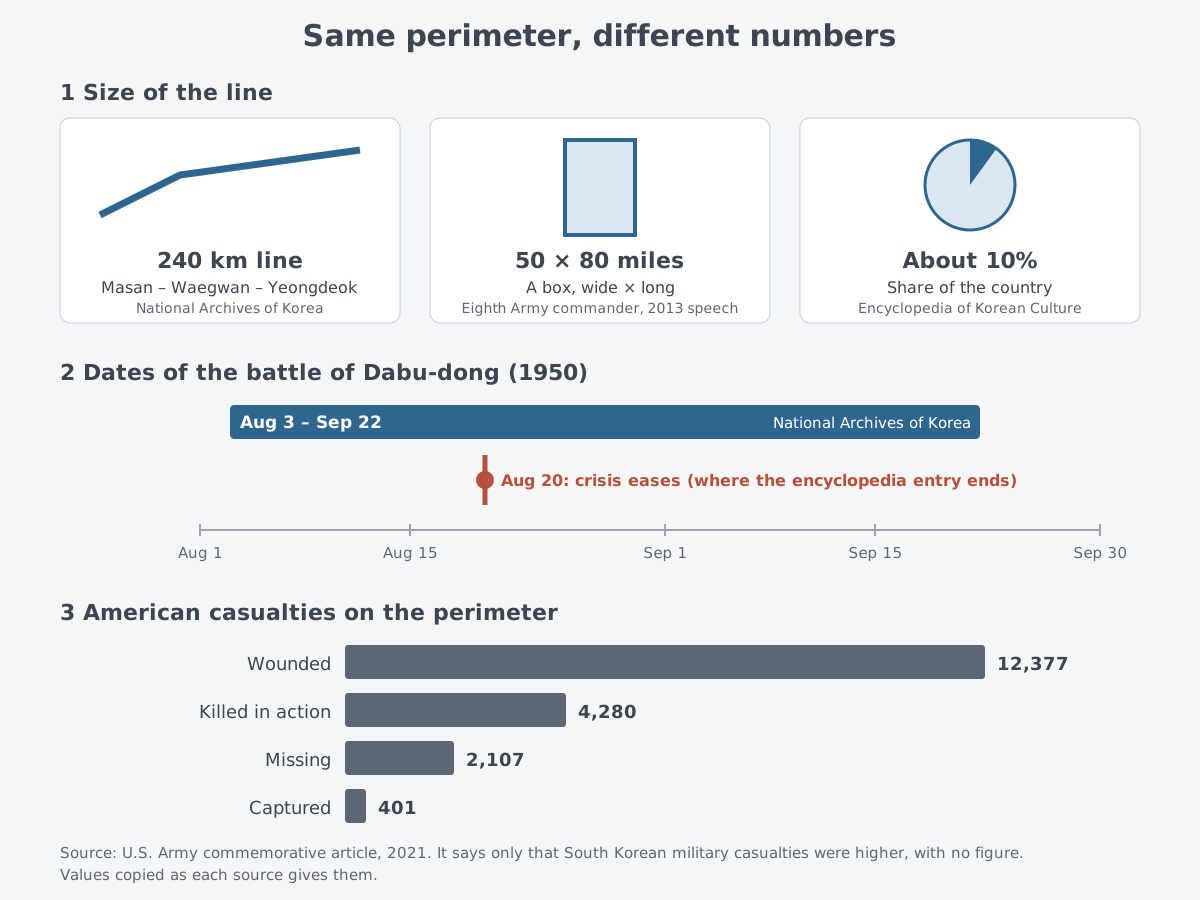
The size of the line is not the only thing that varies. The date of the retreat to the Naktong appears as August 1 in the encyclopedia and as August 3 in Order No. 94's withdrawal deadline and the House of Lords account. The length of the battle of Dabu-dong, as seen above, also changes with where its end is placed. The standoff itself lasted "nearly two months" in the U.S. Army article and "two months" in the NHHC material.
Casualty figures call for even more care. A 2021 U.S. Army commemorative article gives American losses on the Naktong perimeter as 12,377 wounded, 4,280 killed, 2,107 missing and 401 taken prisoner. For South Korean military casualties it says only that they were higher, with no number. In every source, each of those numbers was a person with a name.
The judgments differ in tone depending on who is speaking. The National Archives of Korea sees the battle as the one that saved Daegu and carried the country past the greatest crisis of the war. Together with the success at Incheon, it laid the groundwork for the general counterattack. The encyclopedia's author calls it a "great turning point" from defense to attack and from retreat to counterattack, and writes that a break in the Naktong line could have become "a second Dunkirk." The encyclopedia's entry on Yeongcheon treats that battle as the turning point where the South Korean army moved from defense to offense.
The ways of remembering remain too. In 2009 the South Korean government started a commemoration of the victory in the Naktong battles, held in Waegwan. For a detailed reading of the first five months of the war from American records, the U.S. Army Center of Military History publishes Roy E. Appleman's South to the Naktong, North to the Yalu.
Read next
- The Outbreak of the Korean War: Dawn, June 25, 1950. The first day and first weeks of the war, before the retreat to the Naktong.
- The Incheon Landing: Tides and Operation Chromite. The next chapter after the Naktong held.
- Military logistics, supply and maintenance: performance means little without staying power. Why supply by sea mattered so much, read through today's ideas of logistics.
- Main battle tanks: is gun size all that matters?. How the tank, so important on the Naktong, has changed since.
- The history of laser weapons: from chemical lasers to electric lasers. How far the means of stopping threats from the sky have come in seventy-odd years.