At 6:30 on the morning of September 15, 1950, U.S. Marines began landing on Wolmi-do, a small island off Inchon. By around noon, all resistance on the island had stopped. Yet the main force did not land on the city's waterfront until 5:30 that evening, eleven hours later.
Seawater split the day in two. When the tide went out, wide mud flats lay in front of Inchon. Landing craft could reach the shore only once the water rose high enough to cover them. In the end, the tide set both the date and the hour.
How was this operation, named Chromite, planned, and what worried the people who argued against it? This article sets records from the U.S. Naval History and Heritage Command (NHHC) beside those of the Academy of Korean Studies. It follows why it had to be September 15, and why the numbers differ between sources.
A summer pushed back to the Naktong
By late August 1950, United Nations troops had been pushed into the southeast tip of the Korean peninsula. Mostly American and South Korean, they fought in a small pocket around the port of Pusan, the sea behind them. In English this ground is called the Pusan Perimeter; in Korea it is called the Naktong River defense line.
Supplies and reinforcements kept flowing into that pocket. All of them came by sea, including the U.S. Marine Corps' 1st Provisional Brigade, and they let the line hold, though only barely.
The sea was not only a way to hold on. It was also a way around to the enemy's rear. The landing story starts a little earlier than this summer.
MacArthur's idea and the doubts
On June 29, General of the Army Douglas MacArthur visited the Han River line. He became convinced that the North Korean army would push the battered, poorly equipped South Korean army far south of Seoul, even with American reinforcements. He then decided that a decisive stroke, a landing somewhere behind North Korean lines, could free South Korea.
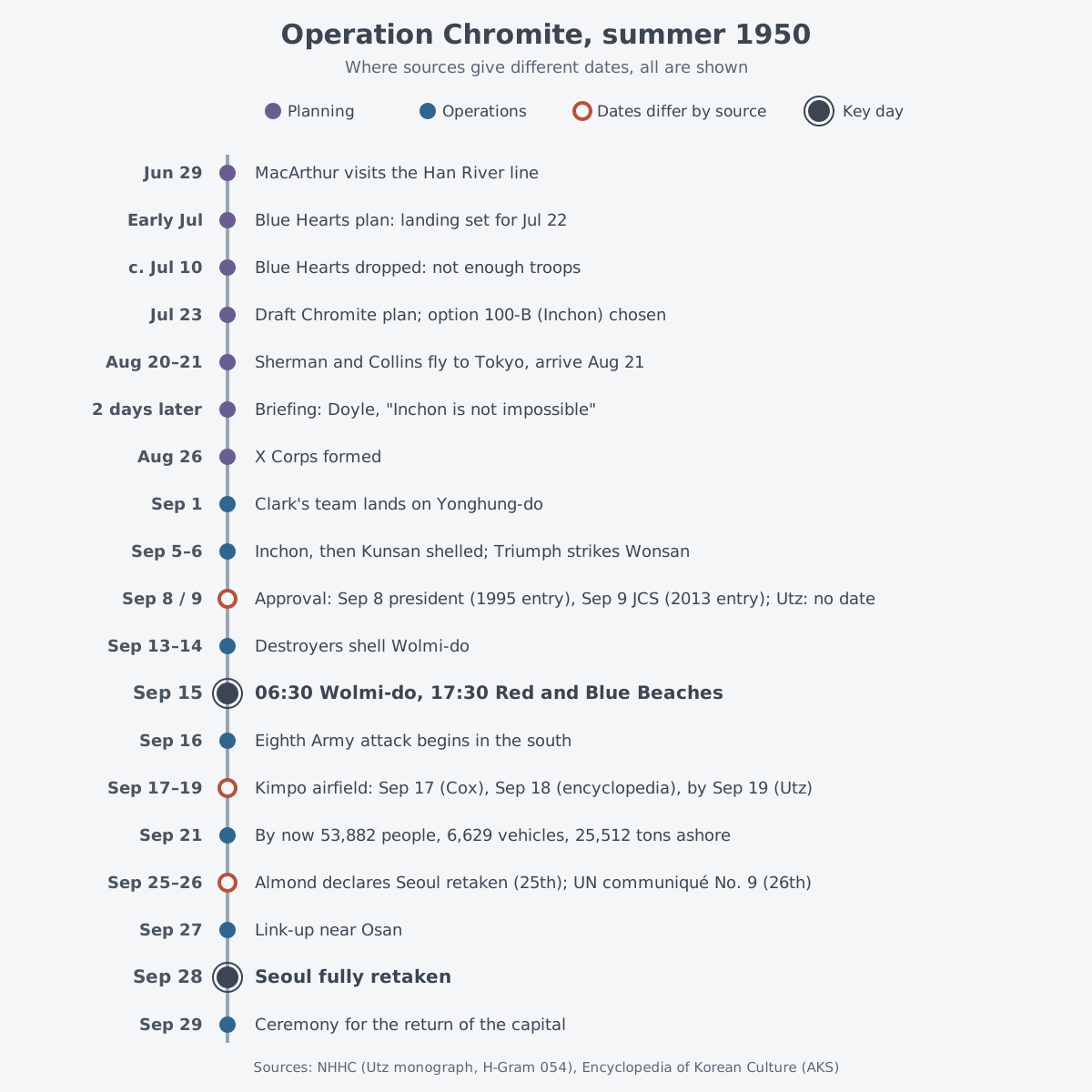
Planning started early. In the first week of July, MacArthur gave orders to his chief of staff, Major General Edward M. Almond, and the Joint Strategic Plans and Operations Group (JSPOG) studied a first plan named Blue Hearts. Blue Hearts set a landing for July 22 but was dropped around July 10, because there were not enough troops to stop the North Korean drive south.
The next name was Chromite. The planners looked at every coast that might work, including Inchon, Kunsan, Haeju, Chinnampo, Wonsan and Jumunjin, and a draft Chromite plan was ready on July 23. Far East Command offered three options: 100-B at Inchon, 100-C at Kunsan, and 100-D near Jumunjin on the east coast. Plan 100-B was chosen, with September 15 as the tentative landing day.
Why Inchon? It was a major port on the west coast, 110 miles behind enemy lines. From Inchon, troops could take the nearby air base at Kimpo and then move on Seoul, the key link in the North Korean supply line. Once taken, Seoul would act as an anvil, and the Eighth Army attacking north from Pusan would be the hammer.
The doubts were serious. U.S. Navy commanders in the theater did not oppose a landing as such, but they strongly opposed doing it at Inchon. Their main worry was the tide and the waterways, which tied the operation to a very tight schedule. Other concerns: the two "beaches" were really a seawall in front of industrial areas, there was no time for a full rehearsal, and typhoon season left no room for delay.
On August 20, Chief of Naval Operations Admiral Forrest P. Sherman, Army Chief of Staff General J. Lawton Collins and other senior officers left Washington for MacArthur's Tokyo headquarters. They landed at a Tokyo airfield on August 21, and the briefing came two days later.
Admiral Doyle's staff went through the details of the assault. Doyle closed the briefing with these words: "the best I can say is that Inchon is not impossible."
MacArthur then spoke for 45 minutes. His first point was that Inchon was so difficult that the enemy would never look for a landing there. His second was that winning at Inchon could finish the war, whereas seizing Kunsan or another site would settle nothing and mean a harsh winter campaign.
Sources give different dates for the approval. The NHHC monograph by Curtis A. Utz says only that the Joint Chiefs of Staff (JCS) formally approved the September 15 assault after Sherman and Collins returned to Washington, with no date.
The Encyclopedia of Korean Culture entry "Incheon Landing Operation," written in 2013, gives final JCS approval on September 9. Its 1995 entry "Korean War" gives the president's approval on September 8. That 1995 entry also says MacArthur sent the Inchon plan to the JCS on July 15. It was turned down because the terrain made Inchon the least suitable place for a landing.
Tides of over 30 feet, mud flats and a narrow channel
High tide is when the sea is at its highest, and low tide is when it has drained the most. The difference in water height between the two is the tidal range. Off Inchon, that difference is very large.
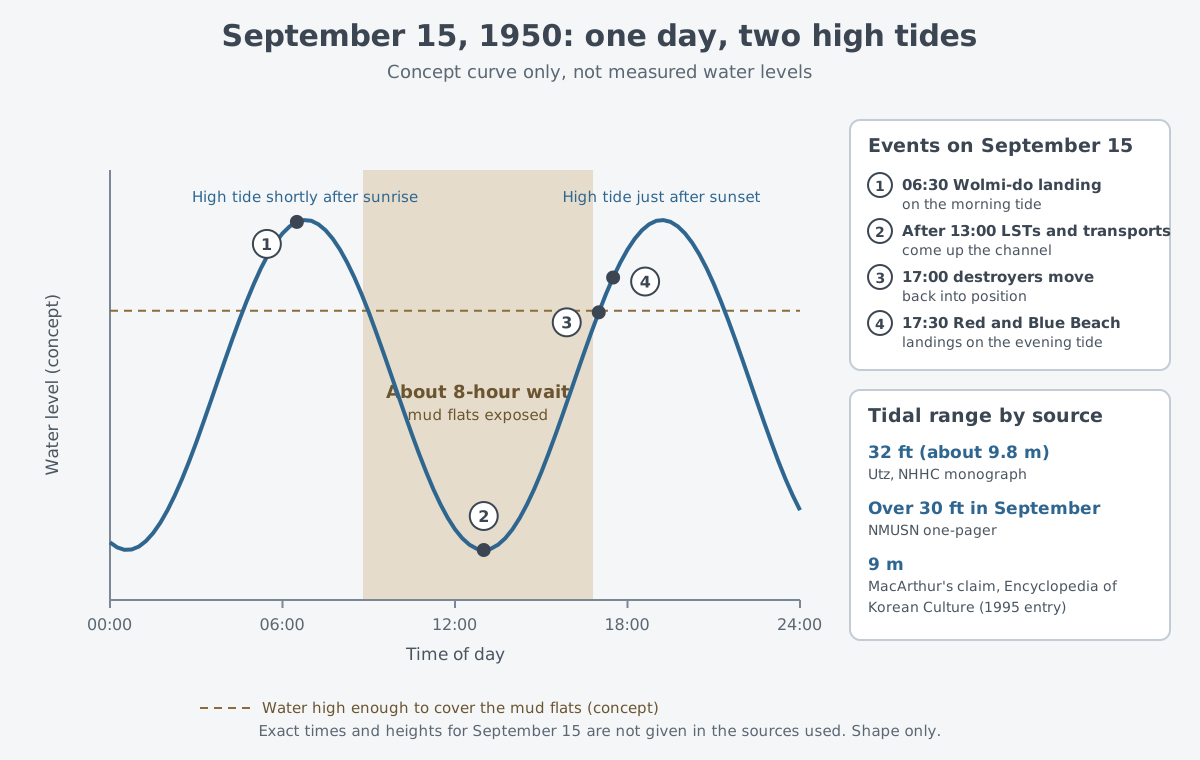
Sources give slightly different values for how large. The Utz monograph gives 32 feet, about 9.8 m. A one-page sheet from the National Museum of the U.S. Navy (NMUSN) says the gap between low and high tide topped 30 feet during September.
The 1995 encyclopedia entry says MacArthur argued that the range was only 9 m and still left six hours usable for a landing. Picture water rising and falling about as high as a three-story building. The real height changed from day to day, though, and the highest tides came on only a few days each month.
When the water went out, wide mud flats lay in front of the city. Landing craft could reach the shore only when the water was high enough to cover them, so a daylight landing was possible on just three or four days a month. In September the highest tides came in the middle of the month, so the planners picked September 15. They had under two months for planning that usually took three to five months.
The encyclopedia's "Incheon Landing Operation" entry lists the usable high-tide days in the fall of 1950: September 15, October 11 and November 3, plus two or three days around each. October was judged too late because of the weather, so September 15 was chosen as the best date. The NMUSN sheet adds that the highest flood tide lasted only three days and did not stay at that level for long.
The schedule for September 15 itself was built around the tide. The Japanese and U.S. tide tables disagreed, but planners expected high tides shortly after sunrise and again just after sunset. So a small first landing would use the morning tide, and the main landing would go in as the water rose again in the evening.
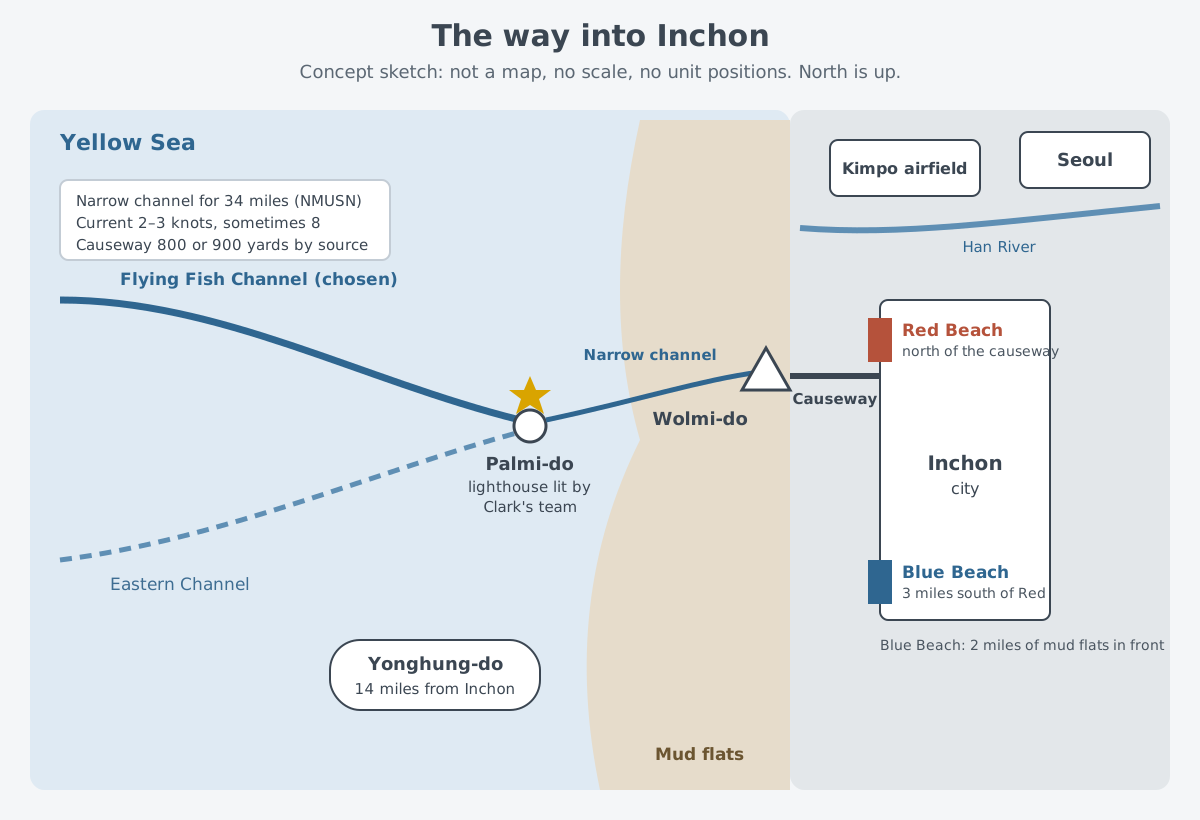
The way in from the sea was narrow too. Two passages led from the Yellow Sea to Inchon, Flying Fish Channel and Eastern Channel, and they joined at Palmi-do. Because the mud flats reached far out, ships had to thread a narrow channel 34 miles long to reach the shore. The normal harbor current ran at a dangerous 2–3 knots and sometimes reached 8 knots.
The harbor itself was poor ground for a landing. The anchorage was cramped, docks and piers were few, and the usual kind of landing beach did not exist. Both landing sites were really built-up industrial areas bounded by seawalls.
Gathering ships also followed the tide. Doyle assembled 17 U.S. Navy tank landing ships (Landing Ship, Tank, LST) and 30 SCAJAP vessels crewed by Japanese sailors. The plan was to leave some LSTs sitting on the mud on purpose as the evening tide went out, then replace them with other ships on the next morning's tide.
The weather did not help. Two strong typhoons formed in September 1950. Jane developed on September 3 and Kezia on September 12, and the task force had to push through winds that often topped 90 knots. Doyle later said these were the roughest seas of his 35 years in the Navy, but every ship reached Inchon unharmed.
Intelligence and deception: Yonghung-do and Kunsan
Were the tide tables right? Would the mud hold any weight? Only someone on the spot could say.
On September 1, a team led by Lieutenant Clark landed on Yonghung-do, an island just 14 miles from Inchon. Clark reported to Tokyo that the Japanese-made tide tables were correct and that the mud flats in front of Inchon would hold no weight at all. He added that the seawalls were higher than estimated.
The scouting by Clark and his South Korean team confirmed that the Japanese tide tables for Inchon from World War II were correct and the U.S. tables were not. Of the two passages, Flying Fish Channel was chosen. On the night the main force came in, Clark's team lit the light on Palmi-do to help ships through the difficult channel.
Yonghung-do also had an effect nobody planned. After the South Korean Navy landed there, the North Korean defenders of Inchon began to think a landing might come south of the city. They started shifting forces in that direction.
Drawing eyes elsewhere was done on purpose as well. On September 5, a UN surface force under Rear Admiral Andrewes of the Royal Navy shelled Inchon, and the next day it shelled Kunsan. The British carrier Triumph, meanwhile, struck Wonsan on the east coast.
The Korean encyclopedia adds that from September 5, bombing hit possible landing areas along the west coast from Pyongyang down to Kunsan. It also says a U.S.-British raiding force attacked Kunsan from September 12, and the east coast group shelled the Samcheok area on September 14 and 15.
Time mattered as well. North Korea was concentrating its minelaying at Kunsan and Mokpo, which it judged more likely landing sites. Samuel J. Cox of the NHHC concludes that a month's delay would have let North Korea mine Inchon heavily, with severe consequences.
Wolmi-do under fire, September 13–14
Wolmi-do was a small island in Inchon's inner harbor. It was a triangle about half a mile on each side, joined to the city by a causeway. Cox's account gives the causeway as 900 yards long, and the Utz monograph gives 800 yards. Radio Hill on the island stood 315 feet high and completely commanded the harbor.
Records put the North Korean garrison at about 400 troops. Guns on the island could hit landing craft from the side at very close range, whether they headed for Red Beach to the north or Blue Beach to the south. So planners chose two days of shelling and air attacks, then capturing the island ahead of the main landing, even though this gave up surprise.
Marine planes flying from escort carriers received orders to set the western half of Wolmi-do on fire, dropping 95,000 pounds of napalm. This could have given away Inchon as the target, but it was treated as a necessary risk.
On September 13, the destroyers went in. They had to move up the narrow channel one behind another as the tide came in, then drop anchor under half a mile from Wolmi-do. That left about two hours of shelling before the ebb tide would strand them on the mud.
At 11:45, 17 moored contact mines were seen strung out in a line. The tide and the schedule allowed no delay, and Vice Admiral Struble chose to keep going even though more mines might be there.
At 13:00, the destroyers opened fire from just under half a mile, and the island fired back. The destroyer Collett was hit nine times by 75 mm shells, and Gurke was hit three times.
On Lyman K. Swenson, a shell that landed close by threw out fragments that killed Lieutenant (junior grade) David H. Swenson, and eight more men in the bombardment force were wounded that day.
Struble ordered the bombardment repeated the next day, September 14. This time, fire from the island was sparse and inaccurate.
September 15: Wolmi-do in the morning, the seawall at dusk
On the morning of September 15, the Marines landed on schedule at 6:30. Just before that, two destroyers swept the waterfront and the front slope of Observatory Hill with proximity fuze shells. A proximity fuze sets off a shell when it comes close to a target, without a direct hit, so these shells burst in the air and scattered fragments.
The first Marines were ashore by 6:33 and met little resistance. Within 30 minutes they held the northern end of the island, and by 8:00 the island was reported secure. By around noon, all resistance on the island had ended.
Cox's account puts the Marines wounded on Wolmi-do at 14, while the Utz monograph gives 17. MacArthur sent a message: "The Navy and Marines have never shone more brightly than this morning."
Then came the wait. For eight hours, as the tide went out, came back in, and the sun began to set, the other Marine units could not land at Red and Blue Beaches. Air strikes and naval gunfire went on through the day, and Cox notes that considerable care was taken to avoid harming civilian parts of Inchon. After 13:00, LSTs and transports started moving up the channel on the rising tide.
By 17:00 the water had risen enough for the destroyers to move back into position, and the shore bombardment started in full. In rain squalls and thick smoke that made it hard to see, 500 landing craft made for the shore. The Marines landed on schedule at 17:30.
Red Beach lay just north of the causeway from Wolmi-do, and Blue Beach lay three miles south of it. The way to Blue Beach crossed two miles of mud flats under shallow water, so the first waves there rode in on amphibious tractors (Landing Vehicle, Tracked, LVT).
At Red Beach, the shape of the shore caused more delay than North Korean resistance. Marines had to climb ladders up the seawall, while others piled up behind them on the strip of mud left narrow by the high tide. Each landing craft carried two long planks for reaching shore if it stuck in the mud, and others had wooden or aluminum ladders with hooks on top. Even so, within an hour the Marines had pushed deep into the town.
First-day casualties depend on what is counted. Cox puts Marine casualties at 174. That figure includes 20 killed in action, one who died of wounds and one missing in action. The Utz monograph gives, for the whole joint task force, 174 wounded in action, 14 nonbattle injuries, one missing and 21 killed in action.
The wounded tended on the LSTs at Red Beach were far fewer than the 300 Doyle's staff had projected. The operating room on LST 898 treated 42 military and 32 civilian cases.
Something else happened on Yonghung-do at about the same time. When North Korean Marines came ashore from junks, Clark, the South Korean Navy boats and South Korean guerrillas had already pulled out, only shortly before. About 50 civilians had decided to remain on the island, and the North Koreans massacred them.
On to Seoul
The mud was still a problem after the landing. The tides and the ground made logistics a major challenge, and speed mattered above all. By September 18, no beach would be reachable by LSTs.
Eight LSTs in the first group beached at Red Beach, while Blue Beach could take only small craft. As the tide went out, the LSTs were left stranded on purpose, as planned, and unloaded on the mud. By the time they backed off on the rising tide on the 16th, Navy and Marine shore parties had landed 4,000 tons of equipment and supplies. Nine fully loaded LSTs soon took their place.
By September 21, the Navy had landed 53,882 people at Inchon, plus 25,512 tons of cargo and 6,629 vehicles.
Sources differ slightly on when Kimpo airfield fell. Cox gives September 17, Utz says "by the 19th," and the encyclopedia entry "September 28 Recapture of Seoul" says it was fully in hand on September 18. On September 20, the U.S. 5th Marine Regiment and the 1st Battalion of the South Korean Marines began landing on the north side of the Han. They beat back strong North Korean resistance to do it, and on the 22nd they retook Yeongdeungpo.
The day Seoul was retaken depends on what counts. On September 25, Major General Almond declared Seoul recaptured, yet Marines newly inside the city were fighting house to house until the 28th. In Tokyo, MacArthur issued UN communiqué No. 9 at 14:20 on September 26, announcing that Seoul had been retaken, when only about half of the city was in UN hands. Seoul was fully retaken on the 28th, and a ceremony for the return of the capital was held at noon on September 29.
Marine casualties in the recapture of Seoul came to 2,301. The forces that retook Seoul from September 18 to 28 were the South Korean Marines, the South Korean 17th Regiment, the U.S. 1st Marine Division and the U.S. 7th Division.
In the south, the Eighth Army launched its major attack on September 16, and it bogged down at once. Then the North Korean defense started to break down, and the Eighth Army pushed northwest toward Inchon. The Australian War Memorial says that two days after the landing, South Korean, U.S. and British troops joined the push out of the Pusan Perimeter. On the morning of September 27, near Osan, the 7th Cavalry Regiment of the 1st Cavalry Division met units of the 7th Infantry Division.
Numbers and judgments
The size of the operation also depends on what is counted. The "Incheon Landing Operation" entry gives 261 UN ships, built around the U.S. Seventh Fleet, and more than 70,000 ground troops. Cox counts the attack force (TF 90) at about 230 ships in all, about 120 of them carrying troops, and lists the supporting task forces separately at about 52 ships. Of the attack force's 47 LSTs, 30 had Japanese crews.
The U.S. X Corps, which carried out the landing, was formed on August 26, built around the U.S. 1st Marine Division and the U.S. 7th Infantry Division. More than 8,000 young South Korean men were trained in Japan and assigned to the 7th Infantry Division, the start of the KATUSA program. From the South Korean forces, the 1st Marine Regiment and the 17th Regiment took part.
Cox calls the label "UN" "a bit of a misnomer" for the assault itself, which the U.S. 1st Marine Division carried out entirely. He adds that the Royal Navy gave meaningful help.
Casualty figures change a great deal with what was counted and for how long. In the Utz monograph, the joint task force lost about 70 killed and 470 wounded, with five missing, in the first week of Chromite. After the fighting for Seoul, the totals stood at 600 dead, 2,750 wounded and 65 missing. In the same period, UN forces took 7,000 North Korean prisoners and killed 14,000.
Widen the count to the whole southern front and the numbers grow. Cox writes that 30,000–40,000 North Koreans in the south were killed and 135,000 captured, but about 30,000 got back to the North. Utz writes that out of 70,000 North Korean troops who had fought around Pusan, only 30,000, with almost no heavy weapons, crossed back over the 38th parallel. The 1995 encyclopedia entry puts communist prisoners in this period at 12,500.
Nearly all of these numbers are about soldiers. The sources used here have no full count of what the people of Inchon and Wolmi-do suffered. Some, like the roughly 50 civilians on Yonghung-do, are left in the record as a single line.
Judgments differ too. Cox says the landing is widely seen as one of military history's most decisive operations. He also notes that the later decision to retake Seoul, instead of fully blocking the North Korean retreat, drew heavy criticism.
MacArthur kept his promise to President Syngman Rhee to retake Seoul as soon as possible. As a result, the escape route of the North Korean forces in the south was not fully closed. Utz, too, writes that had the Eighth Army focused on cutting off enemy forces instead of racing to Inchon, it might have caught the entire North Korean army.
Other records look at another side. The encyclopedia's "Incheon Landing Operation" entry stresses that going around the enemy cut North Korean supply lines in one move. That gave the Naktong line its chance to strike back, and the port of Inchon and the supply facilities up to Seoul could then serve the advance north. The entry's conclusion is that, for all the controversy, the landing secured its beachhead with ease.
The war did not end there. With China's intervention in October 1950, the fighting in Korea went on for almost three more years.
Today, Inchon harbor has a lock between Wolmi-do and Sowolmi-do. It was built to overcome the large tidal range off Inchon, and ships pass through it to reach the inner harbor. The same tide that held the planners of 1950 still shapes the port.
What to read next
- "The Pusan Perimeter: Dabu-dong and the Last Line": the story of the line that South Korean and UN troops held until just before Incheon.
- "The Outbreak of the Korean War: Dawn, June 25, 1950": how this summer began.
- Proximity fuzes: working without a direct hit: the principle behind the shells fired just before the Wolmi-do landing.
- Destroyers and frigates: why warships have different names: the kinds of ships that anchored off Wolmi-do.
- Military logistics: performance must be sustainable: a wider look at why unloading on the mud mattered so much.
- "The Battle of Chosin Reservoir: A Withdrawal at Minus Thirty": the next scene of the war, after Seoul, in the north.