On 2 August 216 BC, on a flat stretch of ground near Cannae in Italy, Rome lost most of an army in a single day. The winner was Hannibal, a general from the North African city of Carthage. His infantry numbered about half of the Roman infantry.
How did a smaller force surround a larger one? And why did Rome not collapse after such a defeat? The answers reach beyond that one day. They run through the whole of the Punic Wars, three conflicts between Rome and Carthage from 264 to 146 BC.
The story rests mainly on two ancient historians, Polybius and Livy. Their numbers do not agree. So below, each figure comes with the name of the writer who gave it.
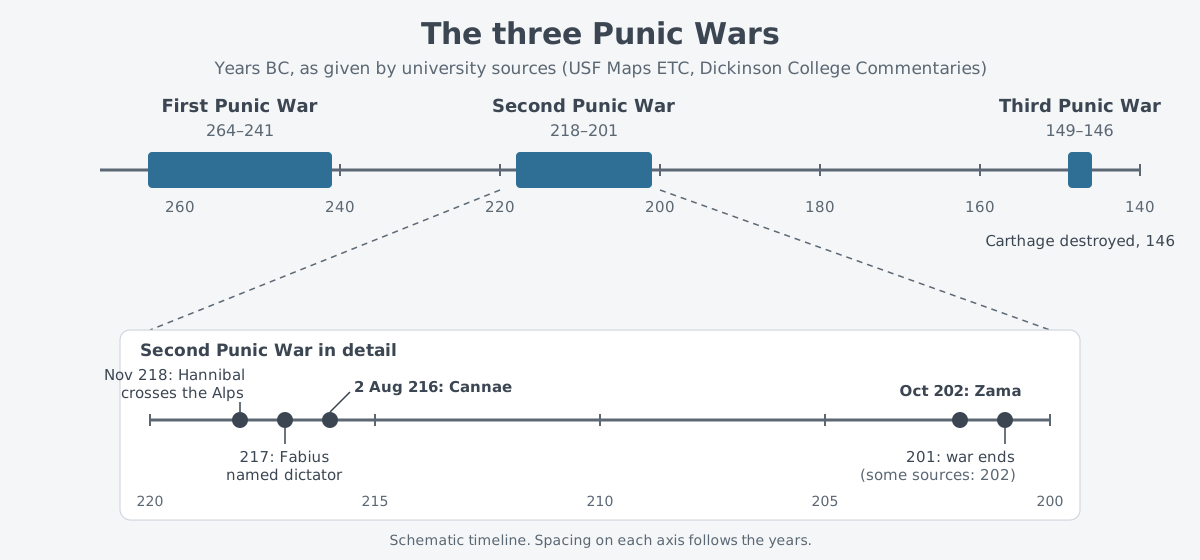
The first war began in Sicily
The first war (264–241 BC) started at Messene, a city on the strait between Italy and Sicily. A band of former mercenaries called the Mamertines held the city. When they were cornered, one group offered the city to Carthage and another asked Rome for help. Rome ordered the consul Appius Claudius to cross the strait.
At sea, Rome was a beginner. As the war dragged on, it set out to build its first fleet: 100 quinqueremes and 20 triremes. The model was a single Carthaginian warship that had run aground in the strait and been captured.
The new ships were clumsy and slow, so Rome made up for it with one device. Later known as the "raven" (corvus), it let Roman crews grapple an enemy ship, cross over and fight hand to hand on deck. Polybius wrote that the sea battle became much like a fight on land.
The war went on without a break for 24 years. Under the peace terms, Carthage left all of Sicily, returned prisoners without ransom and agreed to pay 2,200 Euboean talents in installments over 20 years.
Saguntum and the Alps: the second war
The second war (218–201 BC) began in the Iberian Peninsula. A treaty between Rome and the Carthaginian general Hasdrubal said that the Carthaginians would not cross the Ebro River in arms. When Hannibal attacked Saguntum, a city Rome regarded as under its protection, Rome objected to both the attack and the crossing of the Ebro. Polybius accepted these two events as the "beginnings" of the war but not as its "causes."
Hannibal crossed the Ebro with about 90,000 foot soldiers and 12,000 cavalry. On the way, he left 10,000 foot and 1,000 horse with an officer to hold the new ground, and he sent an equal number of men home. In the Alps, the cliffs and hardships cost him many men and an even larger number of horses and pack animals.
The march from New Carthage took five months, and crossing the Alps alone took 15 days. A university commentary dates the crossing to November 218 BC. When he reached the plain of the Po, he had 12,000 African and 8,000 Iberian infantry and no more than 6,000 cavalry. Hannibal himself recorded these numbers on an inscribed column at Lacinium.
Once in Italy, Hannibal beat Roman armies at the Trebia and at Lake Trasimene. In the view of the Dickinson College commentary, the three battles up to and including Cannae wiped out forces equal to eight consular armies.
Fabius, the general who avoided battle
After these defeats, Rome chose Quintus Fabius Maximus as dictator in 217 BC. He was 58 years old. Unlike a consul, a dictator was a general with absolute powers.
Fabius avoided a decisive battle. He put the safety of his army first and took no risks. He kept his soldiers from scattering to forage, and whenever he had the chance he picked off enemy troops who strayed far from their camp. He also stayed off the open plain because the Carthaginian cavalry was much stronger.
At first, people scorned him and called him a coward. Polybius wrote that, as time passed, everyone had to admit that no one could have handled the situation more sensibly. Even so, the next year the Senate decided to fight.
One day at Cannae
Hannibal first captured the citadel at Cannae. The Romans had been storing grain and other supplies there, gathered from the surrounding country.
The Roman army was led by two consuls, Lucius Aemilius Paulus and Gaius Terentius Varro, who by custom took command on alternate days. Aemilius opposed fighting there because the ground was flat and treeless, which favored an enemy with stronger cavalry. Varro disagreed. Polybius blamed Varro's lack of experience, but that is Polybius' own judgment.
Polybius gives these numbers. The Romans and their allies had about 80,000 infantry and a little over 6,000 cavalry. The Carthaginians had about 10,000 cavalry and not much more than 40,000 infantry. Rome had roughly twice the infantry, while Carthage had more cavalry.
The Romans packed their companies, or maniples, closer together than usual and made each one many times deeper than it was wide. Hannibal placed his Spanish and Celtic cavalry on the left, next to the river, and his Numidian cavalry on the far right. He split his heavy African infantry into two groups on either side, with the Spanish and Celtic infantry between them.
He then pushed the central Spanish and Celtic companies forward, forming a crescent that bulged toward the enemy. The line grew thinner toward its ends. The African infantry stayed back as a reserve.
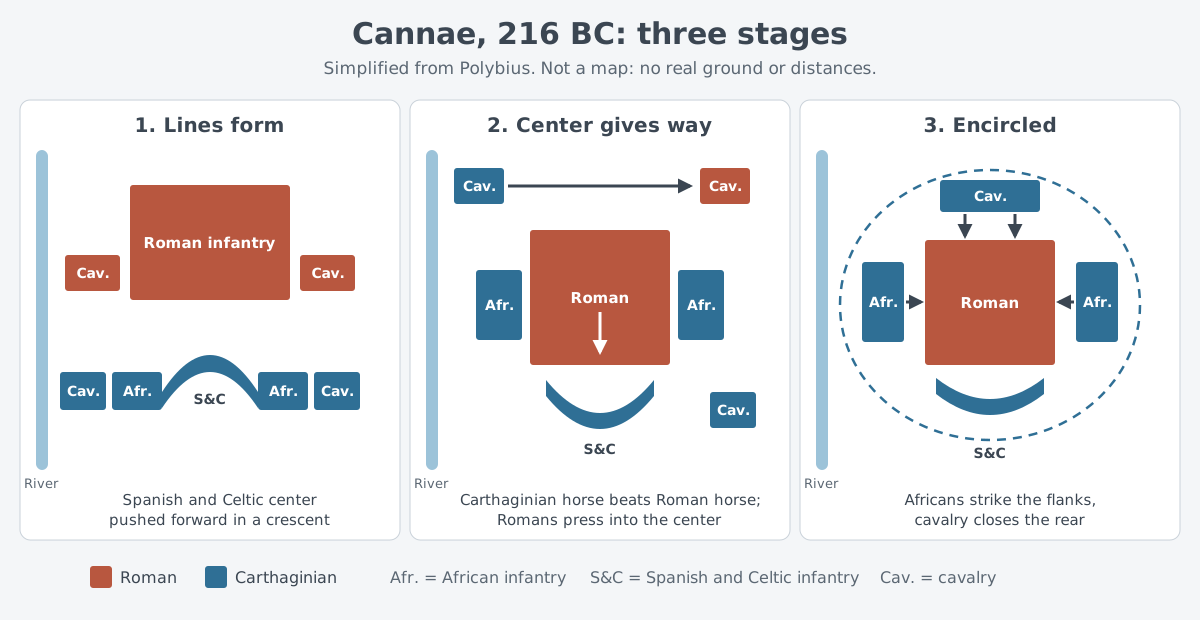
The battle can be read in three stages. First, by the river, the Carthaginian cavalry defeated the Roman cavalry. Next, the Spanish and Celtic infantry in the center gave way under the weight of the legions, and the crescent broke. The Romans pushed deep after them until African infantry stood on both of their sides.
Finally, the Africans turned and struck the Roman flanks. Cavalry under Hasdrubal rode around to the rear of the legions and charged at several points in turn. Hemmed in at the front, sides and back, the Romans were pressed inward and surrounded. A small army had wrapped around a much larger one.
Arms and organization of the two armies
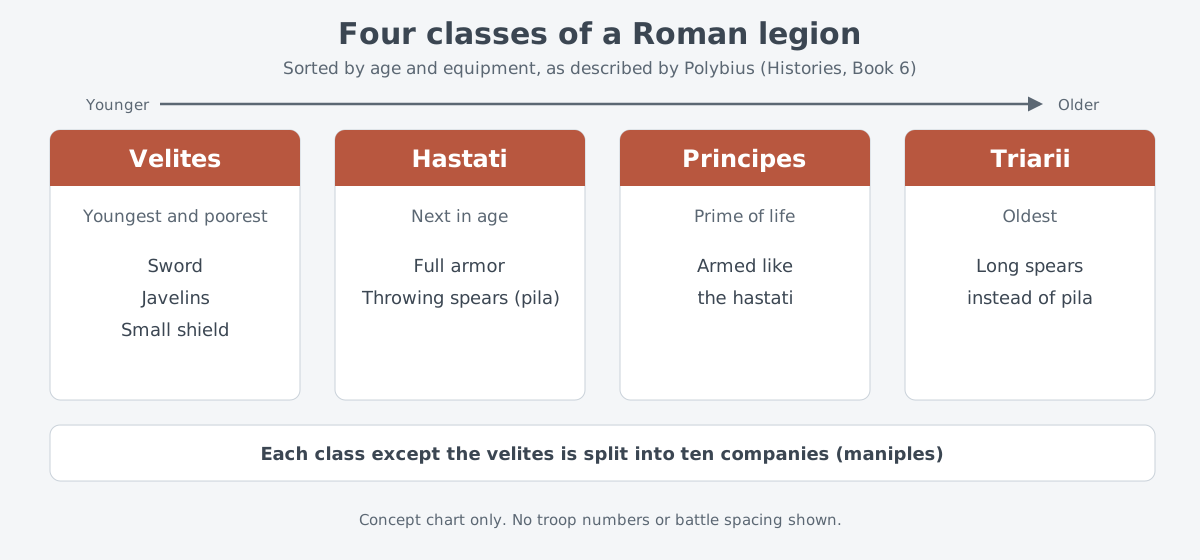
The two armies were built differently. In Book 6 of his Histories, Polybius describes four classes of Roman soldiers, sorted by age and equipment. The youngest and poorest became velites and carried a sword, javelins and a small shield. Next in age came the hastati, then the principes in the prime of life, and finally the oldest men, the triarii.
The hastati wore a full set of armor, and the principes and triarii were armed the same way. The difference was that the triarii carried long spears instead of throwing spears (pila). Each class except the velites was split into ten companies, which were also called maniples (manipuli).
The Carthaginian army mixed many peoples. At Cannae, the African infantry carried the best Roman weapons taken in earlier battles. The Spanish and Celtic troops had similar shields but very different swords. The Spanish sword was as deadly in a thrust as in a cut, while the Celtic (Gallic) sword could only slash and needed a long swing.
Polybius believed that the large Carthaginian cavalry did more than anything else to win at Cannae. In his view, the battle showed that it is better to fight with half the enemy's infantry and an overwhelming cavalry force than to be equal in every respect. That is one historian's reading of the battles of his own era. It is not a rule that carries over to modern armed forces.
Why the casualty figures differ
How many died at Cannae depends on the source. Placing two ancient accounts next to a modern estimate makes the gap clear.
| Source | Roman side | Hannibal's side |
|---|---|---|
| Polybius | About 70,000 infantry killed, about 10,000 captured, about 3,000 escaped. Of 6,000 cavalry, 70 escaped with Varro | About 4,000 Celts, 1,500 Spaniards and Africans, and 200 cavalry killed |
| Livy | 45,500 infantry and 2,700 cavalry killed (48,200 in all), Romans and allies in nearly equal shares | (not given on this page) |
| Modern historians (Dickinson commentary) | Around 30,000 killed | Nearly 6,000 |
The two ancient accounts already disagree with each other. Modern historians also tend to see the Roman army itself as smaller than the ancient writers say, and they put Roman deaths at around 30,000. Whichever figure is chosen, the largest army Rome had fielded up to that time was destroyed.
Rome's recovery and the end of the wars
According to Polybius, the battle gave Carthage almost all of the rest of the coast, and Tarentum surrendered at once. Yet the Senate used every means it had. It calmed and encouraged the people, strengthened the city's defenses and discussed the situation calmly.
Within a month of Cannae, Rome put four legions back in the field, filled with freed slaves and convicts. Hannibal lacked the manpower and the supplies to besiege Rome, so he passed it by. Even in ancient times, that choice was a major subject of debate.
Polybius held that Rome regained its lead in Italy and went on to defeat Carthage thanks to the strengths of its constitution and to wise decisions. That is the reading of a historian who admired the Roman system.
The last major battle was fought in Africa. In October 202 BC, near Zama, a town five days' journey west of Carthage, Scipio defeated Hannibal.
Hannibal put more than 80 elephants at the front of his army, but the young, poorly trained animals panicked and trampled the Carthaginian lines. Scipio's Numidian cavalry drove off the Carthaginian horse and then struck the rear lines. The cavalry strength that had broken Rome at Cannae was now on the other side.
The war ended in 201 BC, though some sources end it in 202 BC, the year of Zama. The peace terms were harsh: Carthage handed over all its warships except ten triremes, along with all its elephants. It agreed not to wage war outside Africa, and not to fight inside Africa without consulting Rome. It also had to pay 10,000 talents over 50 years.
The third war (149–146 BC) grew out of one of those terms, the ban on going to war without Rome's permission. Carthage broke that term under pressure, and this led to war and to the city's destruction. Carthage was wholly destroyed in 146 BC and later rebuilt under Caesar and Augustus.
What Cannae left behind
Later soldiers returned to Cannae again and again. The Dickinson College commentary notes that many regard Hannibal's tactics at Cannae as the most effective maneuvers ever made on a large battlefield.
Alfred von Schlieffen, who shaped Germany's strategy for World War I, believed Germany could win if it followed Hannibal's example. Dwight D. Eisenhower said that every ground commander seeks a battle of annihilation and, as far as conditions allow, tries to repeat the classic example of Cannae in modern war.
Yet Hannibal won Cannae and lost the war. One great victory did not decide the conflict. Rome raised new legions, and Hannibal lacked the men and supplies to besiege Rome.
That supplies were part of why Hannibal could not besiege Rome links this story to modern weapons too. The article Military logistics: performance must be sustainable covers that side. Rome used the raven to make up for its weakness at sea. Later cases of new devices changing the shape of combat are collected in Turning points in military technology.
What to read next
- The Roman Legion: The Organization and Roads Behind an Empire: how the four classes of soldiers in this article fit into a larger organization.
- Alexander at Gaugamela: What Set the Macedonian Army Apart: another ancient battle that combined cavalry and infantry.
- A history of laser weapons: from chemical to electric lasers: to follow the history of weapons all the way to today's lasers.